Policy Issues Final
 Call Kai
 Learn
Learn Practice Test
 Spaced Repetition
 Match
Match Flashcards
 Knowt Play
1/221

There's no tags or description
Looks like no tags are added yet.
Name | Mastery | Learn | Test | Matching | Spaced | Call with Kai |
|---|
No analytics yet
Send a link to your students to track their progress
222 Terms
Market
system where buyers and sellers interact
decisions are personal and voluntary
buyers pursue utility / personal benefit
sellers pursue profit
Prima facie case for the market
nitial/basic case in favor of markets
rests on:
efficiency
economic freedom
information availability / information aggregation
Information role of markets
markets help reveal and aggregate information
individuals only need to know:
their own marginal benefit if they are buyers
their own marginal cost if they are sellers
prices communicate information without central planning
Competitive market w/ one good, cost and benefit graph
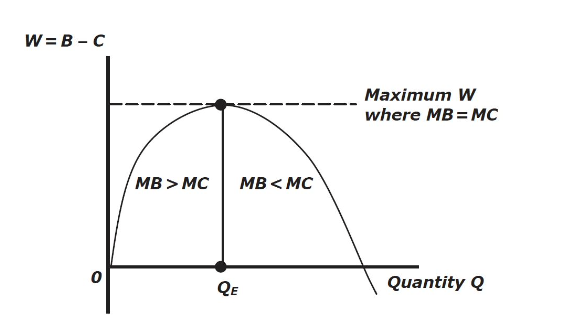
efficiency = max W = B − C
where B = benefit to buyers
and C = cost to sellers
MB = MC
QE = efficient quantity
To prove the efficiency of a competitive market we need to show:
Market assigns goods among buyers to achieve Bmax
Market assigns supply among sellers to achieve Cmin
With Bmax (max benefit) and Cmin (min cost), market chooses the quantity QE that maximizes W =Bmax −Cmin
Buyers in competitive markets
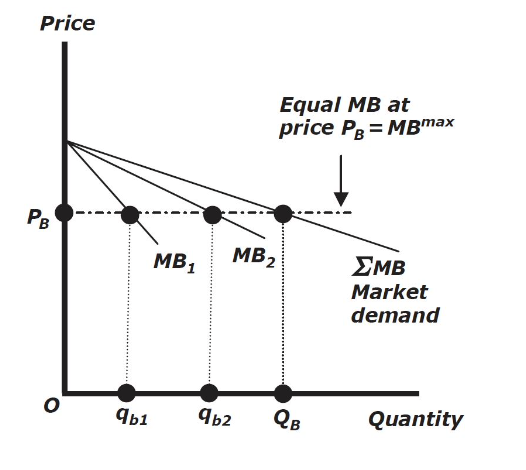
Buyer equilibrium condition
in a competitive market, each buyer chooses consumption where:
MB = PB
PB = price faced by buyers
Total benefit maximized among buyers
with two buyers, total benefit is maximized when:
MB1 = MB2
market pricing achieves this because both set marginal benefit equal to the same price:
MB1 = PB = MB2
Market demand
horizontal sum of individual buyers’ marginal benefit / demand curves
in the slide notation:
QB = qb1 + qb2
Graph intuition for buyers
same market price for all buyers
each buyer consumes until own MB equals that price
this equalizes MB across buyers
therefore total buyer benefit is maximized
Sellers in competitive markets
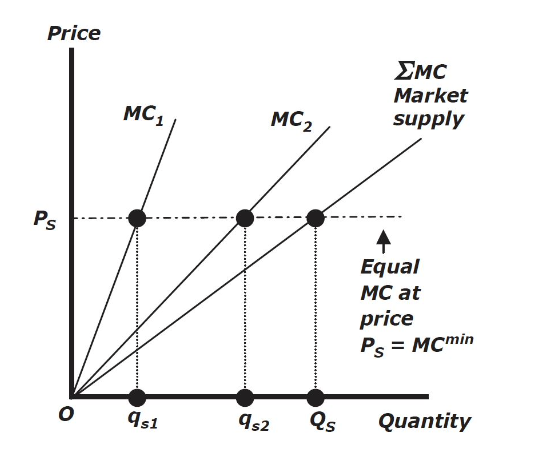
Seller equilibrium condition
in a competitive market, each seller chooses output where:
MC = PS
PS = price received by sellers
Total cost minimized among sellers
with two sellers, total production cost is minimized when:
MC1 = MC2
market pricing achieves this because both set MC equal to the same price:
MC1 = PS = MC2
Market supply
horizontal sum of individual sellers’ marginal cost / supply curves
in the slide notation:
QS = qs1 + qs2
Graph intuition for sellers
same price for all sellers
each produces until own MC equals that price
this equalizes MC across sellers
therefore total cost is minimized
The market equilibrium w/ QE, PE, MBmax = MCmin
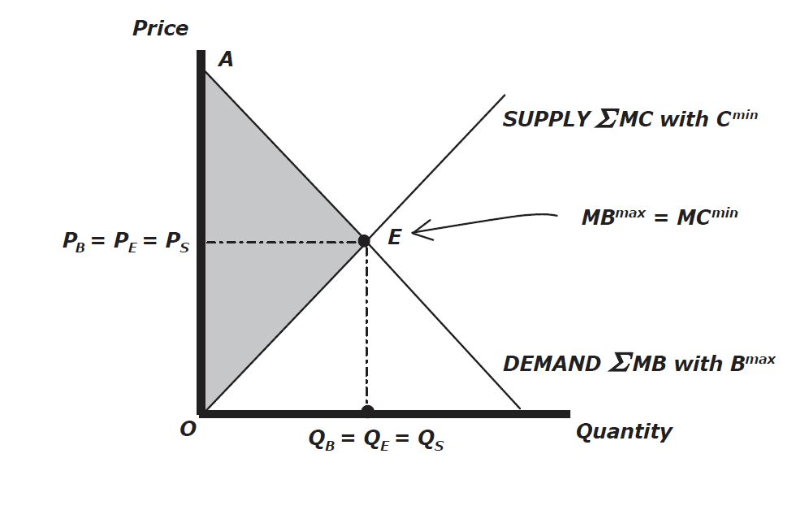
Market equilibrium
where market demand and market supply intersect
determines:
equilibrium quantity QE
equilibrium price PE
Efficient market equilibrium
in the competitive benchmark:
MBmax = PE = MCmin
therefore welfare is maximized at equilibrium
Price equality in equilibrium
slide uses:
PB = PE = PS
buyer price, equilibrium price, and seller price coincide in the no-distortion benchmark
Graph interpretation of welfare area
on the demand-supply graph, welfare is the shaded area
this area is maximized at the competitive equilibrium (QE, PE)
How do we know competitive market will achieve that equilibrium?
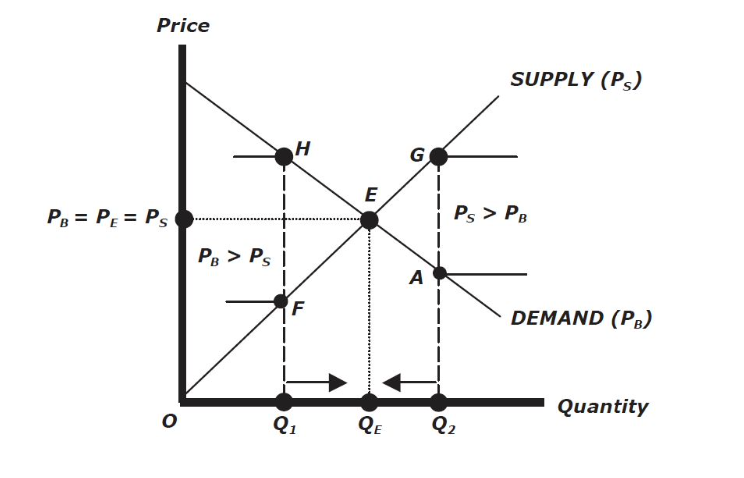
Market-adjustment mechanism
process by which the market moves toward equilibrium
if prices/quantities are away from equilibrium, competitive forces push the market back toward the efficient point
this is the slide’s operational version of the invisible hand
Invisible hand pushes to efficient equilibria
shorthand conclusion from the equilibrium slides
decentralized self-interested behavior leads to efficient equilibrium under competitive conditions
Competitive markets + efficiency
Competitive markets achieve efficiency, defined as max W = B - C
Centralized allocation
government replaces decentralized buyer/seller decisions with its own decisions
slides say this would remove economic freedom
Informational disadvantage of government
government generally lacks the private information buyers and sellers have
therefore it cannot directly calculate:
Bmax
Cmin
or overall W = Bmax − Cmin
Gvt has informational disadvantage compared to markets → Impossible for gvt to achieve efficiency
Asymmetric information
ne party in a transaction possesses greater, more detailed, or better-quality knowledge than the other, creating an imbalance of power
Why markets may outperform centralized planners
buyers know own preferences / MB
sellers know own costs / MC
prices aggregate this decentralized information
a government can only estimate or guess much of it
Market failure
situation where markets fail to achieve efficiency
Main market failures listed in the slides
non-competitive markets
public goods
externalities
natural monopoly
asymmetric information
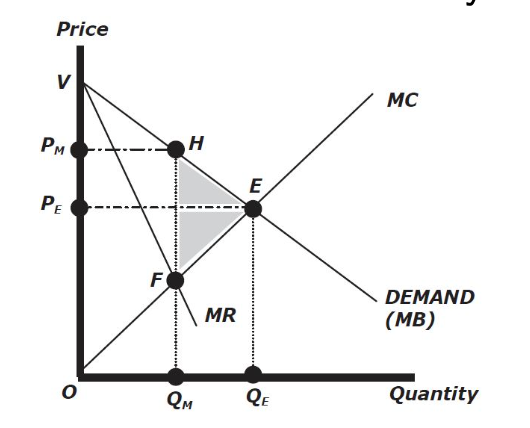
Monopoly
one seller dominates the market
can restrict quantity and raise price above the competitive level
P = PM, > PE
Monopoly profits maximized when P = PM and Q = QM
Public good
good that can benefit many people simultaneously
Free rider problem
individuals may want the good but hope others pay for it
because they can still benefit even if they do not contribute
leads to underpayment and underprovision
Externalities
cost or benefit from an action that is not expressed in a market
affects third parties outside the direct transaction
can be positive or negative
market will tend to over-provide goods with negative externalities and under-provide those with positive externalities
Natural monopoly
industry where competition would wastefully duplicate large fixed costs or infrastructure
one supplier may be cheaper than many
Why natural monopoly is a problem
efficient production structure may involve one supplier but that creates a non-competitive market
regulation becomes necessary
Impact of mobile phones on fish market in Kerala
Key result: mobile phone coverage sharply reduced price dispersion across markets. Prices in different fish markets became much more similar because sellers could respond to where demand was strongest.
Social justice
idea of what makes an outcome fair or just
Why is social justice a separate issue from efficiency?
an outcome can be efficient but still seem unfair; efficiency asks whether total welfare is maximized, while social justice asks whether the distribution/outcome is acceptable morally or politically
Are competitive markets socially just?
no single universal answer; depends on the definition of justice being used and the context; context can change which definition you prefer
Natural right of possession
idea that outcome is socially just if a person’s rightful possessions are respected; people are entitled to what they produce or earn through their own effort
right to compensation
idea that people are entitled to the products of their effort; rewards should reflect personal productive contribution
Do competitive markets satisfy natural right of possession?
yes, in this sense; example: a firm hires labor until marginal cost of labor = marginal benefit of hiring labor, so wages reflect marginal contribution
Problem with natural right of possession as a definition of justice
what people “possess” or can earn is affected by luck, health, education, family background, personal connections, innate ability, or disability; so market rewards may reflect more than just effort or merit
Ex-ante equality
equality of starting opportunity; same opportunity to earn, prosper, and improve in life; no privileged beginnings
people do not necessarily end up equal, but they should begin from a fair starting point with similar opportunity sets
Ex-post equality
equality of final outcomes; “everyone ends up equally”
Pareto improvement
Pareto improvement
Pareto-efficient outcome
an outcome where no further Pareto improvement is possible; you cannot make someone better off without making someone else worse off
Are competitive market outcomes Pareto efficient?
Typically, yes
Must government interventions be Pareto-improving?
No
How does a government make decisions
cost-benefit criterion:
change is efficient if ΔW = ΔB − ΔC > 0; total benefits exceed total costs
How can an efficient change become Pareto-improving in principle?
if gainers compensate losers and still remain better off, then the change could become Pareto-improving
Why is compensation important in government intervention?
because compensation can make a harmful policy change more socially just by addressing the losses imposed on losers
Practical problems with compensation
hard to identify gainers and losers; hard to measure losses; unclear whether gainers should pay directly or whether government should mediate
compensation is socially just, but insisting on it may block efficient change, including even potentially Pareto-efficient change
Trade-off between efficiency and social justice
societies allowing efficient change without compensation may become richer but more unequal; this is the core tension highlighted in the slides
First Fundamental Theorem of Welfare Economics
if all markets are perfectly competitive, the resulting market outcome will be Pareto efficient
under perfect competition, no agent can be made better off without making another worse off, and all gains from trade are exhausted. no market imperfections; the result depends on perfect competition and no distortions/failures
market + perfect competition ⇒ Pareto efficiency
Second Welfare Theorem
any Pareto-efficient allocation can be achieved by the market using lump-sum taxes and subsidies
efficiency and distribution can, in principle, be separated; government can adjust initial endowments, then markets can produce an efficient outcome from there
market + perfect competition + lump-sum taxes/subsidies ⇒ any specific Pareto-efficient allocation
lump-sum tax/subsidy
a transfer that changes a person’s resources/endowment without directly distorting marginal choices in the model used by the theorem
Edgeworth Box
graphical tool showing allocations of two goods between two people; used here to illustrate trade, bargaining, and Pareto-efficient outcomes
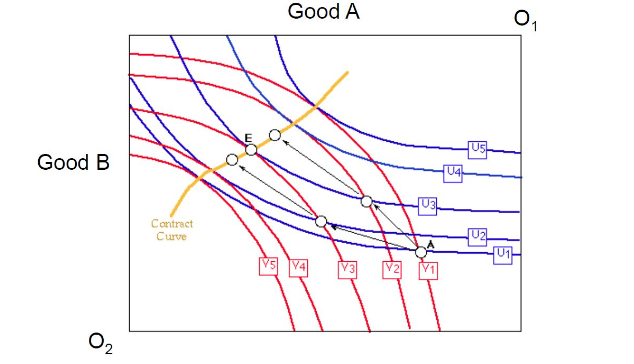
U = Utility of Person 1, Y = Utility of Person 2
A = initial endowment
trade occurs until a point on the contract curve is reached
contract curve = set of allocations where no further mutually beneficial trade is possible; Pareto-efficient set inside the Edgeworth Box
What determines the exact point reached on the contract curve?
bargaining power
the set of possible bargaining outcomes depends on the starting point/endowment
Edgeworth Box and Second Welfare Theorem connection
with lump-sum taxes/subsidies, society can alter endowments so that after bargaining any point on the contract curve is achievable
What do people often say in surveys about equality?
many say: “there should be more equality” and “I feel uncomfortable in having more than you”
Do people always vote for more redistribution if they say they want equality?
no; people often agree with egalitarian statements but do not necessarily support more redistribution politically
Unfairness vs. inequality
people appear more concerned with unfairness than inequality by itself
Rule of law
restriction of the arbitrary exercise of power by subordinating power to well-defined and established laws
what does the rule of law protect us from
from other people and from the government itself
rule of government
he government uses the law as a tool to control the population, but doesn't let the law get in its own way
Why is government especially relevant to rule of law?
because government has a legal monopoly on coercion, so checks and balances are needed
examples of governmental checks and balances
independent judiciary, free press, free speech, freely elected government
equality before the law
everyone should be treated equally before the law; social status or wealth should not matter
economic benefit of rule of law
protects and certifies private property rights, which is essential for markets and efficiency
Why are property rights important for efficiency?
they support market exchange, investment, and productive use of resources; without protection, people may not invest because returns may be taken away
they support market exchange, investment, and productive use of resources; without protection, people may not invest because returns may be taken away
Property rights and credit access
property can serve as collateral, so stronger property rights can improve access to credit
Social justice benefit of rule of law
it protects right of possession and people’s lives
Why do we need rule of law in reality?
incentives often lead people not to behave ethically
Prisoners’ dilemma
strategic setting where individually rational behavior leads to a worse collective outcome; used in the slides to explain why ethical behavior cannot simply be assumed

Efficient outcome = 3,3
Equilibrium outcome = 2,2
Dominant strategy in the prisoners’ dilemma slide = stealing
Nash equilibrium
outcome where no person can gain by changing their own decision given the decisions of others
Efficiency criterion vs Pareto criterion
efficiency / cost-benefit allows winners and losers as long as total gains exceed total losses; Pareto does not allow any loser unless compensated
Ex-ante equality vs ex-post equality
ex-ante = equal starting opportunities; ex-post = equal final outcomes
Rule of law vs rule of government
rule of law limits arbitrary power through established law; rule of government would mean power itself rules, which is precisely what rule of law is meant to prevent
How can the efficient outcome be achieved without formal law?
1. promise not to steal 2. sequential decisions 3. repeated interactions
Condition for reputation to sustain cooperation
interactions must be expected to continue indefinitely or at least long enough for future consequences to matter
Why may private deterrence differ from legal deterrence?
public enforcement under rule of law is not necessarily the same as private retaliation or private protection
causes of underdevelopment
1. physical capital 2. human capital 3. technology
institutions
humanly devised constraints that shape human interactions and structure incentives in political, social, and economic exchange
Economic institutions
institutions that shape economic incentives and contracting possibilities, such as property rights and contract enforcement
Political institutions
institutions that shape political incentives and the distribution of political power, such as the form of government and constraints on politicians and elites
De jure political power
formal political power allocated by official political institutions
De facto political power
actual political power that may come from brutal force, collective action, lobbying, or economic resources, even if not formally assigned by law
Informal institutions
unwritten norms and practices related to how formal rules are actually used, such as social norms
Formal institutions
official, codified rules such as constitutional rules
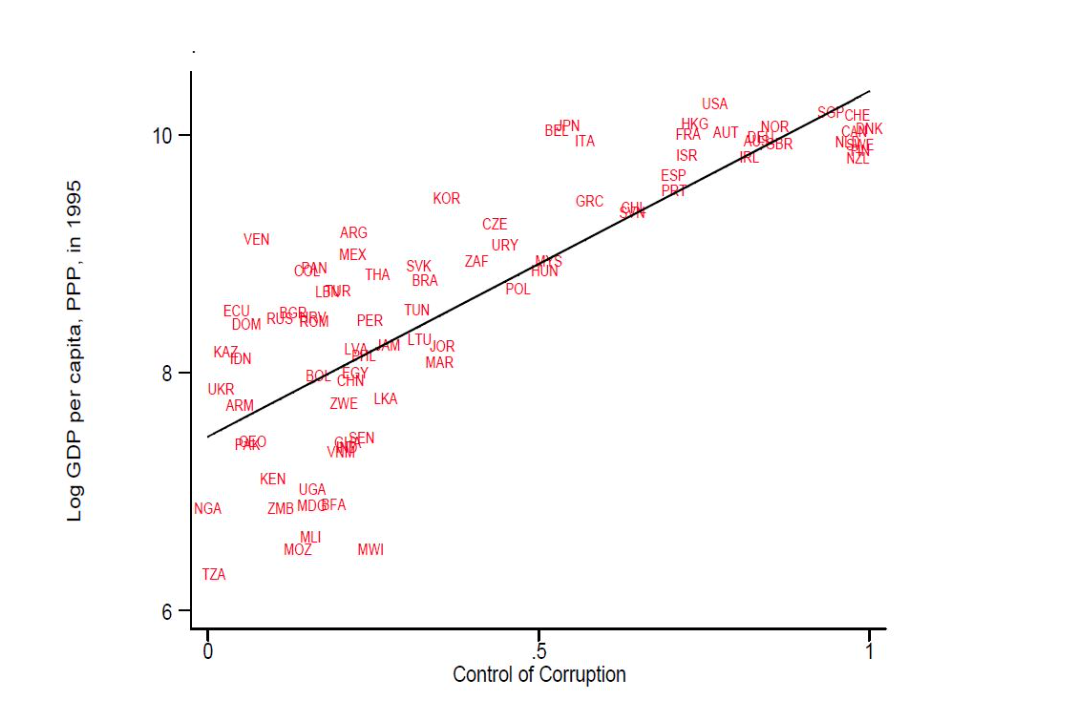
Institutions vs. development
there is a positive correlation between better institutions and higher economic development
Hierarchy of institutions
political institutions and resource distribution shape political power, which then shapes economic institutions, which then shape economic performance and future resource distribution
Political institutions → what type of power?
they allocate de jure political power
Distribution of resources → what type of power?
it helps determine de facto political power
Power without authority
because economic resources can generate de facto influence through force, lobbying, coordination, or other nonformal channels
Commitment problem
groups in power cannot credibly commit not to later change the distribution of resources in their favor
Why does transient de facto power matter?
because if de facto power may disappear, groups may try to change formal political institutions to make their gains more durable
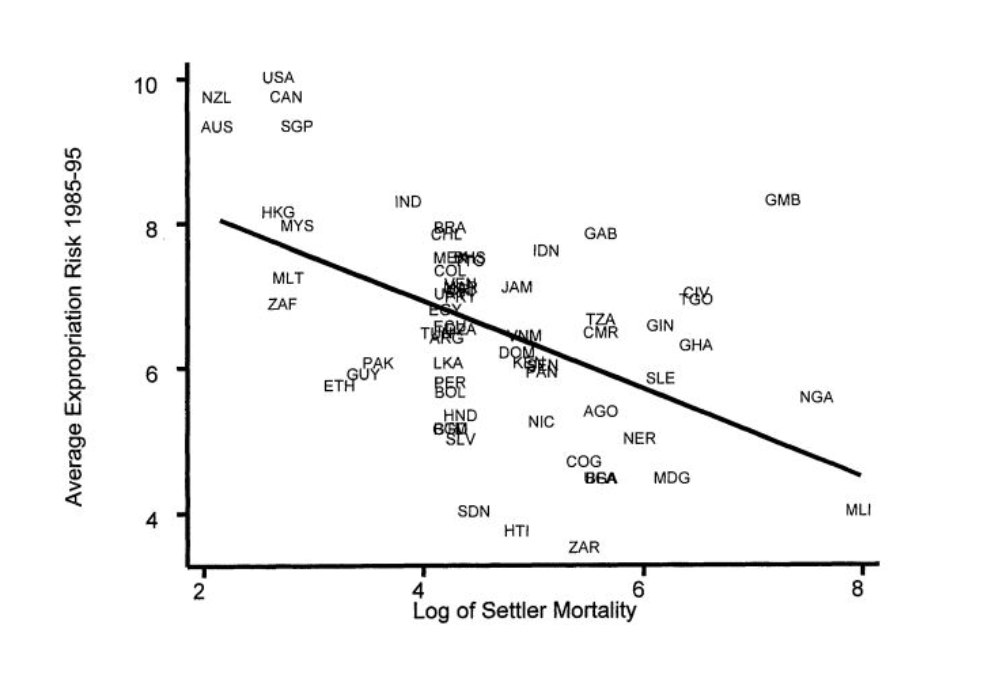
Acemoglu, Johnson, and Robinson (2001)
paper using a natural experiment related to colonial history to study whether institutions cause development
where Europeans faced high mortality, they were less likely to settle and more likely to establish extractive institutions rather than inclusive ones
if institutions persist over time, colonial institutional differences can have long-run consequences for current development
Political principal-agent problem
voters/taxpayers = principals
politicians = agents
politicians meant to act in public interest
politicians also have own goals: reelection, career, party success
core problem: asymmetric information
if actions perfectly observable, voters could punish/replace bad politicians
in reality, monitoring weak: budgets complex, aggregated, poorly justified
information = public good
result: rational ignorance + weak accountability
Why voters do not fully discipline politicians
information costly to collect
private payoff from becoming informed often small
many free-ride on others becoming informed
policy details hard to understand
referendum/election choices can be poorly informed
gives politicians room to deviate from public interest
Political support, campaign money, and public policy
politicians want electoral success
special-interest groups can help through campaign contributions and support → contributions useful for campaigning, advertising, organization
donors usually expect something in return, can shift policy away from public interest toward donor interests
special-interest groups often stronger than ordinary voters because: smaller groups, easier collective action, higher stakes in policy outcomes
Can public finance replace private campaign money?
possible partial fix
idea: fund politics publicly instead of relying on private donors
possible designs mentioned:
funding by parliamentary representation
subsidies matching private funds
other institutional designs
main question: reduce donor influence without creating new distortions
Lithuania study — Baltrunaite (2020)
question: does banning corporate donations reduce political favoritism?
setting: Lithuania, focus: public procurement, about 14% of GDP
test: whether firms making political contributions more likely to win public contracts
reform: 2012 ban on corporate donations to parties/campaigns
evidence: donor firms won by narrow margins more often before reform; could fine-tune bids and raise markup
lesson: campaign finance regulation can reduce special-interest influence, though not eliminate all influence channels
Limits of campaign-finance regulation
impossible to fully control all influence
money can be rerouted through other channels
even if cash donations banned, influence can continue through:
legal entities / indirect giving
in-kind gifts: cars, holidays, watches
media endorsements
celebrity endorsements
takeaway: regulating donations helps, but not complete solution
Role of the media in the principal-agent problem
media can help voters monitor politicians, reduces asymmetric information
can strengthen electoral punishment of corruption but media can also worsen the problem if biased
biased media can amplify special-interest influence
dictators seek media control for this reason
even democracies can have biased media environments
Brazil study — Ferraz and Finan (2008)
setting: Brazil anti-corruption program
from 2003, federal government randomly audited municipalities using federally transferred funds
audit findings made public and spread through media \n- identification: compare municipalities audited before vs after 2004 elections, with similar corruption levels
main result: when violations found, incumbent reelection probability falls by about 17%, effect stronger where local radio existed to spread the informationn
lesson: voters do punish corruption when they actually receive credible information
Italy study — Barone et al. (2015)
question: can less biased media change voting?
background: Italian TV political information seen as biased toward Berlusconi since 1994 \n- 2008–2012: digital TV introduced across Italy
free channels increased about tenfold, 58 of 78 new channels belonged to firms with no ties to Berlusconi or government
outcome studied: 2010 regional elections, main result: digital TV switch lowered Berlusconi vote share by about 5.5 to 7.5 percentage points, effect strongest for older and less educated voters
lesson: more independent/plural media can weaken biased political influence
Non-monetary/media things shaping electoral outcomes
not just money and media. also:
turnout
voter attention
information
politicians
political parties
interest groups
campaign funds
bribes/corruption
celebrity endorsements
weather
Best available tools for reducing the political principal-agent problem
cannot regulate everything
goal: improve accountability with available tools
main tools emphasized in slides:
limit/control political donations
free and independent media
term limits
monetary incentives / pay for politicians
Examples of rents in politics
privileged public spending
low or zero taxes for selected groups
targeted public policies \n- favors for family and friends
Rent
benefit obtained not productively
gained by influencing decisions of others
something that would not be earned in a competitive market
contrast with competition: people paid value of their marginal contribution
Rent creation
political decision makers create rents because they cannot always use policy directly for personal benefit
rents let them exchange public money/resources for:
personal money
political support
party advantage
depends on discretion in public finance and public policy
discretion exists because voters cannot perfectly observe government behavior
Why rent seeking happens
individually rational to enter rent-seeking contests
logic similar to prisoners’ dilemma
even if socially or privately undesirable overall
after resources spent, likelihood of getting rent may not change much. still each actor has incentive to compete for it
Prisoners’ dilemma and rent seeking
if nobody rent-seeks, better collective outcome
if others rent-seek, each individual wants to rent-seek too
result: wasteful competition for transfers/favors
individually rational, collectively inefficient

