Lecture 1-4
 Call Kai
 Learn
Learn Practice Test
 Spaced Repetition
 Match
Match Flashcards
 Knowt Play
1/11

There's no tags or description
Looks like no tags are added yet.
Name | Mastery | Learn | Test | Matching | Spaced | Call with Kai |
|---|
No analytics yet
Send a link to your students to track their progress
12 Terms
Essential Nutrients:
nutrients our body need by cannot be made by the body so we obtain them from what we eat
cannot be made at a rate sufficient to meet needs
required in diet
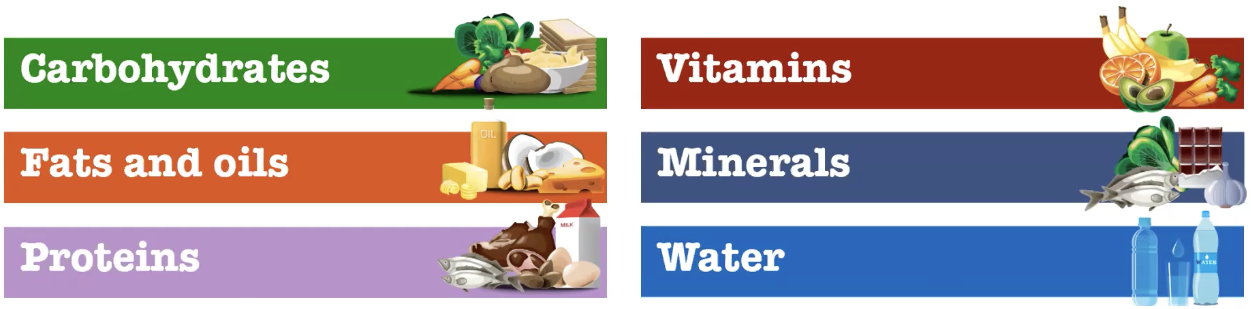
What are the 3 basic functions of nutrients?
provide energy → protein, carbohydrate, and fat
structure → protein, calcium
regulation → body fluid balance, enzymes
Recommended Dietary Allowance (RDA):
average daily level of intake sufficient to meet the nutrient requirements of nearly all healthy people
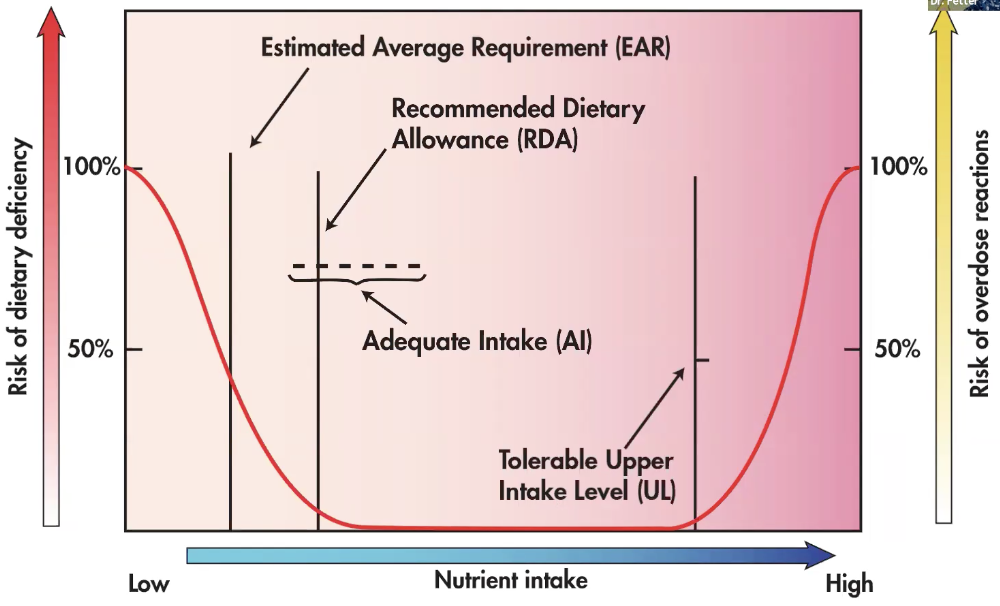
Daily values:
represents a “one size fits all”
What is the difference between Physical and Chemical digestion?
physical digestion occurs primarily in the stomach through grinding and churning, while chemical digestion takes place mainly in the small intestine using enzymes
What did Magendie learn from his experiment involving the dogs and nitrogen?
A) Nitrogen is essential in the diet
B) Magendie learned nothing
C) Peptides are nonessential in the diet
D) Peptides are essential in the diet
E) Nitrogen is nonessential in the diet
A) Nitrogen is essential in the diet → The dogs were unable to survive because they were not getting a dietary source of nitrogen, which means nitrogen is dietarily essential
What did early 1900s scientists recognize in Protein?
many different types of proteins
all proteins contained Nitrogen
a source of Nitrogen was essential in the diet
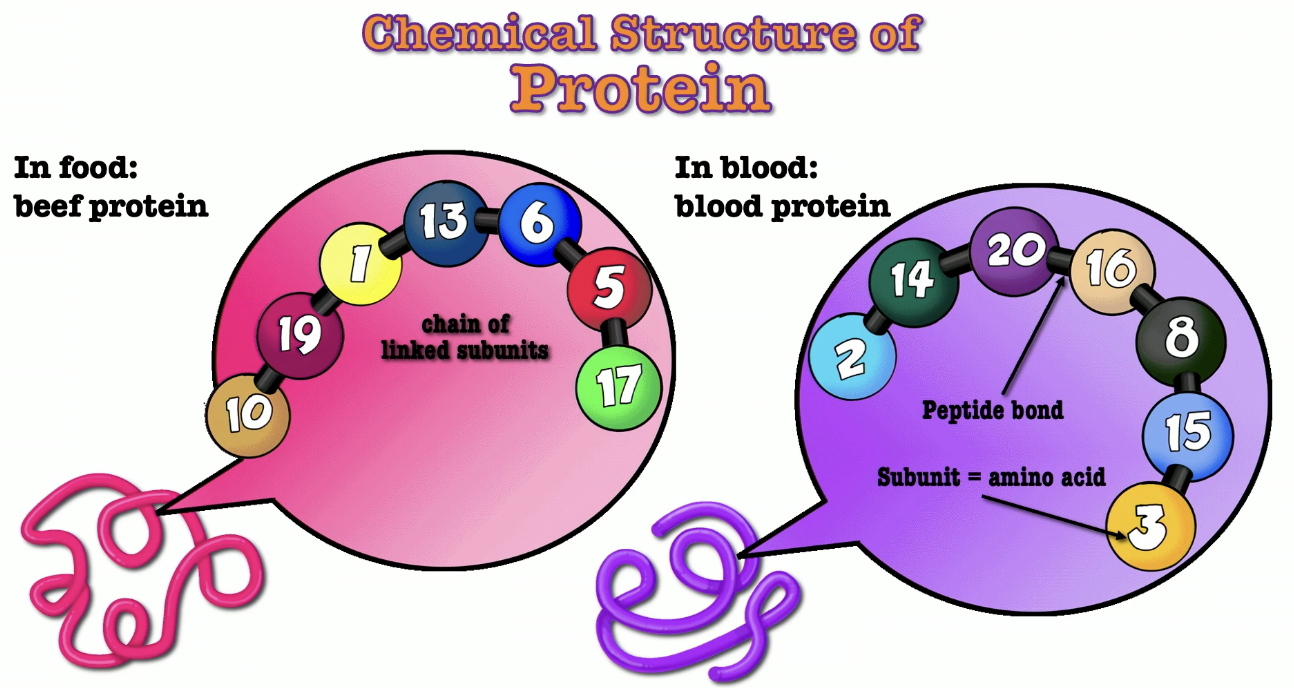
What is the basic unit of protein?
A) lipid
B) amino acid
C) peptide
D) fatty acid
E) monosaccharide
B) amino acid → proteins exist as 3-dimensional shapes which consist of subunits called amino acids
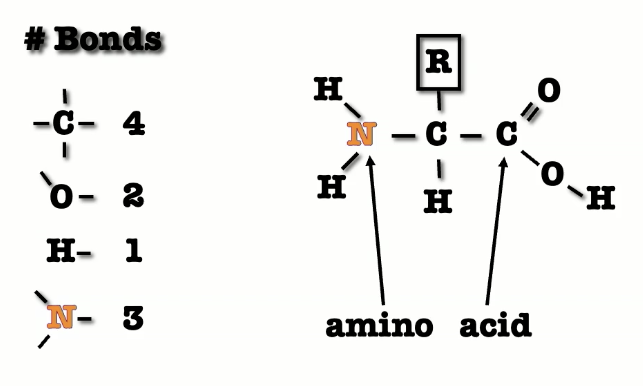
How many different amino acids are there?
20 different amino acids due to their R groups and order
The _______ of amino acids determines the protein's structure, which then determines _________
A) amount; its function
B) order/sequence; the amount of amino acids
C) function; the amount of amino acids
D) function; the order/sequence of amino acids
E) order/sequence; its function
E) order/sequence; its function → The order/sequence of the amino acids determines the structure of a protein, since the R group of each amino acid interacts with other R groups in the strand as well as with the environment
interaction determines the folding of the strand, hence its structure, which ultimately determines what the protein can do (i.e., its function)
Which of the following is true about protein structure? (check all that apply)
i. proteins all have the same shape
ii. all proteins are made up of the exact same amount of amino acids
iii. the R-group determines how the protein folds, thus creating its structure
iv. the structure of the protein determines its function
v. the sequence of amino acids in the R-group determine how the protein is shaped
iii. the R-group determines how the protein folds, thus creating its structure
iv. the structure of the protein determines its function
v. the sequence of amino acids in the R-group determine how the protein is shaped
True or False: As long as a protein contains the same amount of each specific amino acid, the order/sequence of these amino acids does not impact the structure of the protein, hence its function.
False, if a protein is put together with the incorrect specific amino acids, it can cause the protein to be misfolded and not perform its intended function

