PHAR 464 Kahoot Review
 Studied by 0 people
 Call Kai
 Learn
Learn Practice Test
 Spaced Repetition
 Match
Match Flashcards
 Knowt Play
1/51

There's no tags or description
Looks like no tags are added yet.
Name | Mastery | Learn | Test | Matching | Spaced | Call with Kai |
|---|
No analytics yet
Send a link to your students to track their progress
52 Terms
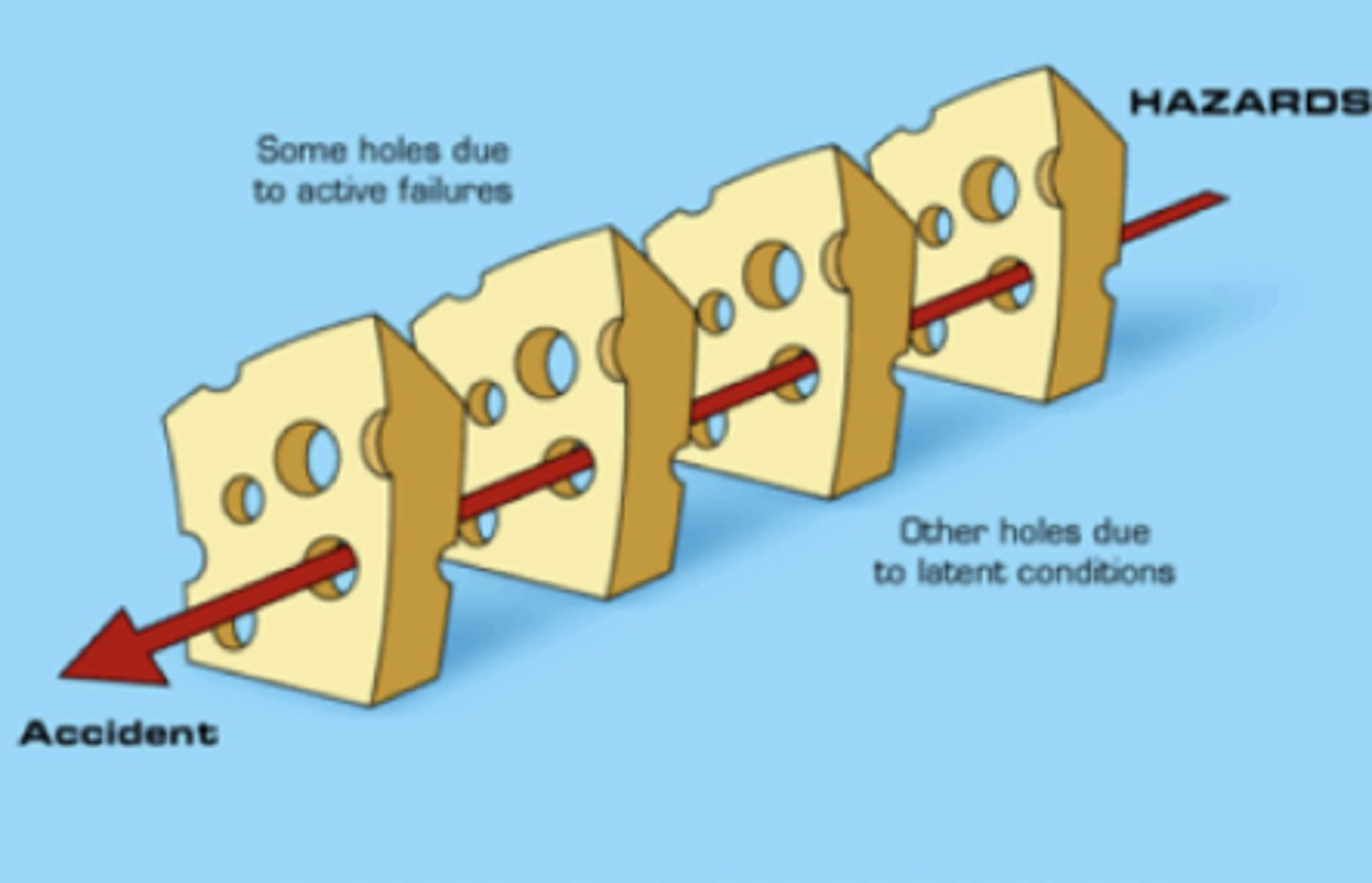
What model is this?
A. Hazards Model
B. Root Cause Model
C. Swiss Cheese Model
D. Layers of Defense Model
C. Swiss Cheese Model
To Drift is Human means that it's human nature to drift towards ______ due to wanting to be more productive
A. Risk
B. Uncertainty
C. Error
D. Justice
A. Risk
Which of the following is a latent failure?
A. Pharmacist forgot to counsel patient
B. Oncology is short staffed
C. Technician picked the wrong medication
D. Nurse programmed the wrong drug in the pump
B. Oncology is short staffed
Slips, lapses, and mistakes are types of:
A. Recklessness
B. At-Risk behavior
C. Human error
D. Just Culture
C. Human error
Examples of _____ include: omitting a double-check, overriding alerts, failure to check allergies.
A. Reckless behavior
B. At-risk behavior
C. Human Error
D. Just Culture
B. At-risk behavior
Which management of unsafe acts is a CORRECT pairing?
A. Reckless behavior - coach
B. At risk behavior - discipline
C. Human error - coach
D. Human error - console
D. Human error - console
What is an instinctive, unconscious, highly efficient mental process that we have no control over or awareness of?
A. Controlled thinking
B. Rule applicaiton
C. Anchoring bias
D. Automatic thinking
D. Automatic thinking
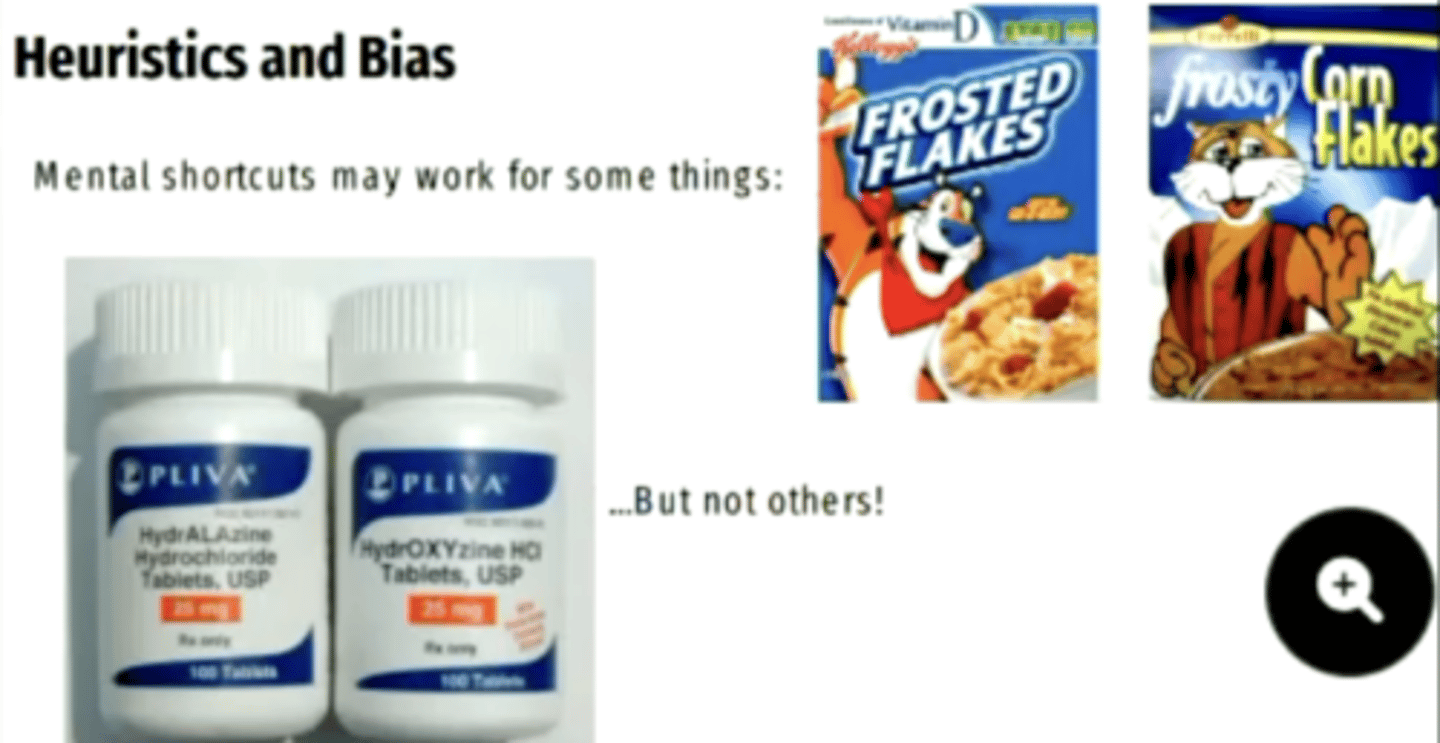
Which mental shortcut is displayed on this slide?
A. Representativeness heuristic
B. Confirmation bias
C. Base rate heuristic
D. Change blindness
A. Representativeness heuristic
What is this process called (scribbled out in black here)?
A. Encoding
B. Stimulus processing
C. Maintence rehearsal
D. Memory analysis
C. Maintenance rehearsal

Inability to recognize changes in a stimuli/environment (due to the brain's limited capacity to recall complex info) is:
A. Status quo blindness
B. Intentional blindness
C. Maintenance rehearsal
D. Changed blindness
D. Changed blindness
Which of the following is NOT a barrier to retrieval (memory recollection)?
A. Memory decay
B. Framing Effect
C. Lack of training/education
D. Low intelligence/aptitude
B. Framing Effect
Which of the following is NOT a workplace strategy to mitigate errors due to human factors?
A. Reducing interruptions to shift changes
B. Setting expectations with personal technology use (e.g. cell phones)
C. Increasing alerts in the electronic health record
D. Creating a to-do list
C. Increasing alerts in the electronic health record
Designs that prevent unintended/undesirable actions from being performed or ensuring a specific action IS preformed are called:
A. Forcing functions
B. Affordances
C. Automated choices
D. Barcode scanning
A. Forcing functions
What is the goal of performing a root cause analysis?
A. To prevent sentinel events from occurring
B. To punish those that cause a sentinel event
C. To identify modes of failure and potential consequences of those failures
D. To identify the source of errors and develop an action plan to prevent recurrence
D. To identify the source of errors and develop an action plan to prevent recurrence
FYI: What Patient Safety Assessment Code (SAC) severity category is described as follows: "Patients with actual or potential: increased length of stay or increased level or care for one or two patients"?
A. Minor
B. Moderate
C. Major
D. Catastrophic
B. Moderate
What Safety Assessment Code (SAC) score would warrant a formal investigation/RCA?
A. 1
B. 2
C. 3
D. 4
C. 3
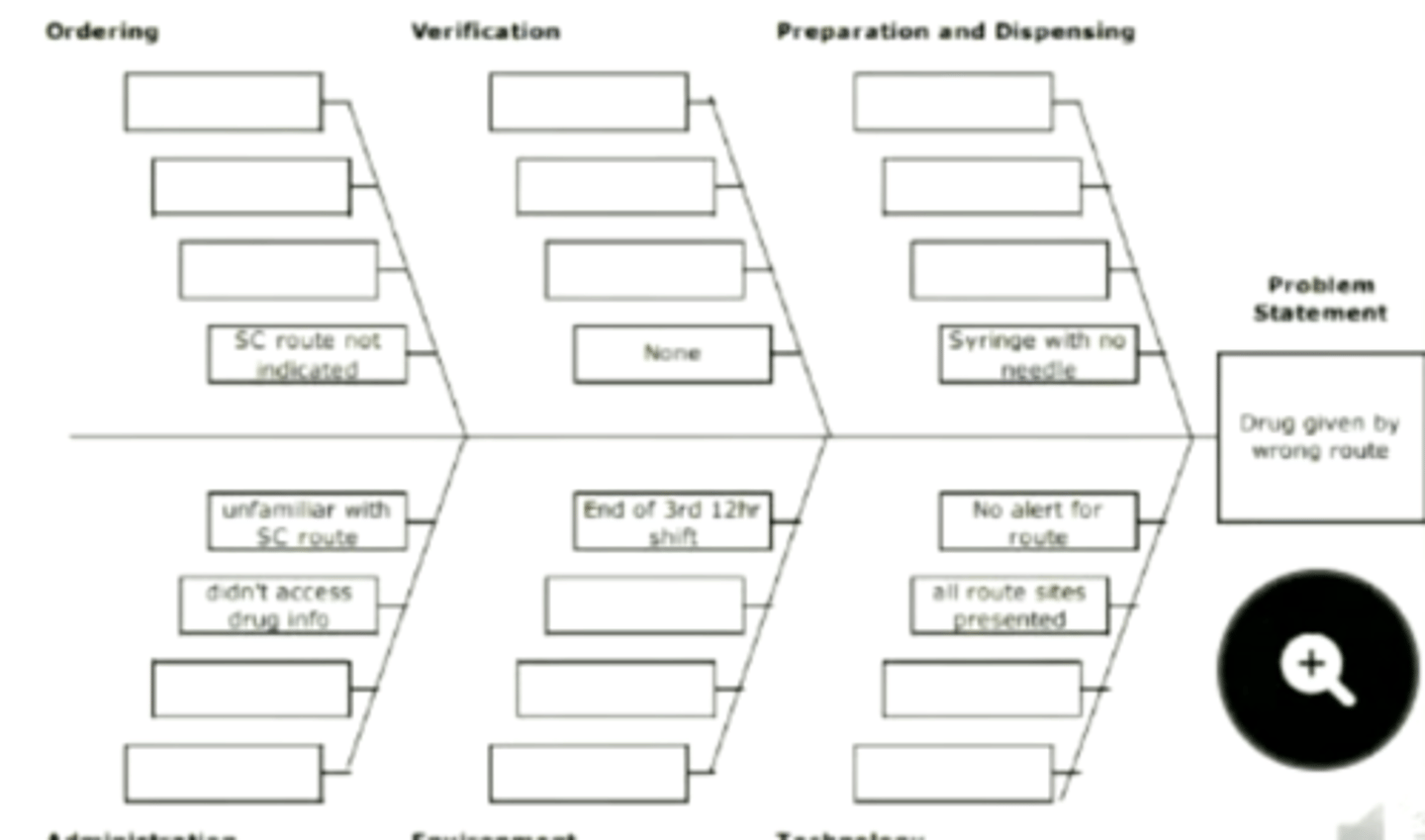
What type of cause/effect diagram is pictured?
A. Process Workflow Mapping
B. Fishbone Diagram
C. Failure Modes Effects Analysis
D. 5 Whys
B. Fishbone Diagram
Which of the following is TRUE about Failure Mode and Effects Analysis (FMEA)?
A. Proactively identifies and ranks process risks
B. FMEA should be conducted by only one discipline (e.g., only pharmacists, only nurses) to ...
C. Retroactively uses a Sentinel Event to identify main points
D. There should be multiple focuses examined to seek overlapping issues
A. Proactively identifies and ranks process risks
Which of the following is NOT one of Donald Norman's User Centered Strategy?
A. Simplify the structure of tasks
B. Use constraints (forcing functions) to guide the use
C. Reoriented users to policies and procedures
D. Make it easy to reverse error prone operations and hard to carry out tasks
E. Make important information visible
C. Reoriented users to policies and procedures

Of the options listed below, which is the most effective type of intervention?
A. Automating a process
B. Implementing a double check
C. Education
D. Writing a new rule or policy
A. Automating a process
Which of the following Adverse Drug Event (ADE) was discussed in class that related to IV Promethazine Injection?
A. Severe bleeding
B. Falls in elderly patients
C. Tissue injury related to inadvertent intra-arterial injection
D. Arrhythmia due to drug interactions with amiodarone
C. Tissue injury related to inadvertent intra-arterial injection
Which type of intervention is most effective?
A. A System Oriented Intervention
B. An Individual Oriented Intervention
C. A Cosmically Oriented Intervention
D. A Disoriented Intervention
A. A System Oriented Intervention
Which of the following concepts related to patient safety earned the Nobel prize in economics?
A. The Forced Function
B. To Err is Human
C. The Nudge
D. Just Culture
C. The Nudge
What improvements strategy/strategies does the "Nudge" employ? Choose all that apply
A. Mandates
B. Thoughtful choice architecture
C. Using individual's innate rationally
D. Using default options to guide behavior
E. Incentives for making good choices
B. Thoughtful choice architecture
D. Using default options to guide behavior
What is the P in PDSA cycle?
Plan
What is the D in the PDSA cycle?
Do
What is the S in the PDSA cycle?
Study
What is the A in the PDSA cycle?
Act
What does DMAIC from Six Sigma stand for?
Define
Measure
Analyze
Improve
Control
What does it mean to "Go to the Gemba"?
A. To go to the real place where work is done
B. To stay committed to your improvement work
C. To support a colleague involved in an error
D. To start a falling project over
A. To go to the real place where work is done
Which of the following can be helpful for combatting lapses that can occur during order verification in community pharmacy? (Choose that all apply)
A. Increase access to high quality patient information
B. Modify incentive structures
C. Promote Situational Awareness
D. Reduce distractions while switching
C. Promote Situational Awareness
D. Reduce distractions while switching
Both Bar Code Scanning and Double Checks were mentioned as strategies to reduce the risk of error during prescription filling processes in community pharmacy. Which is most likely to be more useful?
A. Implementation of Bar Codescanning
B. Double Check of all fills
A. Implementing Bar Code Scanning
Which of the following best describe the focus of the "5S" of Lean Methodology?
A. Improving organization and cleanliness
B. Empowering all staffers to report errors
C. Slowing the pace of work to reduce stress
D. Ensuring effective communication
A. Improving organization and cleanliness
Communication failures are involved in ~___% of malpractice cases?
A. 10%
B. 30%
C. 50%
D. 70%
B. 30%
Communication failures in __% of serious medical errors?
A. 20%
B 40%
C. 60%
D. 80%
D. 80%
What is it called when a prescriber verbally (i.e., face-to-face, by phone) gives order to another healthcare professional (e.g., nurses, pharmacist) who then transcribes it into the medical record?
A. Order set
B. Per protocol order
C. Verbal order
D. Electronic order
C. Verbal order
Providers should write instructions to patient at a level no greater than a:
A. 3rd grade level
B. 5th grade level
C. 8th grade level
D. High school level
B. 5th grade level
What does SBAR stand for?
S = situation
B = background
A = assessment
R = recommendation
Creation of a treatment plan or order set best falls into what process improvement category?
A. Forcing functions
B. Standardization
C. Training
D. Rules
B. Standardization
Alerts and warnings need to be best optimized to prevent what?
Alert fatigue
Which organization is granted "deeming authority" by the Centers for Medicare and Medicaid Services (CMS)?
A. The Joint Commission (TJC)
B. Drug Enforcement Administration (DEA)
C. American Society of Health-System Pharmacists (ASHP)
D. Illinois Department of Financial and Professional Regulation
A. The Joint Commission (TJC)
Which organization is a regulatory body?
A. The Joint Commission (TJC)
B. Food and Drug Administration (FDA)
C. American Society of Health-System Pharmacists (ASHP)
D. The Leapfrog Group
B. Food and Drug Administration (FDA)
The "rules" issued by regulatory bodies or public authorities that MUST BE FOLLOWED with detailed instructions on how laws are carried out/enforced are called
Regulations
Once accredited, The Joint Commission surveyors will visit at least once every. ___ years (unannounced)
A. 1 year
B. 3 years
C. 4 years
D. 5 years
B. 3 years
Which of the following is NOT a reason that accreditation is important?
A. Reimbursement
B. Market competitiveness
C. Promote a culture of excellence
D. Requirement by law
D. Requirement by law
The survey score provided by the Joint Commission is provided through this:
A. SAFETY Matrix
B. SAFER Matrix
C. Likelihood to Harm
D. Failure Mode Effects Analysis (FMEA)
B. SAFER Matrix
Which of the following is NOT a TJC accreditation standard content category?
A. Medication Management (MM)
B. Environment of Care (EC)
C. Leadership (LD)
D. Pharmacy (PH)
D. Pharmacy (PH)
TJC Standards are broken down into:
A. Rules and policies
B. National Patient Safety Goals (NPSG)
C. Elements of Performance
D. Explanations
C. Elements of Performance
What is the top concern challenge for BOTH hospital and ambulatory care settings in being able to meet TJC requirements?
healthcare associated infections
The newest National Patient Safety Goal to be added is about:
improving health equity
FYI: Which is not a leapfrog hospital survey domain?
cost of services
What is a flaw of hospital rating systems?
A. The reported data may be imperfect, unreported, or outdated
B. There are no flaws - ratings are highly accurate
C. Rating systems are valued more than accreditation by organizations
D. Hospitals waste a lot of money paying for rating assessment
A. The reported data may be imperfect, unreported, or outdated
 Note
Note  Flashcards (46)