Behav SN4 (16)
 Call Kai
 Learn
Learn Practice Test
 Spaced Repetition
 Match
Match Flashcards
 Knowt Play
1/75

There's no tags or description
Looks like no tags are added yet.
Name | Mastery | Learn | Test | Matching | Spaced | Call with Kai |
|---|
No analytics yet
Send a link to your students to track their progress
76 Terms
Paivio’s Dual-Coding Theory
the word “tree” can recall some information, and a picture of a tree can recall the same information, … leading to redundancy
The Information Processing Model
Compares human memory to a computer (requires data, encoding, processing, retrieval, etc.)
Thinking requires stimuli → stimuli must be anazlyed → decisions made in the past can inform the future → problem solving is dependent on that person’s capabilities.
Sensorimotor Stage (Piaget)
(From birth to age 2). The child learns to manipulate the environment in order to meet physical needs and learns to coordinate sensory input with motor actions.
Primary Circular Reactions
repetitions of body movements that originally occurred by chance (sucking thumb)
Secondary Circular Reactions
occur when manipulation is focused on something outside the body (like throwing a toy)
Object Permanence
understanding things continue to exist even when out of view
Representational Thought
the child has begun to create mental representations of external objects and events
Preoperational Stage (2 terms)
from about 2 to 7 years of age. It’s characterized by symbolic thinking (imagination/make-believe play) and egocentrism (inability to imagine what others may think or feel).
Conservation
Part of the Preoperational Stage … can’t tell that a slice of pizza if cut in half remains the same amount and would likely think the 1 slice that was sliced in 2 is more.
Concrete Operational Stage
from 7 to 11. They can understand conservation and are no longer about egocentrism, however they can’t think abstractly, but rather only with concrete information
Formal Operational Stage
from 11 and up. Marked by the ability to think logically about abstract ideas.
Hypothetical Reasoning
part of the Formal Operational Stage … the ability to mentally manipulate variables in a number of ways (kids analyzing what makes the frequency of a pendulum)
Fluid Intelligence
used when solving new problems for the first time, possibly using creative methods (this type of intelligence declines with age)
Crystallized Intelligence
solving problems using acquired knowledge, aka procedural problem solving (the decline of this type of intelligence is almost none)
Dementia
a general loss of cognitive function. Includes impaired memory and judgement, and confusion. Can be caused by Alzheimer's disease and Vascular (multi-infarct) dementia (caused by microscopic clots in the brain and or high blood pressure)
Delirium
like dementia but the decline is rapid and can fluctuate, it is reversible as it is caused by an imbalances of a multitude of things in the body
Functional Fixedness
the inability to consider how to use an object in a non-traditional way
Trial-and-error (type of problem solving)
various solutions are tried until one is found
Algorithms (type of problem solving)
a formula or procedure for solving a certain type of problem
Deductive Reasoning (Top-down) (type of problem solving)
ostarts from a set of general rule and draws conclusions from the information given … if the premise is true, then the conclusion has to be true (all humans need oxygen, thus I must need oxygen too)
Inductive Reasoning (bottom-up) (type of problem solving)
o seeks to create a theory via generalizations … the conclusion is likely true, but not guaranteed (my cat has a tail, thus all cats must also have a tail)
Heuristics
“rules of thumb”, that is, simplified principles used to make decisions … kinda like what you expect to happen, but not necessarily or mathematically true to occur
Representativeness Heuristic
categorizing items on the basis of whether they fit the prototypical, stereotypical, or representative image of the category (Similarities = same group) … an animal that looks like a cat must be one, when in reality it could be something else
Availability Heuristic
When we base the likelihood of an event on how easily examples of that event come to mind (thinking something will happen again b/c you’ve heard it happen before multiple times, even when it is an incredibly rare event)
Disconfirmation Principle
if evidence shows a working solution does not work, then it should be discarded
Conformation Bias
the tendency to focus on information that fits an individual’s beliefs, while rejecting information that goes against them
Overconfidence
thinking you can’t be wrong
Hindsight Bias
“I know it all along” … the tendency to believe that you knew something in the past was true, yet you didn’t really and actually got it wrong
Intuition
“gut-feeling”, what’s actually going on is that your brain is sorting thru many old scenarios and looking for patterns, which leads to recognition-primed decision model
recognition-primed decision model
simply being able to sense something is happening and be correct, again, this “wisdom” is gained thru experience on the field
Consciousness
one’s level of awareness of both the world and one’s own existence.
Alertness
is a state of consciousness in which we are awake and able to think … here we also experience physiological arousal (increased heart rate, breathing rate, etc.). What is happening is that the prefrontal cortex is communicating with the reticular formation to keep the cortex awake and alert.
beta waves
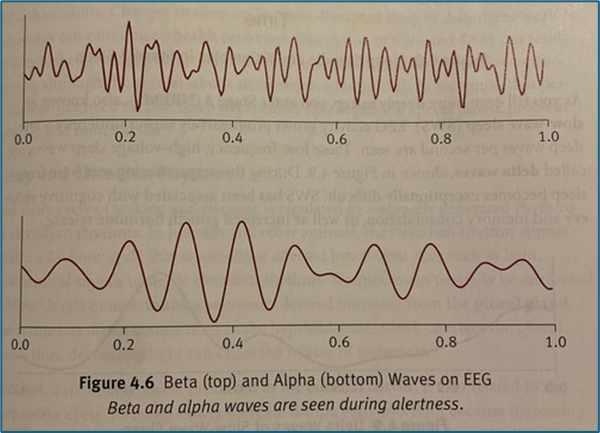
are high frequency and appear when the person is still awake performing some mental task
alpha waves
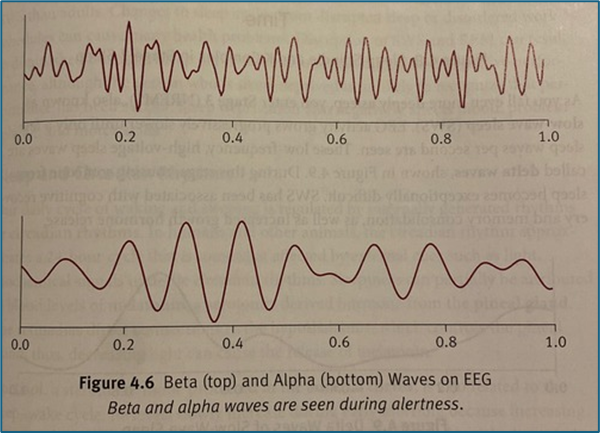
occur when we are awake but relaxed with eyes closed
Stage 1 of Sleep Cycle
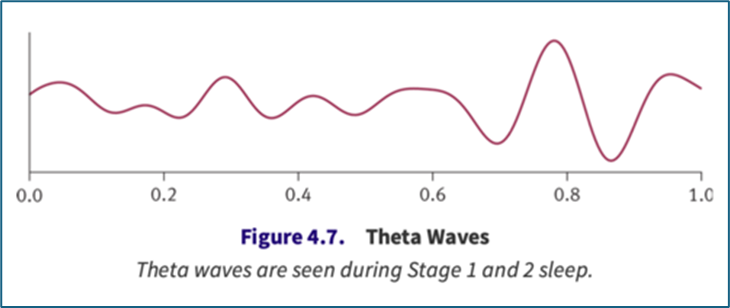
(also known as NREM1), which is characterized by theta waves, which are irregular waveforms with slower frequencies and higher voltage
Stage 2 of the Sleep Cycle
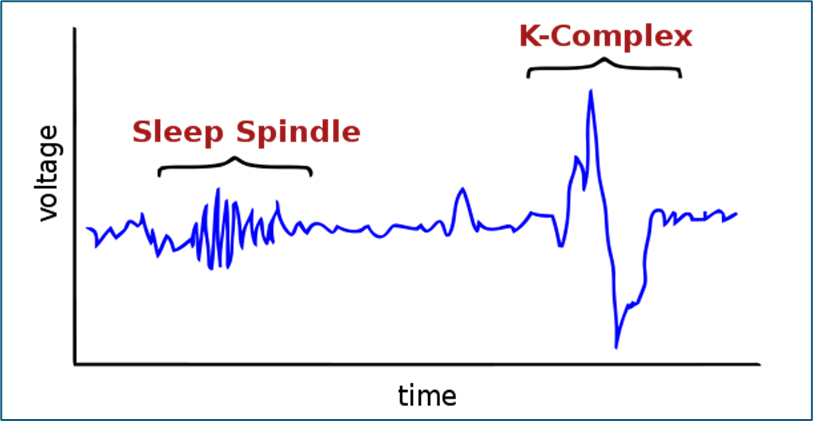
(NREM2). Here we see sleep spindles, which are bursts of high-frequency waves, and K complexes, which are singular high-amplitude waves
Stage 3 of the Sleep Cycle
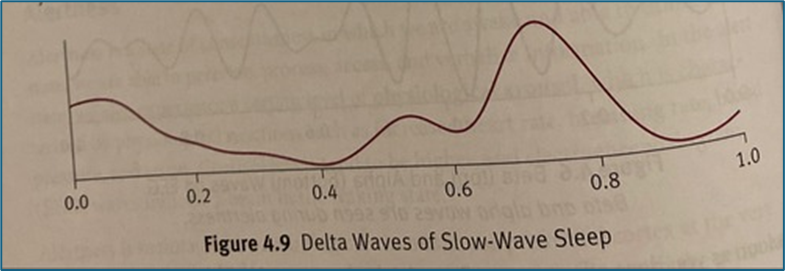
(NREM3), also known as slow-wave sleep (SWS). Characterized by delta waves, which are low-frequency, high voltage and occur less … this is the stage associated with memory consolidation and cognitive recovery
REM
so NREM comes from non-rapid eye movement, while REM comes from rapid eye movement sleep. REM occurs interspersed between the cycles of NREM, and it’s where we dream. Physiologically, our minds mimic the arousal levels that of being awake, but our muscles are paralyzed, which is why REM is also known as paradoxical sleep.
Sleep Cycle Mnemonic
o BAT-D → beta, alpha, theta, and delta … remember, a bat sleep during the day
o Stages 1 and 2 have Theta waves, and Stage 3 and 4 have Delta waves
Wakefulness
happens b/c the levels of cortisol, which occur b/c of increasing light in the morning causes the release of corticotropin-releasing factor (CRF) from the hypothalamus, this CRF causes release of adrenocorticotropic hormone (ACTH) from the anterior pituitary, which stimulates cortisol release from the adrenal cortex.
increasing light à hypothalamus releases CRF à CRF causes release of ACTH à ACTH causes adrenal cortex to release cortisol
Sleepiness
induced by increasing levels of melatonin in the blood; melatonin, which is released by the pineal gland as a response to less light hitting the retina, which is directly connected to the hypothalamus, and the hypothalamus is connected to the pineal gland
diminishing light hits retina à signal sent to the hypothalamus à signal sent to the pineal gland à pineal gland releases melatonin
Activation-Synthesis Theory
dreams are caused by widespread, random activation of neural circuitry
Problem Solving Dream Theory
dreams are a way to solve problems while you are sleeping
Cognitive Process Dream Theory
dreams are merely the sleeping counterpart of stream-of-consciousness
Neurocognitive Models of Dreaming
seek to unify the biological and psychological aspects of dreaming… meaning it happens b/c physiology
Dyssomnias
disorders that make it difficult to fall asleep, stay asleep, or avoid sleep (insomnia, narcolepsy, and sleep apnea)
Parasomnias
are abnormal movements or behaviors during sleep (night-terrors and sleepwalking)
Narcolepsy
involuntary falling asleep randomly, usually b/c of emotional triggers.
Cataplexy
a loss of muscle control and sudden intrusion of REM sleep, occurs in narcolepsy
Hypnagogic and Hypnopompic Hallucinations
occur when going to sleep or awakening
Depressants
reduce nervous system activity, results in a sense of relaxation and reduced anxiety
Alcohol
increases the activity of GABA receptors, and related to many negative physiological declines (depressant)
Sedatives
tend to depress central nervous system activity, resulting in feelings of calm, relaxation, and drowsiness
Barbiturates
§ anxiety reducing/ sleep meds (amobarbital and phenobarbital) (sedative)
Benzodiazepines
also increase GABA activity, causing a sense of relaxation, and are what barbiturates were changed for (alprazolam, lorazepam, diazepam, and clonazepam) (sedative)
Stimulants
cause an increase in arousal in the nervous system
Amphetamines
cause increased arousal by increasing release of dopamine, norepinephrine, and serotonin at the synapse and decreasing their reuptake. Induces sense of euphoria, being on edge, anxiety, delusions of grandeur, and paranoia … can lead to stroke or brain damage (stimulant)
Cocaine
§ similar to amphetamines but decreases reuptake of the neurotransmitters instead, and it also has anesthetic and vasoconstrictive properties (stimulant)
Crack
a form of cocaine that can be smoked, works quickly and has potent effects
Ecstasy
§ both a stimulant and hallucinogen. A designer amphetamine, meaning it does much of the same. More specifically, it causes feelings of euphoria, increased alertness, and overwhelming sense of well-being and connectedness. (stimulant)
Opiates and Opioids
Opiates are naturally occurring (morphine and codeine), while opioids are synthesized (oxycodone, Norco, heroin). On top of feeling euphoric, they act as endorphin agonists, meaning they decrease pain
Hallucinogens
(LSD), cause introspection, distortions of reality and fantasy, and enhancement of sensory experiences
Marijuana
the active chemical is THC, this one instead inhibits GABA activity and increases dopamine activity, it falls under multiple categories such as stimulant, depressant, and hallucinogen
Subtances that increase GABA vs. subtances that increase catecholamines
alcohol, barbiturates, and benzodiazepines increase GABA activity, while marijuana inhibits it … on the other hand, amphetamines, cocaine, and ecstasy increase dopamine, norepinephrine, and serotonin
Mesolimbic Reward Pathway
One of four dopaminergic pathways in the brain. This pathway is normally involved in motivation and emotional response and its activation accounts for the positive reinforcement of substance use. It includes the nucleus accumbens (NAc), the ventral tegmental area (VTA), and the connection between them, the medial forebrain bundle (MFB). … it should seem obvious that its neurotransmitter is dopamine
Phonology
refers to the actual sound of speech
Morphology
refers to the building blocks of words (prefixes, suffixes, etc.), such as rules for pluralization
Semantics
refers to the meaning of words
Syntax
refers to the rules dictating word order
Pragmatics
refers to the changes in language delivery depending on context
Nativist (biological) theory
explains language acquisition as being innate and controlled by the language acquisition device (LAD), a theoretical pathway in the brain that allows infants to process and absorb language rules
Learning (behaviorist) theory
explains language acquisition as being controlled by operant conditioning and reinforcement by caregivers (you learned it b/c parents thought it)
Social interactionist theory
explains language acquisition as being caused by a motivation to communicate and interact with others (you learned it b/c desired to communicate)
Whorfian (linguistic relativity) hypothesis
language greatly affects how we see/understand the world
Broca’s (nonfluent aphasia) aphasia
you can comprehend but can’t articulate your words … b/c Broca’s area is for speech production
§ Broca’s = Broken
Wernicke’s (fluent aphasia) aphasia
you can communicate (albeit nonsensically), but can’t comprehend what you are saying … b/c Wernicke’s area is responsible for speech comprehension
§ Wernicke’s = Wacky

