Fate of Pyruvate & TCA cycle

0.0(0)
studied byStudied by 0 people
0.0(0)
full-widthCall with Kai
learnLearn
examPractice Test
spaced repetitionSpaced Repetition
heart puzzleMatch
flashcardsFlashcards
GameKnowt Play
Card Sorting

1/12

encourage image

There's no tags or description

Looks like no tags are added yet.

Study Analytics
Name
Mastery
Learn
Test
Matching
Spaced
Call with Kai

No study sessions yet.

13 Terms

1
New cards

what’s the different fate for pyruvate?

  • Anaerobic glycolysis - no mitochondria / O2

    • need to regenerate NAD+ by using NADH to make lactate to keep glycolysis going, uses up H+

    • lactate can accumulate → acidosis

  • Aerobic metabolism - mitochondria & O2 available

    • pyruvate enters mitochondria & oxidized in TCA cycle

    • producing CO2 & H2O while consuming H+

    • generate energy in ETC

2
New cards

What is the structure for mitochondria membrane?

Double-membraned

  • outer membrane - freely permeable

  • inner membrane - impermeable, has specificity using transporters

  • inter-membrane space - where all enzymes are

3
New cards

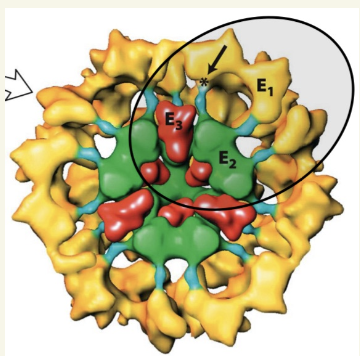
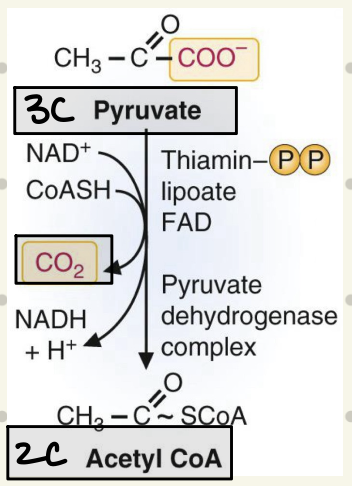
what’s the structure of PDC?

  • my multiple copies of 3 enzymatic subunits: E1, E2, E3

  • requires 5 cofactors for catalysis, found in mitochondria matrix

    • TPP, Lipoamide, FAD, CoA, NAD+

<ul><li><p>my multiple copies of <strong>3 enzymatic subunits: E1, E2, E3</strong></p></li><li><p>requires <strong>5 cofactors</strong> for catalysis, found in mitochondria matrix </p><ul><li><p>TPP, Lipoamide, FAD, CoA, NAD+</p></li></ul></li></ul><p></p>
4
New cards

What’s the role of CO2 in PDC reaction?

  • resulted from redox decarboxylation

  • drives reaction forward because it doesn’t dissolve → immediately leaves
<ul><li><p>resulted from redox decarboxylation</p></li><li><p>drives reaction forward because it doesn’t dissolve → immediately leaves </p></li></ul><p></p>
5
New cards

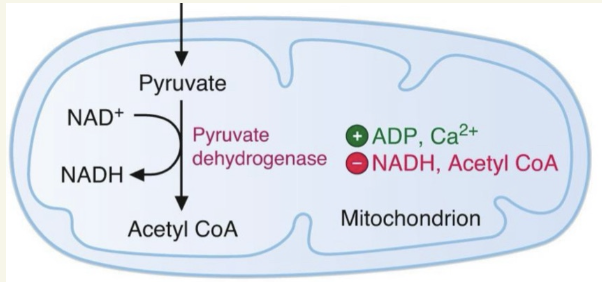
How is PDC reaction regulated?

Feedback Inhibition:

  • Acetyl-CoA inhibits E2

  • NADH inhibits E3

    • turns off process, causing pyruvate build up & glycolysis off

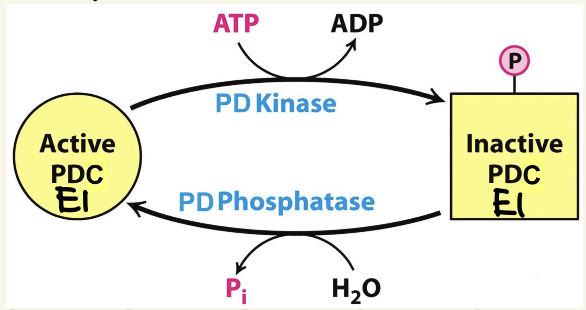
PTM:

  • phosphorylation onto E1

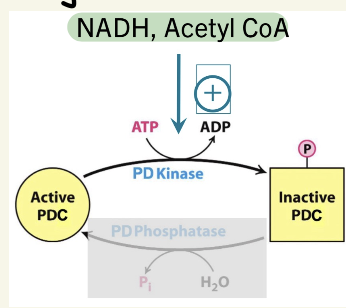
  • PD Kinase - turn PDC OFF

    • add P, using ATP

    • when energy (ATP, NADH, Acetyl-CoA)

  • PD Phosphatase - turn PDC ON

    • remove P by hydrolysis

    • when energy (ADP, NAD+, Ca2+)

<p>Feedback Inhibition:</p><ul><li><p>Acetyl-CoA inhibits <strong>E2</strong></p></li><li><p>NADH inhibits <strong>E3</strong></p><ul><li><p>turns off process, causing pyruvate build up &amp; glycolysis off</p></li></ul></li></ul><p>PTM:</p><ul><li><p><strong>phosphorylation</strong> onto<strong> E1</strong></p></li><li><p><strong>PD Kinase</strong> - turn PDC OFF</p><ul><li><p>add P, using ATP </p></li><li><p>when <span data-name="arrow_up" data-type="emoji">⬆</span>energy (ATP, NADH, Acetyl-CoA)</p></li></ul></li><li><p><strong>PD Phosphatase </strong>- turn PDC ON</p><ul><li><p>remove P by hydrolysis</p></li><li><p>when <span data-name="arrow_down" data-type="emoji">⬇</span>energy (ADP, NAD<sup>+</sup>, Ca<sup>2+</sup>)</p></li></ul></li></ul><p></p>
6
New cards

How is PDC reaction regulated @ muscle at rest?
- how is PD Kinase regulated?

  • rest = energy state (lots Acetyl-CoA, NADH, ATP)

  • turns PDC off by feedback inhibition & phosphorylation by PD Kinase

    • PD Kinase activated by NADH & Acetyl-CoA

<ul><li><p>rest = <span data-name="arrow_up" data-type="emoji">⬆</span>energy state (lots Acetyl-CoA, NADH, ATP)</p></li><li><p>turns PDC off by feedback inhibition &amp; phosphorylation by PD Kinase</p><ul><li><p>PD Kinase activated by <span data-name="arrow_up" data-type="emoji">⬆</span>NADH &amp; Acetyl-CoA</p></li></ul></li></ul><p></p>
7
New cards

How is PDC reaction regulated @ muscle at exercise?
- how is PD Phosphatase regulated?

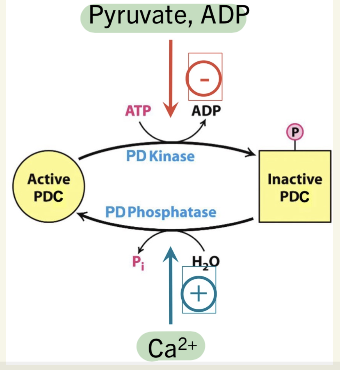
when exercising, intracellular Ca2+ & energy state

  • causes ADP, pyruvate (∵active glycolysis) → need more energy

    • ADP, pyruvate inhibits PD Kinase

  • turns PDC ON → PD Phosphatase

    • PD Phosphatase is:

      • activated by Ca2+

<p>when exercising, <span data-name="arrow_up" data-type="emoji">⬆</span>intracellular Ca<sup>2+ </sup>&amp; <span data-name="arrow_down" data-type="emoji">⬇</span>energy state </p><ul><li><p>causes <span data-name="arrow_up" data-type="emoji">⬆</span>ADP, pyruvate (∵active glycolysis) → need more energy</p><ul><li><p> <span data-name="arrow_up" data-type="emoji">⬆</span>ADP, pyruvate inhibits PD Kinase</p></li></ul></li><li><p>turns PDC ON → PD Phosphatase</p><ul><li><p>PD Phosphatase is:</p><ul><li><p>activated by Ca<sup>2+</sup></p></li></ul></li></ul></li></ul><p></p>
8
New cards

Summarize the allosteric control of PDC

Acetyl-CoA, NADH, pyruvate, ADP, Ca2+
<p>Acetyl-CoA, NADH, pyruvate, ADP, Ca<sup>2+</sup></p>
9
New cards

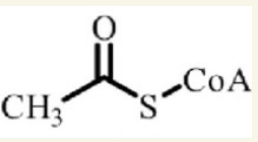
why is Acetyl-CoA important? What is its structure?

  • it’s central to generating energy from any dietary source
<ul><li><p>it’s central to generating energy from any dietary source</p></li></ul><p></p>
10
New cards

what’s the structure of oxaloacetate & citrate?
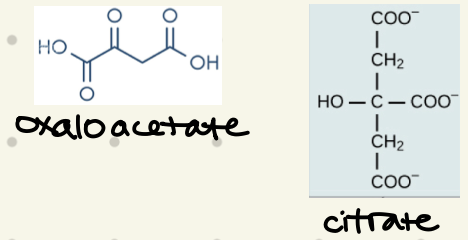
knowt flashcard image
11
New cards

what’s the enzyme linking TCA & ETC?

  • location?

  • how does it work?

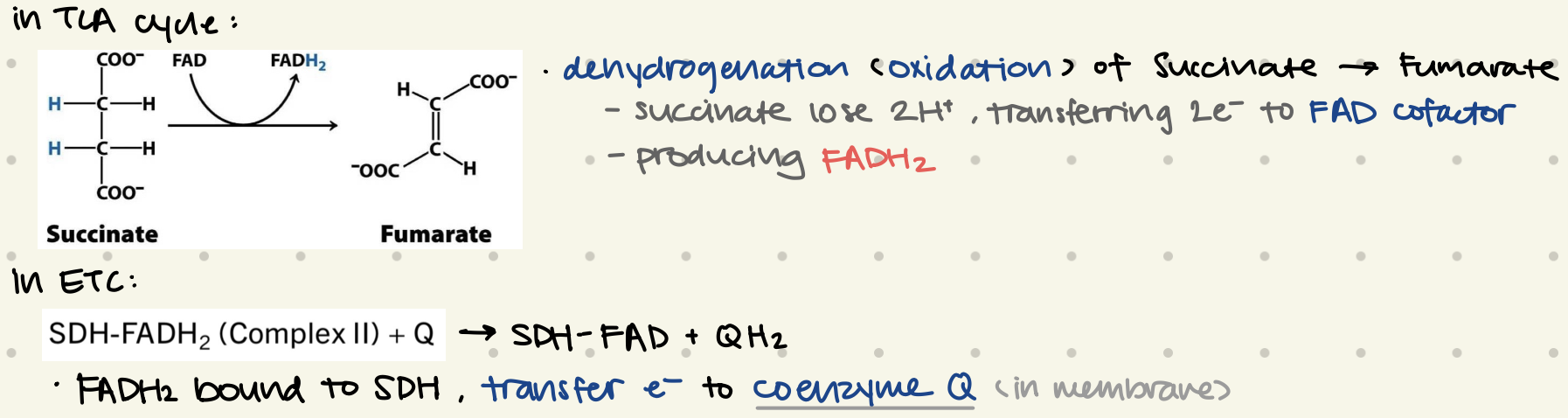
succinate dehydrogenase

  • embedded in inner mitochondrial membrane

  • in TCA:

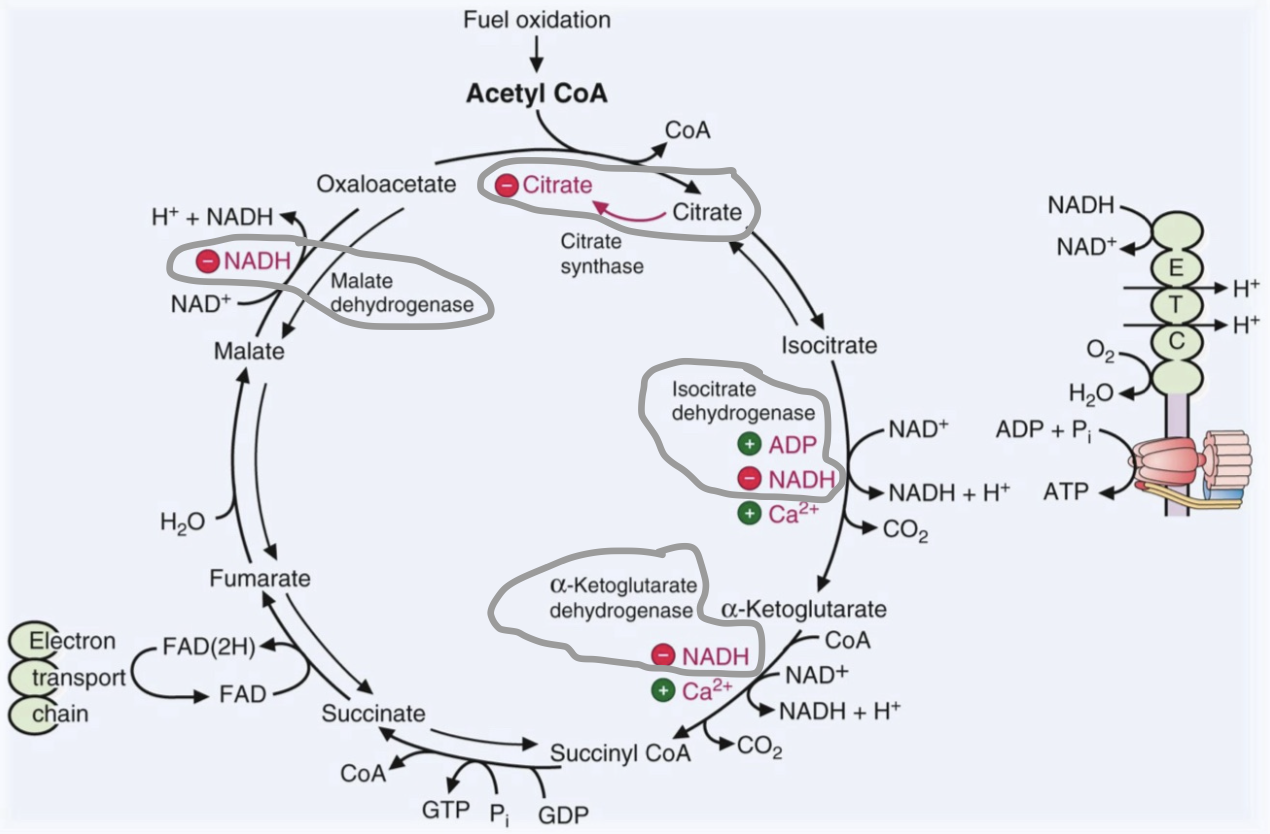
    • dehydrogenation of succinate → fumarate

    • succinate lose 2H+, transferring 2e- to FAD

    • producing FADH2

  • in ETC:

    • FADH2 bound to SDH, transfer e- to coenzyme Q
<p><strong>succinate dehydrogenase</strong></p><ul><li><p>embedded in <strong>inner mitochondrial membrane </strong></p></li><li><p>in TCA:</p><ul><li><p>dehydrogenation of succinate → fumarate</p></li><li><p>succinate lose 2H+, transferring 2e- to FAD</p></li><li><p><u>producing FADH<sub>2</sub></u></p></li></ul></li><li><p>in ETC:</p><ul><li><p>FADH2 bound to SDH, transfer e<sup>-</sup> to <u>coenzyme Q</u></p></li></ul></li></ul><p></p>
12
New cards

How is TCA cycle regulated by?

Stimulated by:

  • ADP, Ca2+ (energy & muscle use)

    • Ca2+ activates dehydrogenase, generating NADH/FADH

Inhibited by:

  • citrate (product inhibition), NADH, ATP

*NADH is the main energy sensor of mitochondria

  • NADH = stop TCA / NADH = start TCA

<p><span style="color: rgb(0, 161, 27);">Stimulated</span> by:</p><ul><li><p>ADP, Ca<sup>2+</sup> (<span data-name="arrow_down" data-type="emoji">⬇</span>energy &amp; muscle use)</p><ul><li><p>Ca<sup>2+</sup> activates dehydrogenase, generating NADH/FADH</p></li></ul></li></ul><p><span style="color: rgb(255, 0, 0);">Inhibited</span> by:</p><ul><li><p>citrate (product inhibition), NADH, ATP</p></li></ul><p>*NADH is the main energy sensor of mitochondria</p><ul><li><p><span data-name="arrow_up" data-type="emoji">⬆</span>NADH = stop TCA / <span data-name="arrow_down" data-type="emoji">⬇</span>NADH = start TCA</p></li></ul><p></p>
13
New cards

what’s the source of Acetyl-CoA for TCA cycle?

sugars, fatty acids, amino acids