AC/DC Circuits - My edit
 Studied by 0 people
 Call Kai
 Learn
Learn Practice Test
 Spaced Repetition
 Match
Match Flashcards
 Knowt Play
1/20

Earn XP
Description and Tags
Name | Mastery | Learn | Test | Matching | Spaced | Call with Kai |
|---|
No analytics yet
Send a link to your students to track their progress
21 Terms
Ohm's law
Current flowing through a conductor is proportional to the voltage across it, given a constant physical condition
dB conversion
= 10log10(Pout / Pin) == 20log10(Vout / Vin)
State Kirchoff's 2 laws
1st law (KCL): Algebraic sum of currents going into and out of a junction must equal 0A.
2nd law (KVL): The sum of EMFs in a circuit equals the sum of potential drops.
The superposition theorem
Definition:
The response of any linear branch or linear circuit with multiple EMFs or current sources, is the same as the sum of the response of each individual EMF while all other source is replaced by its internal resistance (r).
Voltage source is Open-circuited
Current source is Short-circuited
Thevenin's theorem
States that a linear two-terminal circuit can be replaced by an equivalent circuit consisting of a voltage source VTh in series with a resistor RTh, where VTh is the open-circuit voltage at the terminals and RTh is the input or equivalent resistance at the terminals when the independent sources are turned off.
Norton's theorem
Any network of voltage or current sources and resistors is electrically equivalent to an ideal current source in parallel with a single resistor.
Conductance (G)
How easily current flows through a specific object
Unit: Siemens (S)
I/V = 1/R {S}
Conductivity (σ)
A materials inherent ability to conduct. Unit: Siemens per metre (Sm-1)
σ = 1/ρ {Sm-1}
When is the supermesh technique used?
when a current source is shared between 2 loops
Good current source vs Good voltage source
A good current source supplies a constant current irrespective of the load
A good voltage source supplies a constant voltage irrespective of the load
Phase angle (△Φ)
Determines where the peak of the sinusoidal function is relative to standard sine wave.
△t = -△Φ/ω
Steady-State Response
Occurs when components have been driven for a while by a stable sinusoidal signal source.
The response of the circuit is also sinusoidal, and has the same frequency as the signal source.
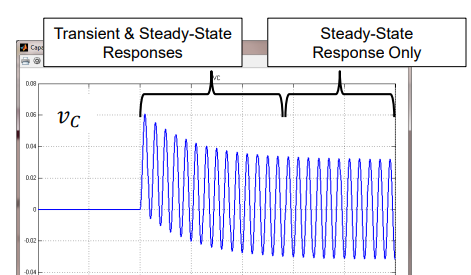
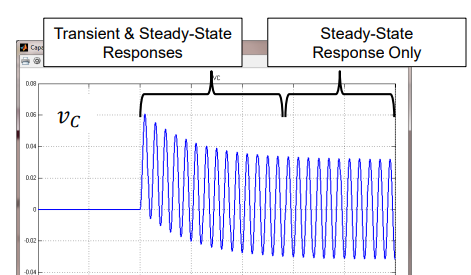
Transient Response
Occurs when the circuit is first switched on, alongside the steady-state response (SSR) and is not stable.
Occurs for a finite period of time.
Frequency of response is still the same as the source frequency.
A Phasor
A way to represent the magnitude and phase of a signal in a linear circuit.
Denoted by a capital. Eg; V, I…
v = Vmcos(ωt + Φ)
V = VmejΦ = Vm∠Φ
Cut-off frequency (for an RC circuit)
ωc = 1/RC
fc = 1/2πRC
Definition:
The frequency at which the transfer function’s magnitude decreases by a factor of 1/√2 of its maximum.
Resonant frequency (ω0)
ω0 = 1/√(LC)
f0 = 1/2π√(LC)
Definition:
Resonant frequency is the frequency when the magnitude of a circuit’s transfer function is at its maximum value, and when the circuit has no overall reactance.
Bandwidth (B / rad s-1)
B = ωc2 - ωc1
B = R / L
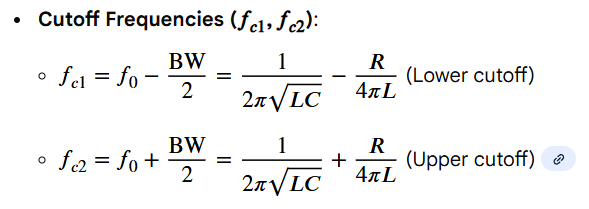
The bandwidth is symmetrical around the resonant frequency (ω0).
Thus, we can add half the bandwidth to ω0 to find ωc1 and ωc2.
Definition:
The bandwidth is the range of frequencies surrounding the resonant frequency where the magnitude of the transfer function remains above 1/√2 of the maximum value.
Q-factor
Q = ω0 / B =ω0 / (ωc2 - ωc1)
Definition:
The ratio between the resonant frequency and the bandwidth of a circuit
Inductance (L / H)
v = L * (di/dt)
Inductance = L (Units: Henrys {H})
Capacitance (C / F)
i = C * (dv / dt)
C = Q/v
C = εA/d
Capacitance = C (Units: Farads {F})
Maximum Power Transfer Theorem (Part 2)
RL = RS —> ZL = ZS*
Impedance is a complex value, so the real and imaginary parts behave differently.
For maximum power to the load:
RL = RS and XL = -Xs
 Note
Note  Flashcards (33)