07 - Neurophysiology and behaviour
 Call Kai
 Learn
Learn Practice Test
 Spaced Repetition
 Match
Match Flashcards
 Knowt Play
1/33

There's no tags or description
Looks like no tags are added yet.
Name | Mastery | Learn | Test | Matching | Spaced | Call with Kai |
|---|
No analytics yet
Send a link to your students to track their progress
34 Terms
Synaptic transmission
Synaptic transmission is the process by which neurons communicate, using chemical messengers (neurotransmitters) to transmit signals across a small gap, the synaptic cleft, from a presynaptic neuron to a postsynaptic neuron.
Synaptic transmission - chemical
Signal uses neurotransmitters
Small gap = synaptic cleft
Slower than electrical synapses
Unidirectional (pre → post)
Highly modifiable (learning, drugs, etc.)
Synaptic transmission - electrical
Direct connection via gap junctions
Ions flow directly between cells
Very fast
Bidirectional (can go both ways)
No neurotransmitters involved
Less flexible (no modulation)
Events in chemical synaptic transmission
Action potential arrives
Reaches presynaptic terminal
Voltage-gated Ca²⁺ channels open
Ca²⁺ enters neuron
Neurotransmitter release
Vesicles fuse with membrane
Neurotransmitter released into synaptic cleft (exocytosis)
Neurotransmitter binds receptors
On postsynaptic membrane
Ion channels open
Causes:
Depolarization (EPSP) or
Hyperpolarization (IPSP)
Neurotransmitter removed by:
Reuptake
Enzymatic breakdown
Diffusion
Examples of neural control of simple behaviours
The reflex arc
Central pattern generator
Synaptic plasticity
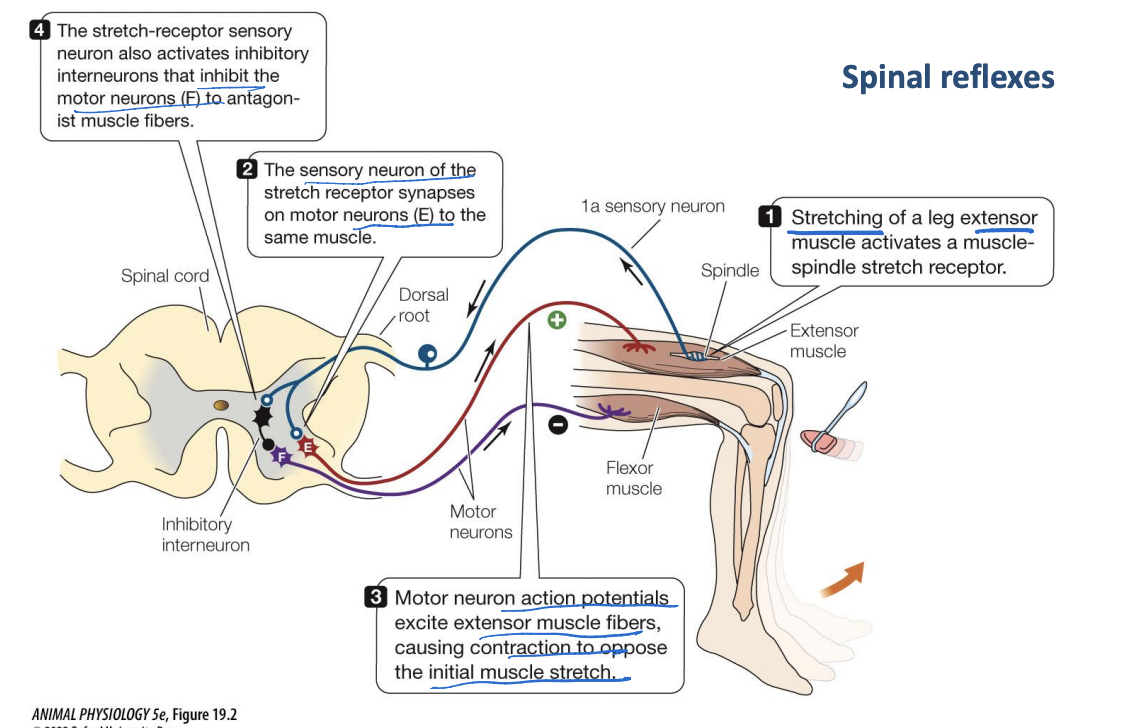
The reflex arc
stereotyped behaviour (you cna predict whats going to happen ) to a distinct stimulus (withdrawal reflex (putting your hands on oven and putting it away away), knee jerk in humans, tail flick in crayfish, startle response is cockroaches)
Central pattern generator
controls rhythmic behaviours (breathing, walking, flying, suckling)
Synaptic plasticity
changes in synaptic strength over time (learning and memory)
The reflex arc
Types of Central Pattern Generators
Cellular oscillator
Network oscillator
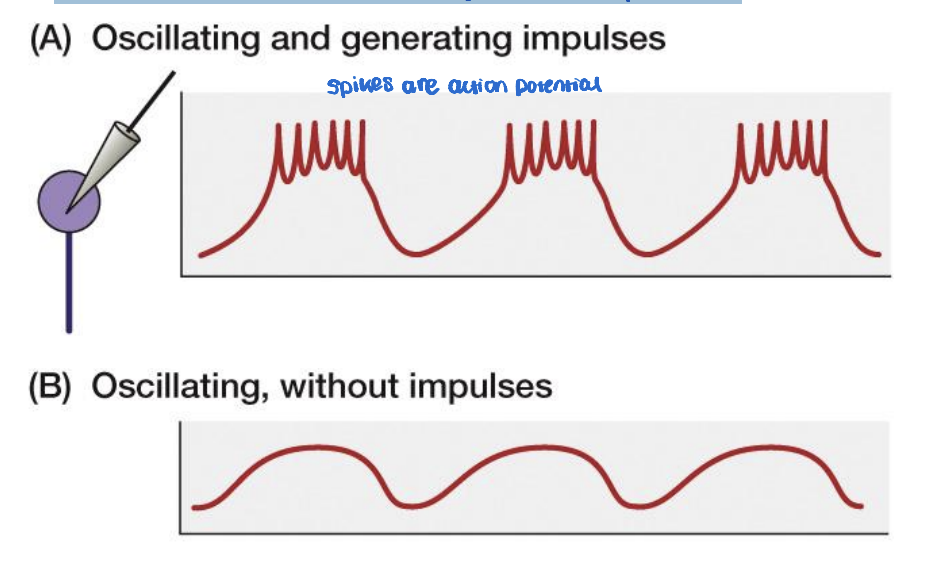
Cellular oscillator
more simpler
Generates temporally patterned activity by itself
2 types
Oscillating and generating impuleses
Driven by one cell that creates a regular rhythm (A).
This cell depolarizes fully, generating action potentials at consistent intervals.
Example: Typical sinoatrial (SA) node cells in the heart.
oscilliation without impulses
Also driven by one cell, but it never depolarizes fully to generate an action potential (B).
The membrane oscillates but remains subthreshold, producing no impulses on its own.
Can influence other cells that do generate impulses when coupled electrically.
Network oscillator
A network of neurons that interact
much more stable, find them throughout
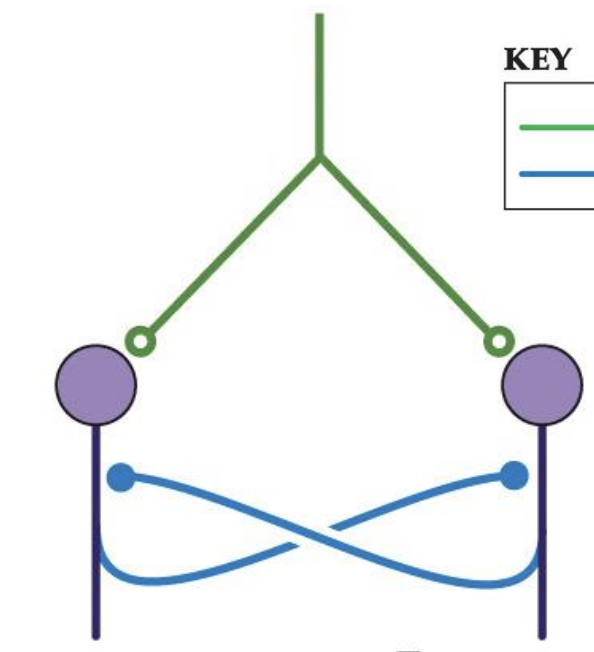
half centre model of an oscillatory network
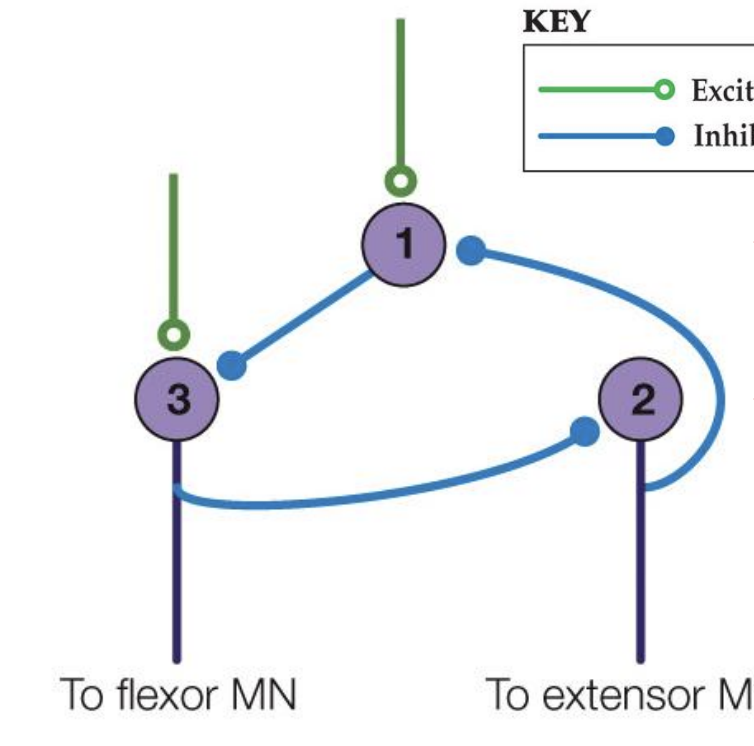
closed-loop model of an oscillatory network (most common)
half centre model of an oscillatory network
>two neurons received excitatory Signal at the same time from another neuron
>one of them is abit quicker to respond to this
>one fires AP + inhibits other neuron
>after Ap is Fired → inhibition is released
> other Neurons then fires
> as soon as exitory stimmas stops where network stops = unstable
closed-loop model of an oscillatory network (most common)
> closed loop cuz once you have exitation pattern can continue
> 1 quicker to respond + iinhibit 3 → can't inhib 2 → 2 fires → inhibs 1 → 3 not ihibited
> 3 fires
>loopContinue
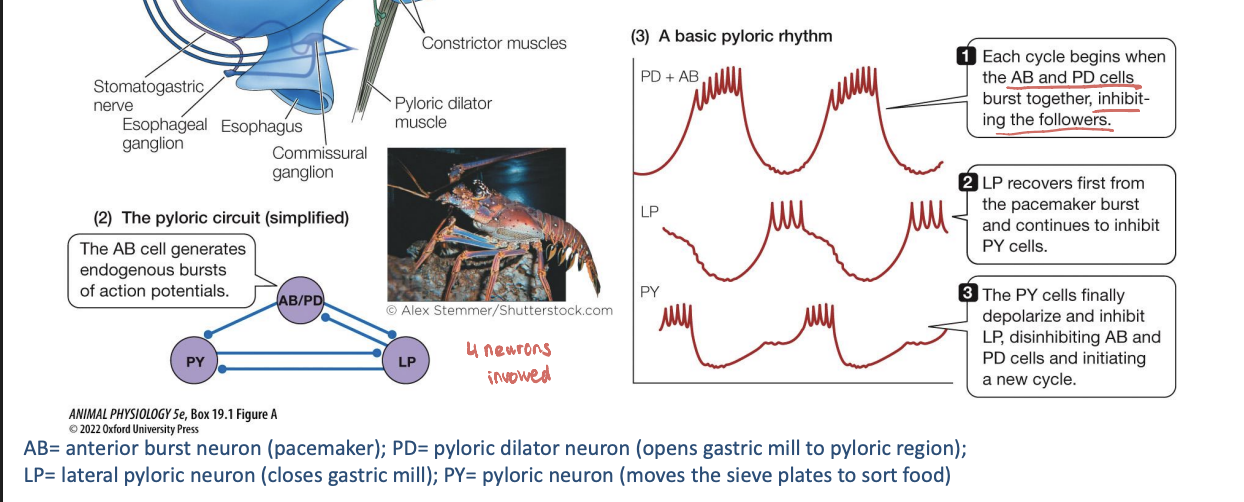
An example of a CPG (crustacean digestion)
Central pattern generators in the spinal cord (salamander )
main idea: can get complicated, we don't just have where multiple are interacting with each other
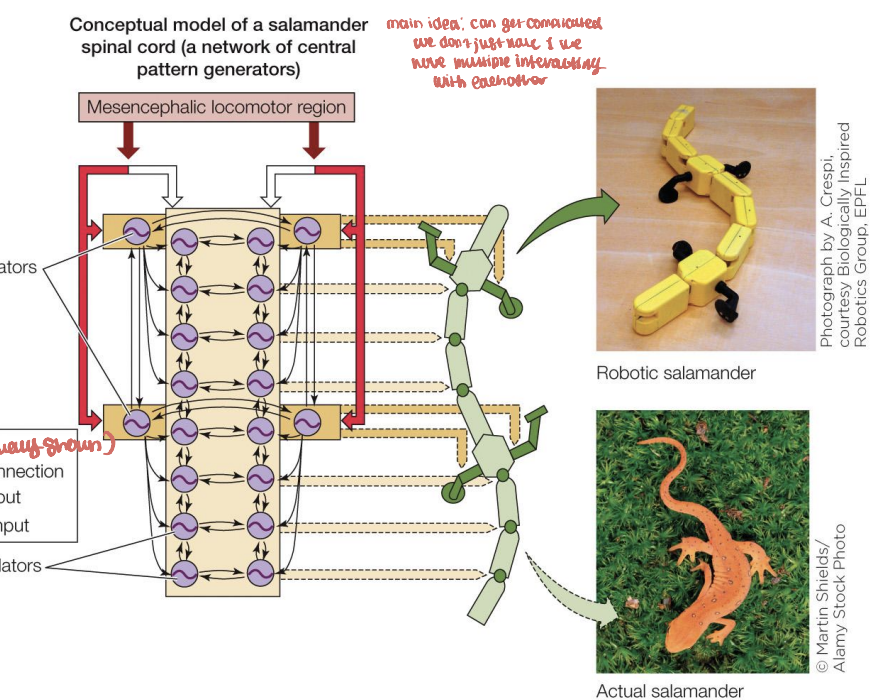
oscillator symbol

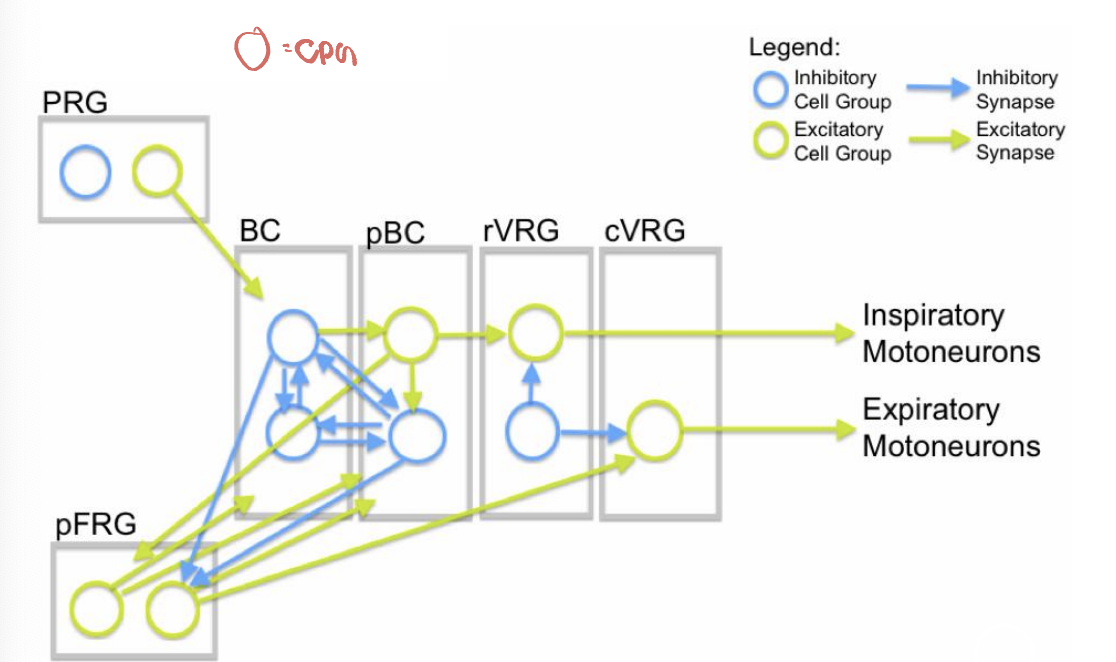
what is this diagram abt
Several central pattern generators can interact (e.g. breathing in humans)

