ACTIVITY 2 THE PROKARYOTES
 Studied by 0 people
 Call with Kai
 Learn
Learn Practice Test
 Spaced Repetition
 Match
Match Flashcards
 Knowt Play
1/14

There's no tags or description
Looks like no tags are added yet.
Name | Mastery | Learn | Test | Matching | Spaced | Call with Kai |
|---|
No analytics yet
Send a link to your students to track their progress
15 Terms
Archaea and Bacteria
The prokaryotes include organisms in one of two domains: _____________ and ______________.
morphology
chemical
nutritional
biochemical; energy
The prokaryotes are a highly diverse group. They are differentiated by many factors, including
___________ (cell shape),
___________ composition,
___________ requirements,
_____________ activities and _________ source (sunlight or chemicals).
Bacillus cereus; Escherichia coli
Micrococcus luteus; Serratia marcescens
MATERIALS
Photos of the following bacterial cultures in agar plate and agar slope:
______________; ______________
______________; ______________
Bacillus cereus; Staphylococcus aureus
MATERIALS
Photomicrographs of the following bacterial cultures:
______________; ______________
colony
A ___________ is defined as a visible mass of microorganisms all originating from a single cell
colony color or pigmentation
form
elevation
margin
Characters used to accurately describe the morphology of a bacterial colony include
___________ or ______________,
______,
___________ and
_________.
color (pigmentation)
Agar plate cultures
__________ - bacteria may produce intracellular pigment responsible for the color of the colonies on the agar surface or water-soluble pigment that diffuse into the surrounding medium.
Most microorganisms are non-chromogenic and colonies appear cream, white or gray.
margin
elevation
form
Agar plate cultures
________ - shape of the edge of the colony
________ - cross sectional shape of the colony
________ - shape of the colony
filiform
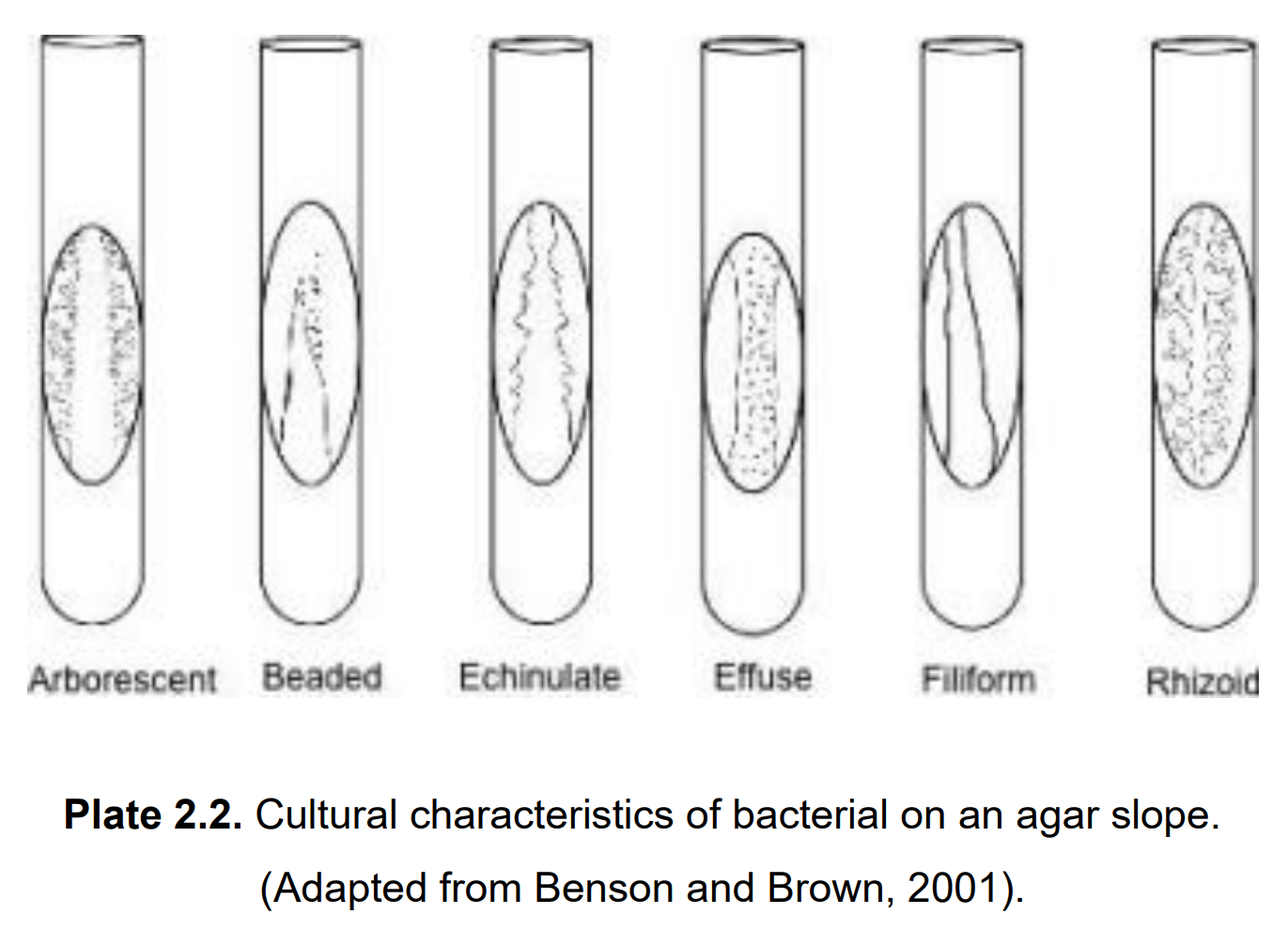
Agar slant cultures
__________ - uniform growth along line of inoculation
echinulate
Agar slant cultures
____________ - margins of growth have a toothed appearance
beaded
Agar slant cultures
____________ - separate or semi-confluent colonies
effuse
Agar slant cultures
___________ - growth is thin, veil-like, unusually spreading
arborescent
Agar slant cultures
_______________ - branched, tree-like growth
rhizoid
Agar slant cultures
____________ - root-like appearance
 Note
Note  Flashcards (20)