Behav SN2 (7)
 Call Kai
 Learn
Learn Practice Test
 Spaced Repetition
 Match
Match Flashcards
 Knowt Play
1/21

There's no tags or description
Looks like no tags are added yet.
Name | Mastery | Learn | Test | Matching | Spaced | Call with Kai |
|---|
No analytics yet
Send a link to your students to track their progress
22 Terms
Sensation vs. Perception
Sensation is to gather all the outside and inside information and converting it into electrical signals … while perception is understanding this information in the brain to make sense of it
Distal vs. proximal stimulus
Distal is the physical thing out in the world, while proximal are the things coming your way in terms of sensory input (heat, photons, etc.)
ex. a tree physically in the background (distal), … its photons coming in contact with my retina to create an image, forming perception (proximal)
Parvocellular Cells
Have high spatial resolution (sharp detail and color detection, helping distinguish objects from the background) but low temporal resolution, making them less effective at detecting motion. (responsible for form, separating object from background)
Magnocellular Cells
Are well-suited for detecting motion because these cells have very high temporal resolution (the opposite of parvocellular cells if you will) … (responsible for motion)
Binocular Cells
Responsible for comparing the inputs to each hemisphere and detecting these differences, depth perception (responsible for depth)
What are the otolith organs and what do they detect?
Utricle: horizontal acceleration
Saccule: vertical acceleration
Higher sound frequencies are recorded in the _______ of the cochlea, while low frequencies at the _______?
entrance … end/tip
What are the semicircular canals used for?
There are three canals, each aligned with one of the three spatial axes (x, y, and z), allowing them to detect movement in different directions. (for angular/rotational movement)
Pacinian Corpuscles:
respond to deep pressure and vibration
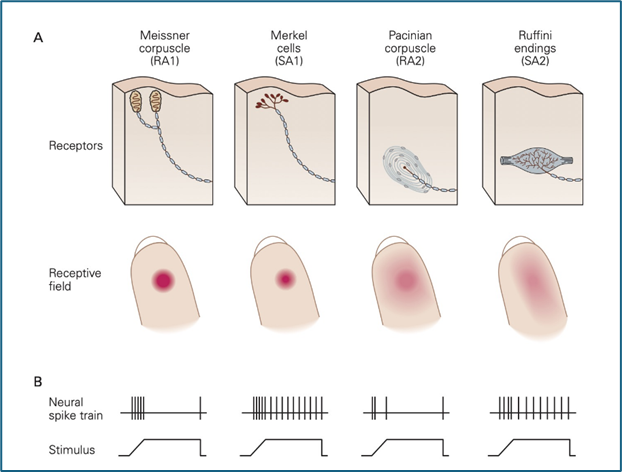
Meissner corpuscles:
respond to light touch
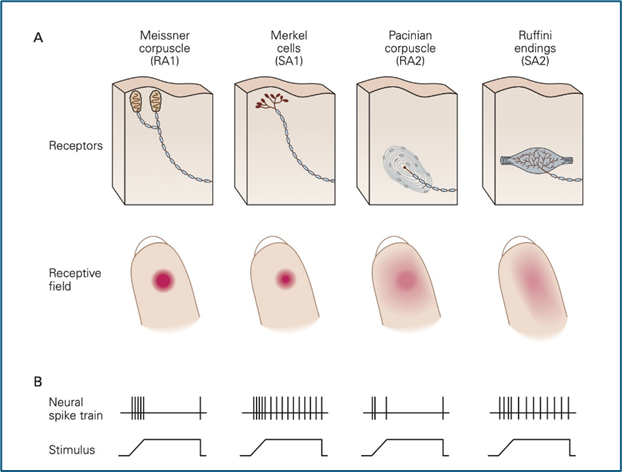
Merkel Cells (disc):
respond to deep pressure and texture
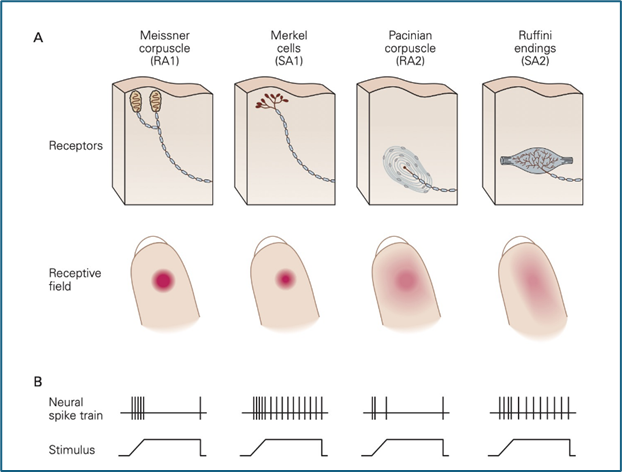
Ruffini Endings:
respond to stretch
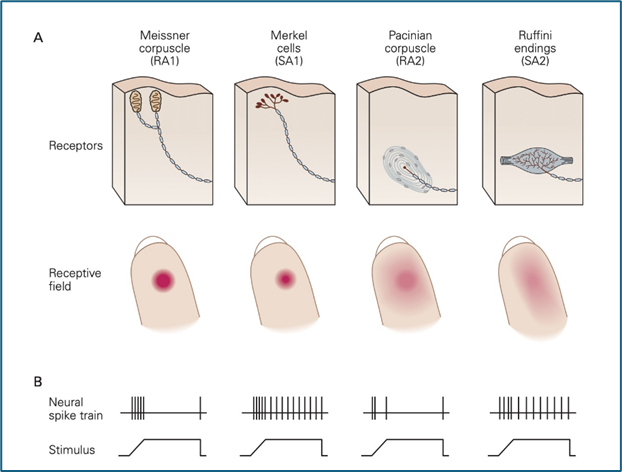
Free Nerve Endings:
respond to pain and temperature
What is proprioception / kinesthetic sense
the ability to tell where your body is in space
Bottom-up (data driven) Processing:
essentially, the brain takes the individual sensory stimuli and combines them together to create a cohesive image before determining what the object is (used when you see an object for the first time)
Top-down (conceptually driven) Processing:
driven by memories and expectation that allow the brain to recognize the whole object and then recognize the components based on these expectation (use for when you see the same object over and over again… you no longer need to be sure it’s that same object, it’s expected).
What is the law of pragnanz
perceptual organization will always be as regular, simple, and symmetric as possible
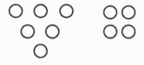
the image is an example of?
proximity

the image is an example of?
Similarity
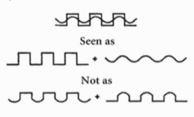
the image is an example of?
Good Continuation

the image is an example of?
Subjective Contours
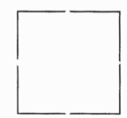
the image is an example of?
Closure

