Physics 7A - Midterm 2
 Call Kai
 Learn
Learn Practice Test
 Spaced Repetition
 Match
Match Flashcards
 Knowt Play
1/33

There's no tags or description
Looks like no tags are added yet.
Name | Mastery | Learn | Test | Matching | Spaced | Call with Kai |
|---|
No analytics yet
Send a link to your students to track their progress
34 Terms
What chapters/topics is this midterm about?
This midterm is about Friction, Gravitation, Energy, Momentum, Collisions, and Centripetal/Circular Motion.
(Chapters 5, 6, 7, 8, 9)
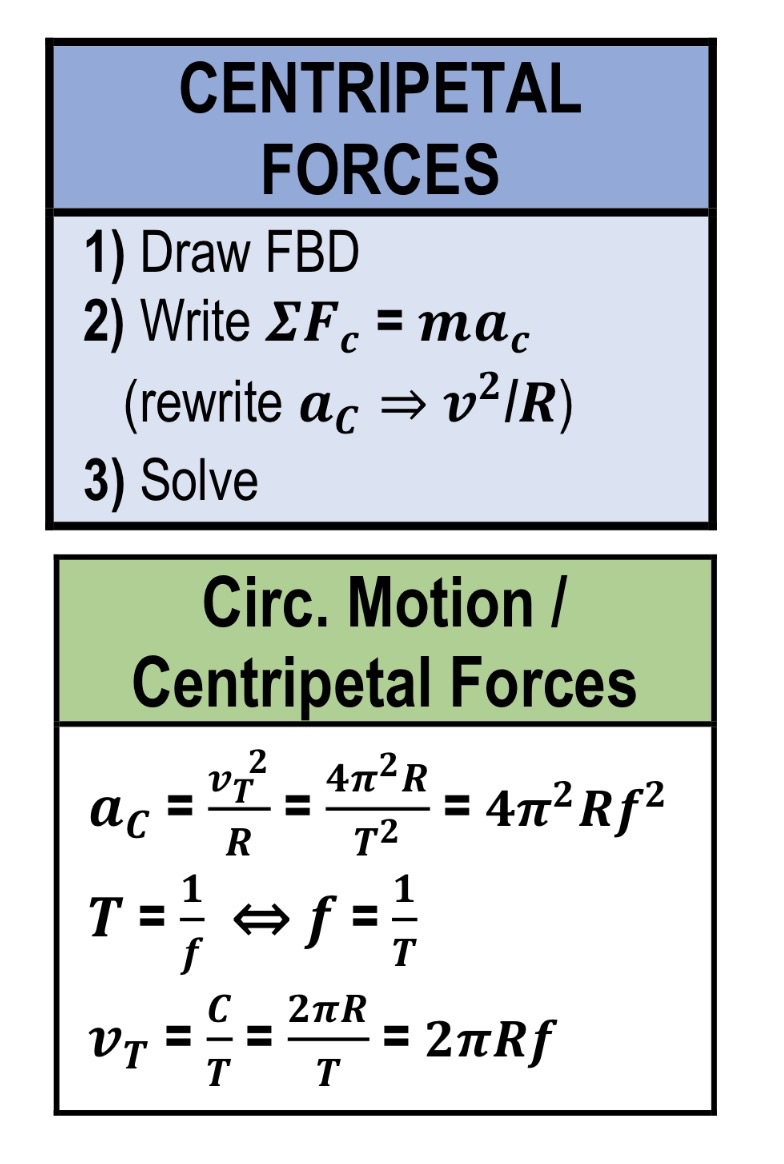
How do you usually solve a centripetal force problem? (block tied to a string going in a circle)
Draw FBD like “side” and “top”
Use ∑Fc = mac
Convert mac into V² / R
Your ∑Fc will become the force that is important (pointing to the center) and it is USUALLY Fn .
Solve!
How do you find T?
T = seconds / cycle
When you indicate axis on an angled line, the y and x formulas equal:
X = Tcos(angle)
Y = Tsin(angle)
What about problems that involve angles? (like the string being held up and the ball going in a circle)
Draw FBD like “side”
Use ∑Fc = mac
Convert mac into V² / R
Draw indicated lines for y and x axis around the angled line.
Your ∑Fc will become the force that is important (pointing to the center) and it is USUALLY the x one .
Then you use Tcos(angle) and to find T, you use the y equation of ∑Fy = may, where ma will cancel out and you would be left with Ty - mg = 0.
Solve for T, and plug that into OG equation.
How do you solve banked curve problems?
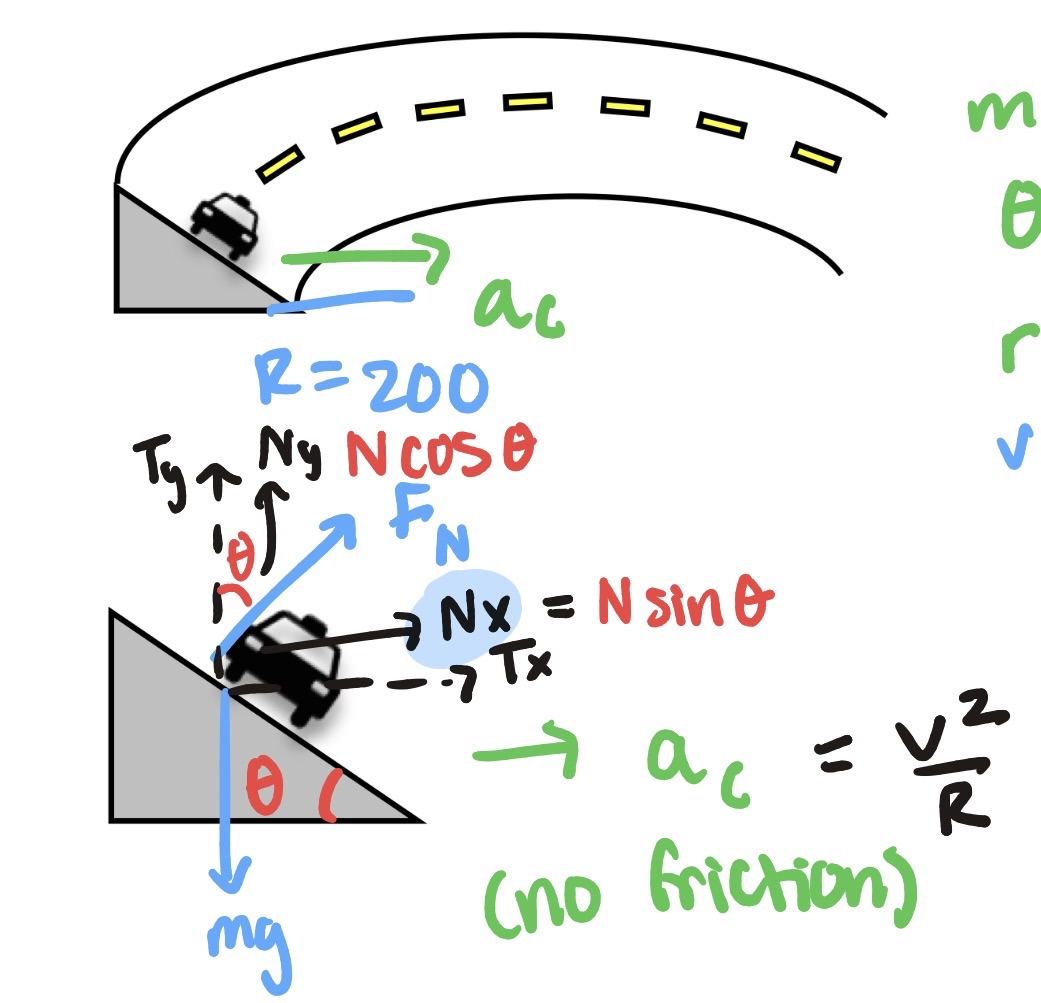
Draw FBD
Use ∑Fc = mac
Convert mac into V² / R
Draw indicated lines for y and x axis around the angled line, which is Fn.
SPLIT the normal force into X and Y components. This is really important!!!
Your ∑Fc will become the force that is important (pointing to the center) and it is USUALLY the FNx one .
Remember that for banked curves the angles are FLIPPED and instead of T its N.
So, you use Nsin(angle) and to find N, you use the y equation of ∑Fy = may, where ma will cancel out and you would be left with Ny - mg = 0.
Solve for N, and plug that into OG equation, and then you’ll realize…
How do you solve Vertical Centripetal Force Problems? (What’s the difference?)
This time, your writing out the forces on the left and then solving.
Draw FBD for Top and Bottom views.
You’ll eventually notice that on the top, both of your forces point towards the center so they are BOTH positive.
Use ∑Fc = mac and write out your forces on the left, and then solve.
Hint: For the bottom, you’ll always have m(ac + g) and for the top, you’ll have m(ac - g)
Solve!
In vertical centripetal force problems, if they ask for the minimum speed before the thing falls, what should you do?
Set FN equal to 0 when solving, because thats the last point the thing reaches before falling off. Usually you’re going to get that vmin = √gr
capital letters usually mean
lowercase letters usually mean
capital letters usually mean constants
lowercase letters usually mean variables
How do you solve Net Work and Work-energy Theorem problems?
Use this chart. The right way is more easier.
For these, IGNORE the vertical forces because they cancel out!
Sometimes, you can also use Fnet = ma if it is horizontal instead of the chart, and relate it to
Wnet = Fnet · d · cos(angle)
When you have Wfriction, what is another way of writing it?
Wfriction = - fk · d, and then -fk can be written as -μkN·d
Wfriction = -μkN·d
and then you would solve for N using the y form of the equation!
What is the Work-Energy Theorem?
Wnet = ΔKE = Kf - Ki
When forces aren’t given, but work is asked for
it is implied that its the NET work.
What is the formula for Conservation of Energy?
MEi = MEf
which is
Ki + Uf = Kf + Uf
which is
Ki + Uf + WNC = Kf + Uf
How do you solve Conservation of Energy problems?
Draw FBD, see where V0 and Vf is. Draw y=0, etc.
Use formula.
Eliminate and EXPAND terms.
Solve.
Some problems give more than TWO points. The 2 points you should pick are
the GIVEN and the TARGET (the known and unknown)
What is a system?
A collection of OBJECTS chosen by you or the problem.
A system is ISOLATED if
NO external forces do work and ONLY internal forces are doing work.
The total energy of a system is CONSERVED if
the system is ISOLATED.
What is WNC?
WNC = Wyou + Wfriction
“Resistive” air forces like air/water resistance
act like friction! remember friction is always opposite your direction
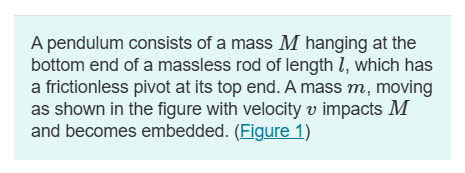
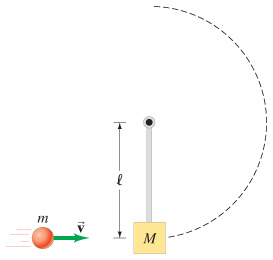
How do you solve Problem 9.44?
Draw FBD.
Step 1: Look at the COLLISION only, write out the momentum.
So this means writing out the small ball which is (m times v) and the combined mass which is (m + M)(V)
Set them equal to each other to find big V.
Step 2: Now look at the movement.
At the bottom, KE is high and there is no PE.
At the top, there is PE.
Expand both and set equal to each other to solve for big V again.
Step 3: Then take your big V, put it back in the first equation you derived, to find little v!
Impulse is:
change in momentum. When you stop an object, you have to remove all of it’s momentum.
You can do this with a huge force for a tiny time (like hitting a wall) or a small force for a long time (like hitting a giant pillow).
Why do cars have "crumple zones" and airbags?
They increase the time (t) it takes for the person to stop. Since the change in momentum is fixed, increasing the time decreases the average force (F) felt by the person.
Impulse = F * ΔT
If a cart moves at a constant speed and rain starts falling vertically into it, what happens to the cart’s horizontal speed?
The horizontal momentum must stay the same because the rain doesn't provide any horizontal force.
Since p = mv, if the mass increases, velocity must decrease to keep p constant.
How do you find the Center of Mass of an irregular shape experimentally?
Hang the object from a pivot point and let it come to rest. Draw a vertical line straight down from the pivot (using a plumb bob). Then, hang it from a different pivot point and draw another vertical line. The point where the two lines intersect is the Center of Mass.
What is the concept of an energy diagram?
An Energy Diagram is a visual map. The "hills" are Potential Energy (U), and your Total Energy (E) is a horizontal line.
What is a "Turning Point" on an energy graph?
It is the location where the Total Energy line intersects the Potential Energy curve. At this point, the object has zero Kinetic Energy (K=0) and must stop and turn around. It cannot go "past" this point because it doesn't have enough energy to climb any higher.
Are astronauts in orbit "weightless" because there is no gravity?
No. Gravity is very much present (it’s what keeps them in orbit). They feel weightless because they are in a state of permanent freefall. Both the astronaut and the station are falling toward Earth at the same rate, so there is no "Normal Force" (floor) pushing up on their feet.
If Einstein lifted a book at a constant speed, what is the change in Potential Energy vs. Kinetic Energy?
Because the speed is constant, the change in Kinetic Energy is zero. All the Work you do goes into increasing the Gravitational Potential Energy (mgh) of the book-Earth system.
Momentum:
You are standing on a skateboard that is at rest. Your friend throws a very heavy medicine ball at you. You have two choices:
Choice A: Catch the ball and hold onto it.
Choice B: Deflect the ball so it bounces back toward your friend.
The Question: Which choice will make you (and the skateboard) roll backward at a higher speed?
Bouncing the ball requires a bigger change in momentum. Since "For every action there is an equal and opposite reaction," the ball pushes back on you much harder if it bounces.
Bouncing/Deflecting = Bigger Impulse = Higher final speed for you.
Energy Diagram:
You are looking at a Potential Energy graph. The graph has a "valley" at x = 2 and a "peak" (hill) at x = 5. Your total energy line is exactly the same height as the peak at x = 5.
The Question:
1. Can the object ever move to x = 6 (past the hill)?
2. What is the object's Kinetic Energy when it is exactly at the top of the hill?
No.
0!
Total Energy = Potential Energy Height → Kinetic Energy is zero → Turning Point.
Center of Mass:
You have a long wooden baseball bat. You find the exact "balance point" and mark it with a line. This is the Center of Mass (COM). You then saw the bat into two pieces exactly at that line.
The Question: Will the two pieces have the exact same mass, or will one piece be heavier than the other? (Think about where the "fat" part of the bat is compared to the handle).
The "fat" part is heavier.
The Center of Mass is the "balance point," but that doesn't mean the mass is equal on both sides. If you cut it at the COM, the short, chunky end will always weigh more than the long, thin handle.
Center of Mass DOES NOT EQUAL Equal Mass on both sides. The heavier side is the one where the mass is more "concentrated" (closer to the COM).
Problem Guessing:
Is it a hit? →
Is it a height change? →
Is it a circle? →
Is it a hit? → Momentum
Is it a height change? → ENERGY
Is it a circle? → CENTRIPETAL

