Social (WS) Exam 3
 Call Kai
 Learn
Learn Practice Test
 Spaced Repetition
 Match
Match Flashcards
 Knowt Play
1/123

There's no tags or description
Looks like no tags are added yet.
Name | Mastery | Learn | Test | Matching | Spaced | Call with Kai |
|---|
No analytics yet
Send a link to your students to track their progress
124 Terms
informational conformity
copy others because you don’t know what to do and think they’re right
compliance
changing your behavior because someone asks you to (do what they want)
persuasion
process that uses a message to change attitudes/thoughts or behaviors
descriptive norm
what you think others are doing, regardless of what you think they think is right
normative conformity
do what others are doing because you want to fit in (for acceptance)
attitude inoculation
challenge beliefs in small ways now, strengthens your ability to defend later
source amnesia
you forget where/how you learned something – but you remember the ‘fact’
sleeper effect
old info takes on new power when you forget original source was untrustworthy
obedience
changing your behavior because an authority figure tells you to
social norms
set of beliefs/behaviors that are accepted and expected by a group
conformity
copy others – you initiate – do because you choose – general term for this
ego depletion
state of vulnerability, difficult to resist temptation, fall for weak arguments
reactance
we want things more if we think we cannot have them
idiosyncrasy credits
group members who usually follow rules get a pass sometimes if they don’t
compliance tactics
techniques that can be used to increase chance someone does what you want
injunctive norm
what we believe people think is right, what we should do, the rules
selective avoidance
we don’t even realize that we avoid info that conflicts with our beliefs
contagion
rapid spread of behavior through a crowd – unconscious conformity
pre-suasion
ways to make sure audience is ready for your persuasive message (Cialdini)
forewarning
it is harder to persuade someone who knows in advance you will try to do so
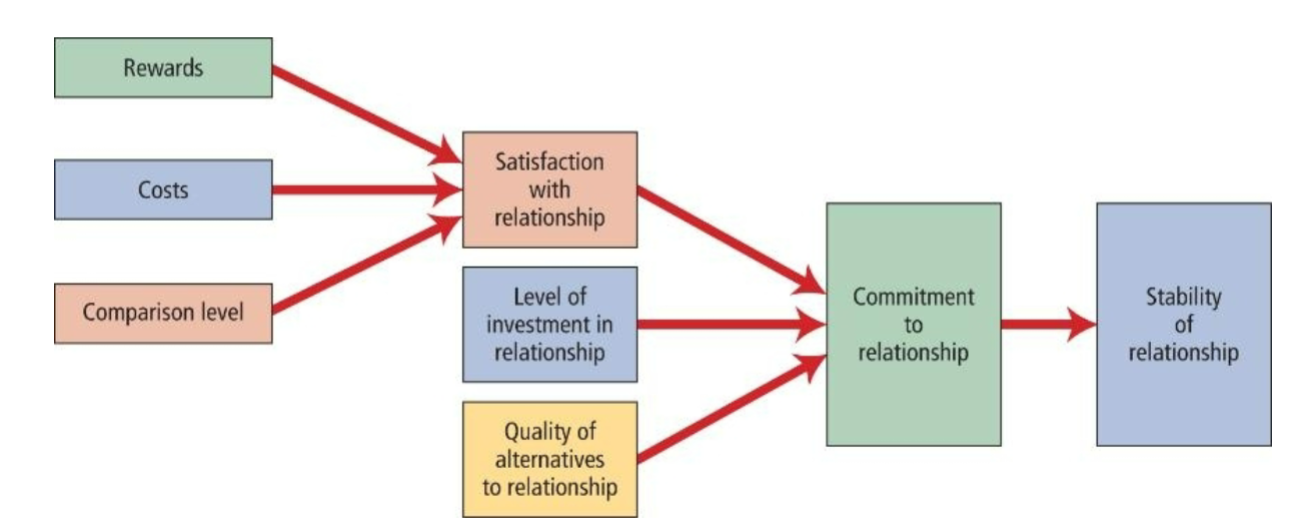
Investment Model of Commitment
Sternberg’s Triangular Theory of Love
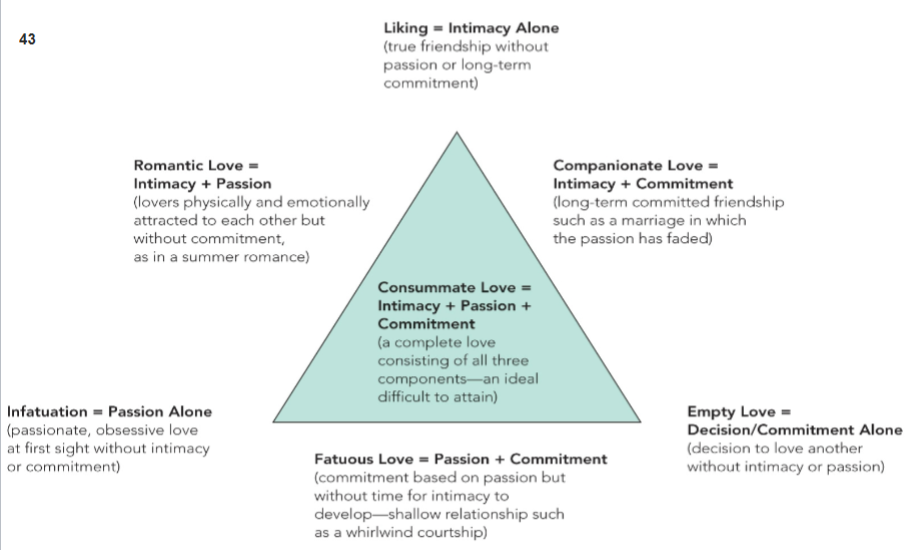
Three basic components of Sternberg’s Triangular Theory of Love
Intimacy
Passion
Commitment
Communal Relationships
primary concern is to be responsive to the other person, we give even if won’t get back
Exchange Relationships
keeping track of what we get and give in the relationship
Yale Attitude Change Approach
study of conditions under which people are most likely to change attitude in response to a persuasive message
_____ matters in persuasiveness
who says what to whom
Impact of credibility on persuasion
more likely to listen to those with power/experts
Impact of attractiveness on persuasion
Attractive people (physically or personality vise) persuade people more than unattractive speakers do
Impact of similarity on persuasion
if they are similar to us we are more likely to agree and believe
Impact of likeability on persuasion
If we like the person we are more likely to agree with them compared to someone we don’t like
Impact of source amnesia on persuasion
if the content of a message has become detached from its source it will impacts persuasion
Impact of sleeper effect on persuasion
a delayed increase in the persuasive impact of a message, occurring when a message from a low-credibility source becomes more influential over time
Impact of age on persuasion
Younger individuals often more influenced by social proof and peers, that older people
Impact of mood on persuasion
Those in a good mood are more open to persuasion than those in a bad mood
Impact of one sided on persuasion
People are less likely to be persuaded if you only present one side of an argument
Impact of two sided on persuasion
Presenting both sides works best to refute the argument of the opposing side
Impact of going first on persuasion
If the speeches are given back to back then delay before they make up their mind it is better to go first due to the primacy effect
Impact of going last on persuasion
If there is a delay between speeches and people make their mind up after the last one it is better to go last due to the recency effect
Elaboration Likelihood Model
2 paths of processing info (fully and superficially)
Central Route
fully
systematic (controlled) processing
focus on arguments/reasons (deep)
refleCtive
Peripheral route
heuristic (automatic) processing
focus on superficial associated factors
status/credibility of speaker, likability, emotion, peers
if I like/feel good; agree; used by advertisers
refleXive
Who uses central route processing?
People who are interested, relevant, motivated, able audience and/or if attitude is cognitively based
Who uses peripheral route processing?
People who are distracted, uninvolved or incapable audience and if attitude is affectively based
Jerry Burger
given permission to do a partial re-do of Milgram’s Classic Study to study obedience more recently
Stanley Milgram
Told testing effects of punishment on learning really testing obedience
Shock study
65 percent went all the way
Solomon Asch
studied normative conformity in group settings
higher number of people, public response, relationship with the group, high status, public statement, all are factors that will make people conform more
Muzafer Sherif
studied informational conformity by using an ambiguous task
jealousy
concerns we are losing the attention of another (seen as a threat to our self esteem)
reciprocal liking
we are more likely to like those who like us, especially if we think they only like us!
romantic love
relationship that involves passion and intimacy (Sternberg) (aka passionate)
commitment
cognitive decision to stay in a relationship long term
loneliness
fewer social connections than desired, associated w/ poor physical and psych health
consummate love
contains passion, intimacy and commitment – a.k.a. complete love
passion
physical attraction and excitement and arousal in a relationship (Sternberg)
companionate love
relationship that involves intimacy (closeness) and commitment (Sternberg)
communal relationship
relationship based on long term care and responsiveness to the other person
proximity
amount of interaction used to be based on physical closeness, tech changed that a bit
avoidant attachment
an independent style, may be distant in relationships, resent dependence
(two types: dismissing and fearful)
investments (relationship)
things you put into a relationship that you cannot get back (e.g.,time + $$)
‘fatal attraction’
the thing that first attracted you becomes the most annoying (attentive→smothering)
exchange relationship
relationship value based on the balance between what you give and what you get
relationship satisfaction
compare the balance of pros and cons in a relationship to what you expect
intimacy
closeness and sharing in a relationship, the bond (Sternberg)
nonconscious synchrony
coordination of body + language patterns w/o realizing, may indicate compatibility
mere exposure effect
more you see something, more you tend to like it (unless first was negative)
anxious attach (preoccupied)
wants close relationships, fears rejection, clingy, tends to be jealous (aka resistant)
propinquity
term used to represent combination of proximity and familiarity
similarity
we are drawn to those like us (looks, values, age, SES, education level, etc)
dissimilarity
differences can push us apart more than similarities attract us!
secure attachment style
comfortable in relationships, confident, positive outlook on world, often successful
lowballing
get them to say yes to something, then reveal hidden ‘costs’ (or extras)
door-in-the-face
get them to say no to a big request, then reduce pressure, ask for smaller
gifting
give something small to increase chance they give back something bigger
foot-in-the-door
get them to say yes to a small request, then ask for something bigger
“limit 6”
people buy more (want more) if you make them think supply is short (or can't have)
Why does the principle of reciprocity work?
Most are socialized to give back for what they get.
ie. Gifting and door-in-the-face
Why does the principle of consistence work?
We like to be consistent, stick to our commitments
ie. Foot-in-the-door and lowballing
Why does the principle of scarcity work?
It triggers reactance – we want things more if we think we can’t have them
ie. “limit 6” and anything else that makes us think we will miss out or can’t get what we want
Ways to resist persuasion
Be Forewarned
Make a Personal commitment
Non-ego depleted
High in reactance
High need for uniqueness
Selective Avoidance
The 3 times we are most likely to see informational conformity
if ambiguous
if there’s a crisis
if others seen as expert
Factors that increase the chance of seeing conformity
high task difficulty, ambiguity, or a unanimous majority of three to five people
Factors that increase chance of obedience
Authority
Commands change gradually
Events move quickly
Victim’s distance or depersonalization
Closeness and legitimacy
Institutional authority
Others obeying
Common beliefs of those who didn’t obey to hurt stranger
Don’t impose your will on another (most common)
You are responsible for what you do
You are free to disobey commands to hurt others
Factors that increase the chance the minority opinion will influence the majority
Self-Confidence
Defections from the Majority
How we ‘pick’ friends and partners
Proximity
Familiarity
Similarity
Physical attractiveness
Reciprocal liking
Values and personality traits
Cialdini’s 7 Principles of Influence
Reciprocity, Scarcity, Authority, Consistency, Liking, Social Proof, and Unity.
Reciprocity
we are socialized to give back for what we get
Scarcity
we want it more if we think we cannot have it
Authority
credibility matters - more likely to listen to those with power/experts
Consistency
we tend to stick to past, don’t like to be wrong, like to see ourselves as coherent and following our beliefs
Liking
similarities helps, attracted to, more likely to believe
Social Proof
we tend to go along with the group/peers
Unity
shared identities, not just liking increase draw
Name Gottman’s 7 principles of successful relationships
Truly Know Each Other
Nurture fondness and admiration
Turn toward each other as friends
Let your partner influence you
Solve solvable conflicts together
Overcome gridlock (perpetual conflicts)
Create shared meaning
John Gottman’s 4 Horsemen
criticism, defensive, contempt, stonewalling
Most recently added fifth horseman
Belligerence
What is the most predictive of divorce?
contempt
Risk factors for and consequences of chronic loneliness
- psychological distress
- reduced physical health and life expectancy
Effective strategies / techniques used to address loneliness
Improve Emotional Intelligence
Prevent Self fulfilling prophecy
Video record and watch to identify interaction issues
Change relationship expectations; be more realistic; more flexible
Use internet to build skills
Change self-defeating attributional style
Treat depression/anxiety/other disorders, if necessary

