🔁 Reabsorption

0.0(0)
Studied by 0 people
call kaiCall Kai
learnLearn
examPractice Test
spaced repetitionSpaced Repetition
heart puzzleMatch
flashcardsFlashcards
GameKnowt Play
Card Sorting

1/10

encourage image

There's no tags or description

Looks like no tags are added yet.

Last updated 6:54 AM on 3/5/26
Name
Mastery
Learn
Test
Matching
Spaced
Call with Kai

No analytics yet

Send a link to your students to track their progress

11 Terms

1
New cards

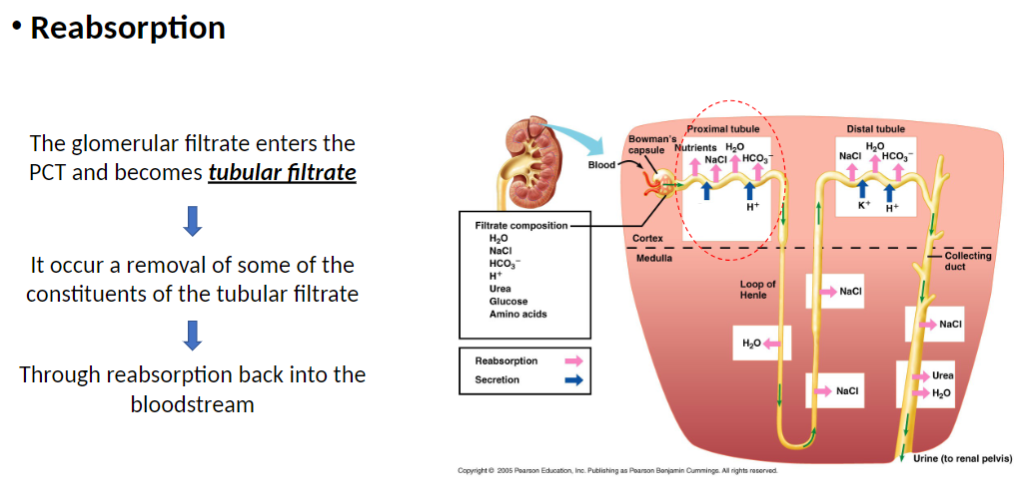
Reabsorption

Process
Glomerular filtrate enters proximal convoluted tubule (PCT) → becomes tubular filtrate
 Some substances in tubular filtrate removed and reabsorbed into bloodstream

Key Concept
Reabsorption recovers water, ions, nutrients from filtrate
Wastes remain in tubular fluid for excretion
<p><strong>Process</strong><br> <strong>Glomerular filtrate</strong> enters <strong>proximal convoluted tubule (PCT)</strong> → becomes <strong>tubular filtrate</strong><br> Some <strong>substances</strong> in <strong>tubular filtrate</strong> <strong>removed</strong> and <strong>reabsorbed</strong> into <strong>bloodstream</strong></p><p><strong>Key Concept</strong><br> <strong>Reabsorption</strong> recovers <strong>water, ions, nutrients</strong> from filtrate<br> <strong>Wastes</strong> remain in <strong>tubular fluid</strong> for excretion</p>
2
New cards

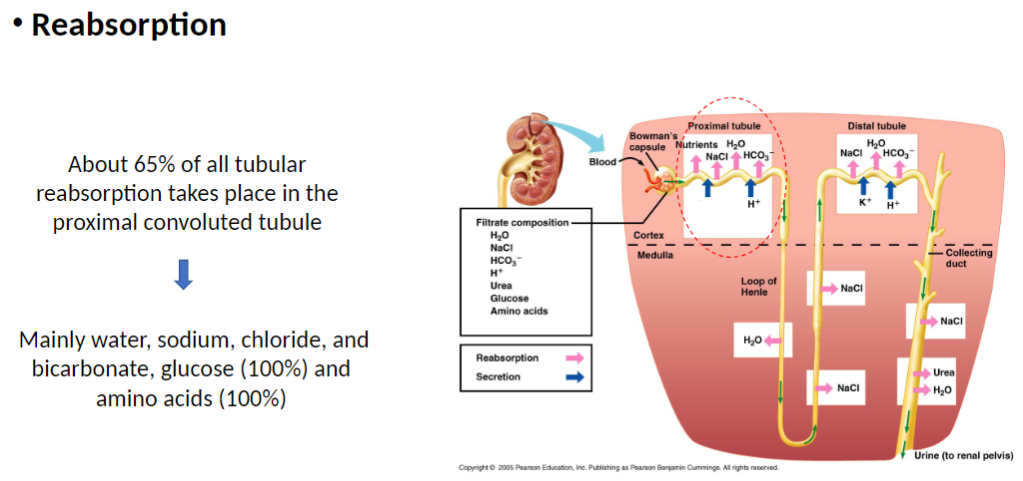
Proximal Convoluted Tubule – Reabsorption

Extent
 About 65% of tubular reabsorption occurs in PCT

Substances Reabsorbed
Water, sodium (Na⁺), chloride (Cl⁻), bicarbonate (HCO₃⁻)
Glucose – 100% reabsorbed
Amino acids – 100% reabsorbed

Key Concept
PCT recovers most water and solutes from filtrate, keeping blood composition stable
<p><strong>Extent</strong><br> About <strong>65%</strong> of <strong>tubular reabsorption</strong> occurs in <strong>PCT</strong></p><p><strong>Substances Reabsorbed</strong><br> <strong>Water, sodium (Na⁺), chloride (Cl⁻), bicarbonate (HCO₃⁻)</strong><br> <strong>Glucose</strong> – 100% reabsorbed<br> <strong>Amino acids</strong> – 100% reabsorbed</p><p><strong>Key Concept</strong><br> <strong>PCT</strong> recovers most <strong>water and solutes</strong> from filtrate, keeping <strong>blood composition stable</strong></p>
3
New cards

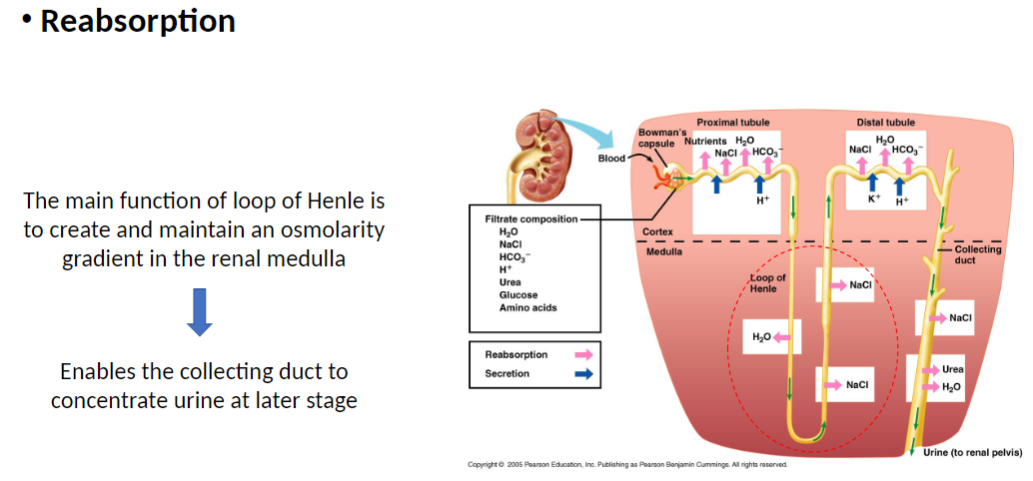
Loop of Henle – Function

Main Function
 Creates and maintains osmolarity gradient in renal medulla (difference in solute concentration between cortex and medulla)

Effect
 Enables collecting duct to concentrate urine later

Key Concept
Loop of Henle controls water and solute reabsorption by generating medullary concentration gradient
<p><strong>Main Function</strong><br> Creates and maintains <strong>osmolarity gradient</strong> in <strong>renal medulla</strong> (difference in <strong>solute concentration</strong> between cortex and medulla)</p><p><strong>Effect</strong><br> Enables <strong>collecting duct</strong> to <strong>concentrate urine</strong> later</p><p><strong>Key Concept</strong><br> <strong>Loop of Henle</strong> controls <strong>water and solute reabsorption</strong> by generating <strong>medullary concentration gradient</strong></p>
4
New cards

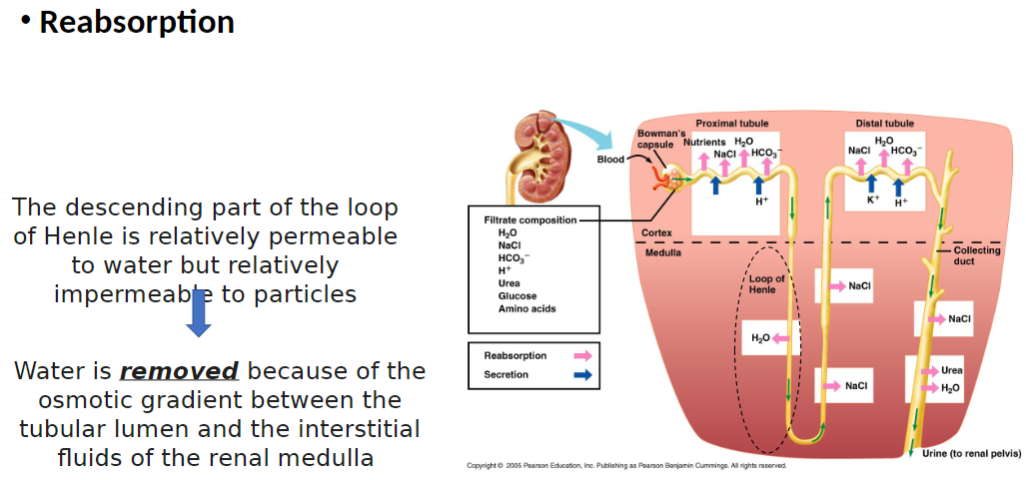
Loop of Henle – Descending Limb

Permeability
Descending limb is relatively permeable to water
 Is relatively impermeable to particles (solutes)

Water Movement
Water is removed from tubular lumen (space inside tubule where filtrate flows)

Cause
 Movement occurs because of osmotic gradient (difference in solute concentration that pulls water)
 Between tubular lumen and interstitial fluid of renal medulla (surrounding kidney tissue)

Key Concept
Water leaves filtrate in descending limb, helping concentrate tubular fluid in renal medulla
<p><strong>Permeability</strong><br> <strong>Descending limb</strong> is <strong>relatively permeable to water</strong><br> Is <strong>relatively impermeable to particles (solutes)</strong></p><p><strong>Water Movement</strong><br> <strong>Water is removed</strong> from <strong>tubular lumen</strong> (space inside tubule where filtrate flows)</p><p><strong>Cause</strong><br> Movement occurs because of <strong>osmotic gradient</strong> (difference in solute concentration that pulls water)<br> Between <strong>tubular lumen</strong> and <strong>interstitial fluid of renal medulla</strong> (surrounding kidney tissue)</p><p><strong>Key Concept</strong><br> <strong>Water leaves filtrate in descending limb</strong>, helping concentrate <strong>tubular fluid</strong> in <strong>renal medulla</strong></p>
5
New cards

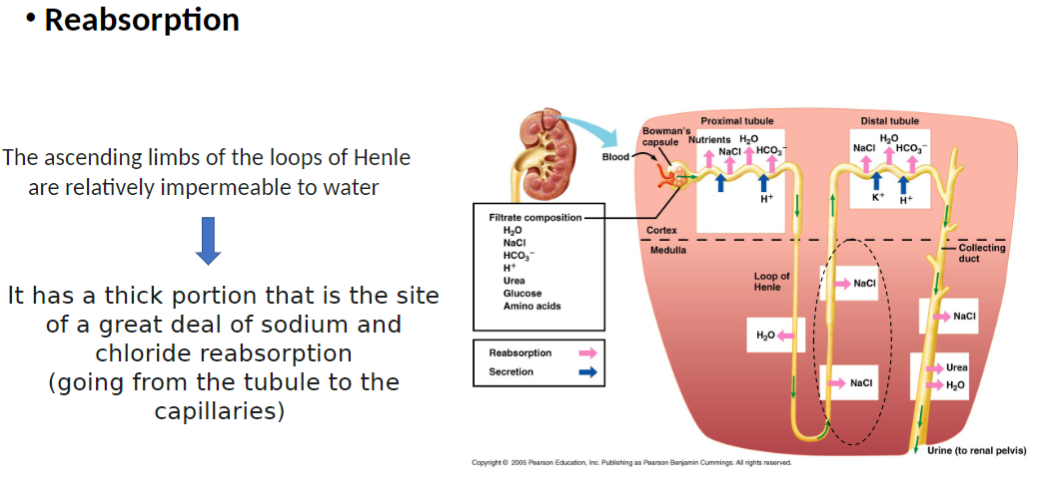
Loop of Henle – Ascending Limb

Permeability
Ascending limb is relatively impermeable to water

Structure
 Has thick portion (thick ascending limb)

Reabsorption
 Major site of sodium (Na⁺) and chloride (Cl⁻) reabsorption
 These ions move from tubule → into capillaries (blood)

Key Concept
Solutes leave filtrate but water cannot follow, helping maintain osmolarity gradient in renal medulla
<p><strong>Permeability</strong><br> <strong>Ascending limb</strong> is <strong>relatively impermeable to water</strong></p><p><strong>Structure</strong><br> Has <strong>thick portion</strong> (thick ascending limb)</p><p><strong>Reabsorption</strong><br> Major site of <strong>sodium (Na⁺)</strong> and <strong>chloride (Cl⁻) reabsorption</strong><br> These ions move <strong>from tubule → into capillaries (blood)</strong></p><p><strong>Key Concept</strong><br> <strong>Solutes leave filtrate but water cannot follow</strong>, helping maintain <strong>osmolarity gradient in renal medulla</strong></p>
6
New cards

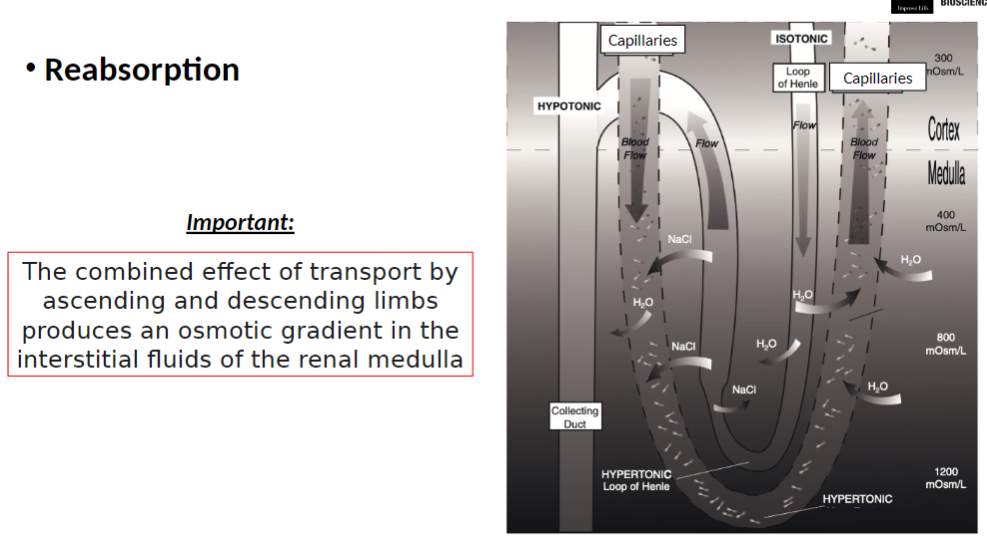
Loop of Henle – Countercurrent Effect

Combined Action
Ascending limb transports Na⁺ and Cl⁻ out of tubular fluid
Descending limb allows water to leave filtrate

Result
 Combined transport produces osmotic gradient in interstitial fluid of renal medulla (surrounding kidney tissue)

Importance
Medullary osmotic gradient is essential for concentrating urine later in collecting ducts
<p><strong>Combined Action</strong><br> <strong>Ascending limb</strong> transports <strong>Na⁺ and Cl⁻</strong> out of tubular fluid<br> <strong>Descending limb</strong> allows <strong>water to leave filtrate</strong></p><p><strong>Result</strong><br> Combined transport produces <strong>osmotic gradient</strong> in <strong>interstitial fluid of renal medulla</strong> (surrounding kidney tissue)</p><p><strong>Importance</strong><br> <strong>Medullary osmotic gradient</strong> is essential for <strong>concentrating urine</strong> later in <strong>collecting ducts</strong></p>
7
New cards

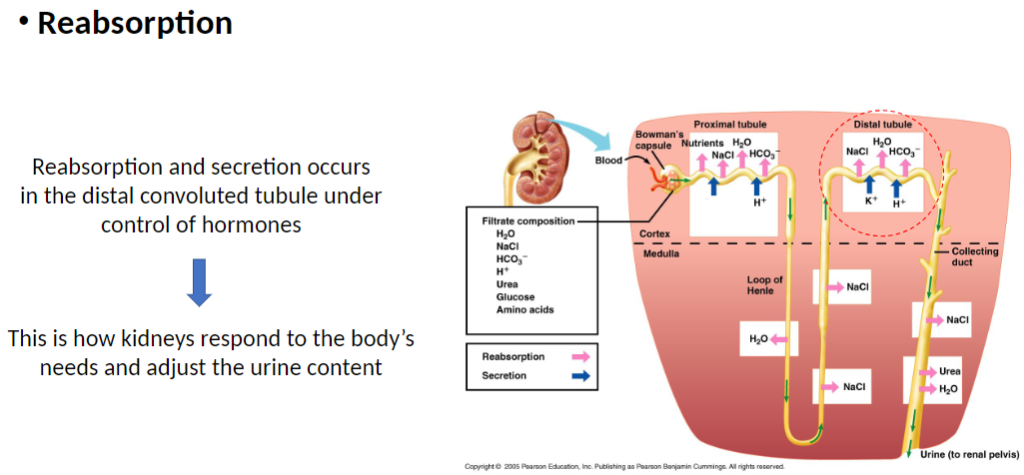
Distal Convoluted Tubule – Regulation

Processes
Reabsorption and secretion occur in distal convoluted tubule (DCT)

Control
 Processes are regulated by hormones

Function
 Allows kidneys to respond to body’s needs
 Adjusts urine composition (what substances remain in urine)
<p><strong>Processes</strong><br> <strong>Reabsorption</strong> and <strong>secretion</strong> occur in <strong>distal convoluted tubule (DCT)</strong></p><p><strong>Control</strong><br> Processes are <strong>regulated by hormones</strong></p><p><strong>Function</strong><br> Allows <strong>kidneys</strong> to respond to <strong>body’s needs</strong><br> Adjusts <strong>urine composition</strong> (what substances remain in urine)</p>
8
New cards

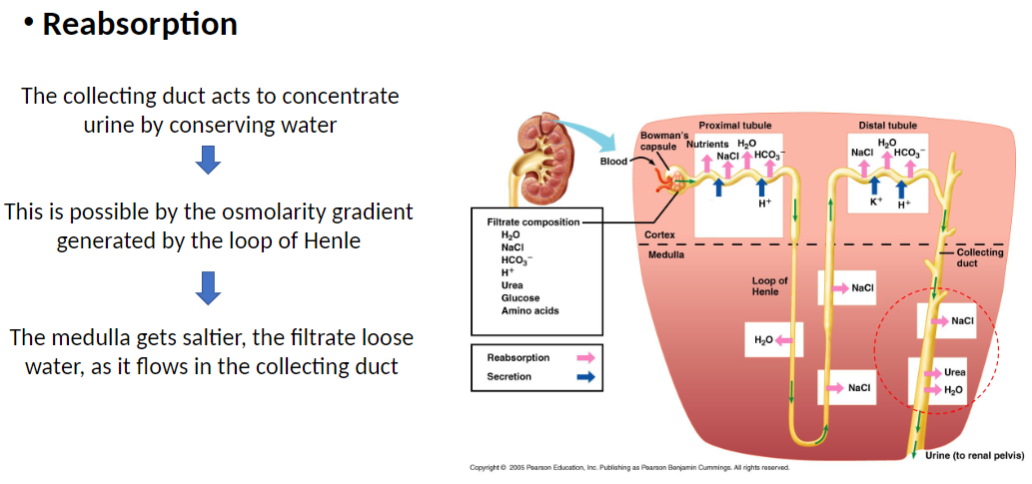
Collecting Duct – Urine Concentration

Function
Collecting duct acts to concentrate urine by conserving water

Mechanism
 Possible because of osmolarity gradient generated by Loop of Henle

Process
Renal medulla becomes increasingly salty (higher solute concentration)
 As filtrate flows through collecting duct, water leaves filtrate

Key Concept
Medullary osmotic gradient allows water reabsorption, producing more concentrated urine
<p><strong>Function</strong><br> <strong>Collecting duct</strong> acts to <strong>concentrate urine</strong> by <strong>conserving water</strong></p><p><strong>Mechanism</strong><br> Possible because of <strong>osmolarity gradient</strong> generated by <strong>Loop of Henle</strong></p><p><strong>Process</strong><br> <strong>Renal medulla</strong> becomes <strong>increasingly salty</strong> (higher solute concentration)<br> As <strong>filtrate flows through collecting duct</strong>, <strong>water leaves filtrate</strong></p><p><strong>Key Concept</strong><br> <strong>Medullary osmotic gradient</strong> allows <strong>water reabsorption</strong>, producing <strong>more concentrated urine</strong></p>
9
New cards

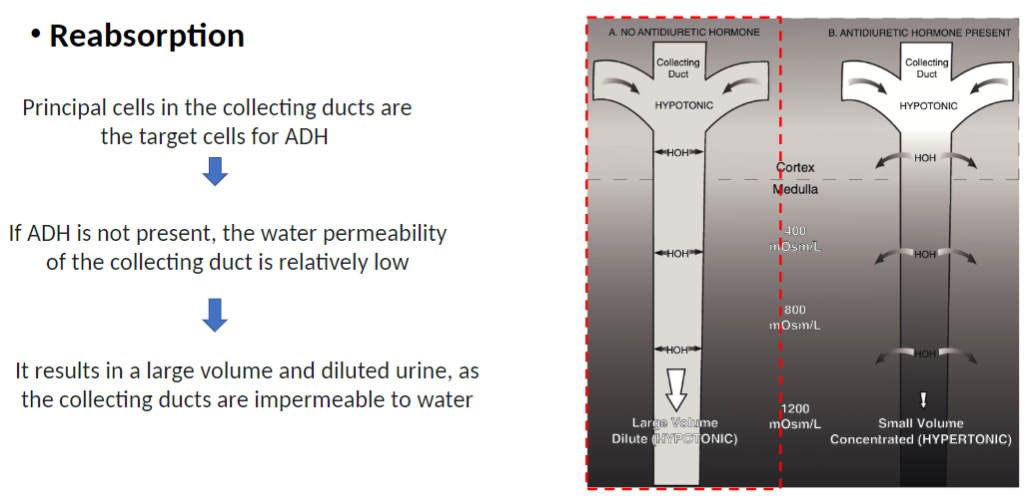
Collecting Duct – ADH Regulation

Target Cells
Principal cells in collecting duct are target cells for ADH (antidiuretic hormone)
ADH is hormone that controls water reabsorption in kidneys

Without ADH
Water permeability of collecting duct is relatively low (water cannot easily pass through)

Result
 Produces large volume of dilute urine
 Because collecting duct remains relatively impermeable to water
<p><strong>Target Cells</strong><br> <strong>Principal cells</strong> in <strong>collecting duct</strong> are <strong>target cells for ADH (antidiuretic hormone)</strong><br> <strong>ADH</strong> is hormone that <strong>controls water reabsorption in kidneys</strong></p><p><strong>Without ADH</strong><br> <strong>Water permeability</strong> of <strong>collecting duct</strong> is <strong>relatively low</strong> (water cannot easily pass through)</p><p><strong>Result</strong><br> Produces <strong>large volume of dilute urine</strong><br> Because <strong>collecting duct remains relatively impermeable to water</strong></p>
10
New cards

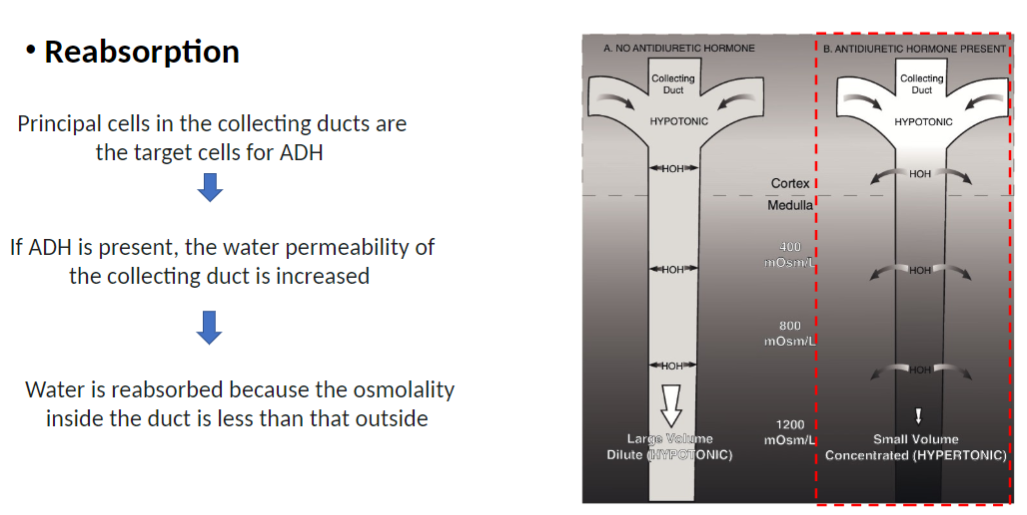
Collecting Duct – ADH Action

Target Cells
Principal cells in collecting duct are target cells for ADH (antidiuretic hormone)

With ADH Present
Water permeability of collecting duct increases

Water Movement
Water is reabsorbed from tubular fluid
 Because osmolality inside duct is lower than osmolality in surrounding medulla
 (osmolality = concentration of dissolved solutes)

Key Concept
ADH increases water reabsorption, producing smaller volume of more concentrated urine
<p><strong>Target Cells</strong><br> <strong>Principal cells</strong> in <strong>collecting duct</strong> are <strong>target cells for ADH (antidiuretic hormone)</strong></p><p><strong>With ADH Present</strong><br> <strong>Water permeability</strong> of <strong>collecting duct</strong> <strong>increases</strong></p><p><strong>Water Movement</strong><br> <strong>Water is reabsorbed</strong> from <strong>tubular fluid</strong><br> Because <strong>osmolality inside duct</strong> is <strong>lower than osmolality in surrounding medulla</strong><br> (<strong>osmolality</strong> = concentration of dissolved solutes)</p><p><strong>Key Concept</strong><br> <strong>ADH increases water reabsorption</strong>, producing <strong>smaller volume of more concentrated urine</strong></p>
11
New cards

Reabsorption

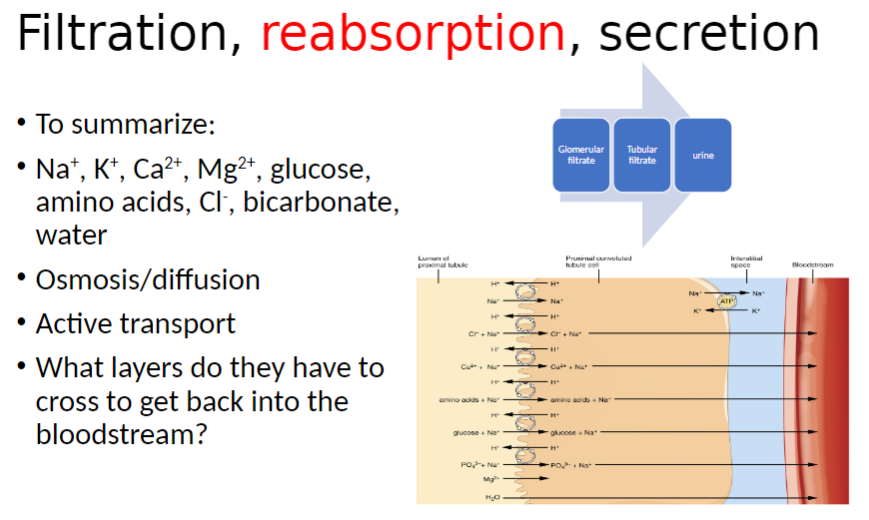
Substances Reabsorbed
Na⁺, K⁺, Ca²⁺, Mg²⁺ (important electrolytes)
Glucose and amino acids (nutrients)
Cl⁻, bicarbonate (HCO₃⁻)
Water

Transport Mechanisms
Osmosis – water movement across membrane due to solute concentration gradient
Diffusion – movement of solutes from high → low concentration
Active transport – movement of substances against gradient using cellular energy (ATP)

Pathway Back to Bloodstream
 Substances move from tubular lumen → tubular epithelial cells → interstitial fluid → peritubular capillaries (bloodstream)
<p><strong>Substances Reabsorbed</strong><br> <strong>Na⁺, K⁺, Ca²⁺, Mg²⁺</strong> (important electrolytes)<br> <strong>Glucose</strong> and <strong>amino acids</strong> (nutrients)<br> <strong>Cl⁻, bicarbonate (HCO₃⁻)</strong><br> <strong>Water</strong></p><p><strong>Transport Mechanisms</strong><br> <strong>Osmosis</strong> – water movement across membrane due to <strong>solute concentration gradient</strong><br> <strong>Diffusion</strong> – movement of solutes from <strong>high → low concentration</strong><br> <strong>Active transport</strong> – movement of substances <strong>against gradient using cellular energy (ATP)</strong></p><p><strong>Pathway Back to Bloodstream</strong><br> Substances move from <strong>tubular lumen → tubular epithelial cells → interstitial fluid → peritubular capillaries (bloodstream)</strong></p>

Explore top notes

note
LIGHT: Geometric Optics
Updated 1289d ago
0.0(0)
note
arguments and fallacies
Updated 1255d ago
0.0(0)
note
APES 4.9 El Nino and La Nina
Updated 1142d ago
0.0(0)
note
BotanyRoots
Updated 1297d ago
0.0(0)
note
1st ISLAMIC COMMUNITY (PART 1)
Updated 1295d ago
0.0(0)
note
Unit 7
Updated 331d ago
0.0(0)
note
LIGHT: Geometric Optics
Updated 1289d ago
0.0(0)
note
arguments and fallacies
Updated 1255d ago
0.0(0)
note
APES 4.9 El Nino and La Nina
Updated 1142d ago
0.0(0)
note
BotanyRoots
Updated 1297d ago
0.0(0)
note
1st ISLAMIC COMMUNITY (PART 1)
Updated 1295d ago
0.0(0)
note
Unit 7
Updated 331d ago
0.0(0)

Explore top flashcards

flashcards
Mesopotamian Empires
40
Updated 1213d ago
0.0(0)
flashcards
SPANISHOCAB
45
Updated 1062d ago
0.0(0)
flashcards
Tussenstop 4
53
Updated 1027d ago
0.0(0)
flashcards
Book A Final
44
Updated 329d ago
0.0(0)
flashcards
unit 3: republic act 7719
111
Updated 1135d ago
0.0(0)
flashcards
Phys II- Exam 1 TQs
190
Updated 246d ago
0.0(0)
flashcards
Mesopotamian Empires
40
Updated 1213d ago
0.0(0)
flashcards
SPANISHOCAB
45
Updated 1062d ago
0.0(0)
flashcards
Tussenstop 4
53
Updated 1027d ago
0.0(0)
flashcards
Book A Final
44
Updated 329d ago
0.0(0)
flashcards
unit 3: republic act 7719
111
Updated 1135d ago
0.0(0)
flashcards
Phys II- Exam 1 TQs
190
Updated 246d ago
0.0(0)



