lecture 1-3
 Studied by 0 people
 Call Kai
 Learn
Learn Practice Test
 Spaced Repetition
 Match
Match Flashcards
 Knowt Play
1/54

There's no tags or description
Looks like no tags are added yet.
Name | Mastery | Learn | Test | Matching | Spaced | Call with Kai |
|---|
No analytics yet
Send a link to your students to track their progress
55 Terms
Medicinal botany:
the study of medicinal plants and their physiological compounds.
Medicinal plants:
Any plant whose roots, leaves, seeds, bark, or plant part is used for therapeutic, tonic, purgative, or other health-promoting purpose.
Why should we care about plants at all?
• Natural products and their derivatives represent over 50% of all drugs in clinical use (many of which are derived from higher plants)1
• In the United States, of the top 150 best selling drugs 87 of them are derived from plants.
• Plant derived anti-cancer drugs first isolated from the Pacific yew save roughly 30,000 lives per year, just in the US.
• Taxol!
• Two drugs derived from alkaloids of Madagascar’s rosy periwinkle, the likelihood of remission for a child suffering from leukemia increased by 85 percent between 1960 and 1997.
discussion- plant based vaccines
VLPs- virus like particles
most widely used drug on earth?
Aspirin
Why are plants important?
allow life to exist, food source, medicine
Traditional medicine:
the knowledge, skills, and practices based on the theories, beliefs, and experiences indigenous to different cultures, used in the maintenance of health and in the prevention, diagnosis, improvement, or treatment of physical and mental illness- specific to individual cultures
• A part of the “alternative medicine system”
In 2007, roughly 38% of adults and 12% of children in the United States used…
some form of traditional medicine.
• Why? family traditions, affordability, accessibility
WHO estimates that over 80% of the people in developing countries rely on traditional medicine such as herbs for daily needs
5 major groups of CAM (complementary and alternative medicine)
Alternative medical systems.
2. Biological-Based Therapies.
3. Manipulative Methods.
4. Mind-Body Interventions.
5. Energy Therapies.
Alternative Medical Systems
• Practices that evolved independent of conventional medicinal approaches.
• Such as traditional medicines
• Chinese, Ayurvedic, and indigenous people’s worldwide.
• Herbal medicine.
• Naturopathy.
• Homeopathy.
• Acupuncture.
Biological-Based Therapies
• Practices, interventions, and products, often overlapping with dietary supplements used by conventional health care providers and herbs by traditional healers.
• Includes:
• health foods
• alternative dietary practices
• Vegetarian or low red meat diets
• Aromatherapy
• Dietary supplements: projected to be $142.5 Billion market by 2025.
Manipulative Methods
•Therapies using manipulation or movement of the body.
• Includes:
• Osteopaths (some considered part of conventional medicine now).
• Chiropractors (largest alternative medicine profession).
• Market value: $12.8 Billion in 2017, continued growth.
• Massage therapists.
Mind-Body Interventions
• Techniques permitting the mind’s capacity to affect bodily function and various symptoms.
• Includes:
• Meditation
• Hypnosis
• Dance therapy
• Music therapy
• Art therapy
Energy Therapies
• Focus either on energy fields originating within the body (known as “biofields”) or those outside the body such as electromagnetic fields.
• Belief that energy flows within the body and adjusting flows can reduce stress, anxiety, and symptoms.
Plants as Medicine
• Fossil records point to humans using plants in a medicinal manner in the Paleolithic age, roughly 60,000 years ago!
• Natural products and their derivatives represent over 50% of all drugs in clinical use (many of which are derived from higher plants)
• Plants and their products as medicine is not a new concept.
• Indigenous peoples around the globe play(ed) a large role in determining which plants were useful for treatment of specific conditions.
• Chinese Traditional Medicine, Ayurvedic (India), Unani (west of Pakistan), Kampo (Japan)
Conventional Medicine’s Debt
• Conventional medicine owes a huge debt traditional medicine.
• Indigenous people huge in determined medicinal properties of plants for centuries!
• Clinical trial-like in various places around the globe.
• Examples:
• Anti-malarial quinine used by Native South Americans, Quechua, for hundreds of years.
• Isolated from Cinchona genus of trees.
• Reserpine (conventional medicine’s first tranquilizer) used in Ayurvedic medicine for centuries as an anxiolytic.
• Used to treat hypertension today (still used in veterinary practices for horse tranquilization).
• From “Indian snakeroot” plant, Rauvolfia serpentina
St. John’s Wort (Hypericum perforatum)
• Used almost exclusively as a botanical anti-depressant.
• Selective inhibition of serotonin, dopamine, and norepinephrine reuptake in the CNS.
• More effective than placebo in treating mild to moderate depressions (at times, shaky data).
• Safety: by itself, St. John’s wort is extremely safe, serious side effect infrequent and include photosensitization and and induction of manic symptoms
• Interactions:
• St. John’s wort activates cytochrome p450, which can eliminate other drugs on board.
• Anticoagulants, oral contraceptives, antiviral drugs.
Ginkgo (Ginkgo biloba)
• Used for a memory impairment, dementia, tinnitus, and intermittent claudication.
• Data suggests potential uses for dementia, claudication.
• Other uses, no significant data yet.
• Safety:
• Adverse effects usually mild, transient, reversible.
• Rare serious effects are bleed and seizures in children ingesting excessive amounts of seeds only.
• Habitat:
• Originated in China but can tolerate many temperate climates and as such is used in landscaping in cities
Saw Palmetto (Serenoa repens)
• Used to treat benign prostatic hyperplasia.
• Data suggests efficacious short term and probably medium term equivalent to finasteride.
• Safety:
• Adverse effects are extremely rare and when they do occur, they are very mild.
• Habitat:
• Right here! Native to the coastal planes of the North America, from the Carolinas down to Florida and west to Texas.
Asian Ginseng (Panax ginseng)
• Used as a sedative, hypnotic, demulcent, aphrodisiac (hey), antidepressant, diuretic, to improve stamina, concentration, and vigilance.
• Safety:
• Low incidence of serious adverse effects.
Echinaceas (Echinacea angustifolia, etc)
• Used primarily to treat and prevent upper respiratory tract infections.
• Safety:
• Adverse effects rare and usually allergic reactions to the plant.
• Habitat:
• Native to North America
Research and Standardization Considerations:
• Preparation of botanicals is extremely important.
• Fresh, dry, part of plant?, exact extraction process, etc.
• Reactive and nonreactive components should be identified.
• Which molecule is responsible for the potential therapeutic effects?
• Are there more than one? (cough, cannabis, cough).
FDA is empowered to:
1) Stop any company from selling a supplement that is toxic or unsanitary.
2) Stop the sale of a supplement that has false or unsubstantiated claims.
3) Act against supplements that pose a unreasonable risk of illness and injury.
4) Stop any company making a claim that a produce cures or treats a disease.
5) Stop a new dietary ingredient from being marked if the FDA does not receive sufficient safety data in advance.
6) Require dietary supplements to meet strict manufacturing requirements.
Federal Trade Commission has the power to:
1) Enforce laws against unfair or deceptive acts or practices to ensure that consumers have accurate data.
2) Stop advertising that is not adequality substantiated.
3) Investigate complains of questionable trade practices
4) Following investigation, negotiate a consent or, or proceed to a cease-and-desist order.
5) Seek injunctions to stop false advertisements.
6) Seek civil penalties for violations
Discussion- catnip:
catnip for cats - behavioral modification.
· last 15 mins, affects 2/3 cats, also tigers, lions, etc.
· can protect cats against mosquitoes.
Reserpine
(conventional medicine’s first tranquilizer) used in Ayurvedic medicine for centuries as an anxiolytic.
• Used to treat hypertension today (still used in veterinary practices for horse tranquilization).
• From “Indian snakeroot” plant, Rauvolfia serpentina
common theme of plants from lecture 2
Not much actual data to support the usage of these plants for treatments
Systematics
the scientific study of biological diversity and its evolutionary history. An important aspect of systematics is taxonomy which involves the identifying, naming and classifying of species.
taxonomy
involves the identifying, naming and classifying of species.
Carl Linnaeus:
18th century Swedish naturalist
• 1753: published ”Species Plantarum” in which he described each species in latin, limited to 12 words.
• He made permanent binomial nomenclature.
• Genus species
• Much easier way of classifying life.
Certain species can consist of two or more subspecies or varieties
• All the members of a variety resemble on another and share one or more features not present in other varieties/subspecies.
• Ex: Prunus persica var. persica is a peach tree, Prunus persica var. nectarina is nectarine.
A generic name may be written alone when…
one is referring to the entire group of species making up that genus.
• Example: Viola
• 2 members of the violet family.
• A: Viola sororia
• B: Viola tricolor
Type specimen:
each species has a dried plant in a museum or herbarium that’s designed by the person who originally named the species.
• Serves as a basis for comparison with other specimen in determining whether they are members of the same species.
Phylogeny
evolutionary history of an organism or group of organisms.
• Phylogenetic trees depict the evolutionary relationships among organisms (hypothesis)
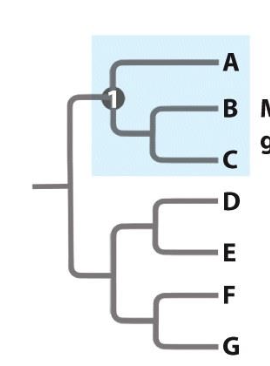
Monophyletic group:
composed of an ancestor and all it’s descendants.
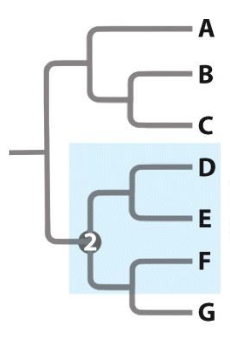
Paraphyletic group:
composed of a common ancestor but not all descendants.
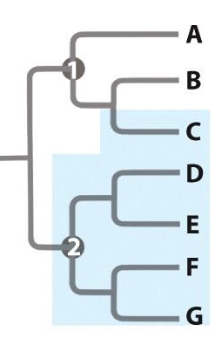
Polyphyletic group:
a group with two or more ancestor but not including the true common ancestor of it’s members
Homology
• Common origin, but not common function.
• Example: bat’s wing compared to a primate’s arm.
Analogy
• Similar structures, but not a common origin.
• Result of convergent evolution.
• Example: bat wing vs. bird wing.
convergent evolution
the independent evolution of similar traits or features in distantly related organisms, driven by similar environmental pressures or ecological niches, resulting in analogous structures (like wings in bats, birds, and insects) that serve the same function but have different evolutionary origins
Cladistics
• Most widely used method of classifying organisms today.
• A form of phylogentic analysis.
• Recognizes a monophyletic group (or clade) by it’s shared derived characters.
outgroup
a closely related group, but lacks the specific characters analyzed in the group
Molecular Systematics
• We no longer rely only on comparative morphology and anatomy to make phylogenetic hypotheses.
• Now we can rely on information in molecules of the plant cells: DNA!
• Molecular systematics relies on information found typically from the chloroplast genome.
• 135-160 kilobases long, circular.
• The fewer the differences between specific genes, the closer the two organisms are evolutionarily related.
DNA Barcoding
• A useful means of identification that essentially displays the nucleotides of a mitochondrial gene in order to give specific codes to organisms.
• We can combine comparative morphology with molecular systematics to make even more informed hypotheses on phylogenetic relationships.
3 domains of life:
Bacteria, Archaea, and Eukarya.
Supergroup
• Eukarya was initially thought to be divided into 4 groups: Protista, Fungi, Animalia, and Plantae.
• Later found this was not monophyletic and instead reclassified eukarya into 7 supergroups (classification between domain and kingdom).
• Still, lots of work being done, supergroups may be restructured with more data.
Origin of Eukaryotes
3 big things:
• Loss of cell wall and the formation of the endomembrane system (hello nucleus).
• Endosymbiosis of mitochondria
• Endosymbiosis of chloroplast.
· Oldest Eukaryotic Fossil: 2.1 billion years ago
Origin of Plants
Evidence of the activities of photosynthetic organisms has been found in rocks 3.4 billion years old.
• ~100 million years after the first fossil evidence of life on Earth.
• Heterotrophs most likely came before autotrophs.
• What’s a heterotroph? Autotroph?
• Arrival of autotrophs changed the flow of energy in our biosphere to what it resembles today:
• Sun → plants→ other forms of life.
Plants are:
• Photosynthetic organisms
• Adapted for life on land.
• Multicellular
• Eukaryotic cells that contain vacuoles and surrounded by thick cell walls that have cellulose.
• Organs specialized in photosynthesis, anchorage, support.
• Reproduction primarily sexual with cycles of alternating haploid and diploid generations.
Kingdom: Plantae
3 phyla of bryophytes:
• Liverworts
• Mosses
• Hornworts
7 extant phyla of vascular plants:
• Lycopodiophyta
• Monilophyta
• Coniferophyta
• Cycadophyta
• Gingophyta
• Gnetophyta
• Anthophyta (angiosperms, yeet).
gametophyte
The haploid, gamete producing generation
In plants, meiosis…
results in the production of spores, not gametes.
• Spores are cells that can divide directly by mitosis to produce a multicellular haploid organism!
sporophyte
The spore producing diploid generation
Diploidy permits
the storage of more genetic information and perhaps allows a more subtle expression of the organism’s genetic background.
• This may be why the sporophyte is the large, complex, and nutritionally independent generation in vascular plants.
• One evolutionary trend is the increasing dominance of the sporophyte and suppression of gametophyte.
Discussion- Ashwaganda
to relieve stress, improve concentration, boost energy — some evidence
 Note
Note  Flashcards (99)