IB biology: A4.1 - Evolution and Speciation
 Call Kai
 Learn
Learn Practice Test
 Spaced Repetition
 Match
Match Flashcards
 Knowt Play
1/28

There's no tags or description
Looks like no tags are added yet.
Name | Mastery | Learn | Test | Matching | Spaced | Call with Kai |
|---|
No analytics yet
Send a link to your students to track their progress
29 Terms
species
organisms which can make fertile offsprings
evolution
change in the heritable characteristics of a population
evidence for evolution by natural selection
base sequences in DNA or RNA and amino acid sequences in proteins
selective breeding of domesticated animals and crop plants
homologous structures
speciation
when groups become separated in space or become different in form or behavior so that they do not regularly breed
3 types of reproductive isolation
geographical isolation
behavioral isolation
temporal isolation
geographical isolation
separation by natural or human made barriers
behavioural isolation
organisms of the same species might develop different mating rituals over time; if the potential mates do not recognise these rituals, the individuals won’t interbreed
temporal isolation
differences in the timing of the reproductive cycles, like mating season or gamete production. This can prevent interbreeding despite the same geographical locations
reproductive isolation due to geographical barriers
The formation of a new geographical barrier divides the original population into two smaller populations: A and B.
The geographical barrier prevents members of the two populations from mixing and interbreeding.
In different environments, evolutionary forces such as natural selection, mutation and genetic drift act independently on the gene pools of the two populations for many generations.
natural selection leads to differential reproduction, eventually leading to genetic separation.
The resulting behavioural and/or physiological changes prevent the populations from mating.
Even if the barrier is now removed, the members of the two populations cannot interbreed. Two new species A and B are formed.
differential selection
when selection pressures are different, so natural selection leads to divergent evolution
case study differential selection
chimpanzees and bonobos, african apes close to each other
used to have common ancestor, but Congo river divided the population
chimpanzees are larger, more aggressive, and male dominated: north of congo river as resources are scarce
bonobos are smaller, more playful, and female dominated: south if congo river where resources are plentiful
temporal isolation
occurs when organisms produce gametes at different times or seasons. An example in animals is brown throut and rainbow trout
Behavioural isolation
organisms have different behaviour routines, e.g. courtship or mating which separates them from other individuals of the species.
Allopatric speciation
means 'different country' → refers to isolating mechanisms that involve spatial separation
Sympatric speciation
means 'the same country'→ refers to isolating mechanisms that occur in the same location but are brought about by temporal or behavioural isolation.
molecular phylogeny - evidence for evolution
the analysis if DNA and RNA base sequences, and amino acid sequences in proteins, with the purpose of dtermining how close 2 species are to each other. very powerful evidence
selective breeding of dogs and plants - evidence for evolution
selective breeding occurs, as we select to breed organisms with the desired characteristics. these rapid changes in the genetic make-up of a population, eventually leading to evolution. this illustrates how quickly evolutionary changes can occur
homologous structures
homologous structures that are physically similar and share a common ancestor, but perform different functions in different species.
Evidence for evolution from homologous structures
pentadactyl (five-fingered) limb of vertebrates
shows how some body structures are fundamentally similar
they indicate divergent evolution from similar structures
analogous structures
Biological structures that have evolved independently in two living organisms to serve the same function in similar environments.
analogous structures origin
do not necessarily indicate evolutionary relationship
unrelated groups of organism adapt in similar ways
insect and bird wings
convergent evolution
Pattern of evolution where distantly related organisms evolve similar traits in response to environmental similarities.
molecular clock
The technique that uses the mutation rate of biomolecules to deduce the time since two species shared a common ancestor.
adaptive radiation
evolution of multiple new species from an ancestral species to occupy different ecological niches. this allows closely related species to exist without competing, increasing biodiversity.
barriers to hybridisation
prezygotic:
variation in the courtship behavior, or behavioral isolation
postzygotic
reduce viability of the zygote
reduces viability of the adult
decreases (or removes) fertility of hybrid and it’s offspring
prevents the mixing of alleles of parent species and subsequent transmission to future generations
polyploidy
A condition where an organism possesses more than two sets of chromosomes.
caused by non-disjunction of chromosomes during mitosis or meiosis
allopolyploidy
a hybrid with more chromosome sets originating from different species. Oftentimes more vigorous than parents.
allopolyploidy explained
normal species and polyploid gamete fuse, create infertile species, but when fused with a normal gemete, results in an allopolyloid
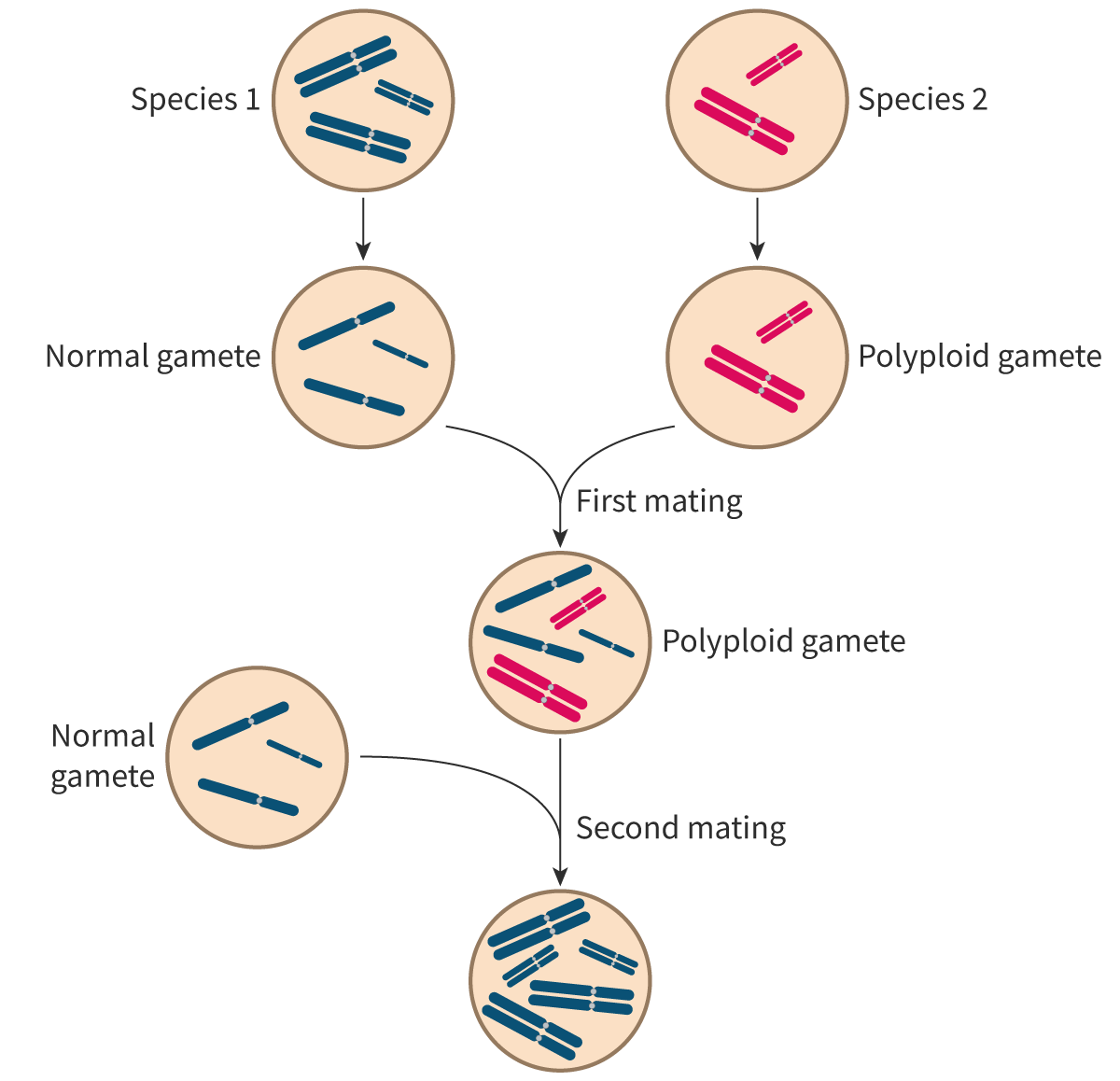
allopolyploidy example
Knotweed → many species of knontweed have been formed through this process

