BIOL 210: Genetics Exam #1
 Call Kai
 Learn
Learn Practice Test
 Spaced Repetition
 Match
Match Flashcards
 Knowt Play
1/88

There's no tags or description
Looks like no tags are added yet.
Name | Mastery | Learn | Test | Matching | Spaced | Call with Kai |
|---|
No analytics yet
Send a link to your students to track their progress
89 Terms
Genome
All chromosomes and DNA sequences that an organism can have.
Protein
Functional unit made of polypeptides.
Enzyme
A protein that functions to accelerate chemical reactions within the cell.
cDNA
Complementary DNA (cDNA) is a synthetic single- or double-stranded DNA synthesized from a mature mRNA template using reverse transcriptase.
DNA
Double-stranded structure of nucleotide bases: adenine, thymine, guanine, cytosine.
mRNA
A single-stranded molecule of RNA that corresponds to the genetic sequence of a gene and is read by a ribosome for protein synthesis.
Polypeptide
A linear sequence of amino acids that is the product of mRNA translation. It can fold and associate with others to form a functional protein.
Amino Acid
A building block of polypeptides and proteins; it contains an amino group, a carboxyl chain, and a side chain.
Gene Expression
The process by which the information within a gene is first accessed to synthesize RNA and polypeptides affects the phenotype of the organism.
Apoptosis
Programmed cell death.
Adaptive Radiation
The divergence of a single group or species into a series of distinct, but related, groups or species.
Genotype
Genetic information
Phenotype
Expressed traits
Messenger RNA (mRNA)
Type of RNA that is transcribed from a protein-encoding gene; contains information for the synthesis of a polypeptide.
Translation
The process where the sequence of codons within mRNA provides the information to make the sequence of amino acids that make up a polypeptide.
Central Dogma of Genetics
DNA – (transcription) → RNA – (translation) → protein
Genetic Variation
Genetic differences among members of the same species or among different species.
Model Organisms
Quick reproduction generation cycle
Appropriate size
Short life cycle
Simple nutrition requirements
Available genome sequenced
PCR (Polymerase Chain Reaction)
Rapid amplification of a certain segment of DNA.
Denaturation
Double-stranded DNA is separated into two single-stranded DNAs.
Annealing
Primers bind to their complementary regions of single-stranded DNA templates at low temperature.
Extension
New DNA strands are extended from the primers; the mixture is rapidly heated and cooled.
Components of PCR
DNA polymerase
DNA primers
PCR buffer: a solution that provides stable pH and overall conditions for the function of DNA polymerase
dNTPs: building blocks of DNA; provide energy for polymerization
Isolated DNA sample: target sequence for PCR
Initiation
RNA polymerase attaches to the DNA molecule and moves along it until it finds a promoter sequence.
Elongation
RNA polymerase reads the DNA strand and adds nucleotide bases to the mRNA strand.
Termination
RNA polymerase comes to a stop at the sequence codon; the mRNA strand detaches from the DNA strand; RNA polymerase and RNA break off from the DNA.
Upstream Region
Located more towards the 5’ end than the start of the gene
Downstream Region
Located more towards the 3’ end than the end of the gene
RNA polymerase
RNA polymerase is a multi-protein enzyme that synthesizes the RNA transcript during transcription. The exact protein composition of RNA polymerases can vary, and different RNA polymerases are involved in the transcription of different categories of genes in eukaryotes.
Cis-Regulatory Module
Determines when and where a gene is transcribed.
Core Promoter
Determines whether or not a gene is transcribed; the site where RNA polymerase binds.
Coding Region
Controls what the gene product (protein) does.
Transcription Factors
A sequence of nucleotide bases that bind to different sites on a gene and interact with the polymerase to regulate, increase, or decrease gene expression.
Allows the cell to regulate gene expression under different circumstances.
More possible binding sites = more possible combinations for gene expression.
Transcriptional Reporter
Remove the coding region and replace it with a (synthetic) reporter; this tracks and “reports” what factors affect the gene's expression.
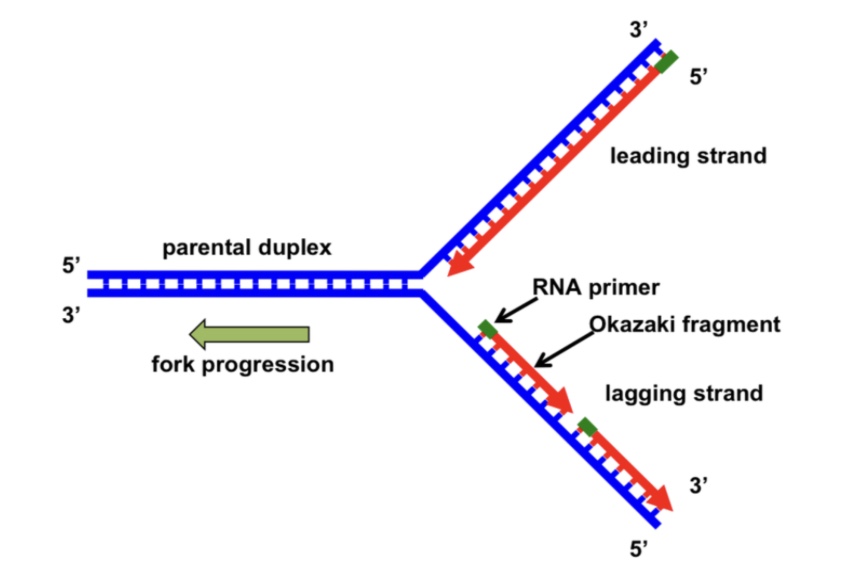
Replication Fork
Site where DNA strands split during replication.
Homologous Genes
Different genes that code for the same function.
Orthologous Genes
Genes present in different species are similar as a result of common ancestry.
Paralogous Genes
Two different genes within the same species that arose from the same gene.
Genome Size (C-value paradox)
Genome size is not directly correlated to organism complexity, although it roughly scales with most organisms.
Sugar-Phosphate Backbone
Alternating sugar and phosphate groups bind together to hold DNA ladder together.
Restriction Endonuclease
An enzyme that cuts DNA internally and breaks the sugar-phosphate backbone.
Hydrogen Bonding
Connect complementary bases in the DNA strand.
Cytosine–guanine: 3 hydrogen bonds
Adenine–thymine: 2 hydrogen bonds
Nucleotide
Building block of DNA: sugar (ribose RNA, deoxyribose DNA), base (A, G, T or U, C), phosphate.
Base Substitution
A genetic mutation where one nucleotide base in a DNA sequence is replaced by another.
Wild type: TCTAAT
Mutant: TCCAAT
Copy Number Variation
Sections of the genome are deleted or duplicated, leading to variation in the number of repeats of specific DNA segments.
Wild type: TCTAAT
Mutant: TCTAATTCTAATTC
Frameshift Mutations
Insertion or deletion of a base that alters the reading frame.
Base Deletion (Indel Mutation)
When one or more nucleotide base pairs are removed from a DNA sequence, causing significant genetic variation.
Wild type: TCTAAT
Mutant: TCAAT
Somatic Mutations
Mutations occurring in somatic cells, in which the mitotic offspring of the mutant cell will show an altered DNA sequence.
Transition Mutations
Mutations in which one pyrimidine replaces the other pyrimidine or one purine replaces the other purine are referred to as transitions.
Transversion Mutations
Mutations in which a purine replaces a pyrimidine, or vice versa are referred to as transversions.
Missense Mutation
Changes in which one amino acid is replaced by a different amino acid. (regardless of what occurred in the DNA sequence)
Nonsense Mutation
Changes in which a codon encoding an amino acid is replaced by a stop codon.
Redundancy
Multiple copies of a gene allow for the use of a backup copy in the case of mutation.
Robustness
Genes have multiple different pathways to achieve the same function; expression using different genes and proteins if mutations prevent typical pathways.
Purifying Selection
Deleterious mutations are eliminated from the population over time via natural selection.
Phylogeny
The ability to visualize past relationships to reconstruct evolutionary history.
Phylogenetic Tree
Branches on a phylogenetic tree represent evolutionary lineages, and the nodes where the branches interact represent the last common ancestor to those lineages.
Intron
a noncoding section of a gene that is transcribed into RNA but is removed during RNA processing before the mRNA leaves the nucleus.
Exon
An exon is a coding section of a gene that remains in the final mRNA after RNA processing.
Natural Selection
he process by which individuals with traits that are better suited to their environment are more likely to survive and reproduce, passing those traits on to the next generation.
Fitness
an organism’s ability to survive and reproduce in its environment.
Oncogenes
genes that have the potential to cause cancer when they are mutated or overactive.
become permanently on
cells divide uncontrollably
tumor formation
Tumor supressor Genes
genes that normally slow down or stop cell division, repair DNA damage, or trigger cell death (apoptosis).
Rho-independent termination
Mechanism in prokaryotes that stops transcription without the help of the Rho protein. The hairpin causes RNA polymerase to pause, and the weak A–U bonds between the RNA and DNA cause the RNA transcript to detach.
Rho-dependent Termination
Mechanism in prokaryotes that stops transcription with the help of a protein called Rho.
The Rho protein binds to a specific site on the RNA called the rut site.
Rho moves along the RNA toward RNA polymerase.
When RNA polymerase pauses, Rho catches up.
Rho separates the RNA from the DNA template, ending transcription.
Hairpin loop
Structure that forms in single-stranded RNA when a sequence of bases pairs with a complementary sequence nearby in the same strand.
A double-stranded “stem” (from base pairing)
A single-stranded “loop” at the top
RNA splicing
The process in eukaryotic cells where introns are removed from pre-mRNA and exons are joined together to form mature mRNA.
Why is gene expression important?
Gene expression is important because it controls which genes are turned on or off, allowing cells to make the proteins they need to function. This determines how cells grow, develop, specialize, and respond to their environment.
What are the 3 structural differences between DNA and RNA?
Sugar – DNA has deoxyribose, RNA has ribose.
Nitrogen base – DNA uses thymine (T), RNA uses uracil (U).
Strands – DNA is double-stranded, RNA is single-stranded.
Semi-conservative replication
The way DNA copies itself so that each new DNA molecule contains one original (parent) strand and one newly made strand.
What does DNA Helicase do?
An enzyme that unwinds and separates the two DNA strands by breaking the hydrogen bonds between base pairs during DNA replication.
What are the 2 functions of genes?
Code for proteins (or functional RNA).
Pass genetic information from one generation to the next.
What is the candidate gene approach?
Method used to study genetic traits by focusing on specific genes that are already suspected to influence a trait or disease, based on their known function.
Expression (Transcription) Profile
a pattern showing which genes are turned on or off in a cell at a specific time or under certain conditions.
What is consensus sequence?
A way of summarizing the most common nucleotides found at each position in a set of similar DNA or RNA sequences. It represents the “typical” or most frequently occurring sequence, helping to identify important regions like promoters or binding sites.
What is descent with modification?
Idea that species change over time, passing traits from parents to offspring, but with small changes in each generation. Over long periods, these small changes can accumulate, leading to new species.
What is the c-value paradox?
Observation that the amount of DNA in an organism’s genome (its C-value) does not consistently correlate with its complexity. In other words, some simple organisms have much more DNA than more “complex” ones, showing that genome size isn’t a direct measure of biological complexity.
What is ploidy?
Ploidy refers to the number of sets of chromosomes in a cell.
Haploid – a cell with one complete set of chromosomes, like a sperm or egg.
Diploid – a cell with two complete sets of chromosomes, one from each parent, like most body cells.
Monoploid – a single set of chromosomes, often used in plants to describe the basic chromosome number of a species.
DNA Helicase
An enzyme that unwinds the double-stranded DNA, separating the two strands so that each can serve as a template during DNA replication.
DNA polymerase
An enzyme that builds new DNA strands by adding nucleotides to a growing chain, using an existing strand as a template.
DNA primase
An enzyme that makes a short RNA primer on a DNA strand, giving DNA polymerase a starting point to begin replication.
DNA ligase
An enzyme that joins DNA fragments together by forming bonds between them, sealing gaps in the backbone. It’s like the “glue” that completes the DNA strand.
Topoisomerase
An enzyme that relieves the twisting and supercoiling of DNA ahead of the replication fork by cutting and rejoining the DNA strands.
The Luria-Delbrück experiment (Fluctuation test)
Showed that mutations in bacteria occur randomly and spontaneously, not as a response to the environment. By comparing bacterial growth in many separate cultures, they demonstrated that resistance arises from pre-existing mutations, highlighting that evolution can happen by chance.
Alternative Splicing
A single gene can produce multiple different mRNA molecules by including or skipping certain exons. This allows one gene to make different proteins, increasing diversity without adding more genes.
Transfer RNA (tRNA)
Carries specific amino acids to the ribosome during protein synthesis, matching its anticodon to the mRNA codon.
Messenger RNA (mRNA)
Carries genetic instructions from DNA to the ribosomes, where it directs the assembly of amino acids to form proteins.
Ribosomal RNA (rRNA)
Carries the genetic instructions from DNA in the nucleus to the ribosome, where proteins are made.
What causes DNA mutation?
Changes in the DNA sequence, which can happen due to errors during replication, exposure to chemicals or radiation, or even certain viruses. Mutations can be random or induced, and they may alter how genes function.

