Chapter 15 - Race and Human Variation
 Call Kai
 Learn
Learn Practice Test
 Spaced Repetition
 Match
Match Flashcards
 Knowt Play
1/40

There's no tags or description
Looks like no tags are added yet.
Name | Mastery | Learn | Test | Matching | Spaced | Call with Kai | Chat |
|---|
No analytics yet
Send a link to your students to track their progress
41 Terms
Linnaes’ Four Races of Huamns
categorized humans into 4 races
Johann Blumenbach’s
took Linneas’ classification and instead classified races into 5
also based his categories on skull shapes
also stated it is impossible to categorize humans into races properly because humans have so much diversity in appearance
there is variation but it exists as a gradient, not as categories
Historical views of human variation
there was ethnocentric bias
Darwin’s new theory of natural selection lead people to realize that physical traits (and behaviour and intelligence) could be inherited
assumed that if other races had “primitive” technology and customs, they must not be evolved enough for modern civilization
biological determinism
Ethnocentric bias
refers to how white Europeans were the ones doing the classifying and they invariably ranked themselves as the best among the races
biological determinism
idea that a population’s cultural and technological abilities are biologically inherited
TRUE OR FALSE: Darwin’s theory about inheritance of traits was the beginning of people’s thinking about breeding
FALSE
Europeans understood breeding long before Darwin’s theory
Eugenics
the selective breeding of humans to improve the human species
was widely supported by western civilization in the late 19th / early 20th centuries
Looksmaxxing
considered Modern Day Eugenics
states that there is only 1 type of attractive guy
History of Eugenics
was taken to the extreme in a Nazi-occupied Europe
became less popular after the holocaust
but didn’t fully go away
ex. Eugenics in Canada
sterilization programs for minorities, especially First Nations until the 1970s
The fantasy of Race
We make up popular culture (about race) to understand our real world culture
then we consume popular culture (about race) which we apply into the real world
Race
is a fiction humans have written and continue to write
it is a social construct
does not reflect biological reality
relies on phenotypic traits
in reality, humans cannot simply be divided into categories based on shared biological traits (like in species)
Is there more genetic variation between populations?
no, there is more genetic variation within populations than between populations
we have more common in between populations than with individuals within populations
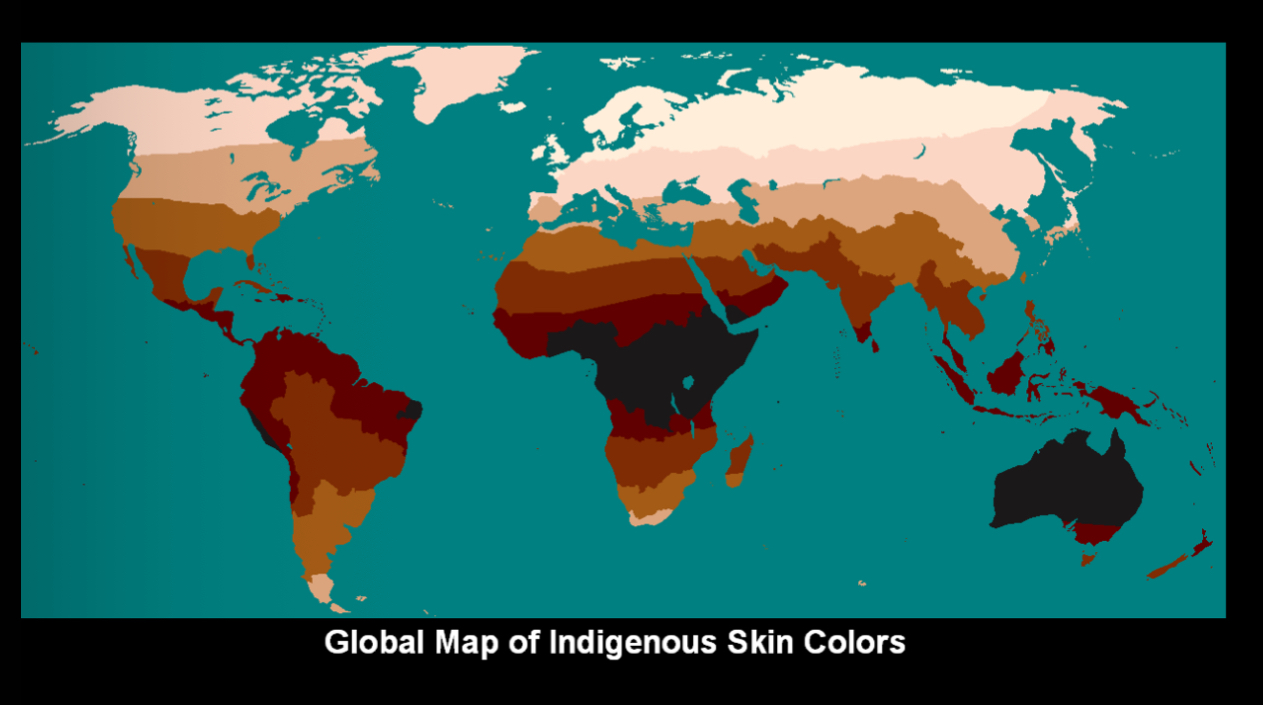
What can you say about this global map of Indigenous skin colours
Darker coloured skin coloured populations are closer to the equator
are more exposed to sunlight
Humans as a Polytypic species
Humans are a Polytypic species
all contemporary humans are members of the same polytypic species, Homo sapiens
even local populations have genotypic and phenotypic variation between individuals
Polytypic spcies
composed of local populations that differ in the expression of one or more traits
Polymorphisms
characteristics with different phenotypic expressions
a genetic trait is polymorphic if the locus that governs it has two or more alleles
geneticists use polymorphisms as a tool to understand evolutionary processes in modern populations
Cline
gradual change in the frequency of a trait or allele in populations dispersed over geographical space
Clinal distribution
reflects natural selection and gene flow
caused by evolution
explained in evolutionary terms
does not reflect racial boundaries
How do we classify people today
Nationality - what country you come from/live in
ethnicity - traditional culture group
ancestry - biological population your ancestors came from
race - a poorly defined social construction that includes aspects of all 3
Is the term “race” useless?
No, we cannot ignore this term because that would mean ignoring the harm it causes
BUT we must understand what it really means
most important thing to remember is that biology cannot be used to divide people into categories
2 levels of physiological response to the environment
Long term - Adaptation: evoltionary change which makes population better-suited to its environment
short-term - Acclimatization: temporary physiological response
Homeostasis
the balance that allows living things to be systems of cooperating functions
Stress
the body’s response to environmental factors that throw homeostasis off balance
it is an attempt to regain homeostasis
acclimatization responses help individual organisms maintain homeostasis even if if there are fluctuating environmental factors
Ulraviolet rays
penetrate the skin and can eventually damage DNA within skin cells
3 major types of cells that can be affected:
squamous cells
basal cells
melanocytes
advantages of dark skin
reduces risk of sunburn
protects from folate degradation (especially important for pregnant for mothers)
Why doesn’t everyone have dark skin?
process of Vitamin D synthesis in the skin needs sunlight
harder for people living up north to reach sunlight
insufficient amounts of vitamin D during childhood results in rickets
rickets - condition often leading to bowing of the long bones of the legs and deformation of the pelvis
Sunlight and acclimatization
humans populations adapt to sunlight levels through changes in skin colour
individuals acclimatize to sunlight by changing skin colour by tanning (short term)
in the sunny seasons, exposure to sunlight stimulates melanocytes to produce more melanin
in the winter, tans fade away and allows individuals to absorb more sunlight and produce more vitamin D
is tanning an acclimatization or an adaptation
Tanning - acclimatization
ability to tan - adaptation
trait that humans evolved through natural selection
Thermal environment of animals
mammals and birds - evolved complex physiological mechanisms to maintain a constant body temp
most mammals won’t survive temperatures that differ from 37^C by only a few degrees, even for only a few hours
humans can range from 50^C to -50^C
Long-term adaptations to heat that our ancestors evolved
sweat glands
vasolidation
limb proportions
body size
Adaptations to temperature
Allen’s rule - populations in colder areas tend to have larger bodies
Bergmann’s rule - populations in colder areas tend to have shorter limbs
based on the laws of thermodynamics - ratio of surface area to volume
Acclimatizations to temperature
short-term responses to cold:
First response - shivering
metabolic rate increases to produce more body heat
vasoconstriction - narrowing of blood vessels
reduces blood flow from the skin and preserves core body heat
vasodilation - widening of blood vessels
to warm peripheries and prevent frostbite
don’t drink alcohol to keep warm in a survival situation
High altitude population adaptations
have adaptations that influence lung volume and red blood cell production
How can lowlanders acclimatize to high altitude
immediately hyperventilating
after a period of time, the body can adjust by increasing red blood cell production
Infectious diseases
caused by invading organisms such as bacteria, viruses, or fungi
throughout evolution, disease has exerted selective pressures on human populations
disease influences the frequency of certain alleles that affect immune response
impact of infectious diseases
humans and pathogens exert selective pressures on each other
microorganisms evolve
a pathogen must not be so virulent so it doesnt kill its host too quickly
selection acts to produce resistance in host populations and/or to reduce the virulence of disease organisms
Malaria
blood-borne pathogen spread to humans through mosquitos
may be the single greatest cause of death in human history
strong selective pressure
sickle cell disease
autosomal recessive disease which causes anemia (red blood cell deficiency)
affects hemoglobin gene
selective pressure
anemia is dangerous and can result in a greater risk of early death
Hemoglobin gene
protein in blood cells which transports oxygen
connection between heterozygotes and malaria vs. anemia
Hb S homozygotes are at risk of anemia
Hb A homozygotes are at risk of malaria
heterozygotes carry the mutated recessive allele, but it is not expressed so they do not get sickle cell disease
because you need 2 alleles to get SCD
heterozygotes are favoured as they are resistant to SCD but are also less likely to get anemia
Heterozygote advantage
alters trait expression in a subtle way which makes carriers immune to diseases, even if the trait is not expressed
ex. can cause carriers to be immune to malarial infection