rejection of democracy
 Call Kai
 Learn
Learn Practice Test
 Spaced Repetition
 Match
Match Flashcards
 Knowt Play
1/49

There's no tags or description
Looks like no tags are added yet.
Name | Mastery | Learn | Test | Matching | Spaced | Call with Kai |
|---|
No analytics yet
Send a link to your students to track their progress
50 Terms
absolute monarchy
type of authoritarian system
autocratic monarch (one person with absolute control) from a ruling family
power is based on religion, divine right, tradition
ex. King Luis XVI
autocracy
type of authoritarian system
single ruler exerts majority of control
power based on the leader, backed by the police and military
“my way or the highway”
standard oil founder John D. Rockefeller
US President Richard M. Nixon
Stalin, Hitler
Oligarchy
government controlled by a few influential members
elite family, ethnic minority, or social group rules
junta
type of authoritarian system
military dictatorship
key positions in government held by military
government exists to support regime and appear legitimate
Egypt, Fiji, Madagascar
minority tyranny
type of authoritarian system
minority group enjoys power/rights, while restricting rights of majority group
dictatorships
(authoritarian/totalitarian)
governments that REJECT LIBERALISM completely:
people should give up liberty, equality, and rights to benefit the common good
strength of a single leader is better than the inefficiency and weakness of democracy
vision and controlled participation
technique of dictatorships
government controls all aspects of society
unions, political parties, etc. are banned
justified by the need for “unity”
elections rigged, voting tracked/corrupted
propaganda
technique of dictatorships
controlling all public information to:
- shape society around the ideology of the leader
- ensure leader and ruling party are viewed positively
art, music, literature are controlled and censored
media controlled to support leader and government
communication with outside world is strictly controlled
indoctrination
technique of dictatorships
“educating” the public - especially youth - to conform to the values of the leader and ruling party
schools controlled — youth “serve” the nation via the military or state controlled groups
history, science, etc. revised to support the leader
censorship
technique of dictatorships
using violence and intimidation to maintain power:
- eliminate opponents and unwanted groups
- eliminate a DISSENT (criticism of gov.)
secret police
technique of dictatorships
eliminate opponents to the state and intimidate citizens
prisons used to punish those who defy the government
scapegoating
government targets
vulnerable minorities as "threats to the nation"
blamed for nation's problems
deflects blame away from leader
creates hatred towards opponents
reinforces need for loyalty
purge
technique of dictatorships
the elimination of real or perceived enemies of the state, together with the use of secret police, these reveal the use of force and terror as a mechanism for control in society
crisis
why individuals surrender civil liberties
things that jeopardize:
- safety and security
- economic security
- well-being
authoritarianism
why individuals surrender civil liberties
helps solve crisis
keeps it from escalating, reassures people, quick/decisive
totalitarianism
use of government to exert complete control over EVERY aspect of people's lives
communism
Draws support from working classes.
Makes decisions in the interest of the working class.
Desire to help working class around the world. (international)
State ownership of the means of production.
Nationalities unimportant (equally)
fascism
Draws support from lower classes & business.
Makes decisions in the interest of the state.
Focuses activities on the state.(national)
Corporate state (private enterprise)
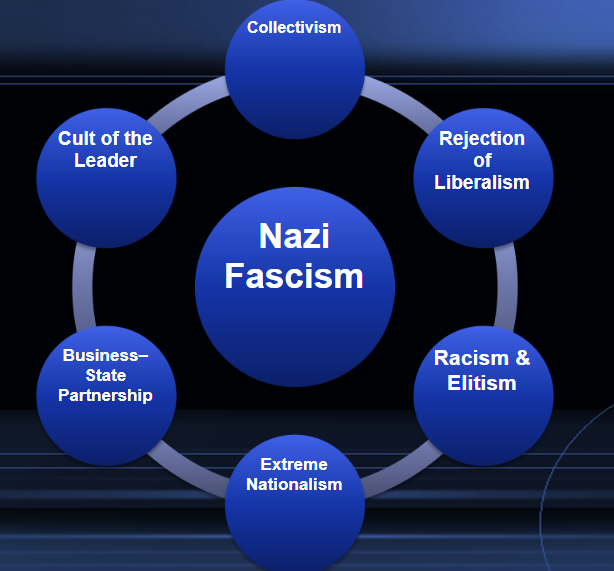
Elitism
Ultra-nationalism(ethnocentric)
racist
Hierarchical Structure
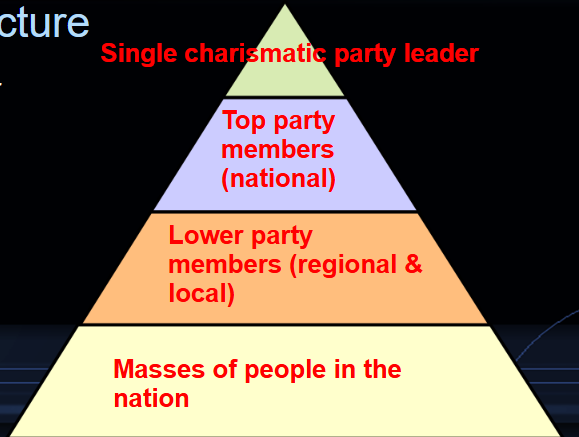
Commonalities
between communism/fascism
New technologies made totalitarianism possible and allowed rulers to maintain an extreme degree of control over their populations
Turned away from the individual and away from limited democratic governments
Both had one party rule (no other political parties allowed)
Both favored a collective, all-powerful state
Germany After WWI
Growth in popularity of fascism
Italy & Germany
Liberal democratic governments seen as weak
Led to WWI
Unable to solve problems of wars aftermath
Harsh terms of Treaty of Versailles
De-industrialization & war reparations
Germany forced to accept sole blame for WW 1 – and all financial liabilities
Germany loses territory
Led to cut military to almost nothing, Rhineland forcibly occupied
Weakness of Weimar Republic
Massive unemployment
Drop in living standards
Hyperinflation
Interwar Years
Germany in the 1920’s was in political chaos. There was no clear leadership and many people vying for power.
On top of this, there was a great fear of communism.
Things only worsened when the Great Depression hit in the 1930’s. Germany was in desperate need of a solution to her problems.
Blame Game
Germany: A Defeated Nation
Humiliation, resentment, fear over losing the war & over the Treaty of Versailles
Germany Rejects Liberal Values:
Democratic gov’t blamed for losing the war and signing the Treaty of Versailles
WW1 victors were all Liberal nations – easy targets of blame for both left and right wing extremist groups
Economic Depression
Treaty of Versailles - $33B reparations made an already weak economy worse
Production halted by crisis in the Ruhr 🡪 massive inflation/unemployment
U.S. helped temporarily – but 1929 Crash sent economy tumbling again
Hitler & Nazis blamed greedy corporations, Jewish financiers, and the government
Adolf Hitler
Born in Austria in 1889
Fought in WWI
Beliefs about supremacy of German race formed
Fascists very aware of ethnic distinctions
Want their nation or group to be dominant
Eugenics/Social Darwinism
Beer Hall Putsch
Hitler now leader of National Socialist or Nazi Party
Tries to seize power in coup in Munich Beer Hall
Fails and Hitler is placed in jail
Lacks military support
Rise to Power
Hitler is released from jail in just eight months. He uses the publicity to draw attention to the Nazi cause and gain the support of more followers.
Taking Control of Government
Nazi Party continues to gain popularity
Hitler only party leader with decent solutions for Germany
Fascists believe society has a shared purpose
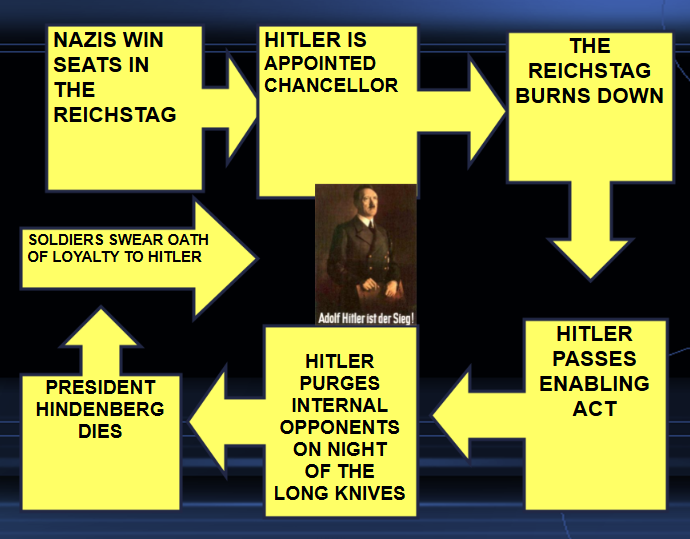
In 1933 – Hitler was made Chancellor out of a belief that his popularity would unify a dysfunctional Reichstag.
Death of President Hindenburg
Removed the only other politician that rivalled Hitler’s popularity.
After Hindenburg’s death, Hitler combines the roles of chancellor & president and becomes “fuhrer” (leader)
already used to Authoritarianism
Germany unified under centralized rule of The Bismarck – many saw authoritarian governments as benevolent
Nazis promoted values that many Germans longed for and embraced after the social and economic chaos following WW1:
NATIONALISM (pride)
MILITARISM (strength)
LAW AND ORDER (stability and safety)
Reichstag Fire
Reichstag burned down – driving Germans into a panic
A “communist” was found nearby, who “confessed” to setting the fire.
Hitler called the fire a Communist plot to overthrow the Government.
Hitler had the Communist Party banned, eliminating his main political opponents.
Enabling Act
Gave Hitler executive (absolute) control
Hitler justified it by saying he needed sweeping powers to protect Germany from its enemies.
Many in the disagreed but intimidation from the SA brown-shirts forced them to conform – Act was passed with only 91 against
Enabling Act gave Hitler the right to enact law by decree for four years and gave police extraordinary powers
Hitler’s first act was to ban political parties, claiming they were a threat to national security
Night of the Long Knives
took place between June 30TH and July 2nd 1934.
Hitler moved against the SA – who had begun challenging his leadership and demanding more power. Hitler also targeted more conservative elements who disagreed with his policies.
Over 100 people were killed for political reasons by the “Blackshirt” SS and Gestapo – more than 1000 were arrested and sent to prison camps.
Oath of Loyalty
Every soldier in the military was then required to swear an oath of loyalty to Hitler.
Nazi Germany
Nazi fascism
first
____ step of Hitler’s rise to power
NAZIS WIN SEATS IN THE REICHSTAG
second
____ step of Hitler’s rise to power
HITLER IS APPOINTED CHANCELLOR
third
____ step of Hitler’s rise to power
THE REICHSTAG BURNS DOWN
fourth
____ step of Hitler’s rise to power
HITLER PASSES ENABLINGACT
fifth
____ step of Hitler’s rise to power
HITLER PURGES INTERNAL OPPONENTS ON NIGHT OF THE LONG KNIVES
sixth
____ step of Hitler’s rise to power
PRESIDENT HINDENBERG DIES
seventh
____ step of Hitler’s rise to power
SOLDIERS SWEAR OATH OF LOYALTY TO HITLER
Nuremburg Laws
“Denaturalization” laws that were used as a basis for racial discrimination against Jewish people
Some laws included:
Marriages between Jews and citizens of German or kindred blood is forbidden. Marriages concluded in defiance of this law are void, even if concluded abroad.
intercourse between Jews and subjects of the state of Germany or related blood is forbidden
Jews are forbidden to display the Reich and national flag or the national colors
Kristallnacht
On November 9, 1938 a massive coordinated attack on the Jews occurred through the German Reich.
Mob violence broke out as the regular German police stood by and crowds of spectators watched.
Nazi storm troopers, along with the SS, beat and murdered Jews, destroyed their businesses and homes, and terrorized and tortured Jewish women and children. 25,000 Jewish men were sent to concentration camps..
Warsaw Ghettos
first established in 1940 when its estimated population was 440,000 but as people were deported to concentration camps the population decreased to about 70,000
It was filled with disease and starvation and the people who lived within it were in constant fear of random killings
The Warsaw ghetto was the largest of all the ghettos in which Jewish people were sectioned off from the rest of the population.
Death Camps
Used for the sole purpose of executions
Largest camp was Auschwitz-Birkenau (also used as a work camp)
Prisoners were executed mainly in gas chambers and mass shootings
Concentration Camps
Were built to torture the people within and use them as cheap labor
Housed political prisoners and “undesirables” (Jews, homosexuals, outspoken journalists)
Camps became larger to house more prisoners after the start of WWII and became more violent
Nazi doctors began using prisoners for medical experiments
Holocaust
“Final Solution” - liquidation of all Jews, Gypsies, and most Slavs in Europe. (including opponents of the Nazis)
Death camps were created to rid the Third Reich of “the unwanted”.
To kill Jews, Romas, Religious Leaders and other Dissenters, Homosexuals, Disabled People, and all non-whites
Auschwitz (12,000/per day)
67% (6M) of Jewish population in Europe annihilated. 90% in Poland and Germany
Explore top notes

