IB Chemistry - SL Topic 2
0.0(0)
Studied by 0 people Call Kai
 Learn
Learn Practice Test
 Spaced Repetition
 Match
Match Flashcards
 Knowt Play
Card Sorting
1/54

Last updated 10:27 AM on 10/30/22
Name | Mastery | Learn | Test | Matching | Spaced | Call with Kai |
|---|
No analytics yet
Send a link to your students to track their progress
55 Terms
1
New cards
Dalton's theory that remains true
1. All matter (materials) consist of very small particles called atoms.
2. An element consists of atoms of one type only.
3. Compounds consist of atom of more than one element and are formed by combining atoms in whole-number ratios.
4. In a chemical reaction atoms are not created or destroyed.
2. An element consists of atoms of one type only.
3. Compounds consist of atom of more than one element and are formed by combining atoms in whole-number ratios.
4. In a chemical reaction atoms are not created or destroyed.
2
New cards
Rutherford's gold foil experiment (1909)
1. The nucleus is very small compared to the rest of the atom.
2. There is lots of space in the atom.
3. All the positive charge is concentrated in the small nucleus.
2. There is lots of space in the atom.
3. All the positive charge is concentrated in the small nucleus.
3
New cards
Number of subatomic particles
3
4
New cards
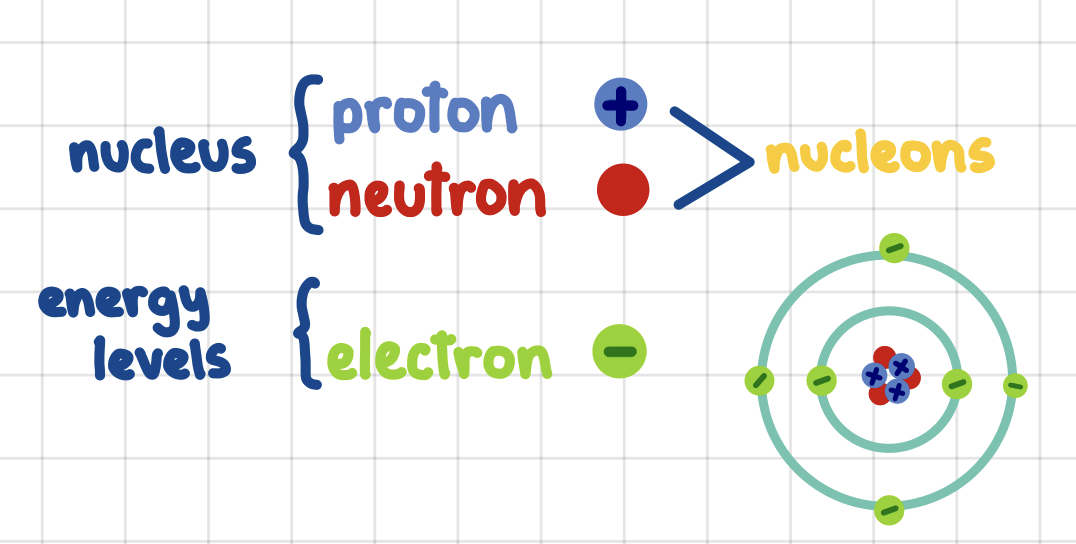
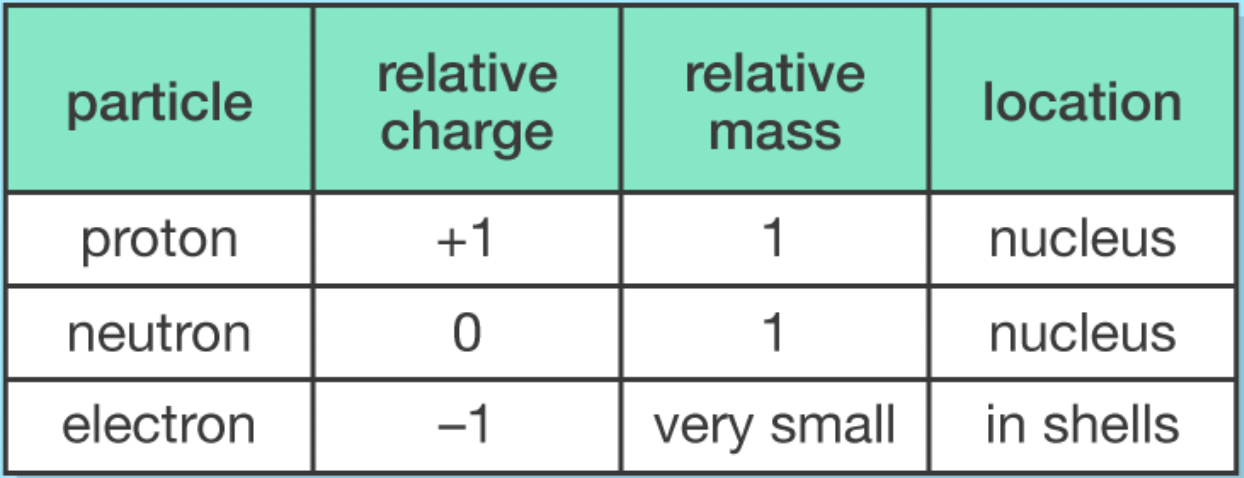
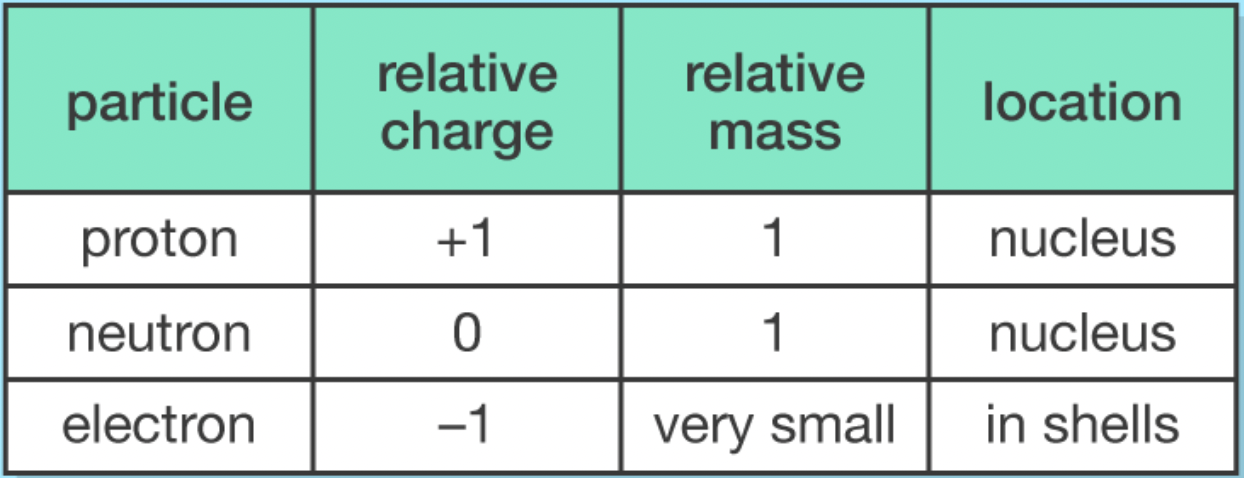
Subatomic particles, location and charge
proton (+) - nucleus
neutron ( ) - nucleus
electron (-) - energy levels
neutron ( ) - nucleus
electron (-) - energy levels
5
New cards
protons + neutrons
nucleons
6
New cards
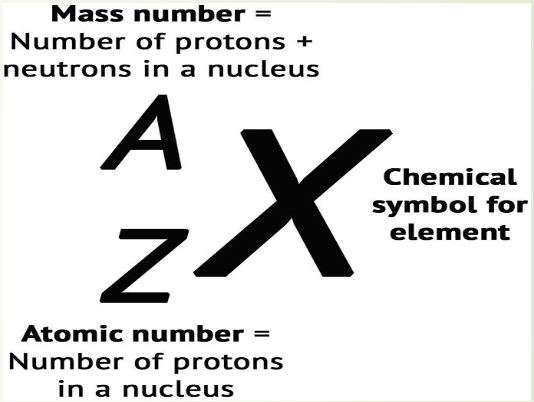
The number of protons in the nucleus of an atom.
atomic number
7
New cards
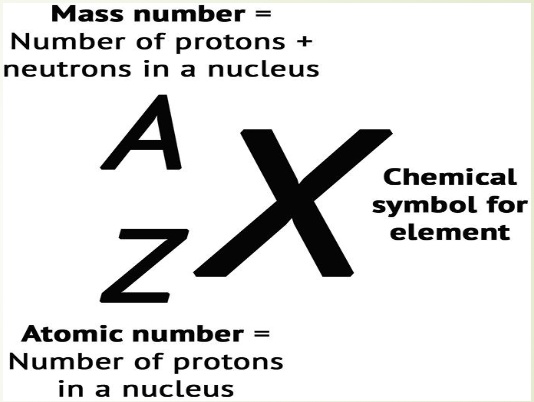
The number of protons plus the number of neutrons in an atom.
mass number
8
New cards
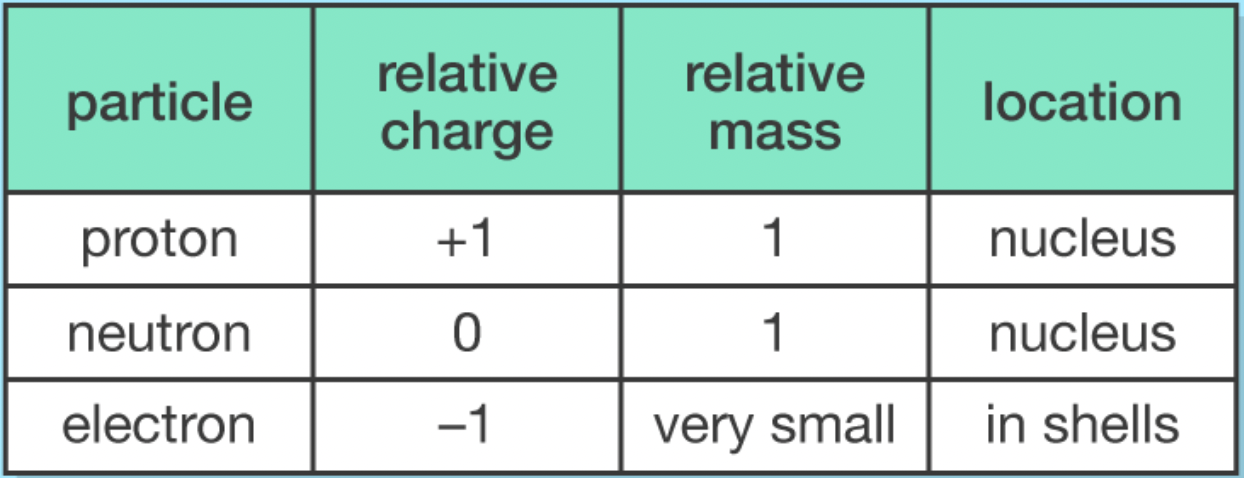
The subatomic particle with a relative mass of 1 and a relative charge of +1.
proton
9
New cards
The subatomic particle with a relative mass of 1 and no charge.
neutron
10
New cards
The subatomic particle with a relative mass of 0 and a negative charge.
electron
11
New cards
Atoms with the same atomic number but different atomic mass.
isotopes
12
New cards
This device is used to determine the relative atomic mass of an element by separating it's isotopes according to the m/z value.
mass spectrometer
13
New cards
Stage 1 of a mass spectrometer, where an atom or molecule is turned into a gas.
vaporization
14
New cards
Stage 2 of a mass spectrometer, where an atom or molecule is stripped of an electron.
ionization
15
New cards
Stage 3 of a mass spectrometer, where positive ions increase their speed when moving through an electric field.
acceleration
16
New cards
Stage 4 of a mass spectrometer, where positive ion are sent through a magnetic field.
deflection
17
New cards
Stage 5 of a mass spectrometer, where positive ions generate an electrical signal when they strike a sensor.
detection
18
New cards
The particle of energy that is released when electrons fall from a higher energy level to a lower energy level.
photon
19
New cards
The type of energy released when an electron falls from a higher energy level to the n=1 energy level.
UV
20
New cards
The type of energy released when an electron falls from a higher energy level to the n=2energy level.
visible light
21
New cards
The type of energy released when an electron falls from a higher energy level to the n=3 energy level.
IR
22
New cards
This term describes how energy levels get closer together as we move away from the nucleus of an atom.
convergence
23
New cards
This type of spectrum contains all frequencies/wavelengths/energies of waves.
electromagnetic spectrum
24
New cards
This type of spectrum contains all colors/wavelengths/frequencies/energies of visible light.
continuous spectrum
25
New cards
This type of spectrum contains specific/discrete colors/wavelengths/frequencies/energies of visible light on a black background.
line spectrum
26
New cards
An atom or ion with all it's electrons in the lowest energy levels possible.
ground state
27
New cards
An atom or ion with some electrons in higher energy levels.
excited state
28
New cards
This principle states that electrons fill the lowest energy levels first.
Aufbau principle
29
New cards
This principle states that any orbital can hold a maximum of two electrons and these electrons have opposite spin.
Pauli exclusion principle
30
New cards
The rule states that 1 electron must be placed in each orbital or equal energy before 2 electrons can be placed in a single orbital.
Hund's rule
31
New cards
The electrons found in the outermost energy level.
valence electrons
32
New cards
All the electrons not in the valence energy level.
core electrons
33
New cards
The electron arrangement of O (oxygen).
2, 6
34
New cards
The electron arrangement of Ca (calcium).
2, 8, 8, 2
35
New cards
The electron arrangement of Ne (neon).
2, 8
36
New cards
The electron arrangement of O1-.
2, 7
37
New cards
The electron arrangement of Ca1+.
2, 8, 1
38
New cards
The full electron configuration of P (phosphorus).
1s2 2s2 2p6 3s2 3p3
39
New cards
The full electron configuration of Fe (iron).
1s2 2s2 2p6 3s2 3p6 4s2 3d6
40
New cards
The full electron configuration of Cl1-.
1s2 2s2 2p6 3s2 3p6
41
New cards
The full electron configuration of Co3+
1s2 2s2 2p6 3s2 3p6 4s0 3d6
42
New cards
The electron configuration of Cr (chromium), using a noble gas core.
[Ar] 4s1 3d5
43
New cards
The electron configuration of Co(cobalt), using a noble gas core.
[Ar] 4s1 3d7
44
New cards
The electron configuration of Cu2+, using a noble gas core.
[Ar] 4s0 3d8
45
New cards
The number of unpaired electrons in C (carbon).
2
46
New cards
The number of unpaired electrons in N (nitrogen).
3
47
New cards
The number of unpaired electrons in Ca (calcium).
0
48
New cards
The number of unpaired electrons in F (fluorine).
1
49
New cards
In addition to Cr, Mo, and Cu, this element promotes one electron from the 4s to the 3d to promote stability.
Ag
50
New cards
An atom with the electron configuration of 1s2 2s2 2p6 3s2 3p6 4s0 3d10.
Cu
51
New cards
An atom with the electron configuration of 1s2 2s2 2p6 3s2 3p6 4s2 3d10.
Zn
52
New cards
The weighted average of masses of all isotopes of an element relative to carbon-12.
relative atomic mass
53
New cards
An atom with more electrons than protons.
anion
54
New cards
An atom with more protons than electrons.
cation
55
New cards
An isotope that is radioactive.
radioisotope