Race, Gender and Crime Final Exam
 Studied by 0 people
 Call Kai
 Learn
Learn Practice Test
 Spaced Repetition
 Match
Match Flashcards
 Knowt Play
1/41

There's no tags or description
Looks like no tags are added yet.
Name | Mastery | Learn | Test | Matching | Spaced | Call with Kai |
|---|
No analytics yet
Send a link to your students to track their progress
42 Terms
What is the “school-to-prison pipeline?”
A term for the theoretical “pipeline” of juveniles from schools directly into prisons due to increased likelihood of formal processing…
It describes policies and practices that push students, especially students of color, students with disabilities, and those from disadvantaged backgrounds, out of schools and into the juvenile and criminal justice systems, often for minor infractions instead of using educational interventions, leading to suspensions, expulsions, arrests, and increased dropout rates.
Are girls/women becoming more of a problem/becoming more violent?
Probably not … it is more likely that there has been a change in the way we respond to violence committed by girls. Some possible explanations:
As more women and girls gained more freedom/visibility, there is greater “opportunity” for interaction with the CJ system
For instance, if women were more likely to stay at home in 1950s vs. 1990s, they would probably be less likely to commit/be accused of a crime.
Women are more likely to be called “mentally ill” / “crazy” instead of “criminal” (historically and, to some extent, today) – asylums were more popular for deviant women than deviant men; even today, men’s prisons far outnumber women’s prisons.
What were “tough on crime” policies? Were they helpful or harmful?
“Tough on Crime” policies are often associated with the “war on drugs:”
Richard Nixon declared drugs “public enemy number one” in 1971 – Ronald Reagan expanded many policies related to what he called the “war on drugs.”
Controlled Substances Act in 1971 – Put drugs in “schedules” (i.e. Marijuana as a Sched. 1 substance, meaning that it is the most dangerous/with no known use/value).
Drug Enforcement Agency (DEA) formed in 1973 (replaced and revised the Bureau of Narcotics and Dangerous Drugs)
Introduced mandatory minimum sentences for drug-related charges, even if non-violent (esp. during Reagan presidency), SWAT raids/etc. of “high risk” areas became more common
Targeted efforts to police crack (rock) cocaine more harshly than powder cocaine – long, intentional history of blaming BIPOC for drug-related woes (e.g. Mexican people in 1910s-20s for Marijuana; Black people in 70s-80s for cocaine).
National anti-drug campaigns usually started somewhere in the late 80s/early 90s
Generally, these policies are ineffective at best, harmful/counterproductive at worst
Do prisons prevent crime? What is “recidivism?”
Offenders placed in detention centers more likely to reoffend (recidivate) compared to those placed in treatment facilities or other interventions
Jails/prisons often create more problems than they solve – Criminal records diminish job opportunities, incarceration creates problems with childcare, criminal justice system creates debt (court fees, jail/prison fees, investigation fees…)
For juveniles, they are more likely to be victimized when placed in adult prisons. Juveniles in adult prisons more likely to reoffend compared to those in juvenile centers
What are some other ways to manage adult and/or juvenile offenders?
It’s usually more cost-effective to treat rather than incarcerate – costs about $30,000-$80,000/year to house a prisoner, less than $5,000/year to treat
Drug courts, post-release treatment programs, mental health programs, etc. are all more cost-effective and better at reducing recidivism compared to prisons
Often called diversion programs (because they divert, or redirect, cases away from prisons/courts)
What are “pathways” to offending? (that is, what is the definition of the term “pathways” to offending)?
“Pathways” to offending refer to “risk factors” that increase the likelihood that an individual will offend. “Pathways” language comes from feminist pathways theory in Criminology, a critical/feminist theory from the 1980s that sought to explain why so many female offenders had victimization histories compared to male offenders.
What are some examples of pathways to offending?
Family/ parent in prison
Lack of economic stability
Peers/friends
Substance use/abuse
Exposure to CJ
What are some examples of protective factors for offending?
Protective factors for offending = help to prevent delinquency/offender “close the path”
Family
School achievement
Positive peer relationships
Community involvement
What percentage of cases pursued through the court system end in plea bargaining?
95- 98%
Alternatively, what percentage of cases pursued through the court system end up in a trial?
Less than 10%
What is the purpose of the PSI?
To give a judge comprehensive background information on a convicted defendant to help them determine a fair and appropriate sentence, covering criminal history, personal life, mental health, substance abuse, and victim impact, while also guiding post-sentence decisions like treatment and parole
What are some strengths and weaknesses of using the PSI?
It offers a comprehensive view of a defendant to aid fair sentencing but is subject to issues such as potential inaccuracies and systemic biases.
What are truth-in-sentencing (TIS) policies? What are the strengths and weaknesses of these types of policies?
Mandate that people convicted of crimes serve a large, fixed percentage (e.g., 85%) of their imposed sentence, limiting parole and good-behavior credits, aiming for sentence certainty and justice by ensuring offenders serve their time
What is “judicial discretion?”
A judge's power to make decisions using their own judgment, guided by legal principles, when the law doesn't provide a rigid, specific answer, allows them to tailor justice to a case's unique facts, such as deciding sentencing, custody, or evidence admissibility, ensuring fairness beyond strict rules.
What are some of the core issues faced by women in women’s prisons?
Overcrowding (leads to stress, anxiety, suicidal ideation)
Facility resources are lacking
CJ system is NOT equipped to deal with physical and mental health needs of female inmates
Female inmates have higher rates of mental illness – exacerbated by imprisonment
Medication often used as cure-all
Often prescribed by physicians or nurse practitioners instead of psychiatrists/psychiatric NPs – less “accuracy” with treating disorders appropriately
Limited access to therapeutic interventions
What are “gender-specific needs?”
The unique biological, social, and psychological requirements that individuals have based on their gender
Women in prison are 3.7x more likely to have experienced trauma vs. women in general population
Women in prison have higher rates of mental illness compared to men
45% of women contemplate suicide when receiving life sentences
Physical health needs:
Female inmates more likely to be HIV positive (vs. male prisoners, vs. general population)
Histories of abuse and risky lifestyles means more risk for Hepatitis C or other diseases
Gender-specific drug treatment programs address women’s unique needs and are more likely to be successful
What is it like for children whose mothers end up incarcerated?
Children who have incarcerated mothers face “typical” issues associated with the loss of a parent – grief/loss/sadness, attachment issues, aggression/delinquency
Children with incarcerated parents are more likely to end up in prison themselves
Although nearly 80% of women in prison have children, less than 9% of women in prison will ever be visited by their children.
Do states generally allow for the shackling of incarcerated pregnant women?
23 states do not have laws against shackling incarcerated pregnant women
Even if a state law or federal law restricts the use of shackles during pregnancy, a law is only as relevant as it is able to be enforced
Are prison nursery programs common? In your opinion, are they good ideas or bad ideas?
There is a growing interest in prison nurseries to allow mothers to bond with children for longer before separation … controversial.
Very few prisons have a program like this.
In my personal opinion, I think it would depend on the mother’s crime on whether or not this would be a good idea
Prisons are considered the top provider for which social services? Why?
Housing, food for impoverished
Mental health services for mentally ill
Health services and dental care for those who need it
Some people are so poor that they wouldn’t be able to afford these services otherwise.
Is there a relationship between generational trauma and the way we incarcerate certain people?
Yes, there's a strong relationship: Generational trauma, often stemming from adverse childhood experiences (ACEs) like abuse or neglect, significantly increases the risk of justice system involvement and incarceration, creating cycles where untreated trauma leads to behaviors and mental health issues that can result in imprisonment, impacting future generations through epigenetic changes and family patterns. Trauma reshapes brain development and coping mechanisms, making individuals more prone to substance abuse, emotional disorders, and violence, thereby contributing to higher incarceration rates, especially within marginalized communities.
What are the similarities and differences between parole and probation?
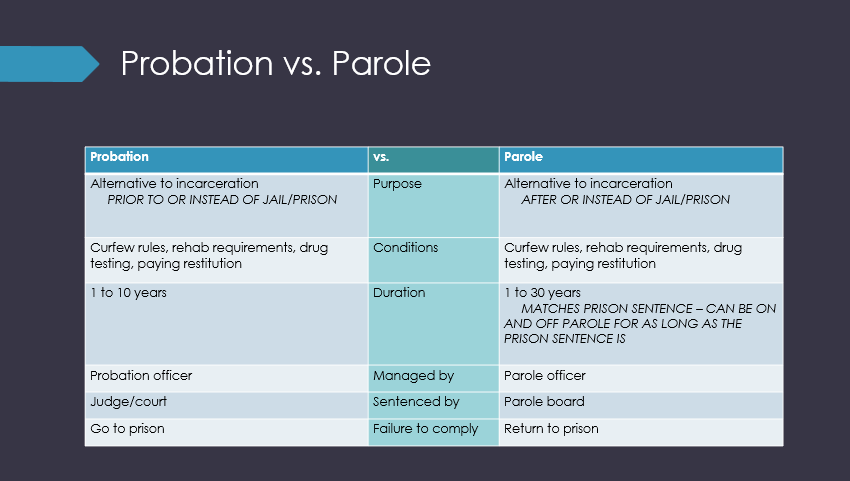
What are some of the common conditions of parole/probation?
Reporting regularly to parole/probation officer
Obeying laws
Submitting to searches
Not possess firearms or use drugs
Avoid excess use of alcohol
Not associating with known criminals
Not leaving jurisdiction of court without approval
Notify officer of change in job/residence
Paying parole/probation fees
What are some of uncommon conditions of parole/probation?
Special conditions required by judge/parole board/etc. as long as related to identifiable correctional objective (p.o. may request conditions)
Urine testing
Psychological treatment
Day center
House arrest
Vocational training
Why do judges sometimes issue unconstitutional conditions of parole/probation?
Judges sometimes impose unconstitutional parole/probation conditions due to a mix of judicial discretion (it's a "privilege, not a right"), a focus on public safety, using broad language, and systemic pressures leading to overly strict or vague rules that don't always align with rehabilitation or constitutional limits, often relying on a flawed "unconstitutional conditions" loophole in criminal law where constitutional rights are less protected.
At what point after release are parolees most likely to violate their parole conditions?
The 1st 6 months after release from prison is the time during which many fail.
Langan and Levin (2002) found that within the first 3 years of release 68% of parolees had been arrested for a new felony (recidivism)
47% were convicted and 25% went back to prison
when you include parole revocations and technical violations with the new felonies 52% of parolees went back to prison
35% of new prison admissions are violators of conditional release – of which 2/3 are returned to prison for technical violations
What is “net-widening” when it comes to probation and other intermediate sanctions?
Probation is considered an “intermediate sanction,” something given before prison.
The biggest issue with the use of intermediate sanctions is “net-widening:” someone who would have received a lesser/no sentence 10-20 years ago would get an intermediate sanction today.
What were the first American police forces in the United States? (recall that they were different for the North vs. the South)
First American police forces in the South were slave patrols, created to seek out Black people who “may or may not” be free – could humiliate, ask for “papers,” and so on
First American police forces in the North were mercenaries, created to protect wares that were moving from city to city
What were some of the ways marginalized people (e.g. Black people, women) were treated when they were police officers?
First Black police officers documented as far back as 1867 in Alabama, but faced an uphill battle in terms of pay, caseload/case type, treatment by fellow officers, etc.
First Black female officer was Georgia Ann Robinson in LAPD, 1911 – advocated for women’s shelter, established the Sojourner Truth Home for destitute women and girls.
Tried to break up a fight between two drunk women, was injured and left permanently blind, could no longer work
BIPOC and policewomen historically not assigned the same duties as white policemen:
Juvenile cases, women’s cases, etc. – fewer and farther between, less commonly reported, taken less seriously
Policewomen in the 1960s had to interpret radio codes and respond to cases on their own – would not be given them by their male peers
Policewomen received different benefits
Paid less even though they had higher levels of education
Were not given the same opportunities for advancement and promotion
What does the research show about the motivation for most people who become officers?
Research shows most people become police officers driven by a mix of altruism (helping others, making a difference), economic factors (job security, benefits, pay), and intrinsic desires for excitement, variety, and community connection, often influenced by personal experiences or family legacy, though societal shifts and media scrutiny are impacting these traditional motivators.
In what ways might the culture of policing be stressful on officers?
Studies on both police and correctional officers have found that all are concerned for their own safety and livelihood – just as susceptible to media over-inflation of “the crime problem” (see The Kill Zone qualitative book
Extremely stressful jobs; police officers among the most likely to commit suicide of all professions
Why would officers have some of the highest rates of suicide out of any professional career?
Due to a combination of intense occupational stressors, a workplace culture that discourages seeking help, and practical risk factors like access to firearms. These factors lead to increased rates of mental health issues such as depression and post-traumatic stress disorder (PTSD) compared to the general population.
What are some of the reasons law enforcement is facing a nationwide recruitment/hiring shortage?
It is a general trend that the workforce is aging, and many different areas are dealing with large numbers of retirements all at once.
The public perception of LEOs is probably at an all-time low, particularly since 2020 and the police brutality that was heavily streamed on social media.
The job market is very competitive – younger workers favor remote work, flexible schedules, work-life balance, and competitive retirement benefits.
Violent crime rates have also been decreasing steadily since the 1990s. Even with a slight jump in 2020, the trends have returned downward
Does a college education make police officers more or less likely to engage in discretionary stops and arrests?
A study of more than 60,000 police traffic stops found that college-educated officers were more likely than other officers to stop drivers for less serious violations, perform consent searches, and make arrests on discretionary grounds.
These results are consistent with those of prior research indicating that college educated officers are more achievement-oriented and eager for advancement based on the traditional performance criteria of stops, searches, and arrests.
What are Sovereign Citizens?
It was a social movement that started in the 1970s in America.
They believe in individual sovereignty – that is, the individual has ultimate authority over themselves. Thus, they argue that courts have no actual jurisdiction over people.
SovCits are usually populated by extremists of all kinds:
Religious extremists, tax evaders, activists, racists, radical environmentalists…
Often engage in a wide variety of strange/disruptive behavior, ranging from frivolous lawsuits to harassment and domestic terrorism.
Often believe that birth certificates, licenses, etc. ensure agreement to being part of a corporation/the government/whatever, and as such, often carry illegitimate documents.
Do most criminal cases result in a trial? Why or why not?
The vast majority of criminal cases do not result in a trial; they end via plea bargaining. In fact, if every cause went through a lengthy trial even when the outcome was inevitable, our courts would be even more bogged down than they already are (as evidenced by the Darrell Brooks trial, which took WEEKS to get through with Brooks exercising his full rights to a trial).
What does it mean to say that our criminal justice system is designed to protect the rights of the accused?
In a criminal case, the prosecutor’s job is to prove “beyond all reasonable doubt” that the alleged crime occurred.
In other words, there must be no other reasonable explanation that can come from the evidence presented at trial.
The person accused (defendant) is presumed innocent until the prosecutor otherwise proves this point. This is why, despite all the overwhelming evidence that Darrell Brooks did, in fact, drive a van through a crowd at the parade, he was still entitled to a lengthy criminal trial (four weeks long).
Do criminal defendants have the right… to testify (or to not testify) in their own trials?
Yes, they have a right to testify in their own trial
Do criminal defendants have the right… to have legal representation (or not) in their own trials?
Yes, they have a right to have a lawyer if they want but also have the right to defend themselves
What does it mean to argue “self-defense” in a homicide case?
Sometimes, those who are accused of murder will argue self-defense as a mitigating factor (bringing the charge down from a homicide charge to something like a manslaughter charge).
Whether a homicide (murder) is considered 1st degree, 2nd degree, etc. usually depends on the intent
1st degree usually refers to premeditated, deliberate murder; 2nd degree would be knowingly/intentionally but without premeditation, etc.
Manslaughter is a lesser charge than murder because intent is different –
Voluntary manslaughter = “crime of passion,” self-defense, etc.
Involuntary manslaughter = killing because of the perpetrator’s negligence (like having a violent dog off-leash, or knowingly serving an allergen at a restaurant).
In other words, if a defendant is able to successfully argue self-defense, does this mean all of their criminal charges go away?
No, it just brings the charge/s down
What kind of argument is the gay panic/trans panic defense?
The “gay panic defense” is a nickname used when individuals who are accused of murdering a gay individual argue that they were provoked (for instance, by arguing that the gay person made “indecent advances” which provoked a “panic,” and manslaughter was the “natural reaction”).
By using the “gay panic” defense, the defendant relies on the judge/jurors’ beliefs that it would be a reasonable reaction to kill someone if they “tricked” you with their sexual orientation
Similar defense: the “trans panic” defense
 Note
Note  Flashcards (21)