HE 10 : Horizontal product differentiation -Karteikarten | Quizlet
 Studied by 0 people
 Call Kai
 Learn
Learn Practice Test
 Spaced Repetition
 Match
Match Flashcards
 Knowt Play
1/22

There's no tags or description
Looks like no tags are added yet.
Name | Mastery | Learn | Test | Matching | Spaced | Call with Kai |
|---|
No study sessions yet.
23 Terms
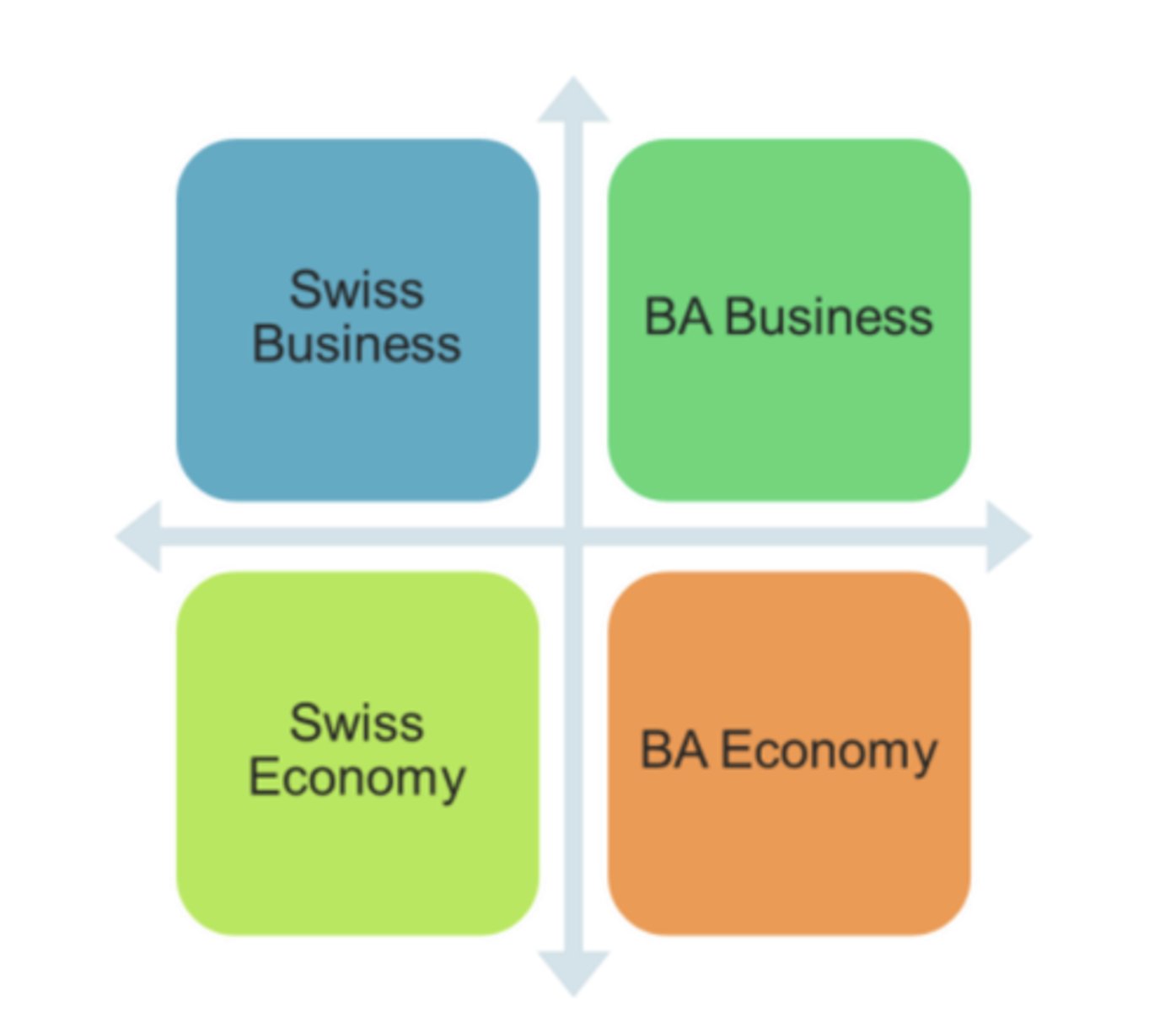
Is it necessary to offer different products in monopoly ?
Doesn't make sense to sell a different product than the competition because there is no competition
If two products are sold at the same price : if no consensus on which is preferred ? If consensus ?
If no consensus : horizontal product differentiation
If consensus : vertical product differentiation
Two important points ?
- Preferring one product because of price is no differentiation
- Horizontal product differentiation suggests relative consumer preference while vertical product differentiation suggests absolute consumer preference.
What is a product ? Consequence
Set of utility-bearing attributes, namely the attributes that consumer value and firms are able to deliver
If two product A and B have the same attributes, there is no differentiation (just need 1 difference)
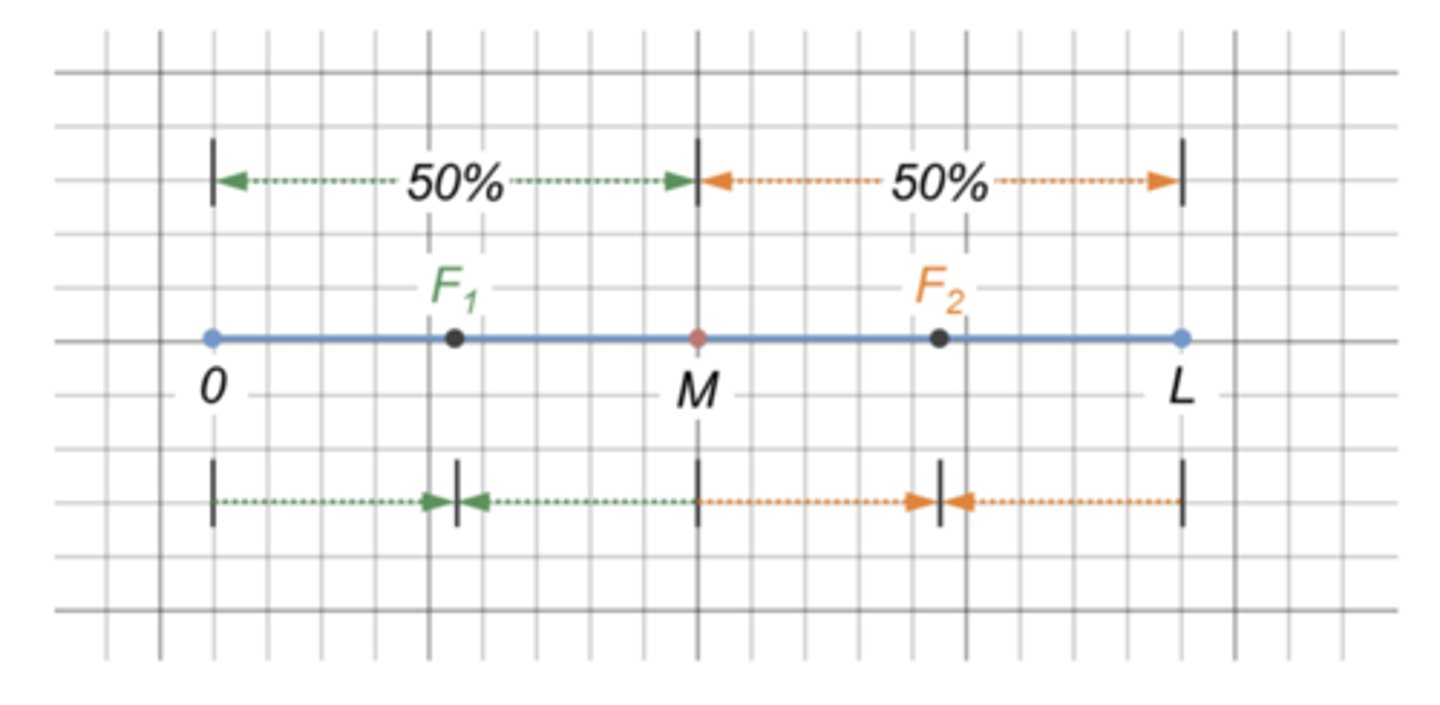
What is the Hotelling model ? Consequence ? What is the market represented with ?
Model assumes two firms produce the same product and compete in the same market (duopoly)
Allow to study the strategic behaviour of firms (firm makes decisions bases on the other's behaviour)
An L miles long street with uniformly distributed consumers
Assumptions Hotelling model for supply side ?
• Both sell the same product but their locations could be different
• Both have no constraint of production capacity
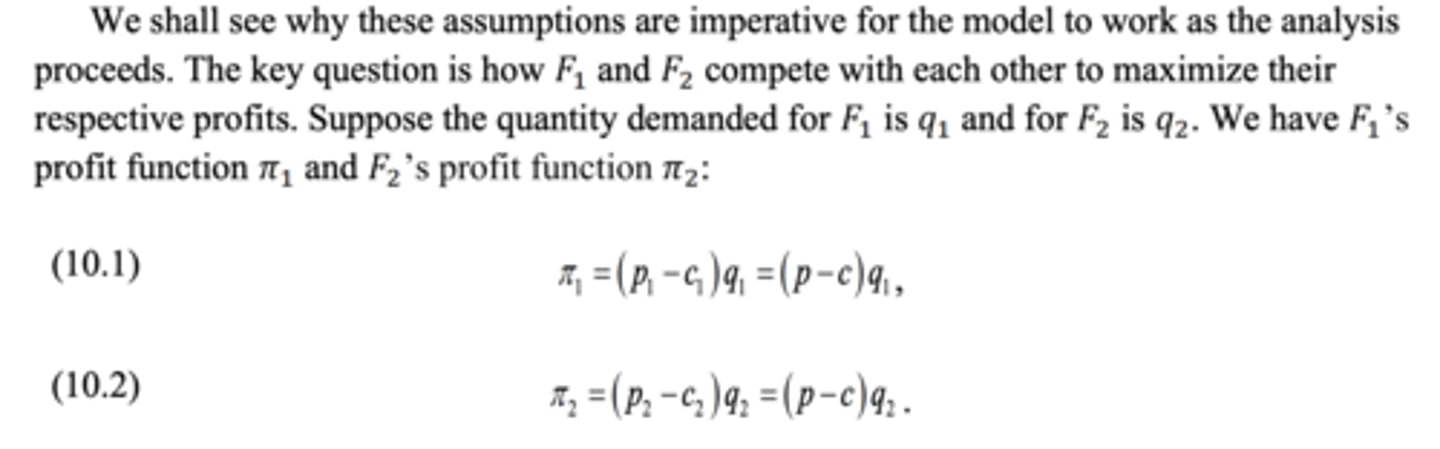
• Both have the same constant marginal cost: 𝑐1 = 𝑐2 = 𝑐
• Both charge the same price: 𝑝1 = 𝑝2 = 𝑝
Assumptions Hotelling model for demand side ?
• Consumers are uniformly distributed along the street
• Each consumer encounters the same transportation cost: 𝑡 per mile (𝑡 > 0)
• Each consumer has the same willingness to pay above or equal to the market price
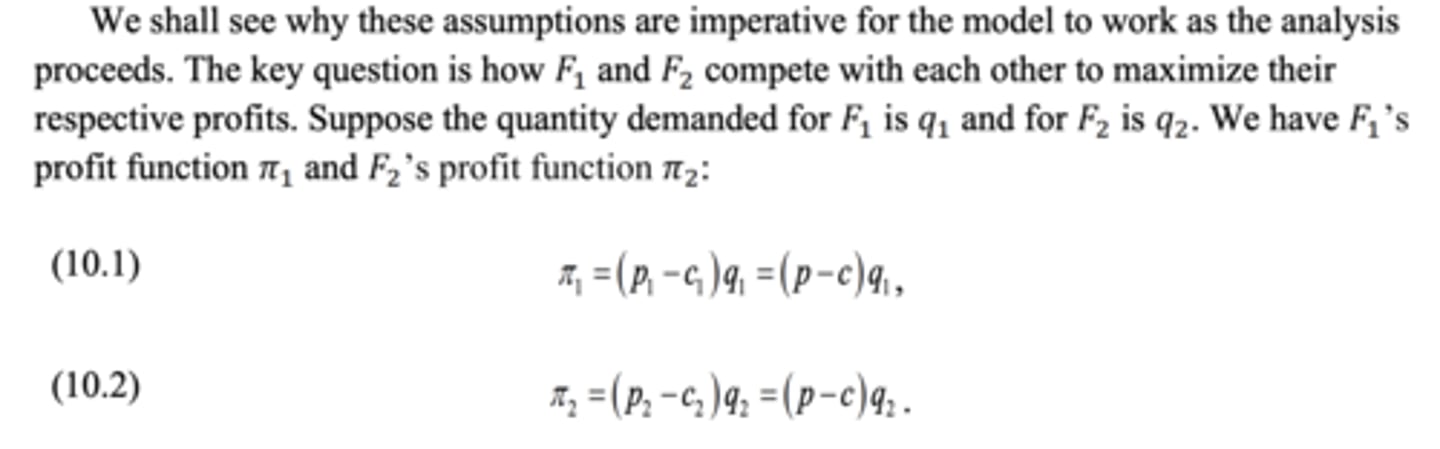
What is the only difference between the two firms ? Total market demand ? Profit maximisation ?
The quantity demanded
q1 + q2
Maximisation of the market share of each firm (depends of the position on the street)
Hotelling model and differentiation ?
As long as firm choose a similar location on the street, regarding of that location the product will be identical
But if different location then there is differentiation based on location
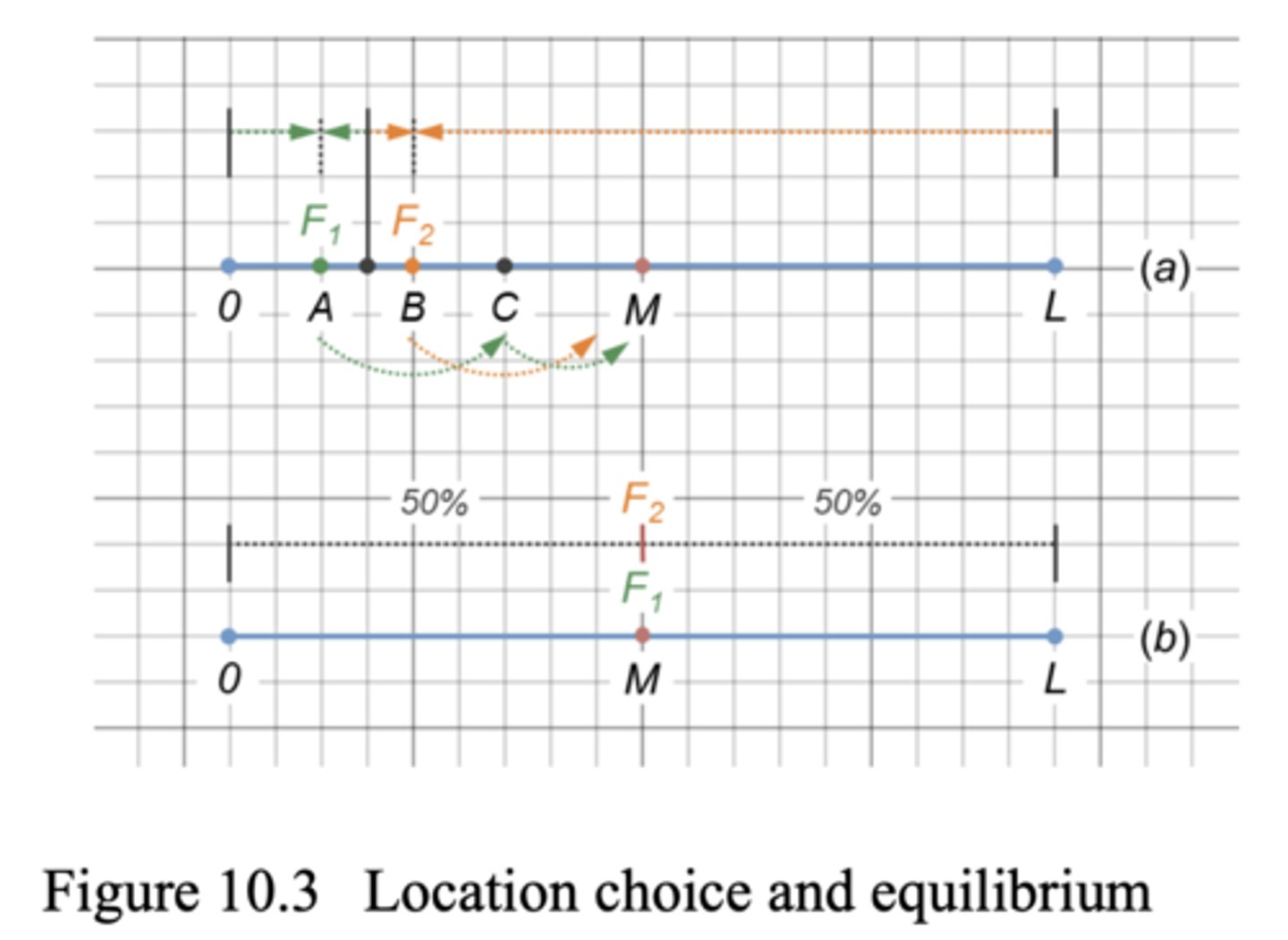
When is an equilibrium achieved ?
When F1 and F2 located at the same position, hence the center of the street because the products are no different in this case (no location differentiation)
What happens once the same location has been chosen ?
Since the two products are the same, the only way to compete is through pricing, both will reduce the price till attaining the marginal cost :
This leads both to charge a price equal to their marginal cost, 𝑝1 = 𝑝2 = 𝑐, which suggests 𝜋1 = 𝜋2 = 0.
What is minimum product differentiation ? What does location equilibrium suggests ? Consequences ?
• Minimum product differentiation is not unique: in any given period, two products may be in various cases of minimum product differentiation, but may not be stable
• Location equilibrium suggests the unique minimum product differentiation in the long run where 𝐹1 and 𝐹2 are located back to back in the center
• Minimum product differentiation leads to zero market power: 𝑝1 = 𝑝2 = 𝑐
• Minimum product differentiation leads to zero economic profit: 𝜋1 = 𝜋2 = 0
What does the distance between F1 and F2 measures ?
The level of differentiation
Characteristics of maximum product differentiation ?
• Maximum product differentiation is unique, because only when the two firms are located at the two ends of the street, can the difference between the two be maximized
• Maximum product differentiation is not stable, because it is not in the location equilibrium
• 𝐹1 and 𝐹2 each obtains 50% of the market share, but consumers have preference
Maximum product differentiation and pricing ?
Firms still have an incentive to lower their prices to steal the market share
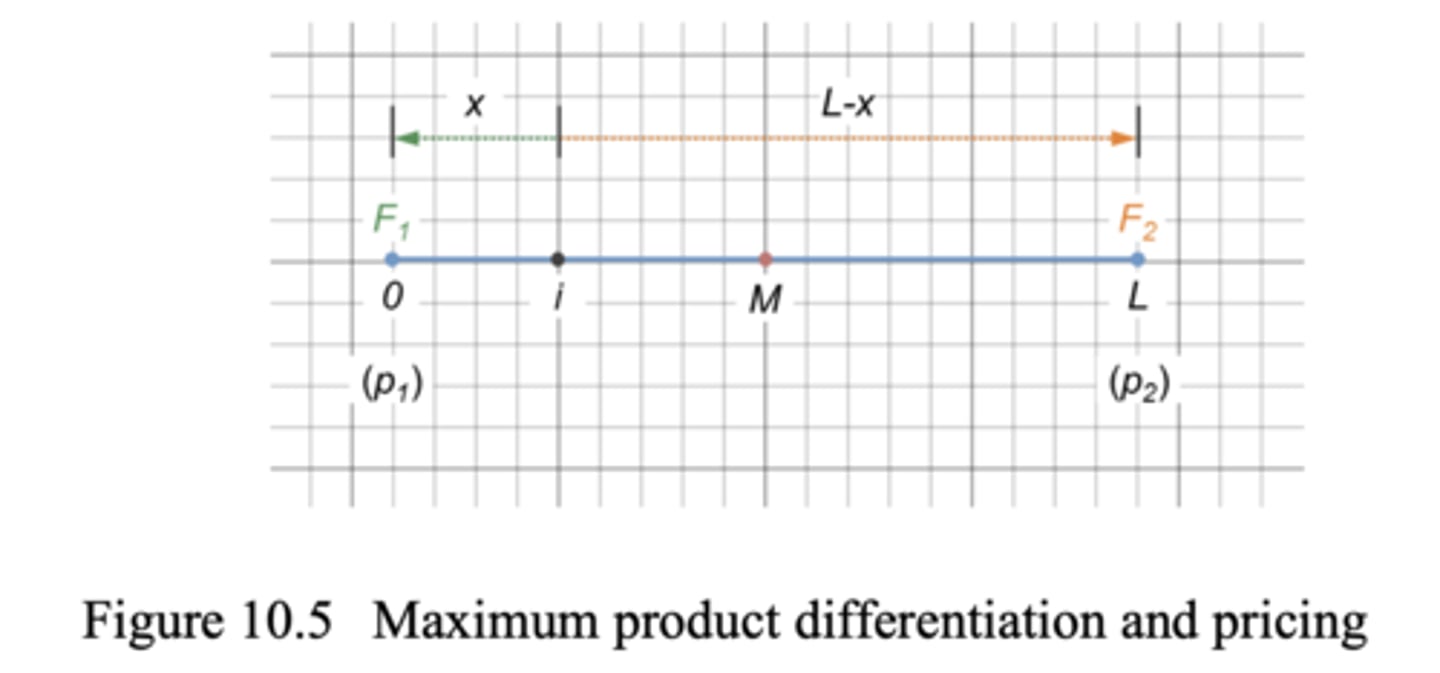
Once a price equilibrium is set, there is somewhere a customer i that is indifferent to buying from F1 or F2
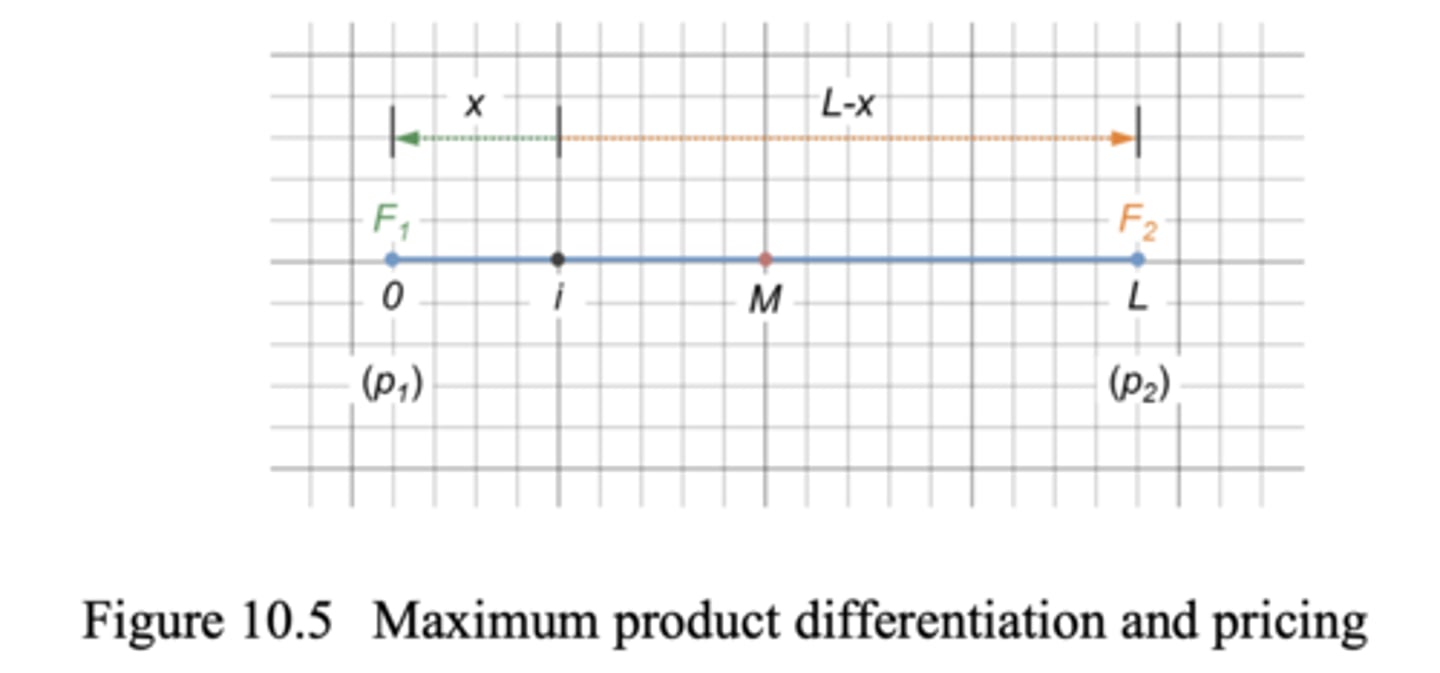
Consequence of this indifference ?
- Consumer on the left of i prefer F1, the ones on the left F2 :
• Quantity demanded for 𝐹1: 𝑞1 = 𝑥
• Quantity demanded for 𝐹2: 𝑞2 = 𝐿 − 𝑥.
- Buying from either firm will bring the same consumer surplus (Willingness to pay r is the same)
Conclusion product differentiation ?
• Product differentiation leads to market power: 𝑝1 = 𝑝2 > 𝑐;
• Product differentiation leads to positive economic profit: 𝜋1 = 𝜋2 > 0
• Price depends on the two constants 𝐿 and 𝑡, excluding marginal cost; and
• Profit also depends on 𝐿 and �
Why do consumer have a preference ?
Because there is a distance / transportation cost
What does L measures ?
Dispersion of consumer preference on location, namely the extent to which consumer preference is spread on location
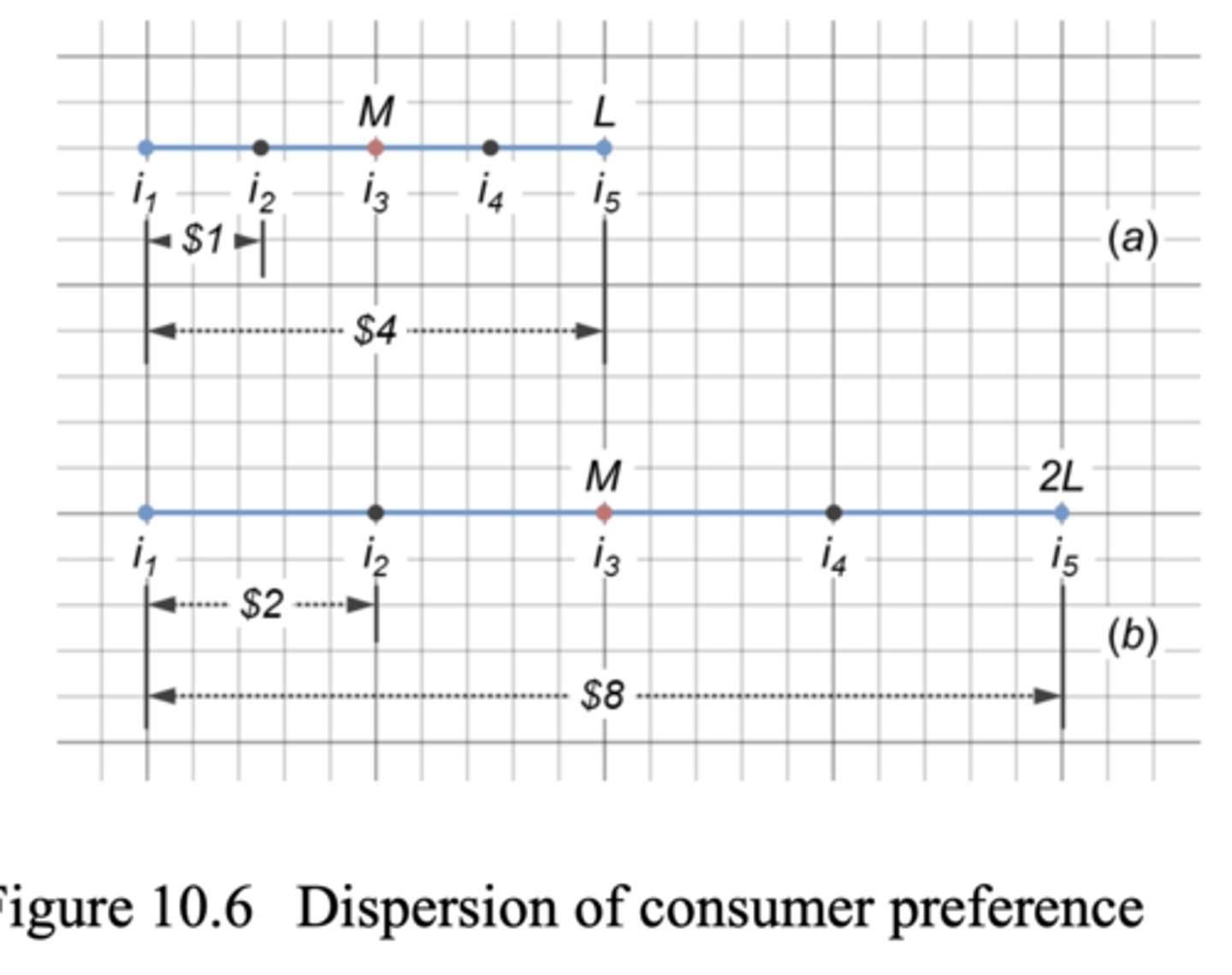
Two extremes of L ?
If L = 0 : Consumers wouldn't be able to have any preference for any location whatsoever, regardless of t
if L = infinity : any two different locations, no matter how close they are, will be perceived extremely different
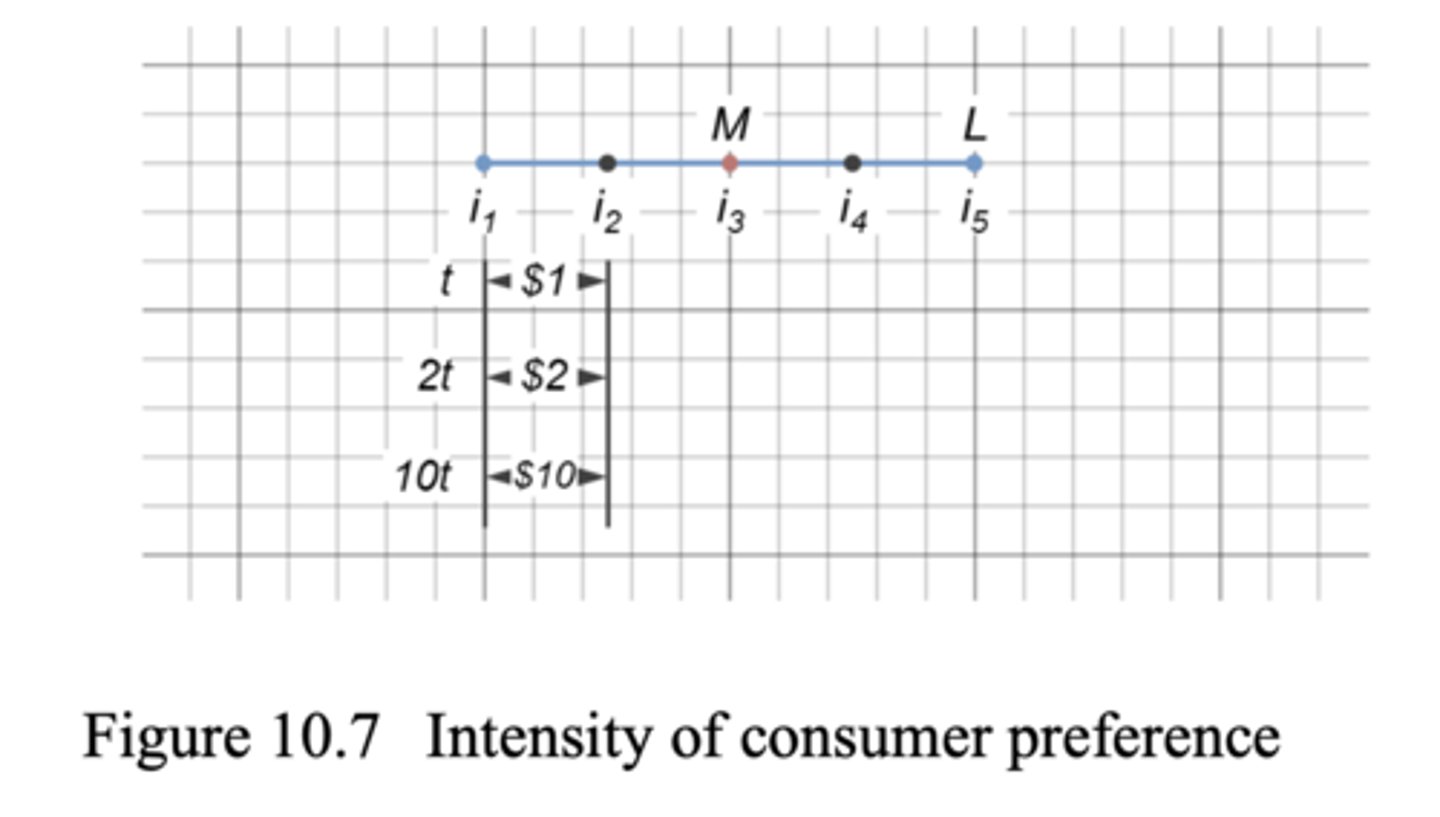
What does t measures ?
Intensity of consumer preference on location, namely the extent to which a consumer would stick to his own location against other locations
Consequence of increasing t ? if t = 0 ? If infinite ?
By increasing 𝑡, the consumer prefers his own location more than before, so his preference for a particular location is intensified.
Consumers can travel to anywhere at a zero cost, regardless of how distant the destination is, no longer intensity of customer preference on location
Transportation cost is infinitely large, then any two different locations, no matter how close they are, will also be perceived extremely different
When do consumer have no preference for location ? Consequence ?
When either L or t = 0
No way two firms can differentiate their products by choosing different locations
 Note
Note  Flashcards (40)