Discourse Features (Spoken Texts)
 Studied by 0 people
 Call with Kai
 Learn
Learn Practice Test
 Spaced Repetition
 Match
Match Flashcards
 Knowt Play
1/31

There's no tags or description
Looks like no tags are added yet.
Name | Mastery | Learn | Test | Matching | Spaced | Call with Kai |
|---|
No study sessions yet.
32 Terms
Openings
Ways to open up a discourse or chat
Differ depending on text type, setting and relationship between participants
Opening Types
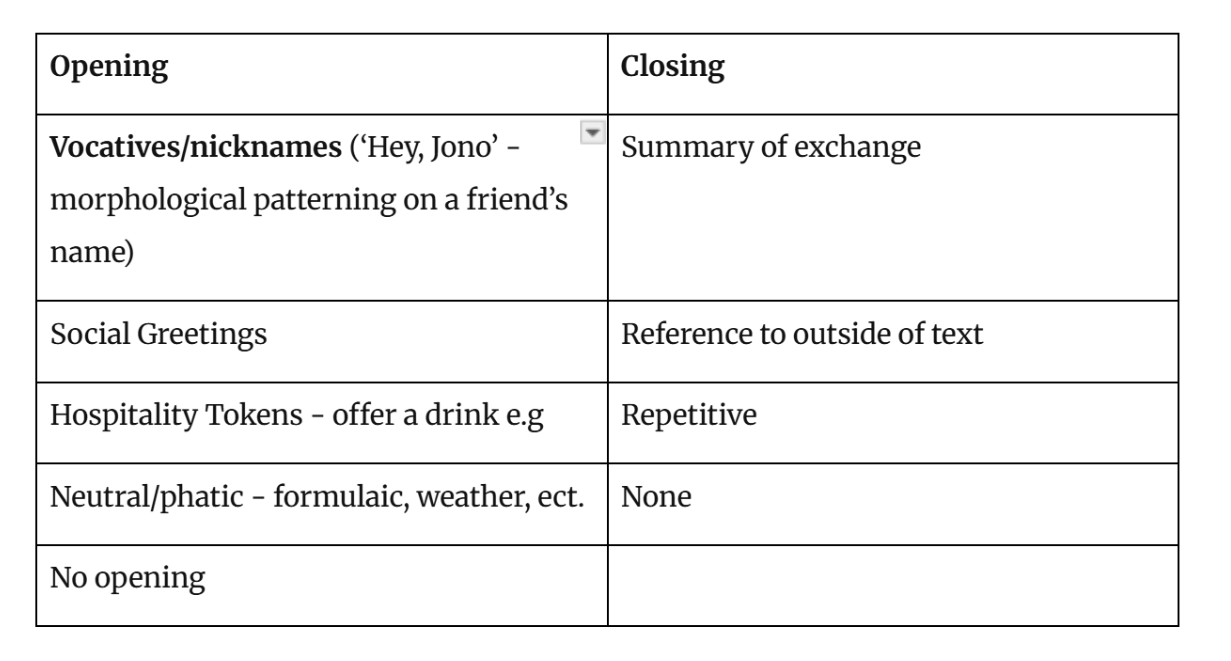
Neutral/Phatic Opening
Focused on building social rapport than to provide information
Low risk conversation starters
e.g. “How’s the weather today?”
Vocatives/Nicknames
Using someone’s name or nickname to get attention
“Hey, Jono” → shows familiarity and closeness
The note about hypocristic suffixation means changing a name (e.g. Jon → Jono)
Vocatives - reflective of a close social distance and intimate tenor - colloquial nature may imply familiarity and endearment
Social greetings
Standard greetings used to acknowledge someone
“Hi”, “Hey”, “How are you?”
These are often phatic (social, not informative)
Hospitality tokens
Polite offers that show friendliness
“Do you want a drink?”, “Grab a seat”
Common when someone enters a space
No opening
Conversation starts straight into content
“Did you finish the assignment?”
Common between close friends or in urgent contexts
Indicative of intimacy and close distance
Closings
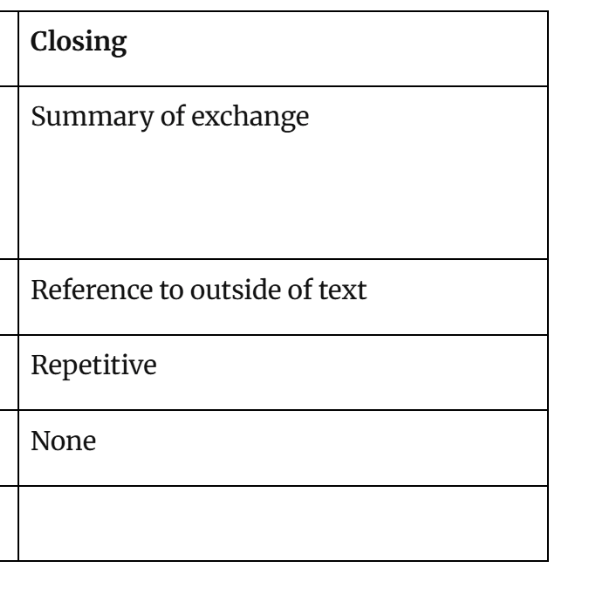
Summary Of Exchange
a brief restatement of what has been agreed, decided, or discussed, used to close the interaction and allow participants to disengage.
e.g. “So, I’ll see you at three?” - the conversation was regarding this - it summarizes the verdict of the conversation
Reference To Outside The Text (Unclear)
Refers to something beyond the contents of the discourse, and uses it as a closure
e.g. “I’ll message you later”
Repetitive
Using repeated words to ease out of a conversation
e.g. “Yep, yep, cool.” - Marks end of conversation
e.g. “Alright alright.”
Avoids abrupt ending - softly disengages - verbal fade-out
No closing
No marked closing - is abrupt and uncalled for
Speakers are very familiar
The interaction is interrupted
The context is urgent or casual
Unplanned/Spontaneous Closing/Opening
Informal - often more close and intimate
Rehearsed (Robotic) and Practiced Openings/Closings
Formal - Is more distant
No opening/closing (example)
In online group chats
Is culturally understood that there is no distinct need for a distinct opening or ending
Non-Fluency Features (FOPPRR)
False Starts, Overlaps, Pauses, Pause Fillers, Repairs & Repetition
False Starts
A speaker starts a phrase, but suddenly switches up in between to complete another sentence/phrase
e.g. “I am (.) We are very sorry for your loss".”
The “I am” is incomplete
Signals spontaneity and is a mistake
Overlaps
One speaker talks over another (is indicated by [ ] )
Cooperative Overlaps
The other speaker talks over them but is in agreement of what the other speaker is saying
e.g. “Bro the person in the far right - [I know yeah!] - is so weird.” - Complements the speaker
Attends to positive face
Non-cooperative Overlaps (Interruptions)
Forceful interruptions to take over the floor - one wants to control the conversation
Reflects social hierarchy
e.g. Being interrupted by the teacher
Can challenge positive face/challenge negative face
Pauses
(.)
For hesitation, tentativeness, shyness and indication for someone else to speak
Pause Fillers
Uhh, ummm, ah, ermmm
Trying to hold onto the floor, or think aloud
Hinting that the speaker has more to say
Repairs (Self-initiated)
Acknowledging that the phrase/word/utterance was incorrect - apologizing (or similar) - and recorrecting it
e.g. “I could have (.) Sorry - I have bought flowers for you.” - Acknowledging error
Repair (other-initated)
When listener asks for clarification
Doesn’t have to be incorrect - just simply for clarification
e.g. “I went to the thing” - “What thing?”
Repetition
When a word of phrase is repeated
e.g. “I just, I just don’t know!” - hesitation, anxiety
Adjacency Pairs
Are sentences that are coupled together
e.g. question and answer, greeting, response, apology and acceptance
Can be indicative of text type - e.g. interviews (question and answer) or in a FAQ - Q&A Format
Interrogative Tags
Question markers at end of declarative sentences (mostly) to keep audience engaged (a check of engagement)
Invites audience to backchannel and attends to their positive face needs (shows that the speaker values the audience’s involvement)
Back-channeling - cooperation
Audience shows approval to the speaker through minimal responses or non-verbal cues
Wants the speaker to “hold the floor”
e.g. “Mhm”, “Yeah”, Nodding, Smiling, Laughter, agreement, discourse particles (okay, right, yep)
Minimal Responses
Small/short replies from the audience to show their engagement to the speaker without interruptions
E.g. Radio hosts
Often backchannel with guest callers, symbolizing their engagement and attend to their positive face needs
Discourse Particles
Words used by the speaker for many different purposes
Are words, not sounds (Pause fillers)
e.g. Well (Topic shift), I guess (hedging), yeah (backchannel), anyway (topic shift)
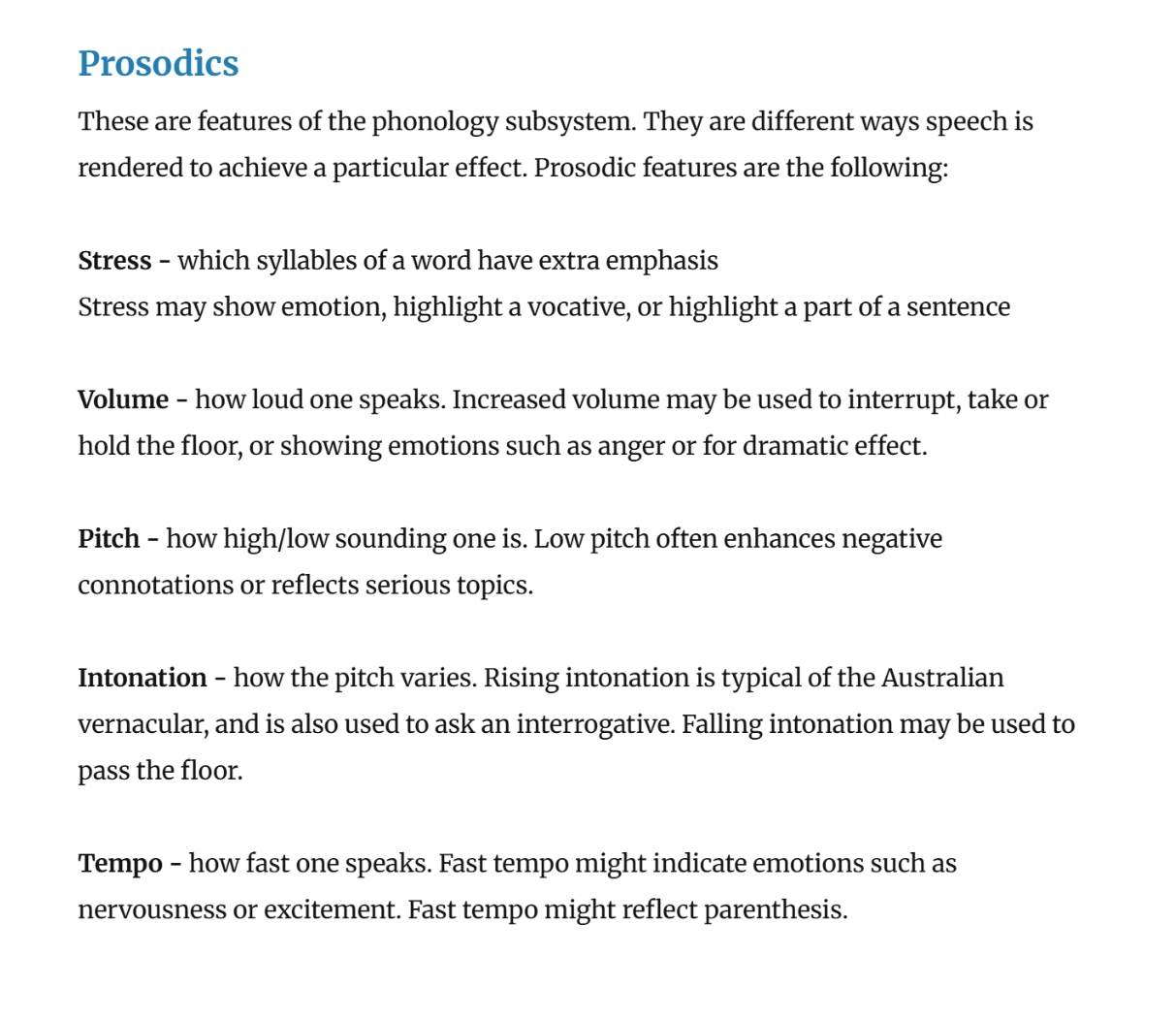
Prosodics (Already Covered)
 Note
Note  Flashcards (87)