3.5.3 Wage determination in competitive and non-competitive markets
 Call Kai
 Learn
Learn Practice Test
 Spaced Repetition
 Match
Match Flashcards
 Knowt Play
1/8

There's no tags or description
Looks like no tags are added yet.
Name | Mastery | Learn | Test | Matching | Spaced | Call with Kai |
|---|
No analytics yet
Send a link to your students to track their progress
9 Terms

How is wage determined in a perfectly competitive labour market?
The equilibrium wage is the point where quantity of labour supplied by workers equals the quantity of labour demanded by employers.
So there are neither labour shortages nor surpluses in the market.
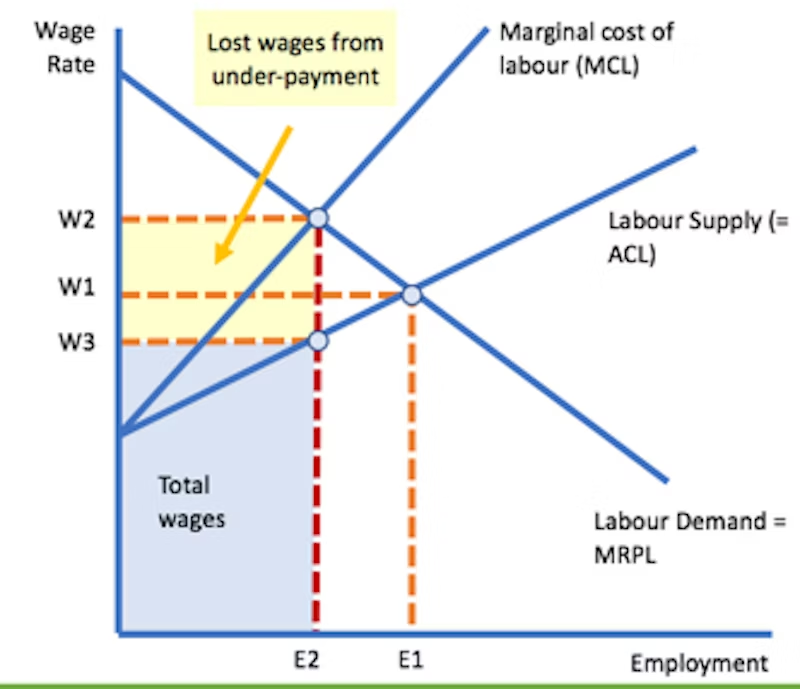
How is wage determined in a non-competitive labour market? Refer to monopsony power
In a monopsony market there is only one buyer of labour
In order to employ an additional worker, the employer has to increase the wage they offer, but due to perfect knowledge, the wages for all workers will have to increase too - therefore, MC curve is above the supply curve (AC)
The firm determines how many workers to employ where the cost of employing them is equal to the value of that worker to the firm (MC=D/MRP), however only pay their workers W3 (determined by supply curve) instead of W2
Therefore, workers are forced to accept lost wages from under-payment
Current labour market issues? Examples?
Technology/AI
Rise of AI has caused a rise in unemployment, especially in lower-skilled jobs
Skills shortages
UK suffers from geographical and occupational immobility (e.g. deindustrialisation has caused high unemployment levels up North)
Youth unemployment
During hard times, firms are unlikely to employ new workers, and are reluctant to let go of current workers
Training up new workers is also costly and time-consuming
Retirement
UK has a rising life expectancy and aging population, so more “baby boomers” retire creating gaps in the workforce if not filled
Rise in number of pensioners also negatively affects government budget and less tax revenue
Wage inequality
Over time, those on the highest wages have seen their wages grow proportionately more than those on lowest wages
Creating more relative poverty (around 20% of UK population live in relative poverty - household income below 60% of median household income)
Zero-hour contracts
Increase in zero-house contracts means people do not know how much they will work or earn that week
Migration
People suggest that migration causes a fall in wages
However, it can help fill skills shortages
What is a minimum wage? Current rate?
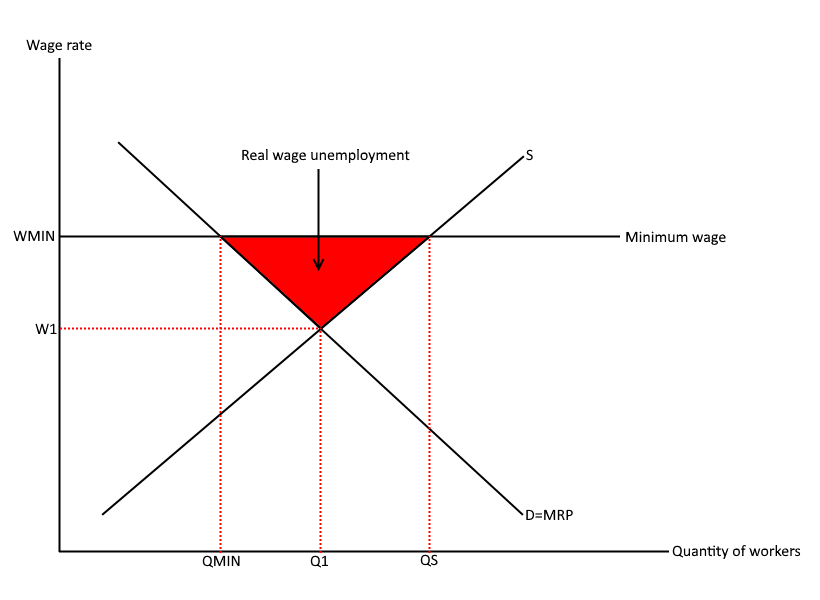
It is a legally-enforced pay floor in the labour market
Current rate is 12.71 pounds for 21 and over
Arguments for minimum wage
Poverty reduction
Ensures that those on the lowest wages have enough to live on, helping lift them out of relative poverty
Encourages workforce participation
Incentives people to enter or remain in workforce, preventing unemployment trap (where benefits outweigh wages)
Efficiency gains
Increased pay leads to a more motivated and content workforce - increasing productivity and efficiency
Reduces wage differentials
Ensure everyone receives a fair wage for their work
Boost consumer spending
Higher wages for low-wage workers will increase their disposable income
Arguments against minimum wage
Job losses
Minimum wage leads to a contraction of demand and expansion of supply of labour - creating excess supply (unemployment)
As firms with tight profit margins have to lay off workers due to higher labour costs
Higher prices
Increased labour costs can be passed onto consumers through higher prices (depends on PED of good/service)
This leads to cost-push inflation and fall in real incomes
Wage spiral
Increase in the wage of the lowest paid will mean that others expect their wages to rise too, in order to maintain wage differential
Fall in investment
Higher labour costs means firms earn lower profits for investment
Impact of minimum wage ultimately depends on where it is set, and the PES and PED of labour - if both elastic, then a rise in minimum wage will create even larger job losses.
Impacts of maximum wage on labour market? Good and bad
Reduces inequality - maximum wages for chief executives prevents overpaying compared to lower wage earners - maximum pay for public sector workers also keeps public spending down
However,
Leads to contraction in supply and expansion in demand of labour - creating excess demand for labour, as people do not think wage is high enough for the job description
Therefore, the UK may suffer from a loss of the best workers, as people move to higher wage jobs abroad - reducing quality of business and competitiveness
Impact of maximum wage also depends on PES and PED of labour - the more inelastic, the less the impact.
E.g. The supply of chief executives is small and firms only need one, so wage is a small part of total costs. Therefore, very inelastic, so maximum wage will have minimal effect, other than reduce wages.
How are public sector wages set?
In the short run, the government can effectively set whatever wages in order to improve the budget
In the long run, if private sector workers receive higher wages and public sector workers do not, then people will move from public to private sector, forcing the government to increase public sector wages to expand supply
Policies to tackle labour market immobility
Geographical immobility:
Improve supply of houses and reduce property prices - also provide cheaper rent for people in temporary jobs
Improve transport links - easier for people to work further away and still remain where they live
More job centres/job announcements - prevents information gaps on jobs available
Subsidies on houses, taxes, etc, in areas where there are labour shortages, encouraging people to move
Occupational immobility:
Increase government spending on vocational training, especially for younger students
Encourage further study past high school into university, etc. - through subsidy of university/college fees
Education could be targeted at improving skills shortages and helping with job application, e.g. interviews

