Lecture 13 - Endothermy
 Call Kai
 Learn
Learn Practice Test
 Spaced Repetition
 Match
Match Flashcards
 Knowt Play
1/21

There's no tags or description
Looks like no tags are added yet.
Name | Mastery | Learn | Test | Matching | Spaced | Call with Kai |
|---|
No analytics yet
Send a link to your students to track their progress
22 Terms
What are some thermoregulations when temperatures are too high (above TNZ)?
Evaporative cooling
Sweating
Panting
Gular fluttering
Allow hypothermia
What are some thermoregulations when temperatures are too low (below TNZ)?
Shivering thermogenesis
Muscle contractions produce heat
Non-shivering thermogenesis (NST)
Heat produced w/out muscle activity
Uses uncoupling proteins in brown fat
Proton leak produces heat instead of ATP
Brown fat
A specialized type of body fat that burns calories to generate heat (thermogenesis) rather than storing energy, helping maintain body temperature and improve metabolism.
How can animals regulate their metabolism to thermoregulate during the winter?
Increase metabolic rate
Biochemical benefits of endothermy
Stable, higher body temperatures
Improves enzyme activity and biochemical reactions
Uncoupling proteins
Mitochondrial inner membrane proteins that dissipate the proton gradient generated by the electron transport chain, releasing energy as heat (thermogenesis) rather than producing ATP.
Typically found in brown fat
Physiological benefits of endothermy
More effective thermoregulation
Higher aerobic metabolic capacity
Life-history benefits of endothermy
Higher reproductive rates
Greater movement capacity
Migration
Searching for food
Less time spent behavioral thermoregulation
What are some hypotheses for the evolution of endothermy?
Warmer bodies improve physiological performance
Maxithermy hypothesis:
higher metabolic rates → increased competitive ability and reproductive success
Selection for higher aerobic capacity led to endothermy
Aerobic scope hypothesis
The hypothesis that selection for higher aerobic capacity led to evolution of endothermy as a by-product
How could we test the aerobic scope hypothesis?
Select for enhanced aerobic capacity and see whether BMR increases.
Also examine whether shifts in metabolic capacity (e.g., larger organ sizes) occur.
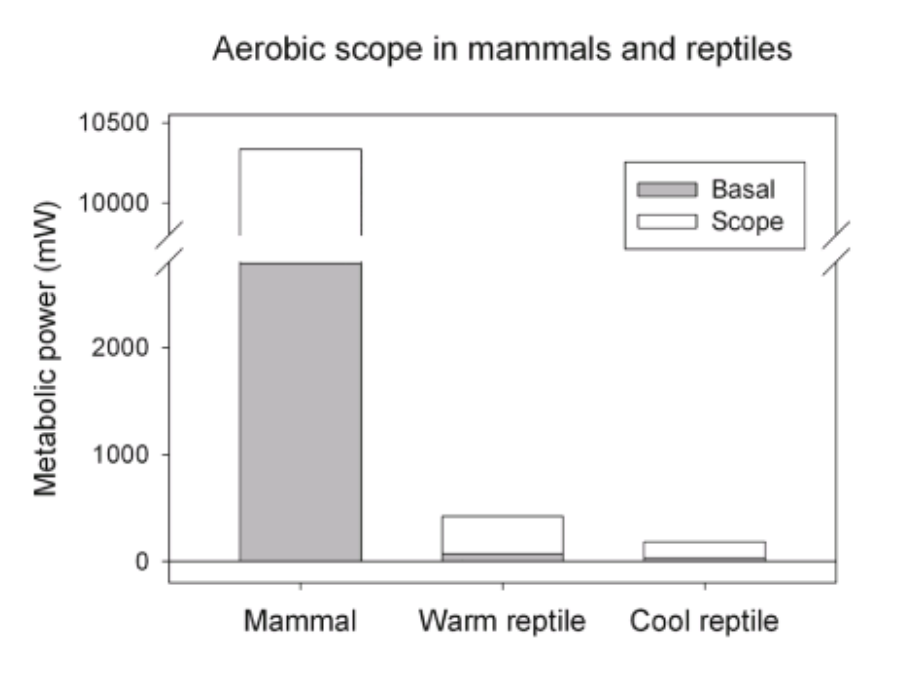
Absolute aerobic scope
Maximal metabolic rate (MMR) minus resting metabolic rate (RMR)
Endotherms have greater absolute aerobic scope, meaning they can sustain much higher levels of aerobic activity
Endotherms have much higher RMR’s than ectotherms
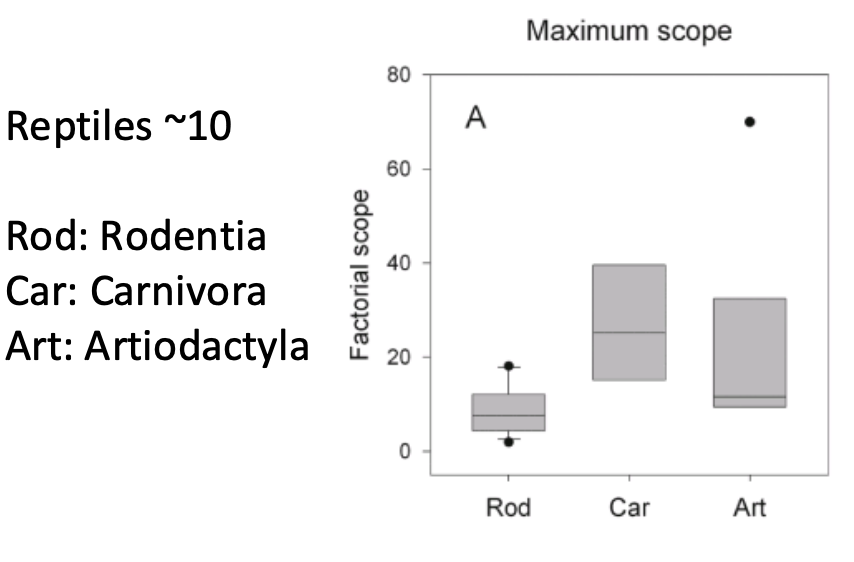
Factorial aerobic scope (FAS)
Maximal metabolic rate (MMR) / resting metabolic rate (RMR)
Roughly similar between reptiles and mammals (~10).
Suggests mechanistic linkage (through organ size?)
Reptilians can produce very short bursts of high power, allowing them to escape from or capture endothermic animals. What are some limitations/consequences of this?
Low capacity for sustained aerobic activity
Fatigue more quickly as they rely more on anaerobic metabolism
Increasing MMR = increasing RMR
Is BMR and MMR heritable or unheritable?
Heritable
Benefits of insulation
Insulation helps retain metabolic heat.
Leads to:
Higher body temperature
Increased metabolic rates
Greater aerobic scope
Torpor
A temporary state where an animal lowers its body temperature and metabolic rate to save energy, usually when food is limited or temperatures are cold.
Define thermoregulatory scope (TS). What does a high or low TS indicate?
Range of body temperature variation.
Species with greater TS tend to be:
Small-bodied
Living at high latitudes
Non-hoarding species
High TS: animals allow large body temperature fluctuations (often use torpor).
Low TS: animals maintain stable body temperature through strong thermoregulation.
What are factors that affect torpor?
Reduced Insulation
Example: fur shaving
Leads to more frequent torpor.
Increased Food Supply
Unlimited food reduces or eliminates torpor.
Environmental Temperature
Colder environments increase energy demands
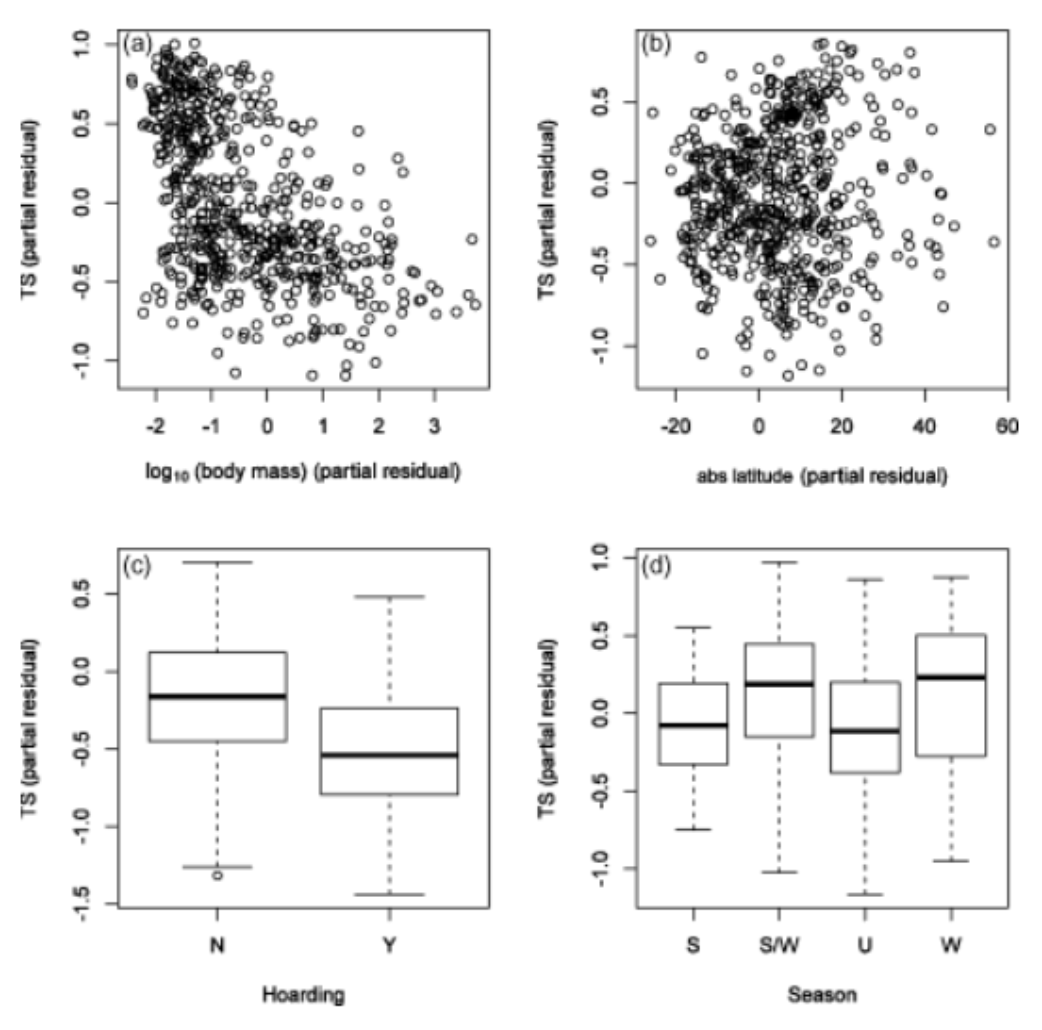
The plots depict how body mass, latitude, and food hoarding behavior alter the amount of body temperature variation (increases in TS, thermoregulatory scope= more heterothermy) in mammals.
First state hypotheses for how the listed factors will alter TS
Body mass
Latitude
Food hoarding
Body mass: Smaller mammals will have higher TS
Due to higher surface area-to-volume ratio, so they benefit more from torpor
Latitude: Mammals at higher latitudes will have higher TS
Colder environments favor greater use of torpor or body temp reduction to save energy
Hoarding: Mammals that don’t hoard will have a higher TS
Non-hoarders rely more on torpor and body temperature variation to conserve energy.
How do you think 1) fur shaving and 2) food supplements will change the incidence of torpor in shrews?
Fur shaving - Will increase torpor due to less insulation and heat retainment
Food supplements - Will decrease torpor due to higher food supply and therefore, higher metabolic rates
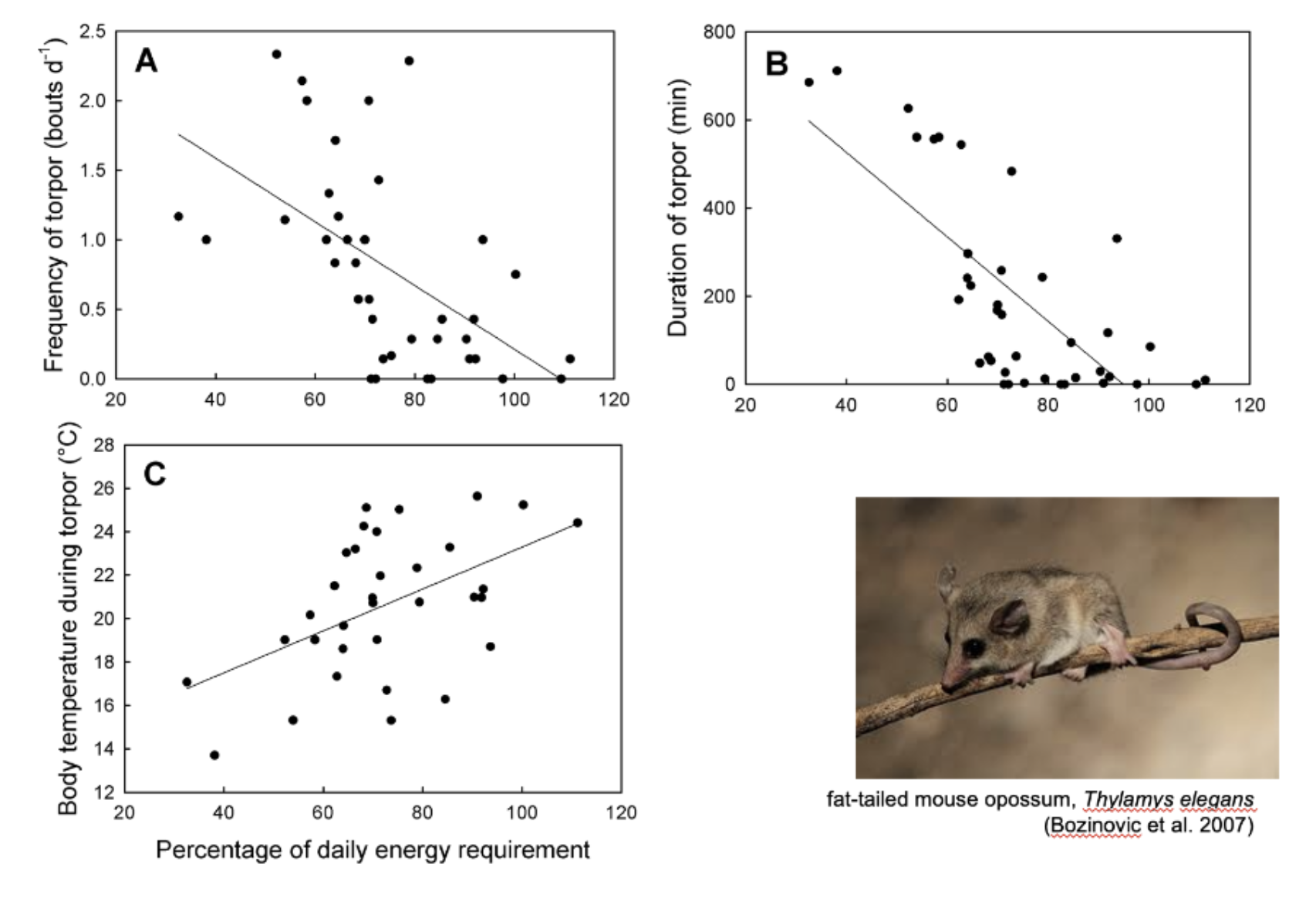
Draw or state your expectations for how the frequency and duration of torpor as well as body temperature during torpor will respond to food intake in opossums?
Frequency - Decreases with more food intake
Duration - Decreases with more food intake
Body temp - Increases with more food intake