Abeka, Science 8: Earth and Space Test 10
 Call Kai
 Learn
Learn Practice Test
 Spaced Repetition
 Match
Match Flashcards
 Knowt Play
1/65

There's no tags or description
Looks like no tags are added yet.
Name | Mastery | Learn | Test | Matching | Spaced | Call with Kai |
|---|
No analytics yet
Send a link to your students to track their progress
66 Terms
What value represents the brightness of a star as viewed from Earth
apparent magnitude
What is a chunk of space debris that has reached Earth's surface?
meteorite
Which scientist proposed a system in which Earth and all other planets orbit the sun.
Nicolaus Copernicus
How many planets were known to ancients astronomers
five
What star is located at the north celestial pole?
Polaris
What is Saturn's outermost major moon, which orbits in the opposite direction of most other moons.
Phoebe
What evolutionary idea claims that the solar system formed from a cloud of gas and dust.
nebular hypothesis
What happens to Earth's orbital speed when Earth approaches aphelion.
Orbital speed decreases.
What is the primary factor that determines the brightness of average stars in the main sequence.
temperature.
What is the smallest type of structure formed by a group of galaxie?.
cluster.
Which of the following stars is part of the Summer Triangle.
Altair.
Which of Neptune's satellites experiences the coldest known temp., in the solar system?
Triton
What is a rapidly rotating neutron star that emits directional beams of radio waves.
pulsar.
Why can the sun's transition region be studied only using space-based solar observations.
it releases ultraviolet radiation.
What type of star is cool, small, and dim.
red dwarf.
What was the first object to be classified as and asteroid.
Ceres.
Which planet travels most rapidly through its orbits.
Mercury
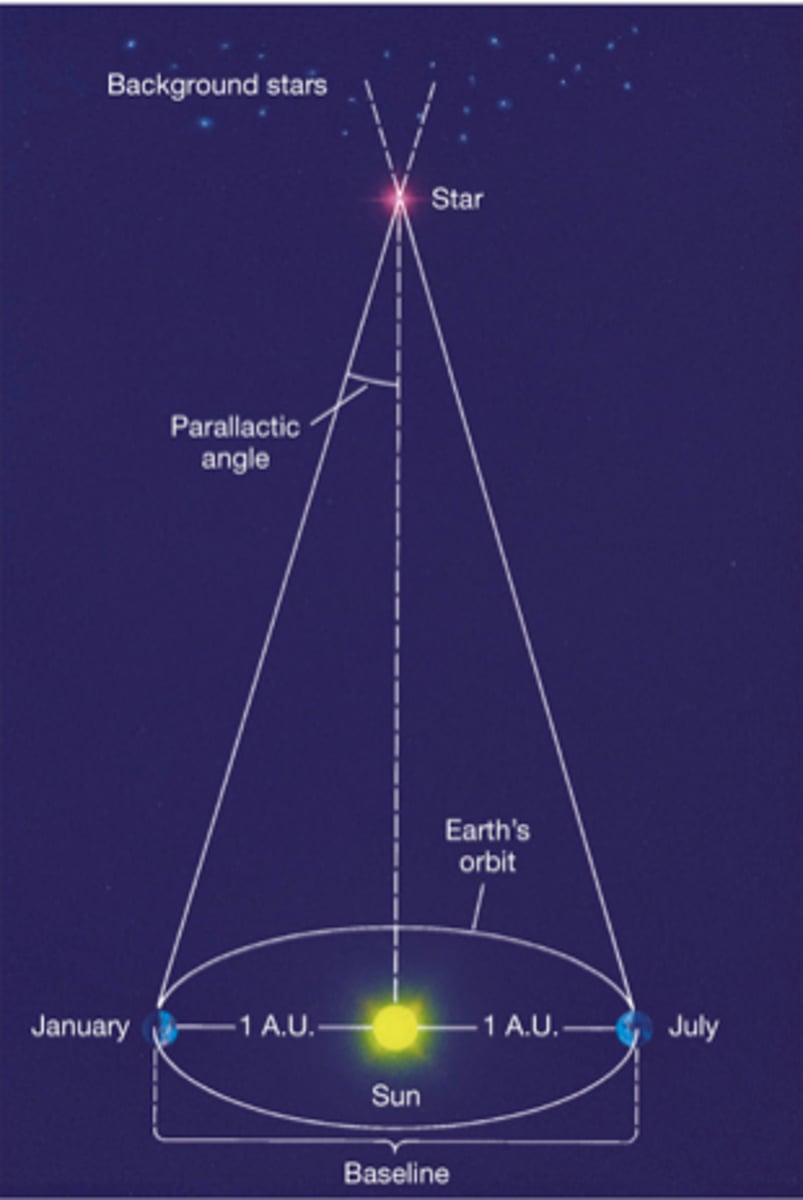
If a right triangle were drawn with the sun, the earth, and a star at the corners, which angle would represent the stellar parallax.
angle at the star.
A star-like object believed to be made up of a large black hole surrounded by a glowing ring of gas is a ?
quasar
The only planet to be discovered mathematically before it was seen is
Neptune
The distance between 2 objects on the celestial sphere is measured as a
angle
Aristotle taught a _____________ view of the universe.
geocentric
The 2 groups of asteroids that travel in Jupiter's orbit are called
Trojan asteroids.
Spiral and irregular galaxies commonly contain large clouds of gas and dust called
nebulae.
The phase in which the moon has a bulging shape and is growing larger is called.
waxing gibbous.
Jupiter's moon is the most volcanically active body in the solar system.
IO
What other property of a plants orbit does Kepler's third lay relate to the planets average distance from the sun
period
What is a trail of space debris left by a comet.
meteoroid stream
What astronomical distance measurement is based directly on the speed of light.
light year.
What is a loose, asymmetrical clump that contains tens, hundreds, or thousands of stars.
open cluster.
What is an object so massive and dense that not even light can escape its gravity
black hole
Which constellation contains the Teapot asterism.
Sagittarius
What is the imaginary band in the sky containing the moon and plants
zodiac
What is the main reason that Pluto is no longer considered a plant but a dwarf planet?
it is near objects not controlled by its gravity.
What evidence indicates that the sun is spinning
movement of sunspots.
Which of Mars's 2 moons orbits closer to the planet and more quickly.
Phobos
Which of the following stars can be found by tracing a line from Orion's belt.
Sirius
What is the central portion of a comet called
nucleus
What is the brightest summer star.
Vega
What is the only planet that takes longer to rotate on its axis than to orbit the sun.
Venus
What are the light-collard streaks surrounding a lunar crater called
rays
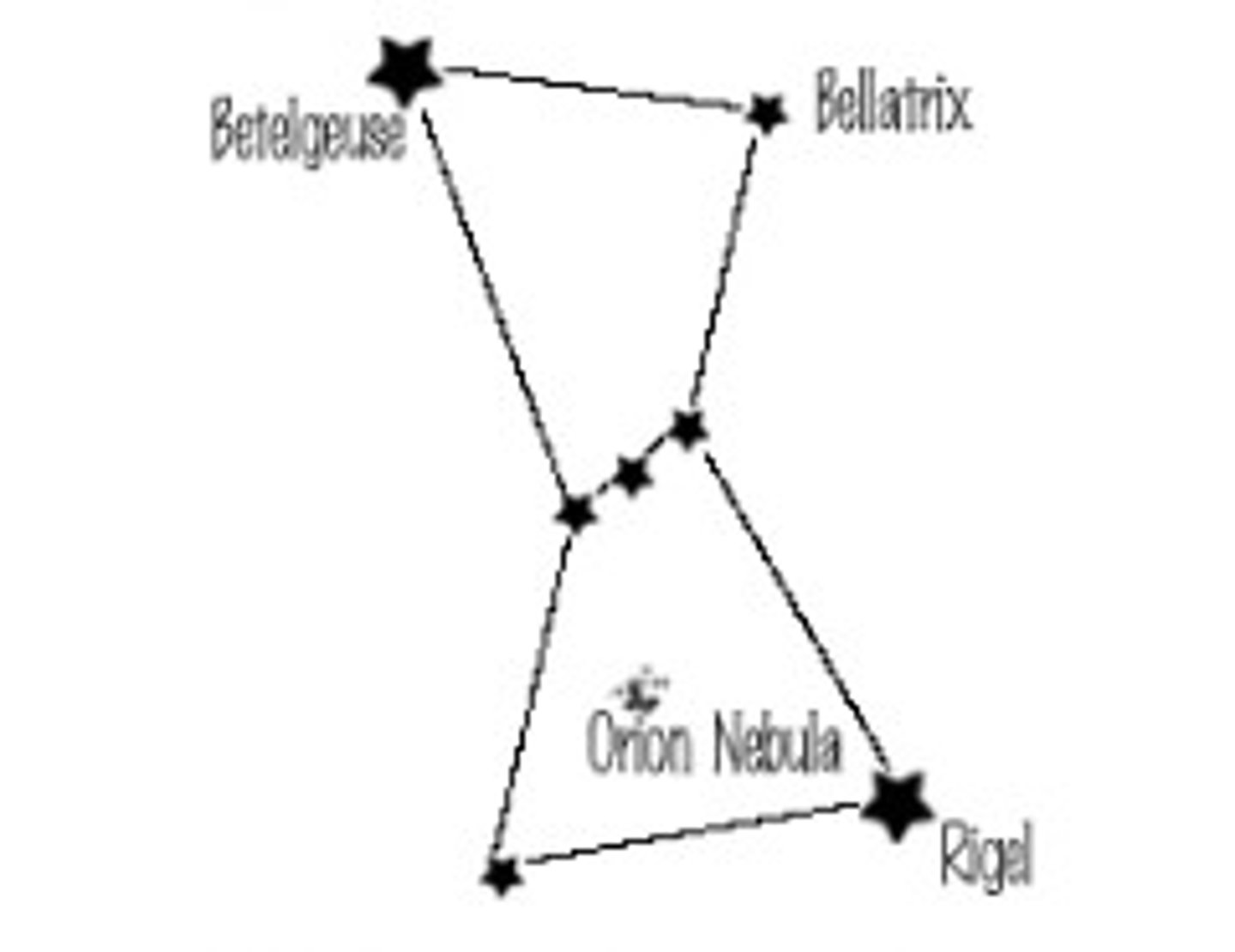
What constellation is pictured
Orion
What is the visible part of the sun
photosphere
What feature of lenticular galaxies can help distinguish them from spiral galaxies.
solid disk
What constellation contains the star Alderamin?
Cepheus
What are moon that help keep a planets rings in place called
shepherd moon
What is an extremely bright meteor that explodes in midair called
bolide
What term describes the composition of interplanetary space
vacuum
What term refers to the "backward" rotation of a planet on its axis.
retrograde
What type of star group travels outside the boundaries of the Milky Way in an unusual orbit around the Galaxy's center.
globular cluster.
What type of partial eclipse occurs when the moon is too small to cover the sun entirely, leaving a ring of light around the moon.
annular (solar eclipse)
What is the outermost layer of the sun's atmosphere called.
corona.
A group of stars that are used to form a picture or represent an object is
asterism
The planets closest to the sun are the
inner planets.
A comet that takes 150 years to complete one orbit is a
short-period comet.
The largest planet in our solar system is
Jupiter.
A star that is always above the horizon at a particular latitude is said to be
circumpolar at that latitude.
the Hertzsprung Russell diagram is used for classifying
stars
the largest known mountain in the solar system is
Olympus Mons.
Based on what we now know about the cause of planet orbits, why would it be impossible for the sun, moon, and all the planets to orbit the earth.
Because of the sun's gravity, the planets would begin to orbit the sun,
Halley's comet completes one orbit in about 76 Earth years, Uranus requires about 84 E. years to complete one orbit. Based on this information, which of the following statements must be true and how do you know.
Halle's comet is, on average, closer to the sun than Uranus is because objects with a closer average distance to the sun orbit more quickly.
Which of the following characteristics do Uranus and Venus have in common
Both have a ""backward" rotation.
Jesus was crucified around the day of Passover, which falls on a full moon. Matthew 27:45 records that during the Crucifixion there was darkness for three hours in the afternoon, From a scientific point of view, could this darkness have been caused by an eclipse? why or why not.
no, because a solar eclipse can occur only during a new moon.
Which of the following statement best explains the difference between an asteroid and a comet.
Asteroids are made of metal or rock.
Which of the following statements best explains why the celestial sphere is useful to astronomers.
the celestial sphere represents the view from Earth.
In his work Divine Comedy, the 14th- century Italian poet Dante described a trip into space. As he traveled away from Earth he visited the following celestial bodies in order: the moon, Mercury, Venus, the sun, Jupiter, and Saturn. What view of solar system structure did Dante hold? How do you know? Compare this view with a modern understanding of the solar system's structure.
* Dante held to a geocentric view of the solar system, in which Earth is at the center and the moon, sun, and planets orbit Earth.
* We can know Dante held a geocentric view of the solar system because, in a heliocentric (sun-centered) system, he would have either reached Venus before Mercury (if both were on the same side of the sun as Earth was) or would have reached the sun before one or both of those planets (if either or both were on the opposite side of the sun form Earth).
* Dante's view of the solar system was that the moon, the sun, and all planets orbit around Earth. A moderns understanding is that only the moon orbits Earth; Earth itself and all the planest orbit the sun.

