Cell Injury and Cell Death
 Note
Note Call Kai
 Learn
Learn Practice Test
 Spaced Repetition
 Match
Match Flashcards
 Knowt Play
1/25

Earn XP
Description and Tags
WK 1
Name | Mastery | Learn | Test | Matching | Spaced | Call with Kai | Chat |
|---|
No analytics yet
Send a link to your students to track their progress
26 Terms
What is the study of disease called?
Pathology
What is the study of abnormal changes in the body?
Pathophysiology
What is the sequence of events and changes in the tissue that lead to disease called?
Pathogenesis
What term refers to the cause of a disease?
Aetiology
What type of disease is present before birth?
Congenital disease
What is an acquired disease?
A disease acquired after birth
What describes a disease with sudden appearances of symptoms that lasts a short time?
Acute disease
What does idiopathic mean?
The cause of the disease is unknown
What are the signs and symptoms of a disease referred to as?
Clinical manifestations
What is a condition that is the consequence of a previous disease, treatment, or injury called?
A condition that is the consequence of a previous disease, treatment, or injury called?
What cellular adaptation involves an increase in cell size?
Hypertrophy
What cellular adaptation involves an increased number of cells?
Hyperplasia
What is the term for the shrinkage in size of cells?
Atrophy
What refers to the replacement of one cell type by another?
Metaplasia
What is the disorderly proliferation of cells called?
Dysplasia
What is hypoxia?
When oxygen saturation of tissue falls below 90%.
What is ischemia?
Interruption of blood flow to cells and tissues.
What causes oxidative stress?
An imbalance between free radicals and antioxidants in the body.
What is pathological calcification?
Abnormal deposition of calcium salts in tissues.
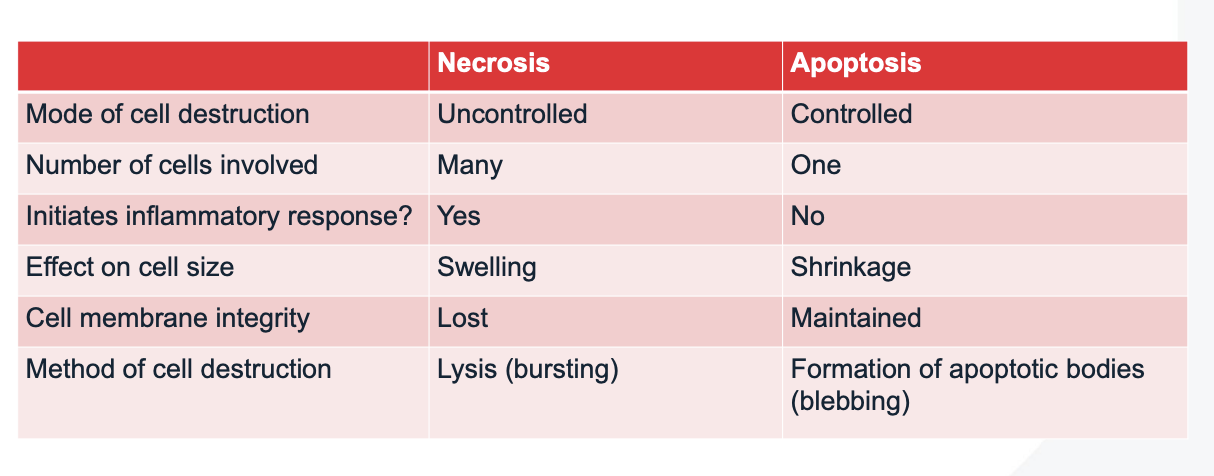
What is apoptosis?
Programmed cell death that is essential for development and provides a protective mechanism.
What characterizes necrosis?
A major pathway of cell death due to irreversible injury.
What is coagulative necrosis?
A type of necrosis where tissue architecture is preserved and has a firm texture.
What is liquefactive necrosis?
A type of necrosis where dead cells are transformed into a viscous liquid.
What is caseous necrosis?
Necrosis commonly seen in tuberculosis, where the tissue appears yellow/white and cheeselike.
What is gangrenous necrosis?
Necrosis resulting from dead tissue due to lack of blood supply; can be dry or wet.
How does apoptosis differ from necrosis in terms of its nature and cause?
Apoptosis is a programmed, controlled process essential for development and protective functions, while necrosis is an uncontrolled, pathological cell death resulting from irreversible injury, often triggering inflammation.