Cellular Commumication
 Call Kai
 Learn
Learn Practice Test
 Spaced Repetition
 Match
Match Flashcards
 Knowt Play
1/22

There's no tags or description
Looks like no tags are added yet.
Name | Mastery | Learn | Test | Matching | Spaced | Call with Kai |
|---|
No analytics yet
Send a link to your students to track their progress
23 Terms
juxtaposition signaling
signaling between adjacent cells
cells touching each other can form pores that allow signaling molecules to move directly to their neighbor
or signaling molecules can interact with a receptor on a neighboring cell
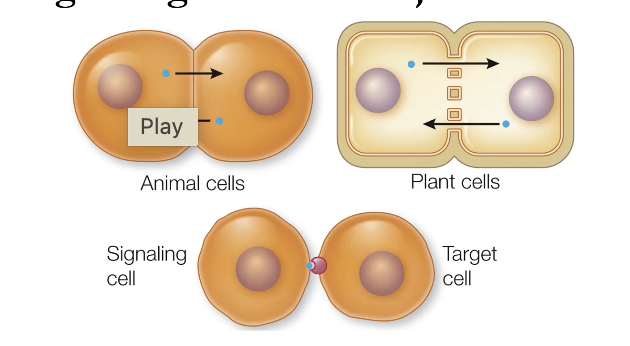
juxtaposition signaling
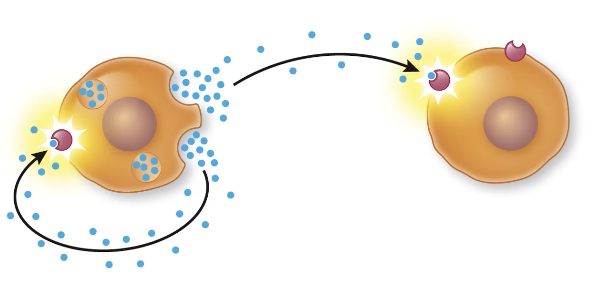
paracrine signaling
paracrine signaling
signaling between nearby cells
signaling molecules are released by a source cell
signaling molecules go into some extracellular fluid and by diffusion travel to a nearby cell or back to itself (not the one right next it)
synaptic signaling
nerve cells send electrical signals, which cause release of neurotransmitters
neurotransmitters are relased by vesicles after the electrical signal has traveled down the nerve cell
vesicles fuse with the membrane and squirt out the neurotransmitters that then travel across the synapse (the short space between nerve cells)
the nuerotransmitter then interacts with some receptor in the receiving nerve cell
endocrine signaling
signaling between distant cells
signaling cells release a signaling molecule and then it travels through the bloodstream to a target cell in an entirely different part of the body
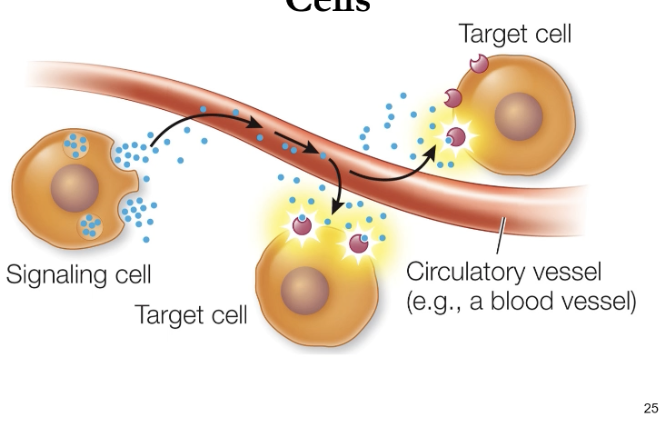
endocrine signaling
what happends when a signal molecule is released
all cells in range will receive the signal
only cells with a receptor tuned to the specific signal can respond to the signal
what does responding mean?
some change in cellular activity
gene expression
enzyme activity
cell division
specific ligand interacts with a specific receptor
binding leads to a conformational change
shape change leads to functional change
ligand
signal molecule
most chemical signals are ____________
most chemical signals are hydrophilic
Because chemical signals are hydrophilic, _____________________
Because chemical signals are hydrophilic, they cannot pass through the membrane without some sort of help
most receptors are ________
most receptors are transmembrane proteins
types of chemical signals
lipid soluble signals (hydrophobic)
water soluble signals (hydrophillic)
lipid soluble signals
pass through the plasma membrane and bind to a specific receptor in the cytoplasm or in the nucleus
activated receptor ligand complex regulates genes by binding to DNA
water soluble signals
cannot pass through membrane
binds to specific plasma membrane receptors
the receptore ligand complex activates a cascade of events in the cell
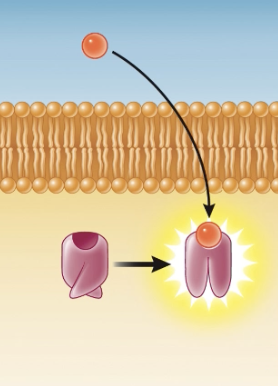
intracellular receptor (molecule is hydrophobic) and goes right through the hydrophobic core
intracellular signaling
receptors found in the cytoplasm or in the nucleus
signal must be hydrophobic or very small to diffuse through membrane
steroids
cortisol
nitric oxide
thyroid hormone
membrane bound receptors
ex. ligand-gated ion channel
allows hydrophillic molecules in
G protein coupled receptor
ligands bind to the receptor and GDP becomes phosphorylated and activates the G protein
the activated G protein is then going ot interact with an effector protein
enzyme-linked receptor
receptor is also an enzyme and triggers and enzamic response
signal transduction pathway
a series of steps triggered by the receptioin of a signal that eventually leads to a biochemical response
intermediate steps often involve activation or inativation of enzymes
the most common regulatory step is the addition or removal of a phosphate group
protein kinase
general name for an enzyme that helps catalyze the addition of a phosphate group from ATP to a protein

