Restrictions on free trade
 Call Kai
 Learn
Learn Practice Test
 Spaced Repetition
 Match
Match Flashcards
 Knowt Play
1/9

There's no tags or description
Looks like no tags are added yet.
Name | Mastery | Learn | Test | Matching | Spaced | Call with Kai |
|---|
No analytics yet
Send a link to your students to track their progress
10 Terms
Reasons for restrictions on free trade?
Protection from dumping: Where a country offloads its surpluses to other countries at very low prices (compared to market equilibrium), harming domestic producers (e.g. China has tariffs on steel tubes from the EU and Japan)
Improve terms of trade and current account trade deficit: Demand for imported goods falls, so price of imports falls, therefore can buy more imports with the same amount of exports
Prevent danger of over-specialisation: Some industries considered too important to become totally reliant on another country for
Protect infant industries: New industries will have high costs, due to no economies of scale, and a small customer base, therefore not competitive in international market. Gives them time to grow and develop
Raise tax revenues: Tariffs are indirect taxes, so can be used to raise tax revenue
Job protection: Prevents domestic producers from losing out to cheaper imports from international firms with comparative advantages, which would lead to structural unemployment
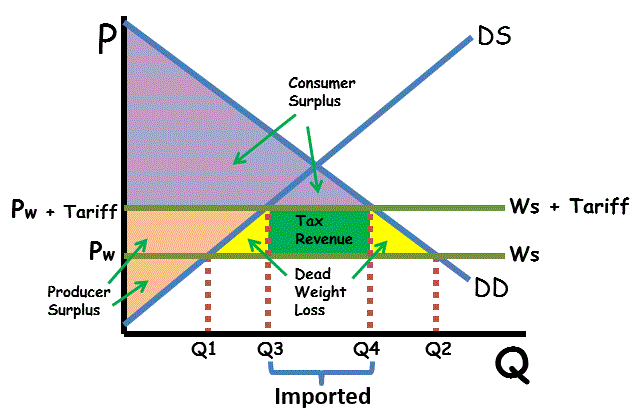
What are tariffs and how do they restrict free trade? Include diagram
Taxes placed on imported goods which make they more expensive to buy (pushing prices closer to domestic prices)
From diagram, shows a fall in imports, increased tax revenue and producer surplus, but inefficient as they cause deadweight loss
What are quotas and how do they restrict free trade?
Limits placed on the level/amount of imports allowed into a country (Limited supply indirectly pushes up price of imports)
Consumers forced to buy domestic goods if they want that good and domestic producers encouraged to produce more
E.g. U.S. has steel import quotas and EU has textile quotas
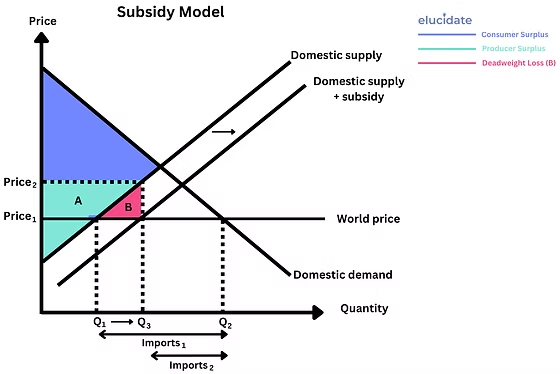
What are subsidies to domestic producers and how do they restrict free trade? Include diagram
Payments to domestic producers which lowers their cost of production (usually to firms that have a lot of their sales as exports)
Makes them more competitive by increasing domestic supply and lowering prices
From diagram, shows fall in imports, from Q1Q3 to Q3Q2
What are non-tariff barriers and how do they restrict free trade?
Regulations and restrictions to make trade more difficult and potentially more expensive for firms.
Examples:
Embargo, which is a total ban on imported goods
Introduce import licensing, forcing international firms to apply for a limited number of licenses, restricting level of imports
Use of legal and technical standards, preventing some products from being sold in the country, if criteria not met (e.g. Japan’s strict safety standards on fruits)
Managed exchange rates to change relative prices of imports and exports (e.g. China accused of keeping yuan undervalued through central bank intervention, making Chinese exports cheaper and imports more expensive)
Impact of protectionist policies on consumers
Suffer from higher prices, as imports become more expensive
Price of domestically manufactured goods also rises due to more expensive imports of raw materials
Less competition means less incentive to be efficient, so goods more expensive, quality falls, and less choice
Impact of protectionist policies on domestic producers
Reduced international competition, means they can sell more goods at a higher price and afford to be less efficient
However, may suffer from higher costs as imported raw material more expensive
More efficient foreign producers lose out, as they are limited as to where they can sell their goods
Impact of protectionist policies on workers
More jobs created in domestic industries leading to more employment
However, less jobs for countries that rely heavily on exporting goods into that country
Impact of protectionist policies on governments
Increase in tax revenues from tariffs and also more corporation tax from domestic firms’ profits
However, can lead to an inefficient economy with minimal growth
Subsidies also incur an opportunity cost
Retaliation by other countries can lead to trade wars, causing reduction in trade and growth overall (e.g. US-China trade war)
Impact of protectionist policies on living standards and equality
More domestic jobs means more wages, therefore workers have a higher standard of living
Consumers also protected from cheap and low quality foreign goods
However, tariff diagram shows a deadweight loss incurred
Foreign goods may actually be of better quality and cheaper
Less trade from trade wars reduces output, and hence less jobs
Tariffs are indirect taxes, therefore have a regressive effect in income redistribution, as the poor spend a larger proportion of income on the goods, so more affected
Explore top notes

