Chapter 12 (Exam 3)
 Call Kai
 Learn
Learn Practice Test
 Spaced Repetition
 Match
Match Flashcards
 Knowt Play
1/179

Earn XP
Description and Tags
Movement Analysis
Name | Mastery | Learn | Test | Matching | Spaced | Call with Kai |
|---|
No analytics yet
Send a link to your students to track their progress
180 Terms
often one of body's weakest areas
Upper extremity
Strength & endurance in shoulder area
Essential for improved appearance & posture
More efficient skill performance
Specific conditioning exercises & activities should be intelligently selected
Upper extremity
Limited use in modern culture
Weakness can impair skill development & performance in common recreational activities
Appropriate base of muscular strength & endurance essential for injury prevention & adequate skill development
Typical weight room exercises concentrate only on
anterior shoulder
Without balanced approach to exercise, there may be
may lead to strong & tight anterior muscles with weak & flexible muscles posteriorly
Analysis of exercises is critical to
appropriate exercise prescription
Strength, endurance, & flexibility of the upper & lower extremity, trunk, & abdominal muscles are very important in
skillful physical performance, appearance, posture & body maintenance
Medical and allied health professionals emphasize development of muscle groups through
resistance training and circuit-training activities
Athletes and non-athletes, both male & female, need
overall muscular development
As we age, we normally tend to lose muscle mass, and as a result
our metabolism decreases
This loss, combined with improper eating habits, results in unhealthful fat accumulation and excessive weight gain
Through increasing our muscle mass, we burn more calories and are less likely to gain excessive fat
Sports participation does not ensure
sufficient development of muscle groups
Emphasis placed on
mechanical kinesiology in physical education & athletic skill development
However, mechanical principles will be of little or no value to performers without adequate strength & endurance of the muscular system
A greater emphasis has been placed on exercises and activities that improve the physical fitness, strength, endurance, and flexibility of participants
Muscles are usually grouped together according to
their concentric function
Muscles work in paired opposition to an antagonistic group
Aggregate muscle grouping activity example
Elbow flexors work together as an agonist group to cause flexion in opposition to the triceps brachii & anconeus (elbow extensors)
In this example elbow extensors are cooperating in their lengthening to allow the flexors to perform their task
Muscles work in paired opposition to an
antagonistic group
Aggregate muscle grouping activity example
In doing so, the triceps & anconeus may or may not be under active tension
If there is no active tension, then the lengthening is passive caused totally by the elbow flexors
If there is active tension, then the elbow extensors are contracting eccentrically to control the amount & speed of lengthening
Depending, these same muscle groups can function to control the exact opposite actions by contracting eccentrically
From viewing an activity you can
Determine which muscles are performing the movement
Know what type of contraction is occurring
Know what kind of exercises are appropriate for developing the muscles
Analyzing various exercises & sport skills
Break down all movements into phases
Number of phases varies, usually 2 or 3 to 5
All sport skills will have at least
Preparatory phase
Movement phase
Follow-through phase
Many begin with a stance phase & end with a recovery phase
Phase names varies from
skill to skill to fit the various sports terminology
Names may vary depending upon body part involved
Major phases may also be divided even further
Stance phase
Allows athlete to assume a comfortable & balanced body position from which to initiate the sport skill
Emphasis is on setting various joint angles in correct positions with respect to one another and to sport surface or base of support
Relatively static phase with fairly short ranges of motion involved
Preparatory phase
Often referred to as cocking or wind-up phase
Used to lengthen the appropriate muscles so that they will be in position to generate more force & momentum when concentrically contract in next phase
Most critical phase in leading toward the desired result of activity
Becomes more dynamic as need for explosiveness increases
Movement phase
Sometimes known as acceleration, action, motion or contact phase
Is the action part of the skill
Summation of force is generated directly to the ball, sport or work object, or opponent
Usually characterized by near-maximal concentric activity in involved muscles
Follow-through phase
Begins immediately after climax of movement phase
Brings about negative acceleration of involved limb or body segment
Often referred to as the deceleration phase
Body segment velocity progressively decreases over a wide range of motion
Usually attributable to high eccentric activity in muscles that were antagonist to muscles utilized in movement phase
Generally, the greater the acceleration in the movement phase,
(Follow-through phase)
the greater the eccentric forces and greater the length & the importance of the follow-though phase
Some athletes may begin follow-through too soon
Inappropriately cuts short the movement phase
Have less than desirable result in activity
Recovery phase
used after follow-through to regain balance & positioning to be ready for the next work or sport demand
To a degree, muscles used eccentrically in follow-through phase to decelerate the body or body segment will be used concentrically in recovery to bring about the initial return to a functional position
Baseball pitch skill analysis
Stance phase begins when player assumes a position with ball in glove before receiving signal from catcher
Pitcher begins preparatory phase by extending throwing arm posteriorly & rotating trunk to the right in conjunction with left hip flexion
Right shoulder girdle is fully retracted in combination with abduction & maximum external rotation of glenohumeral joint to complete this phase
Immediately following, movement phase begins with forward movement of arm & continues until ball release
Follow-through phase begins at ball release as arm continues moving in same direction established by movement phase until velocity decreases to point that arm can safely change movement direction
Deceleration of body & especially the arm is accomplished by high amounts of eccentric activity
At this point, recovery phase begins, enabling the player to reposition to field the batted ball
In actual practice the movements of each joint in the body should be analyzed into the various phases
Our extremities consist of several bony segments linked by a series of joints
Bony segments & their linkage system of joints may be likened to a chain
Any one link in extremity may be moved individually without significantly affecting other links if chain is open or not attached at one end
If the chain is securely attached or closed, substantial movement of any one link cannot occur without substantial and subsequent movement of the other links
An extremity may be seen as representing an open kinetic chain if
the distal end of the extremity is not fixed to any surface
open kinetic chain
Allows any one joint in the extremity to move or function separately without necessitating movement of other joints in the extremity
Beneficial in isolating a particular joint to concentrate on
specific muscle groups
Not very functional
most physical activity, particularly for lower extremity, requires multiple joint activity involving numerous muscle groups simultaneously
Upper extremity examples of open kinetic chain
include a shoulder shrug, deltoid raise (shoulder abduction), or a biceps curl
Lower extremity examples of open kinetic chain
include seated hip flexion, knee extension, & ankle dorsiflexion exercises
With an open kinetic chain, the core of the body & the proximal segment is stabilized while
the distal segment is free to move in space through a single plane
When distal end of extremity is fixed,
as in a push-up, dip, squat, or dead lift, extremity represents a closed kinetic chain
closed kinetic chain
Movement of one joint cannot occur without causing predictable movements of other joints in extremity
Involves body moving in relation to relatively fixed distal segment
Multiple joints are involved & numerous muscle groups must participate in causing & controlling multiple plane movements
Very functional
strongly correlate to most physical activities
In determining appropriate conditioning exercises, consider
open versus closed kinetic chain through analysis of skilled movements
Most sports involve…
closed-chain lower extremity activities & open-chain upper extremity activities
Many exceptions
Open-chain exercises generally isolate…
Open-chain exercises generally isolate only one segment, while closed-chain exercises work all segments in the chain, resulting in conditioning of muscles crossing each joint
Overload principle
Within appropriate parameters, a muscle or muscle group increases in strength in direct proportion to the overload placed on it
The amount of overload applied varies significantly based on several factors (Overload Principle)
An untrained person beginning a strength training program will make significant gains in the amount of weight he/she is able to lift in the first few weeks
Mostly due to a refinement of neuromuscular function, rather than an actual increase in muscle tissue strength
A well trained person will see relatively minor improvements in
(Overload Principle)
the amount of weight that can be lifted over a much longer period of time
Amount & rate of progressive overload is extremely variable and must be adjusted to match the specific needs of the individual’s exercise objectives
Overload may be modified by changing any one or a combination of 3 different exercise variables
frequency, intensity or duration
Increasing the speed of doing the exercise, the number of repetitions, the weight & more bouts of exercise are all ways to modify these variables in applying this principle
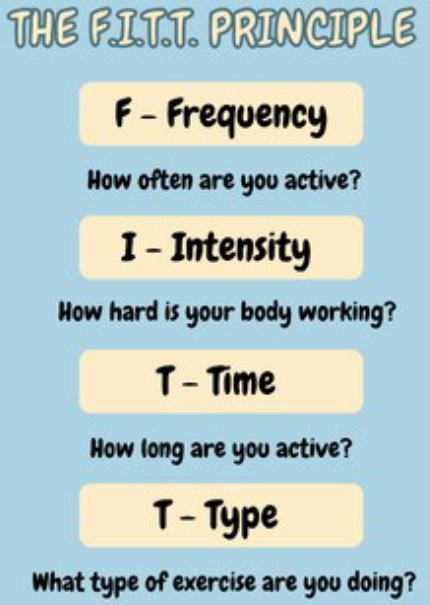
Overload principle may also be modified in by manipulating _____.
FITT components,
which are Frequency, Intensity, Time & Type
FITT
Frequency, Intensity, Time & Type
time (length of time: minutes or seconds) is used instead of duration
type of exercise/training is considered - aerobic, strength training, muscular endurance or flexibility
Examples include running, walking, cycling, swimming, resistance bands, dumbbells, machines, body weight, kick boxing, yoga, stretching
Consider total exercise volume
Progression in overload is
highly variable depending upon the individual, current level of fitness and desired goals
Emphasis should always be placed on safety utilizing proper techniques & ability to progress properly without injury and allowance for recovery time and the involved system to adapt appropriately
Too much progression in too short of a time period will
not allow for sufficient recovery and will result in overtraining and lack of adaptation leading to fatigue, injury, soreness & pain
Too little progression can result in
less than desired progression, no adaptation and a training plateau
If no overload is applied then eventual loss of conditioning will occur as it often does throughout life as many become less active
Too little progression is addressed in what principle?
SAID
Overload Principle Progression
Overload is not always progressively increased
In certain periods of conditioning, the overload should actually be prescriptively reduced or increased to improve the total results of the entire program
Periodization
Intentional variance in a training program at regular intervals
Done to bring about optimal gains in physical performance
Designed so that the athlete will be at his/her peak level during the most competitive part of the season
Exercise variables which may be manipulated include (overload principle)
number of sets per exercise
repetitions per set
types of exercises
number of exercises per training session
rest periods between sets & exercises
resistance used for a set
type of muscle contraction
number of training sessions per day & per week
SAID Principle
Specific Adaptations to Imposed Demands
the body will gradually, over time, adapt very specifically to the various stresses & overloads to which it is subjected
applicable in every form of muscle training, as well as to the other systems of body
SAID Principle Example
if an individual were to undergo several weeks of strength training exercises for a particular joint through a limited range of motion, the specific muscles involved in performing the strengthening exercises would improve primarily in the ability to move against increased resistance through the specific range of motion utilized
Minimal strength gains beyond…
(SAID Principle)
the range of motion utilized in the training would occur usually
Other physical fitness components such as flexibility, cardiorespiratory endurance or muscular endurance would
be enhanced minimally
To achieve specific benefits, exercise programs must be specifically designed for the desired adaption
(SAID Principle)
Adaptation may be positive or negative, depending on whether or not correct techniques are used and stressed in conditioning program design & administration
Inappropriate or excessive demands placed on the body in too short of a time span can result in injury
Adaptation may be positive or negative (SAID Principle)
If demands are too minimal or administered too infrequently over too long a time period, less than desired improvement will occur
Conditioning programs & the exercises included should be analyzed to
determine if they are using the specific muscles for which they were intended in the correct manner
Muscular strength, muscular endurance, & flexibility are…
not general body characteristics
They are specific to each body area & muscle group
Specific needs of the individual must be
specifically addressed when designing an exercise program
Often it is necessary to analyze an individual's exercise & skill technique to specifically design an exercise program to meet his/her needs
Specificity
Addressing specific needs in designing an exercise program
Exercises for use in conditioning programs must be
analyzed to determine their appropriateness for the individual's specific needs
Exercise program goals should be determined regarding
specific areas of the body, preferred time to physically peak & physical fitness needs such as strength, muscular endurance, power, agility, balance, coordination, proprioception, flexibility, cardiorespiratory endurance, body composition, etc.
After establishing goals…
a regimen incorporating the overload variables of frequency, intensity, & duration may be prescribed to include the entire body or specific areas in a manner to address the improvement of the preferred physical fitness components
Regular observation & follow-up movement analysis is
necessary to ensure proper adherence to correct technique and to make adjustments, if needed
One does not necessarily develop adequate muscular strength, endurance & flexibility through
participation in sport activities
One needs to develop muscular strength, endurance & flexibility in order to
be able to participate safely & effectively in sport activities
Adequate muscular strength, endurance & flexibility of the entire body from head to toe should be developed through
correctly employing the appropriate exercise principles
Muscular Development should start
at an early age & continue throughout the school years
Fitness tests results indicate
there is need for considerable improvement in this area
Adequate muscular strength & endurance are important in
the adult years for the activities of daily living, as well as job-related requirements and recreational needs
Many back pains and other physical ailments could be avoided through
proper maintenance of the musculoskeletal system
Valsalva Maneuver
Holding breath while bearing down to lift heavy weights or trying to exhale against a closed epiglottis
Thought to enhance lifting ability
Causes dramatic blood pressure increase followed by equally dramatic drop
Can cause lightheadedness & fainting
Lead to complications in heart disease patients
Do not use Valsalva, Instead
instead breath rhythmically & consistent Exhale during lifting & inhale during lowering
Maintain attempt to pull interlocked fingers apart for 5 to 20 seconds Isometric exercise
Antagonistic contraction is as strong as the agonist contraction
Agonists in right upper extremity are antagonistic to agonists in left upper extremity & vice versa
Isometric contractions of wrist, hand, elbow, shoulder joint & shoulder girdle muscles
Strength of contraction depends on angle of pull & leverage of the joint involved
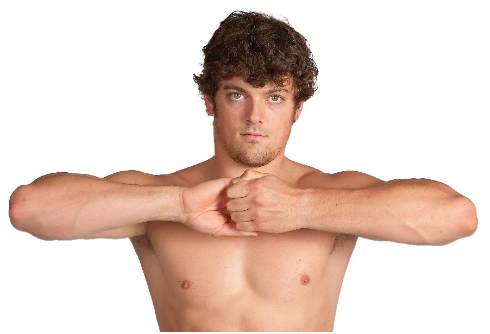
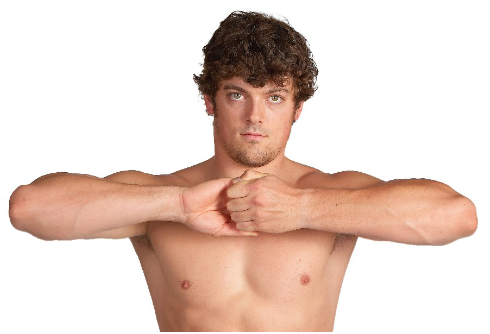
Shoulder Girdle
(Shoulder Pull)

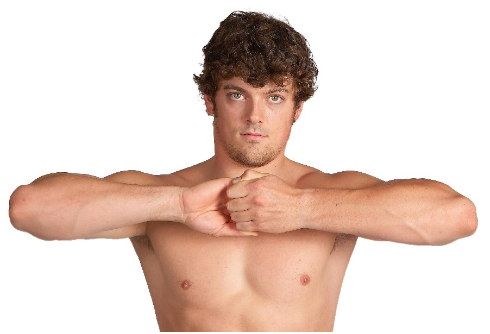
Wrist & Hand
(Shoulder Pull)

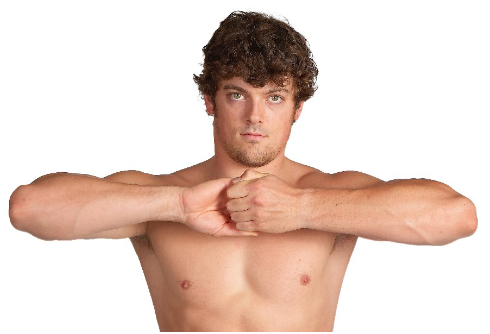
Elbow
(Shoulder Pull)

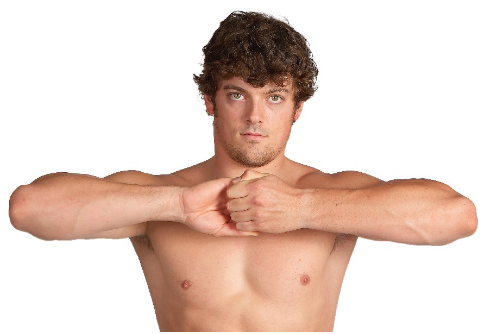
Shoulder Joint
(Shoulder Pull)

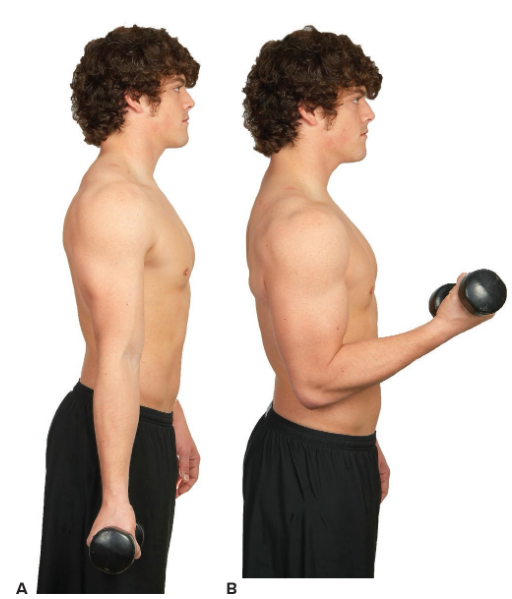
Arm Curl (biceps curl)
Subject stands
Barbell is held in hands with palms to front
Barbell is curled upward & forward until elbows are completely flexed
Return to starting position
open-kinetic chain exercise
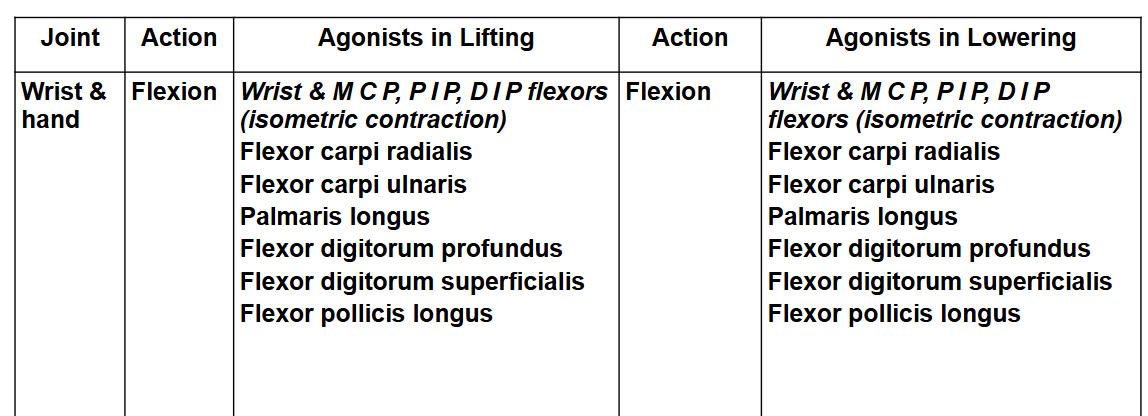
Wrist and Hands
Arm Curl (biceps curl)
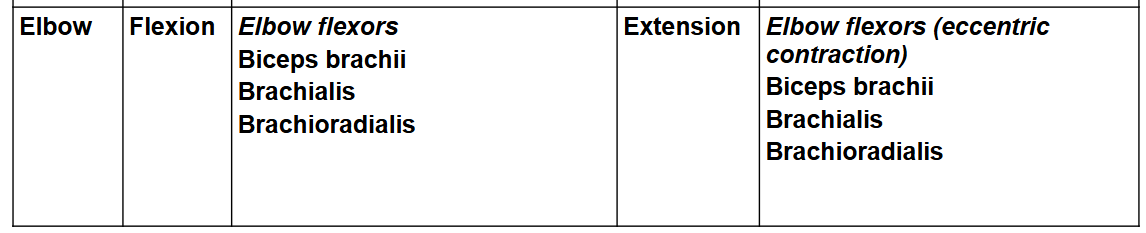
Elbow
Arm Curl (biceps curl)
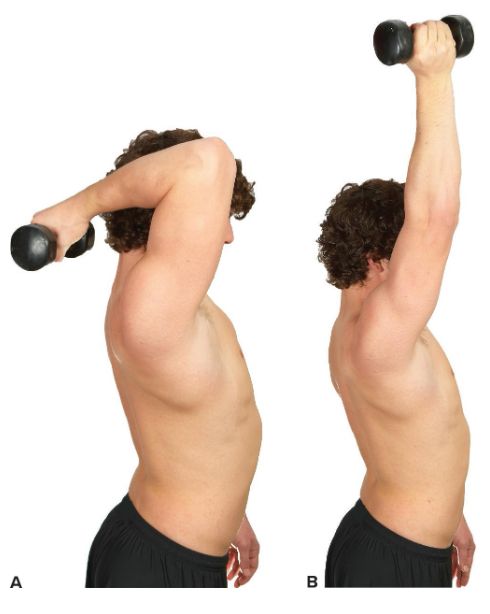
Triceps Extension
Maintaining full shoulder flexion and use opposite hand to assist in stabilization
Subject begins with elbow in full flexion
Elbow is extended until fully straight with dumbbell overhead
Return to starting position
open-kinetic chain exercise
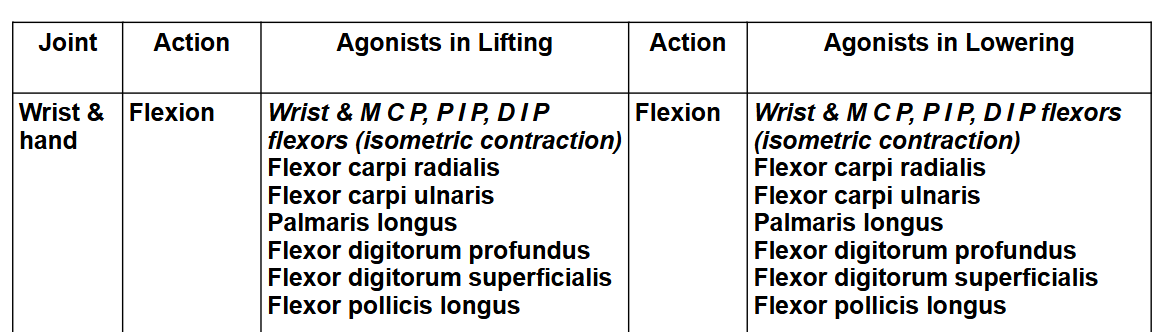
Wrist and Hand
Triceps Extension
Elbow
Triceps Extension

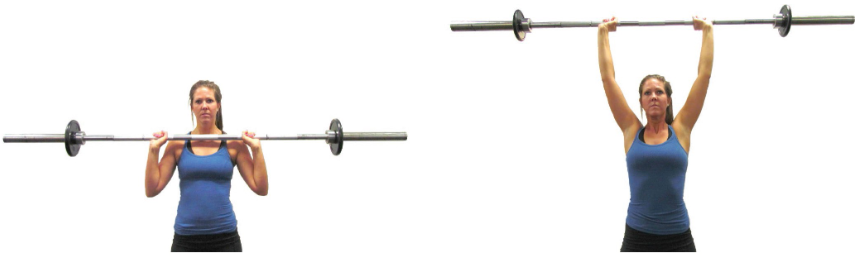
Barbell Press
A.K.A. as overhead or military press
Barbell is held high in front of chest, with palms facing forward, feet comfortably spread, back & legs straight
Barbell is pushed upward until arms are fully flexed overhead Return to starting position
open-kinetic chain exercise
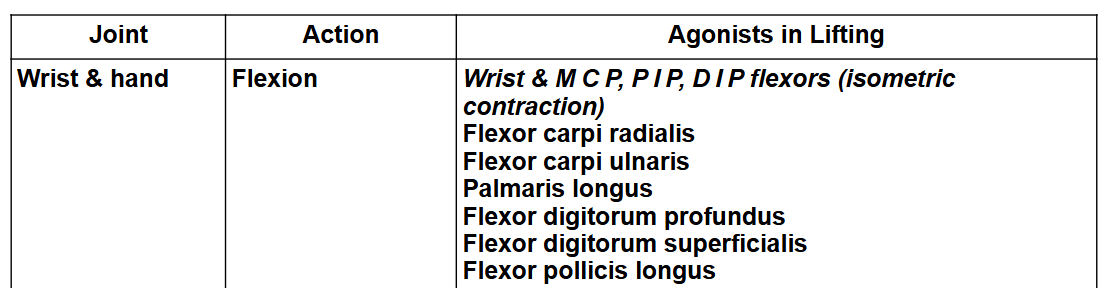
Wrist and Hand
Barbell Press (Agonists in Lifting)
Elbow
Barbell Press (Agonists in Lifting)

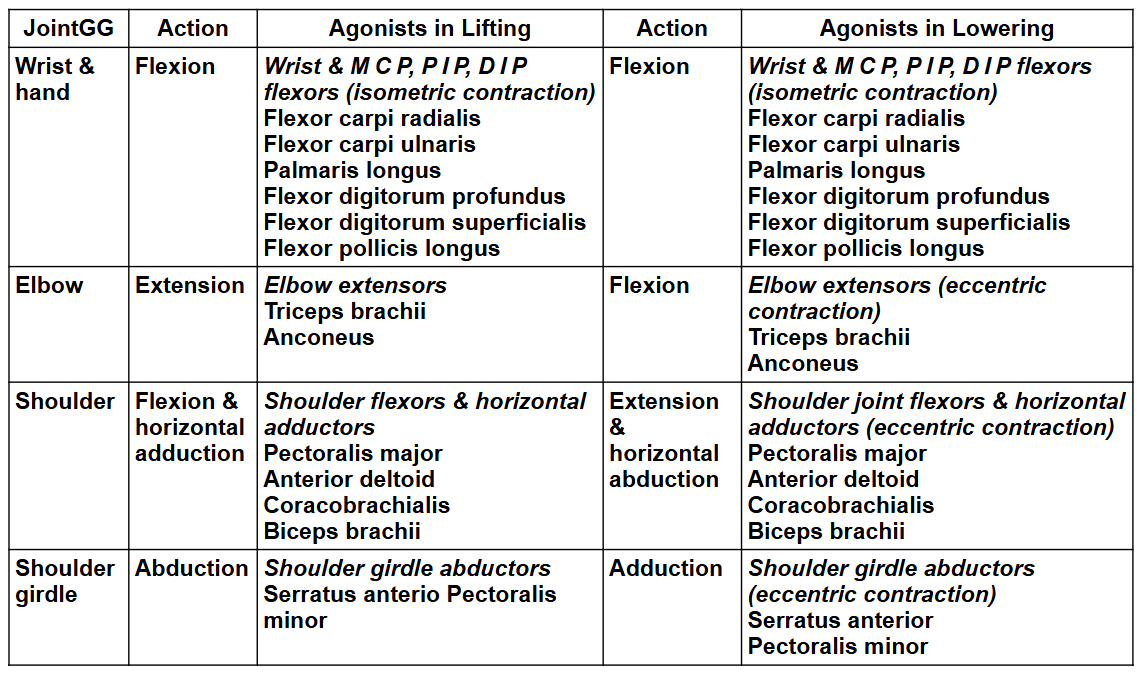
Shoulder
Barbell Press (Agonists in Lifting)

Shoulder Girdle
Barbell Press (Agonists in Lifting)

Wrist and Hand
Barbell Press (Agonists in Lowering)

Elbow
Barbell Press (Agonists in Lowering)

Shoulder
Barbell Press (Agonists in Lowering)

Shoulder Girdle
Barbell Press (Agonists in Lowering)

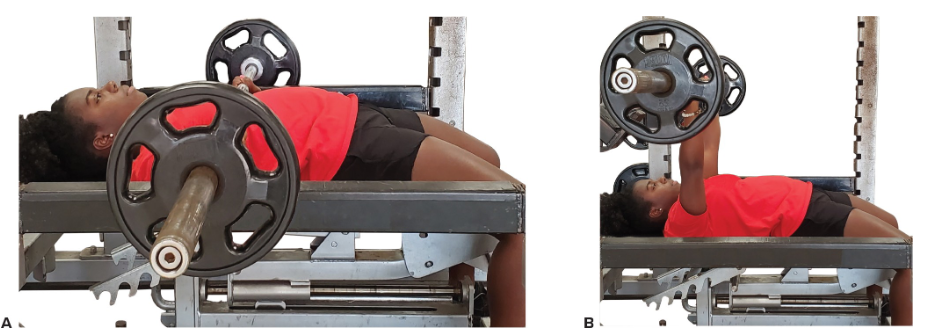
Chest Press (bench press)
Subject lies supine on exercise bench
Subject grasps barbell & presses weight upward through full range of arm & shoulder movement
Weight is then lowered to starting position
open-kinetic chain exercise
Wrist and Hand
Chest Press (bench press)
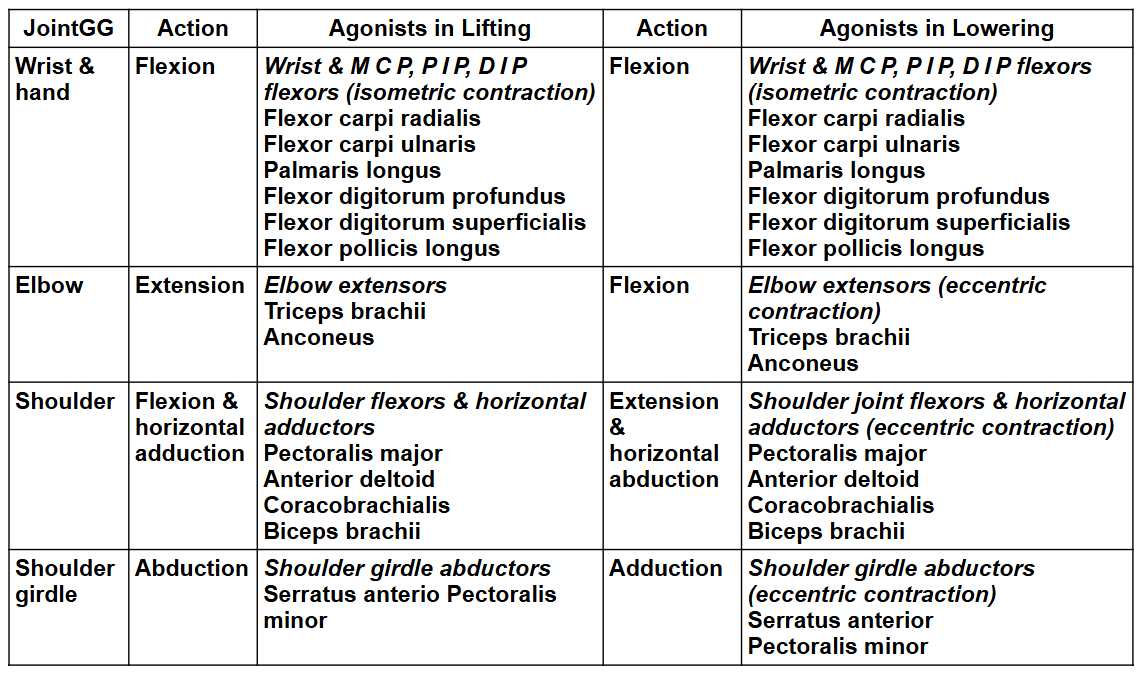
Elbow
Chest Press (bench press)
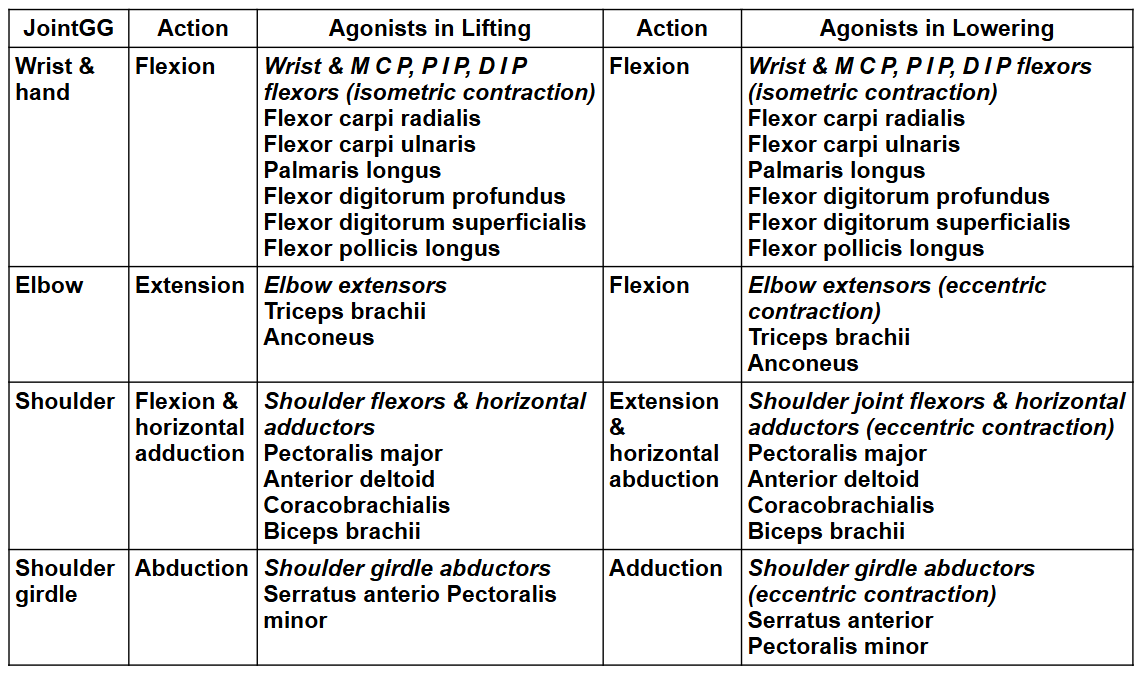
Shoulder
Chest Press (bench press)
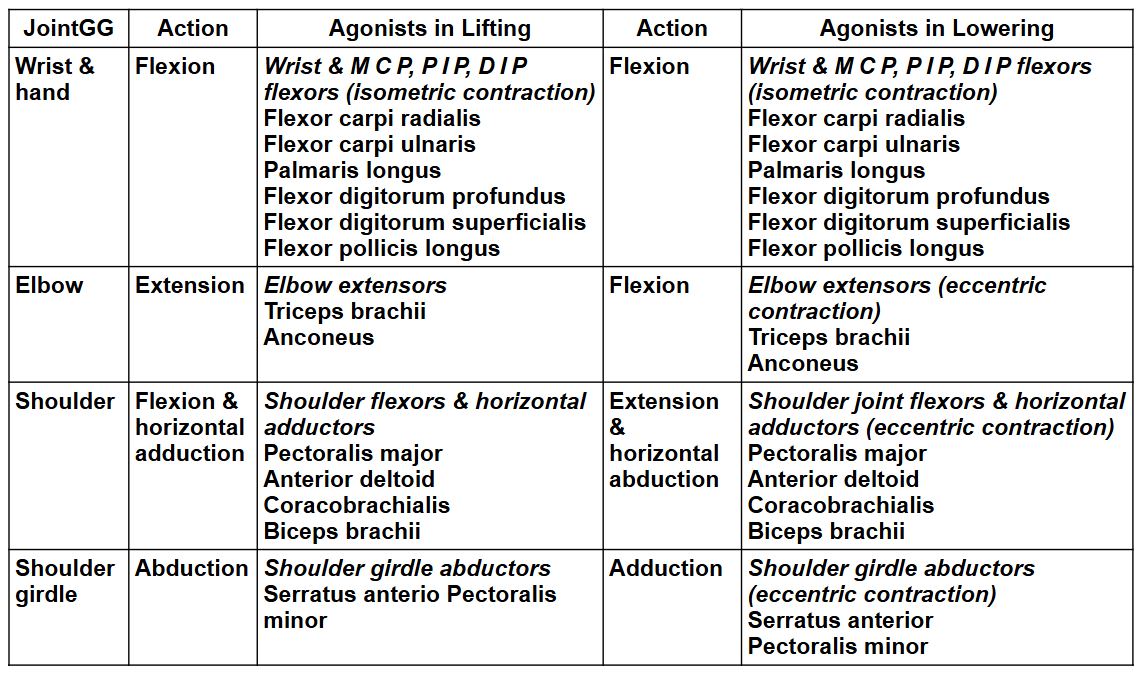
Shoulder Girdle
Chest Press (bench press)
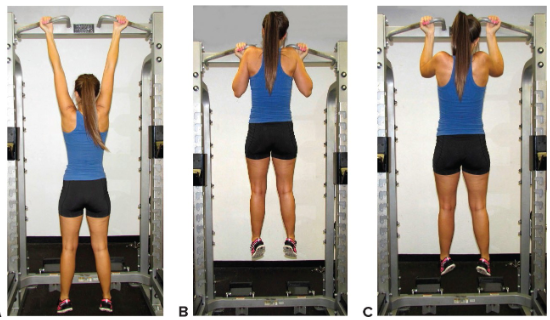
Chin-up (pull-up)
Subject grasps horizontal bar with palms away from face
From hanging position, subject pulls up until the chin is over the bar
Return to starting position
closed-kinetic-chain exercise