PSYC 330 final exam
0.0(0)
 Studied by 24 people
 Call Kai
 Learn
Learn Practice Test
 Spaced Repetition
 Match
Match Flashcards
 Knowt Play
Card Sorting
1/163

Earn XP
Last updated 7:51 AM on 4/28/23
Name | Mastery | Learn | Test | Matching | Spaced | Call with Kai |
|---|
No analytics yet
Send a link to your students to track their progress
164 Terms
1
New cards
what is self-concept (SC)?
*a) Web of Knowledge of “me”*
i) Ex: I am a psychology major, I am straightforward (tied to personality), I am
ii) Descriptions, motives, values I hold dear to myself
* *Develops over the lifespan*
i) Ex: I am a psychology major, I am straightforward (tied to personality), I am
ii) Descriptions, motives, values I hold dear to myself
* *Develops over the lifespan*
2
New cards
when do individals gain self-recognition and what does the mirror self-recognition test (rouge test) show?
18-24 months
(a) Rouge on baby’s face, testing whether the child is able to distinguish the person on the mirror as themselves or another person
(b) If the child was not recognizing themselves on the mirror, they would not care about the rouge on their face
(a) Rouge on baby’s face, testing whether the child is able to distinguish the person on the mirror as themselves or another person
(b) If the child was not recognizing themselves on the mirror, they would not care about the rouge on their face
3
New cards
when does SOCIAL identity begin to form?
during adolescence, typically early to mid-teens
4
New cards
what are 3 functions of the self-concept?
i) Organizes “self-relevant info”
ii) Helps us relate to the world; sense of agency (I’m in control of my decisions and life)
iii) Motivates us (what are my goals? What are my values and how do I go about achieving my goals)
ii) Helps us relate to the world; sense of agency (I’m in control of my decisions and life)
iii) Motivates us (what are my goals? What are my values and how do I go about achieving my goals)
5
New cards
according to the self-discrepancy theory by Higgins, what are the different “selves” people have?
Notion: ppl have different “selves”
(1) __Self-concept: ACTUAL self =__ How *you see yourself*
(2) __Self-guide #1: OUGHT self =__ How you feel *others think you should be*
* Internalized sense of should/should not expectations (relates to superego)
(3) __Self-guide #2:__ IDEAL self = How you *wish you were/want to be*
* Aspirations
(1) __Self-concept: ACTUAL self =__ How *you see yourself*
(2) __Self-guide #1: OUGHT self =__ How you feel *others think you should be*
* Internalized sense of should/should not expectations (relates to superego)
(3) __Self-guide #2:__ IDEAL self = How you *wish you were/want to be*
* Aspirations
6
New cards
wat results from the mismatch between the difference selves according to the self-discrepancy theory by higgigns & what are the 2 types fo mismatches?
__Self-discrepancies:__ mismatch b/t the “selves”
(1) __Actual-ideal (mismatch): “dejection-related emotions”__
* Sadness, depression (low arousal)
* Ex: I’d like to be an opera singer, but here I am just singing in my room with no audience
(2) __Actual-ought: “agitation-related emotions”__
* Guilt, Anxiety (high arousal)
* Ex: I’m out clubbing on a Thursday night, I really should be writing my assigned paper
\
we have the propensity to experience both types of discrepancies, but one mismatch might be stronger than the other
(1) __Actual-ideal (mismatch): “dejection-related emotions”__
* Sadness, depression (low arousal)
* Ex: I’d like to be an opera singer, but here I am just singing in my room with no audience
(2) __Actual-ought: “agitation-related emotions”__
* Guilt, Anxiety (high arousal)
* Ex: I’m out clubbing on a Thursday night, I really should be writing my assigned paper
\
we have the propensity to experience both types of discrepancies, but one mismatch might be stronger than the other
7
New cards
what cultural variations exist in Self-concept?
cultures that emphasize “fitting in” versus “standing out”
8
New cards
what does **independent culture** emphasize and how does it relate to self-concept?
*Aka, INDIVIDUALIST*
* Ex: the united states, most of the western sphere
* *Self=separate, autonomous*
* Focus upon individuals as autonomous agents in their environment
* “I am someone distinct from even the closest ppl to me”
* Importance placed on:
* *Individual needs*
* *Being consistent – I am who I am regardless of the context*
* ex: blunt regardless of who they’re around- in front of parents AND friends
* Idea of not being consistent is seen negatively (ex: “two-faced”)
* Ex: the united states, most of the western sphere
* *Self=separate, autonomous*
* Focus upon individuals as autonomous agents in their environment
* “I am someone distinct from even the closest ppl to me”
* Importance placed on:
* *Individual needs*
* *Being consistent – I am who I am regardless of the context*
* ex: blunt regardless of who they’re around- in front of parents AND friends
* Idea of not being consistent is seen negatively (ex: “two-faced”)
9
New cards
what does **interdependent culture** emphasize and how does it relate to self-concept?
*Aka, COLLECTIVIST*
* Ex: Asian and latin American countries
* *Self= connected to others (relational)*
* “I would not be who I am were it not for the relationships I have)
* The people around me are a part of me
* Importance placed on:
* *Needs of group/others*
* Personal desires take a backseat to the needs of others
* Ex: I wanna major in film, but my parents expect me to be a doctor
* *Maintaining group harmony – being less consistent than in independent cultures*
* Seen more positively to attune to the group’s personality (intentional strategizing to different contexts)
* Ex: Asian and latin American countries
* *Self= connected to others (relational)*
* “I would not be who I am were it not for the relationships I have)
* The people around me are a part of me
* Importance placed on:
* *Needs of group/others*
* Personal desires take a backseat to the needs of others
* Ex: I wanna major in film, but my parents expect me to be a doctor
* *Maintaining group harmony – being less consistent than in independent cultures*
* Seen more positively to attune to the group’s personality (intentional strategizing to different contexts)
10
New cards
as evidence for cultural variations in self-concept, what did the “I am” statement completions show?
__Bochner__: agentic vs. communal trait listings
* comparing independent and interdependent, we see differences in proportions of agentic and communal traits
* __agentic__ – property of me as I sit here, devoid of connections to others (ex: I am conscientious, I am a good athlete)
* applies more to independent culture
* __communal:__ relational traits (“I am a sister,” “I am a friend”)
* applies more to interdependent culture
__kitayama__: invented the “I am” statements; traits “distilled” by independent samples but “contextualized” by interdependent samples
* the way different cultures talk about traits is diff
* ex:
* distilled- I am friendly
* contextualized – I am friendly around those I know, but shy to others
* comparing independent and interdependent, we see differences in proportions of agentic and communal traits
* __agentic__ – property of me as I sit here, devoid of connections to others (ex: I am conscientious, I am a good athlete)
* applies more to independent culture
* __communal:__ relational traits (“I am a sister,” “I am a friend”)
* applies more to interdependent culture
__kitayama__: invented the “I am” statements; traits “distilled” by independent samples but “contextualized” by interdependent samples
* the way different cultures talk about traits is diff
* ex:
* distilled- I am friendly
* contextualized – I am friendly around those I know, but shy to others
11
New cards
as evidence for cultural variations in self-concept, what did the trait lists across contexts show?
*cross*: when the context changes,
* interdependent cultures list different traits (when in diff contexts, bc they define themselves based on who they’re around)
* independent culture ppl list the same traits (regardless of what setting they are in, bc who they are do not change according to the context)
* interdependent cultures list different traits (when in diff contexts, bc they define themselves based on who they’re around)
* independent culture ppl list the same traits (regardless of what setting they are in, bc who they are do not change according to the context)
12
New cards
what is self-esteem?
attitude about “me” – how positive/negative does one feel about themselves?
13
New cards
what are the 2 types of self-esteem?
1. __State SE__ – can vary across domaisn & situations
* ex: Surveys asking how ppl feel AT THE MOMENT
2. __Trait SE__ (average level) – relatively constant
(1) ex: surveys asking general tendencies
\
SE can fluctuate over time & context
14
New cards
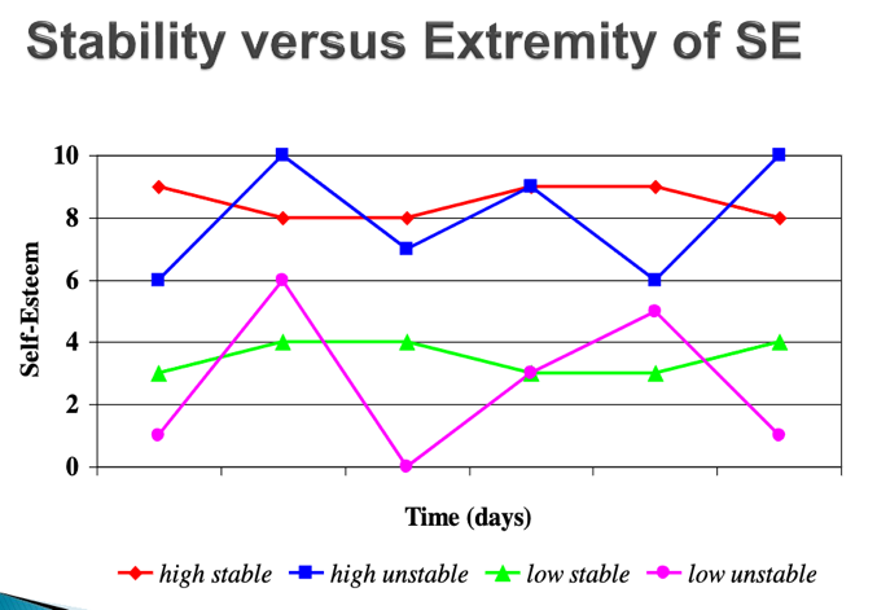
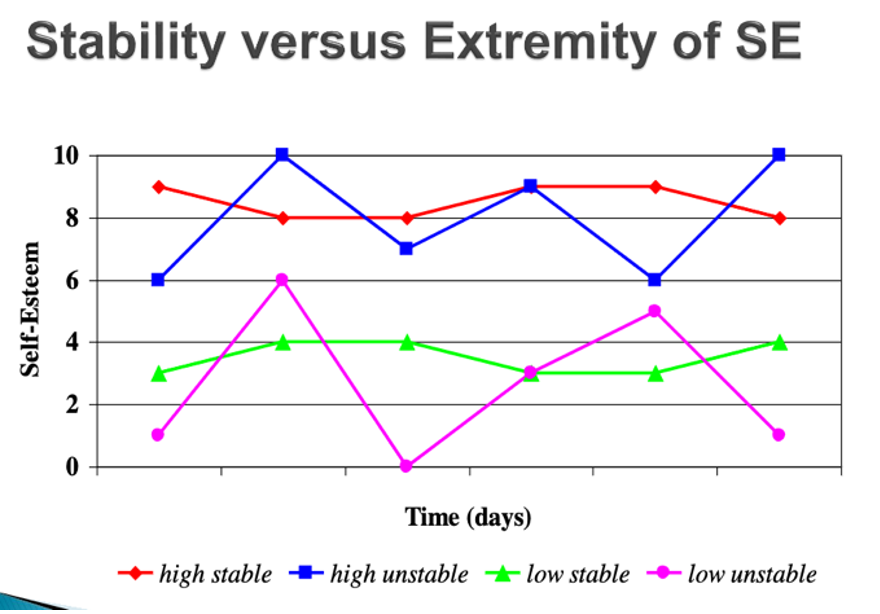
what did the graph on stability vs. extremity of SE show?
in graph, assumption that ppl are in same context
ii) for *high stable SE* person, they feel good about themselves most of he time
* evaluation of self doesn’t change much
iii) for *high unstable SE* person, there’s more variability in how they think abt themselves, contexts matter a lot
ii) for *high stable SE* person, they feel good about themselves most of he time
* evaluation of self doesn’t change much
iii) for *high unstable SE* person, there’s more variability in how they think abt themselves, contexts matter a lot
15
New cards
what’s the link between stability of Self-esteem and self-concept?
i) *stable SE:* clearly denoted, consistent SC
* there’s a difference between high and low stable SE
ii) *unstable SE:* SC is less clear
* without clear self-evaluation, externalities and feedback (ex: exam grade) carry more weight in evaluation of SE = SE is contingent on other factors
* there’s a difference between high and low stable SE
ii) *unstable SE:* SC is less clear
* without clear self-evaluation, externalities and feedback (ex: exam grade) carry more weight in evaluation of SE = SE is contingent on other factors
16
New cards
what does research suggest about the link between unstable, high self-esteem and violence?
(1) it’s not that violence is masking low SE
(2) __retaliatory aggression__ = people seek external sources to ensure their SE & protect their SE
(3) for people w/ unstable high SE, it feels really good when people praise them but negative feedback hits especially hard (which leads to retaliation)
* they strive to get rid of the threat, and violence becomes a mechanism for that
(2) __retaliatory aggression__ = people seek external sources to ensure their SE & protect their SE
(3) for people w/ unstable high SE, it feels really good when people praise them but negative feedback hits especially hard (which leads to retaliation)
* they strive to get rid of the threat, and violence becomes a mechanism for that
17
New cards
what are the 3 functions of self-esteem?
1. confidence
2. __self-efficacy (Bandura)__
* setting reasonable and attainable goals
* having faith that when you move goal line that’s out of reach at this moment, im gonna work towards achieving it
3. __“sociometer” (leary & Baumeister)__
* “do others accept or reject me” – sociometer is a way of measuring whether others are cool with what im doing
* having a good read that im well accepted by those around me – evolutionarily, ticket to survival bc you need to get along with others to survive
* if group doesn’t like me, then I will get excluded and kicked out – threat to survival for social species like humans
18
New cards
what is a cultural variation in self-esteem?
collectivist cultures show lower SE on standard assessments than those from individualist cultures
*(1) reasons:*
* __impression management__ – desire to appear modest, humble (social desirability)
* BUT NOT ENTIRELY BC study by Fiske et al (1997) shows that even in conditions of total anonymity, collectivist culture still show lower SE
*(1) reasons:*
* __impression management__ – desire to appear modest, humble (social desirability)
* BUT NOT ENTIRELY BC study by Fiske et al (1997) shows that even in conditions of total anonymity, collectivist culture still show lower SE
19
New cards
what is __Heine et al(1999)__ state about the real difference in the cultural variations in self-esteem?
(a) CVs in SE are due to a __real difference__
(b) need for positive self-regard may be culturally variant
* individualistic cultures value high SE
* collectivistic cultures value self-critical focus more
* self-critical focus: need to critique self
* ex: “I would rather have honest feedback to allow myself to improve”
(b) need for positive self-regard may be culturally variant
* individualistic cultures value high SE
* collectivistic cultures value self-critical focus more
* self-critical focus: need to critique self
* ex: “I would rather have honest feedback to allow myself to improve”
20
New cards
what is __Chen et al(2006)__ state about the measurement issue in the cultural variations in self-esteem?
CVs in SE are due to a measurement issue
(b) need may be *universally felt* but *differentially expressed*
* individualistic cultures: autonomous/agentic SE
* collectivistic cultures: relational SE
* how much am I contributing to communities, how do my interactions with those around me look like
* ex: “my family would be proud of me”
(b) need may be *universally felt* but *differentially expressed*
* individualistic cultures: autonomous/agentic SE
* collectivistic cultures: relational SE
* how much am I contributing to communities, how do my interactions with those around me look like
* ex: “my family would be proud of me”
21
New cards
what are the 5 ways that people maintain/protect their SE if they feel that they’re getting negative feedback?
1. reduce self-awareness
2. have self-serving cognitions
3. use self-handicapping
4. use downward social comparison
5. “basking in reflected glory” (Cialdini)
22
New cards
how does one “reduce self-awareness” when they’re getting negative feddback to maintain SE?
(1) if actual self if not living up to my self-guides, then it feels uncomfortable (self-discrepancy theory)
(2) might *distract* myself - “drowning one’s problems”
(2) might *distract* myself - “drowning one’s problems”
23
New cards
how does one “have self-serving cognitions” when they’re getting negative feddback to maintain SE?
(1) INTERNAL/DISPOSITIONAL explanations for SUCCESS
* “I aced the test because I am smart and I was dedicated to studying”
(2) but then use EXTERNAL explanations for FAILURE
* “I didn’t get that interview because that interviewer is too anal”
* “I aced the test because I am smart and I was dedicated to studying”
(2) but then use EXTERNAL explanations for FAILURE
* “I didn’t get that interview because that interviewer is too anal”
24
New cards
how does one “use self-handicapping” when they’re getting negative feedback to maintain SE?
(1) ex: “to study or not to study…”
* providing ready-made explanation if things don’t go well
* “if I fail the test, it was bc I didn’t study, not bc I’m stupid”
(2) negative effects:
* setting oneself up for failure
* others start noticing
* providing ready-made explanation if things don’t go well
* “if I fail the test, it was bc I didn’t study, not bc I’m stupid”
(2) negative effects:
* setting oneself up for failure
* others start noticing
25
New cards
how does one “use downward social comparison” when they’re getting negative feedback to maintain SE?
(1) comparing w/ those WORSE than us
* ex: when I get exam score back and I get an 87, I make myself feel better by knowing and comparing myself to a person who got an 80
* reminding oneself that I could’ve done worse
(2) similar to a coping strategy when something bad happens
* ex: tornado strikes home, but another family lost their son
* ex: when I get exam score back and I get an 87, I make myself feel better by knowing and comparing myself to a person who got an 80
* reminding oneself that I could’ve done worse
(2) similar to a coping strategy when something bad happens
* ex: tornado strikes home, but another family lost their son
26
New cards
how does one “bask in reflected glory” when they’re getting negative feedback to maintain SE?
(1) associating w/ successful others
(2) ex: sports team doing really well, ppl who have some ties to that team(even minuscule) feel really excited when the team is doing well – ppl like to associate with success
* feeling connected to a group has implications for one’s own self-esteem
* “WE are doing great!!”
(2) ex: sports team doing really well, ppl who have some ties to that team(even minuscule) feel really excited when the team is doing well – ppl like to associate with success
* feeling connected to a group has implications for one’s own self-esteem
* “WE are doing great!!”
27
New cards
what are characteristics of narcissism?
a) grandiose sense of self +lack of concern for others
i) high SE is confidence vs. narcissism is over-confidence
b) high SE ppl(bt not narcissistic) care about others and have compassion
i) high SE is confidence vs. narcissism is over-confidence
b) high SE ppl(bt not narcissistic) care about others and have compassion
28
New cards
how is narcissism “intrapersonally beneficial”?
a) those who are high in narcissism are low in other potentially problematic things
i) they tend to have low depression, low anxiety
i) they tend to have low depression, low anxiety
29
New cards
how is narcissism “interpersonally dysfunctional”?
manipulative, low relationship commitment
* those high in narcissism tend to make a good first relationship bc they are charismatic but problems surface when relationships start to deepen
* “I can get ppl to do what I want, even if it means harm for them”
* “why should I be concerned about ur problems?”
* example of low relationship commitment- having a trophy wife, once they’re older they get a divorce and go find another young woman
* those high in narcissism tend to make a good first relationship bc they are charismatic but problems surface when relationships start to deepen
* “I can get ppl to do what I want, even if it means harm for them”
* “why should I be concerned about ur problems?”
* example of low relationship commitment- having a trophy wife, once they’re older they get a divorce and go find another young woman
30
New cards
what are some examples of narcissism?
i) reality television – stars who come on reality TV shows show narcissism, and normalize narcissism
(1) ex: paris Hilton wearing a shirt with her face on it
(2) ex: the kardashians
ii) now possible to hire fake paparazzi to take photos
(1) ex: paris Hilton wearing a shirt with her face on it
(2) ex: the kardashians
ii) now possible to hire fake paparazzi to take photos
31
New cards
trends over time: looking at song lyrics to detect narcissism
over the past years, language like “I”, “me”, “my” and antisocial words like aggression and hurting people increased while languages like “we”,” “us” and social words related to love and caring decreased
32
New cards
trends over time: study on college students and rates of narcissism by __jean twenge__
__study on college students__, who completed the personality inventory at some point between 1982 and 2009
(1) items:
* “if I ruled the world if would be a better place”
* “I can live my life any way I want to”
* “I like to be the center of attention”
\
(a) in the early 80s, 17% of ppl answered the majority of the items in the narcissistic direction on the personality inventory
(b) by 2009, it was 30%
(c) even at later time, majority of ppl are not that narcissistic BUT number of ppl who show narcissism almost doubled from 1982 to 2009
(d) consistent with people’s experience, people who are narcissistic are the ones who end up in your workplace, makes it more noticeable
(1) items:
* “if I ruled the world if would be a better place”
* “I can live my life any way I want to”
* “I like to be the center of attention”
\
(a) in the early 80s, 17% of ppl answered the majority of the items in the narcissistic direction on the personality inventory
(b) by 2009, it was 30%
(c) even at later time, majority of ppl are not that narcissistic BUT number of ppl who show narcissism almost doubled from 1982 to 2009
(d) consistent with people’s experience, people who are narcissistic are the ones who end up in your workplace, makes it more noticeable
33
New cards
what is __vulnerable narcissism?__
* subtype of narcissistic personality disorder
* feelings of inadequacy, unstable low self-esteem, hypersensitivity to criticism or rejection
* may appear shy or introverted, but still have a strong sense of entitlement and need for admiration
* may engage in self-pity and seek ressurance from others to boost fragile self-esteem
* “narcissitic paradox” = in one way, i think i’m great and don’t need anyone else but i’m also very sensitive to external feedback
* feelings of inadequacy, unstable low self-esteem, hypersensitivity to criticism or rejection
* may appear shy or introverted, but still have a strong sense of entitlement and need for admiration
* may engage in self-pity and seek ressurance from others to boost fragile self-esteem
* “narcissitic paradox” = in one way, i think i’m great and don’t need anyone else but i’m also very sensitive to external feedback
34
New cards
what is __identity?__
self we show to others
35
New cards
what did the “evaluative audience perception” video by Botto & rochat (2018) show about *identity*?
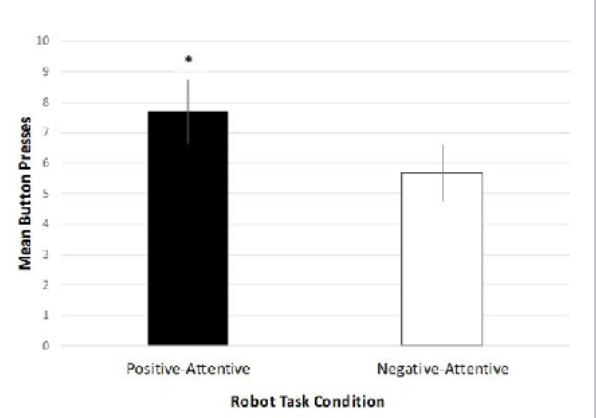
i) “robot task” – observe when children will begin being sensitive to the evaluation of others, see when children will strategically modify their behavior when others are watching
* 14-24 mo infants
* show infants how to activate a robot with 2 conditions:
* positive value - “wow isn’t that great!”
* negative value - “oh no!” after pressing remote
* invited infants to press the remote to activate robot, either:
* watched them
* pretended to read a magazine (not paying attention to infant)
* expected infants to play with the positive remote significantly more when observed, and choose to explore the negative remote once no one was watching = actually occurred
* by 24 months (2 yrs of age), kids can modify behavior strategically to align w/ others’ attention & values
* self-referent emotions like embarrassment begin to come out
* children, like adults, are sensitive to the values we place on objects & behaviors
* 14-24 mo infants
* show infants how to activate a robot with 2 conditions:
* positive value - “wow isn’t that great!”
* negative value - “oh no!” after pressing remote
* invited infants to press the remote to activate robot, either:
* watched them
* pretended to read a magazine (not paying attention to infant)
* expected infants to play with the positive remote significantly more when observed, and choose to explore the negative remote once no one was watching = actually occurred
* by 24 months (2 yrs of age), kids can modify behavior strategically to align w/ others’ attention & values
* self-referent emotions like embarrassment begin to come out
* children, like adults, are sensitive to the values we place on objects & behaviors
36
New cards
what did Erikson state about identity and role confusion?
i) identity vs. role confusion= occurs during adolescence- navigating social roles, trying to see how to actively interact with diff roles
*ii) erikson says that identity provides:*
* __continuity__ – consistency of self
* key factor in determining how ppl present themselves across diff contexts
* there is an essence of myself that’s carried throughout different situations
* __contrast__ – differentiation from others
*ii) erikson says that identity provides:*
* __continuity__ – consistency of self
* key factor in determining how ppl present themselves across diff contexts
* there is an essence of myself that’s carried throughout different situations
* __contrast__ – differentiation from others
37
New cards
what are the 2 steps in resolving identity crises?
1. *decide which values are most important* – intrapersonal
* ex: going to college makes a lot of ppl question the ways they thought the world functioned, “who am i?”
2. *align self w/ values via ACTIONS –* interpersonal
* ex: “equality”
* ex: what you’re posting on social media shows others what you value
38
New cards
why do we study sex differences?
benefits:
(1) gain a better understanding – are there any traits or tendencies that tend to be higher or lower in men versus men?
\
potential costs:
(1) possibility of things being misconstrued
(3) drawing incorrect conclusions & overgeneralizing
(4) threat to egalitarianism and equity between sexes
\
we need to be cognizant of “is does not equal ought”
(1) gain a better understanding – are there any traits or tendencies that tend to be higher or lower in men versus men?
\
potential costs:
(1) possibility of things being misconstrued
(3) drawing incorrect conclusions & overgeneralizing
(4) threat to egalitarianism and equity between sexes
\
we need to be cognizant of “is does not equal ought”
39
New cards
sex vs. gender
__sex__: BIOLOGICAL categorizations
* “male” “female”
* genes, hormones, reproductive organs
__gender__: SOCIAL categorizations
* “man” “woman”
* differentiation by psychological characteristics, role expectations, gender identity ( how I see myself)
* “male” “female”
* genes, hormones, reproductive organs
__gender__: SOCIAL categorizations
* “man” “woman”
* differentiation by psychological characteristics, role expectations, gender identity ( how I see myself)
40
New cards
history of studying sex differences:
before 1973: not much
* exception: karen horney (took issue to freud’s psychoanalysis and the supposed inherent inferiority of women)
1974: *The Psychology of Sex Differences* by Maccoby and jacklin
* starting point of thinking abt comparing men and women on various key dimensions
* some of the stereotypical differences b/t males and females
* collection of empirical findings, but not perfect
* since mid-70s: meta-analysis =looking across a wide swatch of studies to look for consistent patterns or idiosyncrasies
* exception: karen horney (took issue to freud’s psychoanalysis and the supposed inherent inferiority of women)
1974: *The Psychology of Sex Differences* by Maccoby and jacklin
* starting point of thinking abt comparing men and women on various key dimensions
* some of the stereotypical differences b/t males and females
* collection of empirical findings, but not perfect
* since mid-70s: meta-analysis =looking across a wide swatch of studies to look for consistent patterns or idiosyncrasies
41
New cards
what is effect size?
additional compliment for helping to make sense of interpret diffs that we see or effects we find
b) asking, “how large of a diff is there?”
c) __cohen’s__ __*d*__*:* size of group (sex) diffs relative to within-group variability
* usually ranges from -3 to +3
* expresses effect size in ST DEV units = allows a standardized metric of identifying diffs
* __positive__ __*d*__ __(group 1)__*=* mean for men higher in particular trait
* __negative__ __*d*__ __(group 2__) *=* mean for women higher in particular trait
b) asking, “how large of a diff is there?”
c) __cohen’s__ __*d*__*:* size of group (sex) diffs relative to within-group variability
* usually ranges from -3 to +3
* expresses effect size in ST DEV units = allows a standardized metric of identifying diffs
* __positive__ __*d*__ __(group 1)__*=* mean for men higher in particular trait
* __negative__ __*d*__ __(group 2__) *=* mean for women higher in particular trait
42
New cards
what are the general rules of interpretation for cohen’s d (effect size)?
(1) ±0.20= small
(2) ±0.50 =medium
(3) ±0.80 = large
ii) even large effect size doesn’t mean we’ll always see diffs @ individual level = tends to be a lot of within group variability
(1) not all men are higher in trait X than women, but only exception is circulating levels of testosterone in women and men bc men have exponentially higher levels of testosterone
(2) ±0.50 =medium
(3) ±0.80 = large
ii) even large effect size doesn’t mean we’ll always see diffs @ individual level = tends to be a lot of within group variability
(1) not all men are higher in trait X than women, but only exception is circulating levels of testosterone in women and men bc men have exponentially higher levels of testosterone
43
New cards
examples of interpreting sex difference effect sizes:
*d=0.90*
* general range of 0.8< is large, mean score for men is group 1 and women is group 2, so positive means score for men is larger
* \
*d=-1.32*
* score for women is very large
\
*d=0.02*
* no sex difference, so small as to be incidental
\
there’s variability within groups
(1) not every man is higher in d value than every woman
* general range of 0.8< is large, mean score for men is group 1 and women is group 2, so positive means score for men is larger
* \
*d=-1.32*
* score for women is very large
\
*d=0.02*
* no sex difference, so small as to be incidental
\
there’s variability within groups
(1) not every man is higher in d value than every woman
44
New cards
what’s the sex difference effect size in EXTRAVERISON?
a) d =0.15
i) small effect with men being more extroverted
i) small effect with men being more extroverted
45
New cards
what’s the sex difference effect size in ASSERTIVENESS?
i) d= 0.24
* small effect with men being more assertive, related to extraversion
(1) how might this manifest in/impact social interactions? = men might dominate conversations more, women might feel restricted, leads to long-term biases, particularly within friendships
* small effect with men being more assertive, related to extraversion
(1) how might this manifest in/impact social interactions? = men might dominate conversations more, women might feel restricted, leads to long-term biases, particularly within friendships
46
New cards
what’s the sex difference effect size in NEUROTICISM?
d = -0.49
i) women are higher in neuroticism
ii) just as much you can describe someone as neurotic, you can describe them as being emotionally expressive (including positive emotions)
* impulsivity: d = 0.06, not much difference between men and women
* anxiety: d=-0.24, women are slightly higher in anxiety than men
i) women are higher in neuroticism
ii) just as much you can describe someone as neurotic, you can describe them as being emotionally expressive (including positive emotions)
* impulsivity: d = 0.06, not much difference between men and women
* anxiety: d=-0.24, women are slightly higher in anxiety than men
47
New cards
what’s the sex difference effect size in OPENNESS?
d = -0.05 to -0.07
i) hard to measure/operationalize
ii) diff researchers might be measuring diff things
iii) very small effect size/difference= not much of a take-home
i) hard to measure/operationalize
ii) diff researchers might be measuring diff things
iii) very small effect size/difference= not much of a take-home
48
New cards
what’s the sex difference effect size in AGREEABLENESS?
a) (d=-0.32)
i) small to moderate effect, women tend to be a little higher
ii) driven by sub-traits
i) small to moderate effect, women tend to be a little higher
ii) driven by sub-traits
49
New cards
what’s the sex difference effect size in TENDER-MINDEDNESS (related to agreeableness)?
i) d= -0.97
(1) being kind, empathic, compassionate to others
(2) women as the “nurturing caregiver”; large effect size for women
(1) being kind, empathic, compassionate to others
(2) women as the “nurturing caregiver”; large effect size for women
50
New cards
sex difference effect size for “who smiles more during interactions”?
(1) d=-0.60
* related to agreeableness & tender-mindedness
(a) women risk losing more if they don’t smile, due to social expectations that state that women need to be more agreeable and friendly
(b) socialization affects the way personality traits are expressed
(i) applies to other personality traits as well
* ex: men raised to show less neuroticism, to not cry while women are raised without being told not to cry
* related to agreeableness & tender-mindedness
(a) women risk losing more if they don’t smile, due to social expectations that state that women need to be more agreeable and friendly
(b) socialization affects the way personality traits are expressed
(i) applies to other personality traits as well
* ex: men raised to show less neuroticism, to not cry while women are raised without being told not to cry
51
New cards
sex difference effect size for CONSCIENTIOUSNESS?
a) d= -0.14
i) not a strong difference
i) not a strong difference
52
New cards
sex difference effect size for HONESTY-HUMILITY?
a) d=-0.37
i) small to moderate, women ranking higher on aspects like honesty, humility
ii) Lee & ashton (2020)
i) small to moderate, women ranking higher on aspects like honesty, humility
ii) Lee & ashton (2020)
53
New cards
what’s the sex difference effect size for self-esteem?
a) across ages: d=0.21 for SE (men rank slightly higher in SE)
i) largest effect sizes: adolescence
i) largest effect sizes: adolescence
54
New cards
what is depression?
i) characteristics such as low self-esteem, pessimism (expecting the worst to happen), and the perception that one has little control over one’s life
55
New cards
are there sex diffs for depression in childhood?
NO
56
New cards
after puberty, how do women and men differ in depression rates?
i) women show depression rate roughly 2x that of men
(1) \~25% of all women have at least one depressive episode in their lifetime vs. 10% of men who have a depressive episode
(2) largest sex diffs in depression show up b/t ages of 18\~44
(1) \~25% of all women have at least one depressive episode in their lifetime vs. 10% of men who have a depressive episode
(2) largest sex diffs in depression show up b/t ages of 18\~44
57
New cards
what are some differences in the depressive symptoms between men and women?
(1) depressed women more often than depressed men report excessive eating & weight gain
(2) women more likely to cry when depressed & confront feelings, men more likely to become aggressive
(3) women more likely to seek treatment, men more likely to miss work
(4) nervous activity (e.g. fidgeting) more common in depressed women, inactivity common in depressed men
(5) among depressed college students:
* men more socially withdrawn, more likely to use drugs & experience aches and pains
* women more likely to experience hurt feelings and decline in self-esteem
(6) men more likely to commit suicide “successfully” bc they choose gun as a method, women more likely to make nonfatal suicide attempts bc they use less lethal methods like OD on pills
(2) women more likely to cry when depressed & confront feelings, men more likely to become aggressive
(3) women more likely to seek treatment, men more likely to miss work
(4) nervous activity (e.g. fidgeting) more common in depressed women, inactivity common in depressed men
(5) among depressed college students:
* men more socially withdrawn, more likely to use drugs & experience aches and pains
* women more likely to experience hurt feelings and decline in self-esteem
(6) men more likely to commit suicide “successfully” bc they choose gun as a method, women more likely to make nonfatal suicide attempts bc they use less lethal methods like OD on pills
58
New cards
what are the 4 contributors to sex diffs in rates of depression?
1. rumination
2. “isolation of modernity”
3. body dissatisfaction
4. evoltuonary adaptationist theory
59
New cards
how does __rumination__ contribute to sex diffs in rates of depression?
(1) rumination = repeatedly focusing on one’s symptoms/distress (e.g. “why do I continue to feel so bad aby myself?”)
(a) key contributor to women’s greater experience of depressive symptoms, women ruminate more than men
(b) their lower power in the workplace, relative lack of control over important areas of their lives, work overload, lower status in heterosexual relationships= women search for ways to control their lives & start to ruminate
(c) rumination can fail to lead to effective solutions, perseverance of depressive symptoms
(d) but gender diff in rumination is small
(a) key contributor to women’s greater experience of depressive symptoms, women ruminate more than men
(b) their lower power in the workplace, relative lack of control over important areas of their lives, work overload, lower status in heterosexual relationships= women search for ways to control their lives & start to ruminate
(c) rumination can fail to lead to effective solutions, perseverance of depressive symptoms
(d) but gender diff in rumination is small
60
New cards
how does __“isolation of modernity”__ contribute to sex diffs in rates of depression?
(1) universal need for belonging, being removed from others can be painful (ex: pandemic)
61
New cards
how does __body dissatisfaction__ contribute to sex diffs in rates of depression?
(1) reinforced by unrealistic media portrayals of women
(a) after entering mate competition, dissatisfaction with physical appearance
(b) onset of women’s depression & emergence of sex diff appears \~age 13, when heterosexual interactions begin to increase
(c) men place greater value on physical appearance in their mate selections worldwide= women under greater pressure to compete in the realm of attractiveness
(d) body dissatisfaction increase in women around puberty along w/ onset of eating disorders (binging, purging, dissatisfaction with current weight)
(a) after entering mate competition, dissatisfaction with physical appearance
(b) onset of women’s depression & emergence of sex diff appears \~age 13, when heterosexual interactions begin to increase
(c) men place greater value on physical appearance in their mate selections worldwide= women under greater pressure to compete in the realm of attractiveness
(d) body dissatisfaction increase in women around puberty along w/ onset of eating disorders (binging, purging, dissatisfaction with current weight)
62
New cards
what is the __evolutionary adaptionist theory__ of sex diffs in rates of depression?
(1) moderate levels of depression send signals of distress to social partners to elicit help or prompt partners to invest more in the relationship
(a) ex: mother of newborn baby might have postpartum depression if she doesn’t receive as much help as she needs from husband or kin, inducing these social partners to invest more
(b) birth of child = women most at risk of experience depression during lifetime
(c) men more likely to get angry to induce partners to invest more
(a) ex: mother of newborn baby might have postpartum depression if she doesn’t receive as much help as she needs from husband or kin, inducing these social partners to invest more
(b) birth of child = women most at risk of experience depression during lifetime
(c) men more likely to get angry to induce partners to invest more
63
New cards
during middle ages(after 44 years old), rates ________in the incidence of depression and in the nature of depressive symptoms
converge
64
New cards
what is the sex difference effect size for interest in casual sex?
i) d=0.81
(1) large effect, men on avg. more
(1) large effect, men on avg. more
65
New cards
what is the sex difference effect size for # of lifetime partners desired?
i) d=0.87
(1) large effect size, men on avg. more
(1) large effect size, men on avg. more
66
New cards
what did the “sex with strangers” study find on sex differences in sexual preferences?
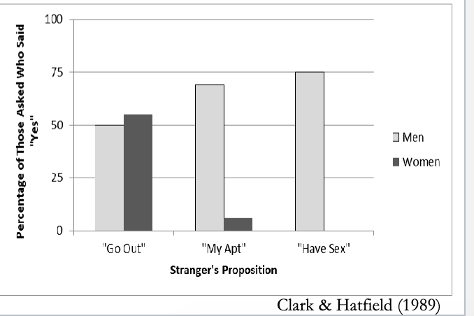
Researchers sent out assistants(confederates) to approach random people of the opposite sex on campus with *3 different statements* after “I saw you on campus and found you attractive..”
1\. Would you go out on a date with me?
2\. Would you come back to my place with me?
3\. Would you have sex with me?
\
recorded % of ppl approached who agreed to the request
\
__Results__
6\. __Go out:__ similar results
7\. __My apt:__ very few women said yes (69% men said yes)
8\. __Have sex:__ 0% women (men: 75% said yes)
= Slight upward trend among these 3 statements with men
\
metanalysis found that attitudes toward casual sex as 1 of the 2 largest sex differences in the sexual domain, with men typically much more positive than women abt casual sex
1\. Would you go out on a date with me?
2\. Would you come back to my place with me?
3\. Would you have sex with me?
\
recorded % of ppl approached who agreed to the request
\
__Results__
6\. __Go out:__ similar results
7\. __My apt:__ very few women said yes (69% men said yes)
8\. __Have sex:__ 0% women (men: 75% said yes)
= Slight upward trend among these 3 statements with men
\
metanalysis found that attitudes toward casual sex as 1 of the 2 largest sex differences in the sexual domain, with men typically much more positive than women abt casual sex
67
New cards
what is the evolutionary hypothesis for the results of the “sex with strangers” study?
hypothesis= men and women differ in their desire for sexual variety
1\. men:
* tend to have more sexual fantasies than do women
* engage more often in “partner switching” during the course of those fantasies
* fantasize abt 2 or more sex partners during a dingle fantasy episode
1\. men:
* tend to have more sexual fantasies than do women
* engage more often in “partner switching” during the course of those fantasies
* fantasize abt 2 or more sex partners during a dingle fantasy episode
68
New cards
what was journalist natalie angier’s hypothesis on the results of the “sex with strangers study”?
1\. women would agree to casual sex as easily as men, if it weren’t for concerns abt their *personal safety*
2\. he replicated the “sex w/ strangers” study in diff part of country
* results virtually identitical- more men than women willing to have sex with stranger
* roughly half of the women in each study quite willing to go out on date, puzzling if they were concerned abt their safety
* when asked abt reasons for refusal, most participants (both men and women) said they had a SO or that they just didn’t know the person enough
2\. he replicated the “sex w/ strangers” study in diff part of country
* results virtually identitical- more men than women willing to have sex with stranger
* roughly half of the women in each study quite willing to go out on date, puzzling if they were concerned abt their safety
* when asked abt reasons for refusal, most participants (both men and women) said they had a SO or that they just didn’t know the person enough
69
New cards
what does the __socialization theory__ state about sex differences?
i) sex diffs arise bc of differential reinforcement
(1) little girls and boys are taught that diff behaviors are okay
(a) Reinforcement: what you are taught is okay/not (direct), what we associated (indirect), marketing, media
(b) ex: “boys will be boys”
(c) ex: clothing, job types, toys
(1) little girls and boys are taught that diff behaviors are okay
(a) Reinforcement: what you are taught is okay/not (direct), what we associated (indirect), marketing, media
(b) ex: “boys will be boys”
(c) ex: clothing, job types, toys
70
New cards
what did __bandura’s social learning theory (bobo dolls)__ show in relation to the socialization theory?
kids came in to see a bobo doll being beaten, would they mimic the same behavior? YES
* kids learn by observing behaviors
follow-up work: __bandura, ross & ross (1961)__
* kids watch male or female adults interacting with bobo doll, adults modeling aggressive behavior or not
* __same-sex modeling= l__ittle boys more closely modeled male adults’ behavior, little girls more closely modeled female adults’ behavior
* __sex-types behavior__
* girls = more imitation of VERBAL AGGRESSION after watching female model
* boys = more imitation of PHYSICAL AGGRESSION after watching male model
* kids learn by observing behaviors
follow-up work: __bandura, ross & ross (1961)__
* kids watch male or female adults interacting with bobo doll, adults modeling aggressive behavior or not
* __same-sex modeling= l__ittle boys more closely modeled male adults’ behavior, little girls more closely modeled female adults’ behavior
* __sex-types behavior__
* girls = more imitation of VERBAL AGGRESSION after watching female model
* boys = more imitation of PHYSICAL AGGRESSION after watching male model
71
New cards
what are the 2 problems in socialization theories?
*(1) problem: causal direction?*
* is it not possible for a child to shape their environment as well?
* causal errors can occur
* ex: a little boy truly loves playing with trucks, not bc they were reinforced to like it
(2) *problem: origins of sex-differentiated socialization?*
* where did these sex dfferences even come from?
* ex: the idea of associating pink for girls and blue for boys; it used to be flipped a century ago, how did it even get flipped
* is it not possible for a child to shape their environment as well?
* causal errors can occur
* ex: a little boy truly loves playing with trucks, not bc they were reinforced to like it
(2) *problem: origins of sex-differentiated socialization?*
* where did these sex dfferences even come from?
* ex: the idea of associating pink for girls and blue for boys; it used to be flipped a century ago, how did it even get flipped
72
New cards
what is the __social role theory__ regarding sex differences?
(1) sex diffs arise bc of differential distribution into social roles (not differential reinforcement)
(2) if men are breadwinners and women are in charge of childrearing in society, are there innate differences or have people grown into their roles in society?
(2) if men are breadwinners and women are in charge of childrearing in society, are there innate differences or have people grown into their roles in society?
73
New cards
what does the __biosocial model by eagly and wood__ state in relation to the social role theory?
(a) introduces possibility that its not about innate tendencies but what social roles mandated or dictated them
(b) if men had historically been assigned childrearing and women were breadwinners, we could see personality traits that might align with their social roles
(c) women show more dominance and extraversion and men might have come to show more openness and agreeableness
(d) men and women have equal propensities to hold certain personality traits
(b) if men had historically been assigned childrearing and women were breadwinners, we could see personality traits that might align with their social roles
(c) women show more dominance and extraversion and men might have come to show more openness and agreeableness
(d) men and women have equal propensities to hold certain personality traits
74
New cards
what is the proble with social role theory regarding sex differences?
(1) *origins of sex-differentiated roles?*
* how have men and women come to hold these social roles?
* how have men and women come to hold these social roles?
75
New cards
what is the __hormone theory__ of sex differences?
i) hormonal, physio diffs cause sex diffs as we develop
(1) ex: testosterone
(1) ex: testosterone
76
New cards
what are 2 problems of the hormone theory regaring sex diffs?
*(1) bidirectional link b/t hormones and behavior =* when people are being aggressive, their testosterone levels may rise; not that ppl who have high testosterone are aggressive
*(2) origins of hormonal diffs?*
*(2) origins of hormonal diffs?*
77
New cards
what is the __evolutionary psych__ view of sex diffs?
i) sex diffs arise b/c males and females faced diff adaptative problems (APs)
ii) diff Adaptive Problems -→ diff solutions
* ex: attitudes toward casual sex
* evolutionarily, men might focus more on just being reproductively fit
ii) diff Adaptive Problems -→ diff solutions
* ex: attitudes toward casual sex
* evolutionarily, men might focus more on just being reproductively fit
78
New cards
what is the problem of the evolutionary psych view of sex differences?
i) *problem:* no clear explanation for individual & within-sex diffs
79
New cards
what is the __integrated theory__ of sex differences?
i) would include *all* levels of analysis (socialization, social role, hormones, evolution)
ii) universal, but including both group and individual diffs
ii) universal, but including both group and individual diffs
80
New cards
history on the view of masculinity & femininity:
in the past, based on sex differences, researchers sought a single personality dimensions: masculinity on one end and femininity on the other
\n With rise of feminism (early 1970s): challenged assumption of single masculinity-femininity dimension = masculinity and femininity are independent dimensions (can be high on both, etc)
* Can also be stereotypically masculine/feminine
\n With rise of feminism (early 1970s): challenged assumption of single masculinity-femininity dimension = masculinity and femininity are independent dimensions (can be high on both, etc)
* Can also be stereotypically masculine/feminine
81
New cards
what are the 2 major personality instruments (masculinity, femininity, androgyny)?
1. __Masculinity dimension:__ assertiveness, boldness, dominance, self-sufficiency, instrumentality
2. __Femininity dimension__: nurturance, expression of emotions, empathy
\
__Androgynous__: scores high on both dimensions; reflects notion that a person could possess both characteristics
1. Viewed as the most highly developed (reflected political movement)
82
New cards
what did critics state about the androgyny?
\
1. some assumed that masculinity and femininity were separate dimensions while some argued both were multidimensional
2. Several studies found masculinity and femininity did consist of a single, bipolar trait - those who scored high on masculinity tended to score low on femininity & vice versa
1. some assumed that masculinity and femininity were separate dimensions while some argued both were multidimensional
2. Several studies found masculinity and femininity did consist of a single, bipolar trait - those who scored high on masculinity tended to score low on femininity & vice versa
83
New cards
how did the originators of the new conceptions of sex roles change their view from masculinity vs femininity to instrumentaluty vs. expressiveness?
* Janet spence no longer believed that her questionnaire assessed sex roles and suggested that her scale really measure the persoanlity characteristics of instrumentality and expressiveness
84
New cards
according to janet spence, what is instrumentality?
* personality traits that involve working with objects
* getting tasks completed in a direct fashion
* showing independence from others
* displaying self-sufficiency
* getting tasks completed in a direct fashion
* showing independence from others
* displaying self-sufficiency
85
New cards
according to janet spence, what is expressiveness?
the ease with which one can express emotions
* such as crying
* showing empathy for the troubles of others
* showing nurturance to those in need.
* such as crying
* showing empathy for the troubles of others
* showing nurturance to those in need.
86
New cards
how did sandra bem change her view on sex role to consider her measure to assess __gender schemata?__
gender schemata= cognitive oreintations that lead individuals to process social info on the basis of sex-linked associations
* ideal is not to be androgynous, but to be **gender-aschematic =** not to use gender at all in one’s processing of social info
* ex: they, them, theirs
* ideal is not to be androgynous, but to be **gender-aschematic =** not to use gender at all in one’s processing of social info
* ex: they, them, theirs
87
New cards
what did researchers find about the tendency for sex-typed behaviors and attitudes themselves to show moderate heritability within sex?
* among women, 38% of variance in proclivity to engage in sex-typical behaviors like crying, expressing emotions, sensitivity to others’ feelings, taking risks, fighting = explained by genetic diffs
* moderate heritability (\~50%) for measures of “gender atypicality” in boys and girls = masculinity in girls and femininity in boys
\
these findings suggest that genes also play a role, even within each gender, in the degree to which the sex roles are adopted (but environmental factors also influence sex roles)
* moderate heritability (\~50%) for measures of “gender atypicality” in boys and girls = masculinity in girls and femininity in boys
\
these findings suggest that genes also play a role, even within each gender, in the degree to which the sex roles are adopted (but environmental factors also influence sex roles)
88
New cards
what are gender stereotypes?
the beleifs we hold about men and women
89
New cards
what are the 3 components of gender stereotypes?
1. __cognitive:__ the ways we form **social categories** (e.g. we may categorize all men into “cads” or “dads”, those who play around and are reluctant to commit versus those who are faithful and invest heavily in their children)
2. __affective:__ may feel hostile/warm toward someone bc you place that person in specific social category
3. __behavioral:__ you may discriminate against someone bc of their belonging in social category such as “woman” or “man”
90
New cards
do the contents of stereotypes stay consistent across cultures?
YES
1. Men: aggressive, autonomous, achievement oriented, dominant, persevering; instrumental-oriented (asserting independence)
2. Women: affiliative, deferent, nurturant, self-abasing; communal-oriented
1. Men: aggressive, autonomous, achievement oriented, dominant, persevering; instrumental-oriented (asserting independence)
2. Women: affiliative, deferent, nurturant, self-abasing; communal-oriented
91
New cards
what are stereotypic subtypes for men & women?
\
1. Men: 5 subtypes
1. ex: playboy= cool, casual, player, lady killer, macho
2. ex: career man= social climbers, manager
2. Women: 3 subtypes
1. classically feminine/”soccer mom” = housewives, secretaries, maternal women
2. sex bombs, tarts, vamps
1. for women, “madonna-whore” dichotomy, good mothers vs. women who exude sexuality
3. career woman - confident, intellectual, liberated
1. Men: 5 subtypes
1. ex: playboy= cool, casual, player, lady killer, macho
2. ex: career man= social climbers, manager
2. Women: 3 subtypes
1. classically feminine/”soccer mom” = housewives, secretaries, maternal women
2. sex bombs, tarts, vamps
1. for women, “madonna-whore” dichotomy, good mothers vs. women who exude sexuality
3. career woman - confident, intellectual, liberated
92
New cards
what are the real-world consequences of gender stereotypes?
* prejudice, damage to health, reputations
* found in legal decisions, medical treatement, car purchases, check cashing, job hunting
\
ex: in wrongful death lawsuits, families of the victim receive more money if a man was killed than if a woman was killed
ex: women quoted higher prices than were the men for exactly the same car
* found in legal decisions, medical treatement, car purchases, check cashing, job hunting
\
ex: in wrongful death lawsuits, families of the victim receive more money if a man was killed than if a woman was killed
ex: women quoted higher prices than were the men for exactly the same car
93
New cards
what are the 5 models of the personality-illness connection?
1. interactional model
2. transactional model
3. health behavior model
4. predispotion model
5. illness behavior model
94
New cards
what is the __interactional model__ of personality-illness connection?
early model
i) objective events happen to ppl, but personality factors determine the impact of those events by influencing ppl’s ability to COPE
ii) personality has its effects on coping responses- how ppl RESPOND to the event
iii) personality is assumed to moderate (influence) the relationship b/t stress and illness
* events like exposure to microbes or chronic stress cause stress, but personality factors make a person more/less vulnerable to those events
* ex: not everyone studying for their final exams will become exhausted or overwhelmed by stress
ii) other researchers report that recent levels of positive affect predict stronger immune response to an antigen injection
iii) but interactional model doesn’t fully explain the psychological mechanisms underlying the interactions
i) objective events happen to ppl, but personality factors determine the impact of those events by influencing ppl’s ability to COPE
ii) personality has its effects on coping responses- how ppl RESPOND to the event
iii) personality is assumed to moderate (influence) the relationship b/t stress and illness
* events like exposure to microbes or chronic stress cause stress, but personality factors make a person more/less vulnerable to those events
* ex: not everyone studying for their final exams will become exhausted or overwhelmed by stress
ii) other researchers report that recent levels of positive affect predict stronger immune response to an antigen injection
iii) but interactional model doesn’t fully explain the psychological mechanisms underlying the interactions
95
New cards
what did the __research on susceptibility to the common cold by sheldon cohen & colleagues__ support the interactional model?
(1) participants agreed to let researchers expose them to the common cold virus (nose drops)
(2) 25% subjects exposed went on to develop a full-blown cold
(3) found that the higher a person’s score on the personality trait of *sociability*, the stronger their immune system response to the virus
(4) concluded that it was the high levels of positive affect that sociable ppl have that’s most associated with a vigorous immune response to viruses
(2) 25% subjects exposed went on to develop a full-blown cold
(3) found that the higher a person’s score on the personality trait of *sociability*, the stronger their immune system response to the virus
(4) concluded that it was the high levels of positive affect that sociable ppl have that’s most associated with a vigorous immune response to viruses
96
New cards
what is the __transactional model__ of personality-illness connection?
personality has 3 potential effects:
(1) it can influence coping
(2) influence how the person appraises/interprets the events
(3) influence the events themselves = ppl choose to be in certain situations & they evoke certain responses from those situations
* ex: disagreeable person may create interpersonal situations in which they get into a lot of arguments
\
ex: 1 person might interpret getting stuck as a major frustration and might respond with a great deal of worry, stress, and anxiety
* other person might interpret getting stuck in traffic as an opportunity to relax, enjoy some music = doesn’t experience the same level of stress
\
appraisal & the person’s influence on events is why this model is transactional= not only do events influence persons, but also persons influence events
(1) it can influence coping
(2) influence how the person appraises/interprets the events
(3) influence the events themselves = ppl choose to be in certain situations & they evoke certain responses from those situations
* ex: disagreeable person may create interpersonal situations in which they get into a lot of arguments
\
ex: 1 person might interpret getting stuck as a major frustration and might respond with a great deal of worry, stress, and anxiety
* other person might interpret getting stuck in traffic as an opportunity to relax, enjoy some music = doesn’t experience the same level of stress
\
appraisal & the person’s influence on events is why this model is transactional= not only do events influence persons, but also persons influence events
97
New cards
what is the __health behavior model__ of personality-illness connection?
i) personality doesn’t directly influence the relationship b/t stress and illness, personality effects health indirectly through health-promoting or heath-degrading behaviors
ii) ex: ppl low in conscientiousness engage in variety of health-damaging behaviors like smoking and dangerous driving
ii) ex: ppl low in conscientiousness engage in variety of health-damaging behaviors like smoking and dangerous driving
98
New cards
what is the __predisposition model__ of personality-illness connection?
i) personality and illness are both expressions of an underlying predisposition
ii) simple conception, suggests that associations exist b/t personality and illness bc of a third variable, which is causing them both
iii) ex: enhanced sympathetic nervous system reactivity may be the cause of subsequent illnesses, as well as cause the behaviors and emotions that lead a person to be called neurotic
ii) simple conception, suggests that associations exist b/t personality and illness bc of a third variable, which is causing them both
iii) ex: enhanced sympathetic nervous system reactivity may be the cause of subsequent illnesses, as well as cause the behaviors and emotions that lead a person to be called neurotic
99
New cards
what is the __illness behavior model__ of personality-illness connection?
ii) illness behavior – action that ppl take when they think they have an illness, like complaining to others or going to the doctor
iii) personality might influence whether a person would seek medical attention or report illness symptoms
iii) personality might influence whether a person would seek medical attention or report illness symptoms
100
New cards
what is stress?
a) subjective reaction to events perceived as uncontrollable & threatening
i) reactions diff for individuals
ii) stress lies “in between” person & event = stress is simply not the event, diff factors like individual interpretations, temperament, culture, etc influence the way we view and respond to our environment
i) reactions diff for individuals
ii) stress lies “in between” person & event = stress is simply not the event, diff factors like individual interpretations, temperament, culture, etc influence the way we view and respond to our environment
 Note
Note  Flashcards (20)