Micro chapter 11 microbial control
 Studied by 0 people
 Call Kai
 Learn
Learn Practice Test
 Spaced Repetition
 Match
Match Flashcards
 Knowt Play
1/151

There's no tags or description
Looks like no tags are added yet.
Name | Mastery | Learn | Test | Matching | Spaced | Call with Kai |
|---|
No analytics yet
Send a link to your students to track their progress
152 Terms
What is microbial control
physical and chemical methods to destroy or reduce undesirable microbes in a given area by altering enzyme function
Decontamination
Physical, chemical, and mechanical methods to destroy or reduce undesirable microbes in a given area
What are the microorganism capable of causing
infection or spolage
Types of microorganism that are dangerous
Vegetative bacterial cells and endospores•
- Fungal hyphae and spores, yeast
• Protozoan trophozoites and cysts
• Worms
• Viruses
• Prions
Physical agents of microbial control
Heat•
Dry
• Incineration
• Sterilization•
Dry oven
• Sterilization•
Moist•
Steam under pressure
• Sterilization
• Boiling water, hot water, pasteurization•
Disinfection
Radiation control methods
Ionizing
-X-RAY , cathode(High velocity electron), gamma
-Sterilization
-Non ionizing
-Uv Disinfection
Mechanical removal methods
-Filtration
-Air
-Disinfection
-Liquids
-Sterliziation
-Chemical agents
-Gases
-Sterlization
-Disinfection
Liquid control methods
-Anitsepsis (Animate)
-Inanmate
-Disinfection
-Sterilization
Disinfection
The destruction or removal of vegetativepathogens but not bacterial endospores. Usually used onlyon inanimate objects
Sterilazation
The complete removal or destruction of allviable microorganisms. Used on inanimate objects.
Antisepsis
Removing pathogens from living tissue/ Chemicals applied to body surfaces to destroyor inhibit vegetative pathogens.
Highest resistance bacteria
Prions
Bacterial endospores (Bacillus, clostridium)
Moderate resistance
-Protozoan cysts; naked viruses
Bacteria with no endospores but resistant walls
• Mycobacterium, Pseudomonas, Acinetobacter, other gram(-)•
-Staphylococcus (most heat- and chemical-resistant bacteria)
least resistance
most bacterial vegetative cell
Fungal spores and hyphae
yeast
enveloped viruses (Covid-19)
protozoan trophozoites
Heat (moist) endospore kill temp
120 C
Heat (moist) vegetative forms kill temp
80C
Heat (moist) relative resistance
1.5x
Radiation dosage endospores
4,000 grays
Radiation dosage vegetative
1000 grays
Sterilizing gas (ethylene oxide) endospores
1,200 mg/l
Sterilizing gas (ethylene oxide) vegetative
700 mg/l
Sporicidal liquid (2% glutaraldehyde) endospore resistance
3 hours
Sporicidal liquid (2% glutaraldehyde) vegetative resistance
10 mins
What is sterilization?
Process to destroy all viable microbes.
What are microbicidal agents?
Antimicrobial agents aimed at destroying a certain group of microorganisms (bactericide, fungicide, virucide, sporicidal).
What is disinfection?
Use of a physical process or a chemical agent (disinfectant) to destroy vegetative pathogens but not bacterial endospores.
What is antisepsis?
Application of chemical agents (antiseptics) directly to exposed body surfaces, wounds, and surgical incisions to destroy or inhibit vegetative pathogens.
What are germicides?
Microbicidal agents (germicides) are antimicrobial agents aimed at destroying a certain group of microorganisms (bactericide, fungicide, virucide, sporicidal).
Cide
to kill
Static
stop reproduction
What are agents that cause microbistasis?
Antimicrobial agents
What is the aim of antimicrobial agents?
To temporarily prevent microbes from multiplying
What are methods that reduce the numbers of microorganisms?
Sanitation and degermation
What is sanitation?
Any cleansing technique that removes microorganisms from inanimate surfaces to reduce the potential for infection and spoilage
What is degermation?
Reduction of microbial load from living tissue by mechanical means
What is decontamination?
Destruction, removal, or reduction of undesirable microbes
Name some methods of decontamination/ examples
Asepsis, disinfection, sanitization, degermation, sterilization
What is sepsis?
The growth of microorganisms in the tissues
Give examples of sepsis.
Presence of infected wounds, blood infection
What are asepsis techniques?
Techniques that prevent the entry of microorganisms into sterile tissues
Provide an example of asepsis technique.
Cleansing the skin with iodine prior to surgery, using sterile needles
What are antiseptics?
Chemicals applied to body surfaces to destroy or inhibit vegetative pathogens
Name some examples of antiseptics.
Iodophors, antibacterial soap, chlorhexidine
What is disinfection?
Destruction of vegetative pathogens on inanimate objects
Give an example of disinfection.
5% bleach, boiling water
What is sanitization?
Cleansing technique that removes microorganisms and debris from inanimate surfaces
Provide an example of sanitization.
Dishwashing, laundering clothes
What is degermation?
Cleansing technique that removes microorganisms and debris from living tissue
Give an example of degermation.
Surgical handscrub, alcohol wipes
What is sterilization?
The removal or destruction of all viable microbes
Name some methods of sterilization.
Autoclaving, ionizing radiation (correctly applied)
What are some factors that affect microbial death?
Number of microbes, Nature of microbes, Temperature and pH, Concentration or dosage of agent, Mode of action of the agent, Presence of solvents, organic matter, or inhibitors
What is the term for permanent loss of reproductive capability in microbes?
Sterilization
What is related to microbes that are hard to detect?
They often reveal no conspicuous vital signs
What are some factors that can affect the effectiveness of a microbial death
Number of microbes•
Nature of microbes in the population
• Temperature and pH of environment
• Concentration or dosage of agent•
Mode of action of the agent•
Presence of solvents, organic matter, or inhibitors
microbistatic
the quality of inhibiting the growth of microbes
Microbicidal
kills microbes
Practical considerations in microbial control
-Does the application require sterilization?•
Is the item to be reused?•
Can the item withstand heat, pressure, radiation, orchemicals?
Is the method suitable?•
Will the agent penetrate to the necessary extent?•
Is the method cost- and labor-efficient and is it safe?
What are the physical and chemical agents target
Cell wall
Cell membrane
Protein and nucleic acid synthesis
Protein function
Cell wall
becomes fragile and cell lyses (some antimicrobial drugs, detergents, and alcohol)
Cell membrane
loses integrity (surfactants from agents break the lipids and dissolve the membrane)
Protein and nucleic acid synthesis
prevention of replication, transcription, translation, peptide bond formation, protein synthesis (chloramphenicol, ultraviolet radiation, formaldehyde)
Protein function
Disrupt or denature proteins (alcohols ,phenols, acids, heat)
What happens to a native state of protein once it is introduced to agents?
Phosphodiester bonds break and can either
-Denature
-Change shape
-Or active sites of protein will be blocked
This prevents active site from accepting substrate and enzymes needed for metabolic processes
What is cystine responsible for
Forms phosphodiester bonds
physical methods of control
Heat (moist and dry)•
-Dry heat: Oven/baking
Cold temperatures•
Desiccation• (Drying out)
Radiation•
Filtration
Bacterial activity in colder enviornments
Doubling decreases, and enzymes are not operable
Can viruses pass through filtration?
Yes since they are nanometers small
moist heat
lower temperatures and shorter exposure time; coagulation and denaturation of proteins, which halts cellular metabolism
Dry heat
moderate to high temperatures; dehydration, alters protein structure; incineration
When is a bacteria most resistant
When bacteria is an endospore
When is bacteria least resistant
When bacteria is vegetative
Thermal death time (TDT)
shortest length of time required to kill all test microbes at a specified temperature
Thermal death point (TDP)
the lowest temperature required to kill all microbes in a sample in 10 minutes
Methods of moist heat control
1. Sterilization with Steam Under Pressure
2. Nonpressurized Steam
3. Boiling Water: Disinfection
4. Pasteurization
Sterilization with steam under pressure
The autoclave: (15 psi/121oC/10-40min) Pressure increases steam temperature
-The pressure raises the steam temperature, ensuring it reaches the surface of the item.
-This method is suitable for items that can withstand heat and moisture, leading to protein denaturation, membrane destruction, and DNA breakdown
What can you not autoclave
Plastics!!!!!!!!!!!!!!
nonpressurized steam
-Tyndallization - intermittent sterilization for substances that cannot withstand autoclaving
-Items exposed to free-flowing steam for 30-60 minutes, incubated for 23-24 hours and then subjected to steam again
-Repeat cycle for 3 days
-Used for some canned foods and laboratory media
-Disinfectant
If pressure is higher
There is a high boiling temp
If pressure is lower
There is a lower boiling temp
1 Atmosphere
Ambient
2 Atmosphere
absolute
Pasteurization
Heat is used to eliminate potential infection-causing agents and spoilage while preserving food flavor and value.
-The flash method involves heating to 71.6°C for 15 seconds, reducing microbe count but not sterilizing.
-Non sterilization kills non spore forming pathogens and lowers overall microbe count (Does not kill endospores or many nonpathogenic microbes)
Ultrapasteurization (UHT) at 134°C for 2-5 seconds produces sterile milk
Boiling water: Disinfection
Boiling at 100°C for 30 minutes to destroy non-spore-forming pathogens
A small flash pasteurizer
used by dairies for calves' milk.
Dry heat uses ______ temperatures than moist heat:
higher
Incineration
Flam, electric heating coil, infrared incinerators
-Ignites and reduces microbes and other substances
-Very common in microbio lab
Hot air( dry) ovens
- heated,
circulated air (150oC-180oC,
12min-4h)
- Coagulate proteins
Dry heat incinerator
Infrared incinerator with shield toprevent spattering of microbial samples during flaming
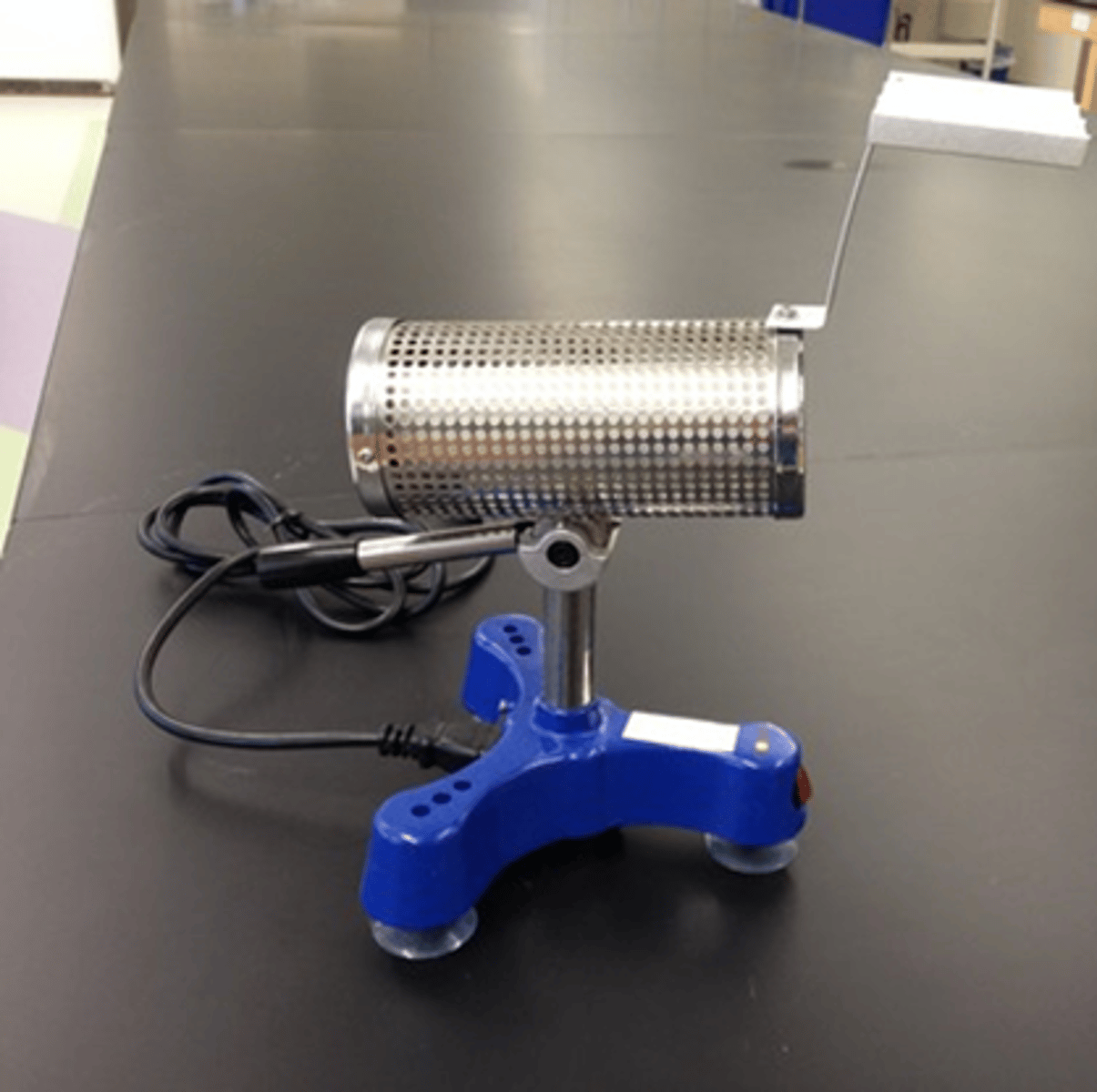
Cold
Microbiostatic- slows the growth of microbes
Refrigeration 0-15C and freezing < 0C
-USED TO PRESERVE FOOD, MEDIA AND CULTURES
Desiccation
Gradual removal of water from cells, leads to metabolic inhibition
• Not effective microbial control – many cells retain ability to grow when water is reintroduced•
Lyophilization – freeze drying; preservation
Lyophilization
freeze drying; preservation
Radiation
Energy emitted from atomic activities anddispersed at high velocity through matter or spaceTypes of radiation suitable for microbial control
Types of radiation microbial control
-Ionizing radiation
-Non iodizing radiation
Types of ionizing radiation
-Gamma rays
-X Rays
-Cathode rays
Types of non-ionizing radiation
UV light (Thyamine dimer)
Energy in relation to wavelenght
Wavelength is inversely proptional to energy
Shorter wavelength= more energy
Longer wavelength= Less energy
What do gamma rays do
blow apart proteins
Ionizing radiation
deep penetrating power sufficient energy to cause electrons to leave their orbit•
Gamma rays, X rays, cathode rays•
Breaks DNA
Non ionizing radiation
little penetrating power
-UV light creates pyrimidines dimer
-Interferes with replication
 Note
Note  Flashcards (87)