Test #2 Content: ENVSOCTY 3GV3 - Advanced Vector GIS
 Call Kai
 Learn
Learn Practice Test
 Spaced Repetition
 Match
Match Flashcards
 Knowt Play
1/122

There's no tags or description
Looks like no tags are added yet.
Name | Mastery | Learn | Test | Matching | Spaced | Call with Kai | Chat |
|---|
No analytics yet
Send a link to your students to track their progress
123 Terms
Facilities - Feature Class Input Properties (Network Analysis)
FacilityType
0 = Candidate
1 = Required
2 = Competitor
3 = Chosen
Weight
Relative weighting of a facility according to its attractiveness, desirability, importance, etc.
Capacity
How much weighted demand a facility is capable of supplying
CurbApproach
Direction of travel when arriving at or departing from facility
Facilities - Feature Class Output Properties (Network Analysis)
DemandCount
# of demand points allocated to a facility
DemandWeight
Sum of weights of all demand points allocated to a facility
Total_[Cost]
Sum of the network costs between a facility and the demand points allocated to it
TotalWeighted_[Cost]
Cumulative weighted cost for a facility
Demand - Points Feature Class Input Properties (Network Analysis)
GroupName
Name of the group a demand point is part of
Weight
Relative weighting of demand point
ImpedanceTransformation
Overrides the network analysis layer’s impedance transformation value
Linear, power, exponential
ImpedanceParameter
Overrides the network analysis layer’s impedance parameter value
Cutoff_[Cost]
Overrides the network analysis layer’s Cutoff value
Ex; 5 minute cutoff (nobody going to demand point if greater than 5 min away)
CurbApproach
Direction of travel when arriving or departing from a demand point
Demand - Points Feature Class Output Properties (Network Analysis)
FacilityID
Object ID of the facility the demand point is allocated to
Null values indicates that the demand point was not allocated to facility or was to more than one facility
AllocatedWeight
Null = demand point was not assigned to a facility (outside of cutoff)
0 = demand point is only assigned to competing facilities
+ Value = amount of demand assigned to chose and required facilities
Lines Feature Class (Network Analysis)
Output only class that contains line features that connect demand points to the facilities they are allocated to
Represents shortest network path between a demand point and facility
Lines Feature Class Properties (Network Analysis)
Name
Name of the line formatted such that the facility name and demand point name are listed in order they are visited
FacilityID or DemandID
IDs of conencted features
Weight
Weight assigned from a demand point to a facility
TotalWeighted_[Cost]
Weighted cost of traveling between a demand point and facility
Point, line, and polygon barriers classes (Network Analysis)
Serves to temporarily restrict or alter costs on parts of the network
Ex; flooding (polygon barrier)
When a new network analysis layer is created, the classes are empty
They are populated only when you add objects into them
Adding barriers not required
Available in all network analysis layers
Impedance Transformation
Function that transforms the cost of travel between demand and facilities
Types of Impedance Transformations
Linear cost = impedance
Power cost = impedanceb
Exponential cost = e(b x impedance)
Impedance Parameter (b)
Parameter value set by user, which can emphasize near or distant locations
Ranges of Impedance Parameter (b)
b > 1
Emphasizes distant locations (higher impedance costs for distant)
As value increases emphasis increases
0 < b < 1
Emphasizes nearby locations (higher impedance costs for nearby)
As value decreases emphasis increases
± values of b
Will result in the same solution
7 Location-Allocation Models
Minimize weighted impedance (P-Median)
Maximize coverage
Maximize capacitated coverage
Maximize coverage and minimize facilities
Maximize attendance
Maximize market share
Target market share
Minimize Weighted Impedance Objective
Given N candidate facilities and M demand points with weights. locate P facilities such that the sum of all weighted costs between demand points and solution facilities is minimized
Minimize Weighted Impedance Examples
Private sector: Warehouses
Optimal locations for a warehouse which will minimize a cost
Public sector: libraries, health clinics, etc.
Minimize Weighted Impedance Handling of Demand
If an impedance cutoff is set, any demand outside all the facilities’ impedance cutoffs is not allocated
A demand point inside the impedance cutoff of one facility has all its demand weight allocated to that facility (‘all or nothing’)
A demand point inside the impedance cutoff of 2 or more facilities has all its demand weight allocated to the nearest facility only
Maximize Coverage Objective
Given N candidate facilities and M demand points with weights, locate P facilities such that the number of demand points covered by solution facilities is maximized within an impedance cutoff
Covering as many demand points as possible!
Maximize Coverage Examples
Public sector
Emergency response facilities like fire station, police stations, etc.
Private sector
Delivery service facilities
Pizza delivery
Maximize Coverage Handling of Demand
Any demand point outside all the facilities impedance cutoffs is not allocated
A demand point inside the impedance cutoff of one facility has all its demand weight allocated to that facility
A demand point inside the impedance cutoff of 2 or more facilities has all its demand weight allocated to nearest facility only
*Demand is handled the same way as minimize impedance
Maximize Capacitated Coverage Objective
Given N candidate facilities and M demand points with weights, locate P facilities such that the number of demand points covered by solution facilities is maximized and the weighted demand allocated to a facility does not exceed the facility’s capacity
Maximize Capacitated Coverage Examples
Public sector;
Facilities that are built with defined capacities like hospitals or schools
Maximize Capacitated Coverage Handling of Demand
If an impedance cutoff is specified, any demand point outside all the facilities impedance cutoffs is not allocated
An allocated demand point has all or none of its demand weight assigned to a facility—demand is not apportioned
If the total demand within the impedance cutoff of a facility is greater than the capacity of the facility then only the demand points that maximize total captured demand and minimize total weighted impedance are allocated
Maximize Coverage & Minimize Facilities Objective
Given N candidate facilities and M demand points with weights, locate P facilities such that the number of demand points covered by solution facilities is maximized with an impedance coverage
Additionally, the number of facilities required to cover demand is minimized
Same as maximize coverage except solver chooses P
Maximize Coverage & Minimize Facilities Examples
Same as maximize coverage when cost of building is not a factor
Public sector;
School bus stops
Minimize # of bus stops but want to serve all demand points
Maximize Coverage & Minimize Facilities Handling of Demand
Same as maximize coverage
Maximize Attendance Objective
Given N candidate facilities and M demand points with weights, locate P facilities such that demand weight is maximized by the solution facilities while assuming that demand decreases in relation to the distance or travel time between facilities and demand points (distance decay)
Maximize Attendance Examples
Private sector
Retailers, restaurants, coffee shops
Public sector
Transit stops
Maximize Attendance Handling of Demand
Demand outside the impedance cutoff of all facilities is not allocated to any facility
When a demand point is inside the impedance cutoff of one facility, its demand weight is partially allocated according to the cutoff and impedance transformation
The weight of a demand point covered by more than one facility’s impedance cutoff is allocated only to nearest facility
Distance Decay
Refers to the decrease in spatial interaction with distance from a location
For Maximize Attendance, it is specified by an impedance transformation and parameter
Specification should be based on empirical information
Linear Decay Formula
Demand = weight x (1 - (linear cost/cutoff))
Equal weight with distance of facilities
Power Decay Formula
Demand = weight x power cost
High weight to nearby facilities
Exponential Decay Formula
Demand = weight x exponential cost
Very high weight to nearby facilities
Maximize Market Share Objective
Given N candidate facilities and M demand points with weights, locate P facilities such that demand weight is maximized by the solution facilities in the presence of competitors
Requires weights (relative measures of attraction) for candidate facilities as well as competitor facilities
Uses a Huff Model
Maximize Market Share Examples
Private sector
Same as Maximize Attendance providing you have access to weights of competitor facilities
Discount stores
Maximize Markey Share Handling Of Demand
Demand outside the impedance cutoff of all facilities is not allocated to any facility
A demand point inside the impedance cutoff of one facility has all its demand weight allocated to that facility
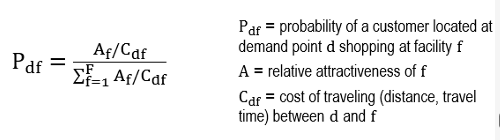
A demand point inside the impedance cutoff of 2 or more facilities has all its demand weight allocated to the facilities that cover it. The weight is split among the facilities proportionally to the facilitys attractiveness and inversely proportional to the distance or travel time between the facility and demand point (Huff Model)
Total market share is the sum of the weight of all demand points located on the network
Use the calculate captured market share
Percent of people going
Target Market Share Objective
Given N candidate facilities and M demand points with weights, P facilities are located to capture a specific percentage of the total market share in the presence of competitors
Solver chooses the # of facilities for you
Requires weights for candidate facilities as well as competitor facilities
Uses a Huff Model
Target Market Share Examples
Same as maximize attendance providing you have access to weights of competitor facilities
Discount stores
Target Market Share Handling of Demand
Same as maximize market share
Huff Model
Typically used to address the following question;
What is the likelihood that a customer will shop at a particular store given the presence of competitors?
Demand is allocated to facilities within a cutoff as follows;
demand = weight x P
What models does B have no effect on?
Maximize coverage
Maximize capacitated coverage
Maximize coverage & minimize facilities
How are the best sties selected (optimization)?
Combinatorial problem
n choose p
n! / p!(n-p)!
Typically not used for obvious reasons… very high values
How are the best sites selected (Vertex Substitution Heuristic)
Generate a random configuration of P facilities (initial solution)
Pick a candidate facility from the pool of remaining candidates
Calculate if candidate facility can be used to replace, one at time, each of the P facilities
Swap candidate facility with facility in P that yields the greatest improvement
Continue steps 2-4 until no further improvement is found
Vehicle Routing Problem
Problems involve routing a fixed number of vehicles (routes), through a set of stops (orders) such that total travel cost (travel time, distance) is minimized, and vehicle capacity constraints are not violated
Can be viewed as a fleet version of the traveling salesman problem
Partitions stops among vehicles subject to capacity constraints and finds the shortest tour or route for the stops assigned to each vehicle
Tours start and end at a depot
Order in which stops are visited is determined
Service Area
Problems involve assigning portions of a network to a location based-on predetermined criteria
Service Area - Public Sector Problems
Locations are public sector facilities (fire stations, police stations, parks, hospitals, etc.)
Criteria;
Ex; walking distance to schools, response times for emergency services
Service Area - Private Sector Problems
Service areas are referred to as trade areas or market areas
Locations are retail and commercial establishments
Criteria are based on travel times or distances to locations
Service Area - Accessibility Problems
Locations are typically residences (could be places like workplaces)
Criteria are based on travel times or distances from locations
Is intersected with opportunities to derive a type of accessibility known as cumulative opportunity ( adds up # of locations within that distance or time threshold)
What would you do if you want to associate every link in a network with its closest facility - Service Area Problem
Set up artificially high cutoff values, that way all links would be allocated to nearest facility
Shortest Path
Finds the least cost (travel time, distance) route connecting 2 locations on a network
Traveling salesman problem
Finds the least cost (travel time, distance) route that visits a set of stops from a specified starting location on a network
Route starts and ends at the same location
Order in which intermediate stops are visited is determined
Route analysis layer options if intermediate stops are visited
Use current
Preserves the sequence of stops
Finds best route given the order of steps
Find best
Reorders the sequence of stops to find the shortest possible route
Preserve first & last stop
Reorders intermediate steps to find shortest possible route
Preserve first stop
Begins at the first stop with other stops being reordered to find the shortest possible route
Preserve last stop
Ends at the last stop with other stops being reordered to find the shortest possible route
OD Cost Matrix
Finds the least cost paths (travel time, distance), through a network from multiple origins to multiple destinations
Instead of just solving 1 record it can solve thousands
Options;
Number of destinations to find
Cutoff
Output is typically input for some other form of analysis in which network cost is more appropriate than straight-line distance cost (like near tool)
We are most interested in the table it creates
Closest Facility
Solver computes best routes between network locations (like fires) and facilities (like fire stations) and for each location, selects the path with lowest cost (travel time, distance), thus identifying the closest facility
Options;
Number of facilities to find
Direction(s)
Cutoff
Solver can display best routes through the network and directions
Can perform many analyses at once (such as multiple accidents)
OD Cost Matrix vs. Closest Facility
Closest facility solver can be used to create an OD cost matrix, but it will take more time
Can generate true shapes of routes
Can generate directions
OD cost matrix solver is designed to handle large M x N problems
Cannot generate true shapes of routes
Cannot generate directions
What is Location Analytics?
Concerned with enriching business data with geography to gain insights into customer behavior that could lead to enhanced decisions
What industry is location intelligence the most important for?
Telecommunications
Examples of Applications of Location Intelligence
Finance
Real estate
Supply chain
Risk
Marketing
Management
Spatial Data Sources
Census and postal geography boundaries
Locations of facilities
Own and competition
Customer data
Demographic data from Census or other survey
Behavioral data (distance decay)
Road networks
Ex; DMTI
Market segmentation data
Ex; PRIZM or Tapestry
Digital orthophotos or other remotely sensed data
Terrain models
Business Data Sources
Record keeping and management control
Billings
Services rendered
Financial
Inventory
Customer accounts or status
Orders
Shipping manifests
Issues with Business Data
Expensive
Maintenance and integration with existing systems
Spatial techniques couple it with geographic coordinate system
Data quality issues
Addresses may be partially incomplete
Temporal issues
May change over time
Ex; sending flyers to wrong people
Dissemination Block
Lowest level of geometry which you can obtain a few attributes about
Dissemination Area (DA)
Smallest division for mapping, complete coverage of Canada
These boundaries respect the boundaries of census subdivisions and census tracts
Generally follow roads, or natural features
Normally contain 400-700 people to avoid data suppression
Census Tract (CT)
Urban or rural neighborhood boundaries defined within CMA or CA
6,247 nationally
Boundaries follow main streets and permanent + easily recognizable physical features
Have populations between 2500-8000 people with average of 4000 people
Have similar economic status and social living conditions at time of their creation
Respect CMA, CA, and provincial boundaries
Census Subdivision (CSD)
Municipalities or equivalent
Ex; towns, villages
5,161 nationally
Census Division (CD)
Group of neighboring municipalities joined together for the purposes of regional planning and managing common services
293 nationally
Census Metropolitan Area (CMA)
Area consisting of one or more neighboring municipalities situated around a core with forward or reverse commuting
Must have a total population of at least 100,00 of which 50,000 or more live in the core
41 nationally
Hamilton’s includes Burlington and Grimsby
Census Data
Conducted every 5 years in Canada
2 forms are
Short form (100% distributed)
Long form (25% random sample)
Takes about 2 years from collection to release
Large scale statistics released first
DA released last
Census 2A
100% of population
Population by age
Sex
Marital status
Mother tongue
Dwellings by tenure
Structural type and size
Family structure
Number of children living arrangements
Census 2B
25% Random sample
Population by home and official languages
Ethnic origin
Citizenship and place of birth
Immigration status
Religion
Mobility status
If you have moved recently
Transportation (to work, etc.)
Labor force
Full-time or part-time
Occupation
Industry
Income
Used to be self-reported
Households and dwellings by period of contruction
Need for repairs
When was the household built?
CHASS
Canadian census anlayser
Open-access while on campus
Market Segmentation Data
Involves identifying subgroups of people within a larger population such that each subgroup has similar needs or desires
‘Homogeneous group of consumers you can sell a product too’
Demographic Market Segmentation Data
Method assumes that people’s values, interests, and attitudes can be traced back to demographic characteristics
Typical segments might include (sociodemographic descriptions);
Millennials
Boomers
2-parent households with 1 child under 5
Single women aged 18-34
Retired adults aged 50-69 who have an advanced degree
Geographic Market Segmentation Data
Assumption is made that people’s values, interests, and attitudes can be traced to their geographic characteristics
‘People who live close to each other, share similar characteristics’
Typical segments might include;
People living in the downtown core
People living in rural areas
People living in drought, hurricane, or flood zones
Behavioral Market Segmentation Data
What hobbies do they participate in? What products and services do they use and buy? What are their shopping routines?
Typical segments might include;
People who grocery shop once per week and use at least 10 coupons each time
People who do most of their online shopping using a tablet or cell phone
People who use social networks at least 3 hours every day
Psychographic Market Segmentation Data
Focuses on people’s attitudes, opinions, personality characteristics, life goals, social standing, and other more conceptual and flexible variables
Segments might include;;
People who practice mindful thinking and believe in helping others achieve their goals
People who like to be alone and think each person should be responsible for themselves
Early adopters
What’s the segmentation data in Canada called and how many segments are there?
PRIZM
67
Suitability Analysis
Used to identify the most suitable sites from a set of candidate sites by ranking and scoring those sites by ranking and scoring those sites based on multiple weighted criteria
Candidate sites can be point locations or areas
Multi-criteria evaluation (MCE) underlies it
Multi-Criteria Evaluation
Aims to identify the best site(s) from a set of candidate sites by considering multiple criteria
Has been adapted for use in GIS to provide a formal basis for aiding decision making
2 approaches of multi-criteria evluation
Multi-objective decision making (MODA)
Multi-attribute decision making (MADA)
Multi-objective decision making (MODA)
Objective = abstract variable, interested in relative desirability
Continuous decision problem
Boundaries of site define the solution as potential sites are not explicitly identified for evaluation
Rasters
Multi-attribute decision making (MADA)
Attribute = descriptive variable
Discrete decision problem
More common in retail location problems
Choose suitable site from a set of candidates
General MADA Model in BAO
Start with a set of candidates
Choose criteria that influence site selection
Determine the type of influence for each criterion
Weight the importance of each criterion
Sum the weighted criteria to help make a decision
Approaches to Weighting
Ranking methods;
Rank sum
Rank reciprocal
Rank exponent
Rating methods;
Point allocation
Ratio estimation
Ranking Methods
Simplest method of all weighting techniques
Every criterion under consideration is ranked in preference order
1 is most important
Once criteria are ranked, several procedures are available for generating numerical weights using the ranks
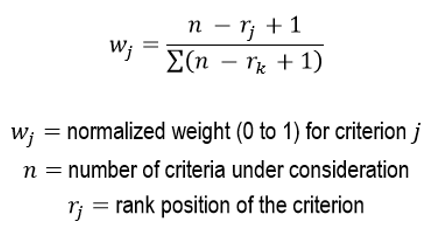
Rank Sum Equation
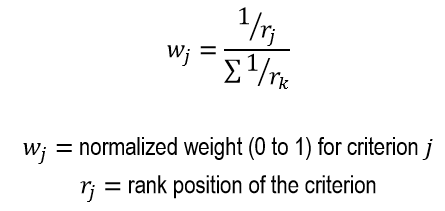
Rank Reciprocal Equation
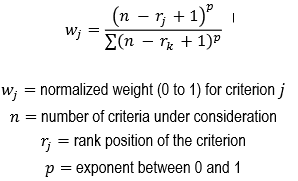
Rank Exponent Equation
Like rank sum but you add an exponent
Exponent = 0 would be equal weight across everything
Exponent = 1 would be identical to rank sum
Ranking Methods Advantages and Disadvantages
Advantages
Simple
Easy to implement
Disadvantages
Limited to a small number of criteria
Larger the number of criteria, the more difficult it is to arrive at a reliable ranking since they would eventually lead toward tiny differences between weights
Lacks theoretical foundation
Point Allocation (Rating Method)
Decision maker estimates weights on a predetermined scale (like 0-100)
Each criterion would be allocated points with the sum of all points = 100 (0 means criterion can be ignored)
Greater the points, greater the relative strength of the criterion
Each criterion normalized using;
wj = rj / 100
Ratio Estimation (Rating Method)
Assign 100 to the most important criterion
Assign proportionally lower values to criteria of less importance
Take ratio of each criterion to the least important criterion
Ratio expresses relative desirability of a change from the worst level to the best level
Normalized weights are derived at the end by dividing each ratio by the total of all ratios
Rating Methods Advantages and Disadvantages
Advantages
Easy to understand, conceptualize as prioritizing where to put your money
Disadvantages
Limited to small number of criteria
Same problem as ranking approaches
Lacks theoretical foundation
Calculation of Weighted Scores
Determined based on the weights that are chosen and the type of influence each criterion has
Positive influence weighted score
How much more is a value compared to the min value in the range
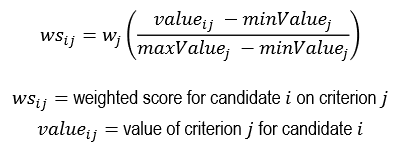
Inverse Influence Weighted Score
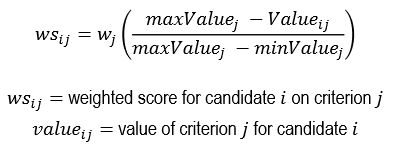
Ideal Influence Weighted Score
How far is value from ideal
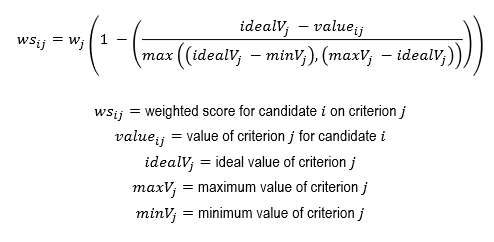
Trade Areas
The geographical area containing (potential) customers served by a business or network of businesses
Can be scaled
Ex; applied to a community, business district, downtown
What would a trade area analysis tell you?
Where a business’s customers are coming from
How many potential customers live in a trade area
Where to look for more customers
Who is concerned with trade area analysis?
Retailers or commercial service providers
Commercial property developers
Real estate departments of retail chains
Leasing companies
Location analysts who work with any of the above
Marketing firms who advertise for businesses
Factors that affect trade area size and shape
Store size (attractiveness)
Area for furniture would be much larger than Starbucks
Settlement patterns (residential density)
Dense area would mean more close
Transportation network
Barriers to movement
Presence of competitors
Types of Trade Areas
Convenience
Destination
Convenience Trade Area
Purchase of products and services needed on a regular basis
Ease of access (travel time or distance)
Ex; groceries, gasoline, coffee, etc.