Chapter 10 - Social Media MKTG
 Call Kai
 Learn
Learn Practice Test
 Spaced Repetition
 Match
Match Flashcards
 Knowt Play
1/28

There's no tags or description
Looks like no tags are added yet.
Name | Mastery | Learn | Test | Matching | Spaced | Call with Kai |
|---|
No analytics yet
Send a link to your students to track their progress
29 Terms
Digital Marketing Strategy
The focus on digital encourages organisations to address opportunities for moving their business online to enable staff to connect with customers, regardless of location, and to process orders using automation rather than manual intervention
A digital marketing strategy places the customer at the centre of the process, instead of products or services, and moves the culture within the organisation to think differently
Digital marketing strategy can seem complex and focused on tactics- a successful strategy is based on evidence
It’s a longstanding discussion between academics and practitioners as to which goes first, the objectives and then the strategy, or the strategy followed by the objectives.
The Difference Between Strategy and Tactics
Strategy is a plan or program to achieve your aim or vision.
Require a clear and strong vision
They set the direction for the organization and are often designed to be in lace for several years
Objectives are detailed SMART goals (i.e. specific, measurable, achievable, realistic and timed).
Tactics are actions to achieve the objectives.
Strategy
The marketing strategy is the set of decision rules, or program that adjusts (product price, advertising budget, distribution budget) from period T to period T + 1, for all T
A formal corporate strategy provides a coherent model for all business units and ensures that all those involved in strategic planning and its implementation are following common goals
Strategy is a plan
The Link Between Strategy and The Hierarchy of Objectives
Marketing mis is the 4 ps: product, price, place, and promotion
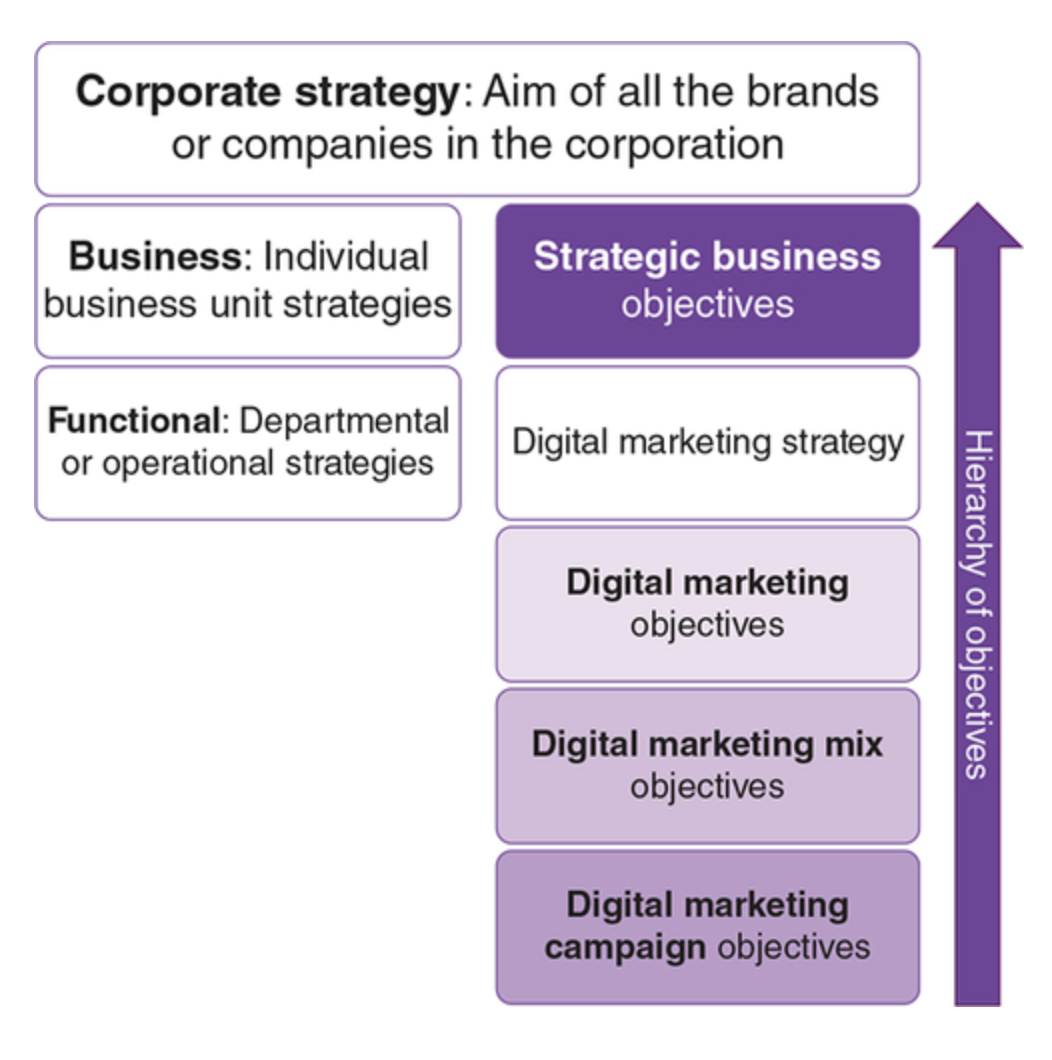
Hierarchy of Objectives
An objective has been defined as ‘an aim or end of action.
An order or hierarchy was suggested so that business objectives can be grouped into an order or hierarchy of importance, with the main company or corporate goals ranked at the top, followed by the key objectives of the business, and then the sub-objectives of individual departments.
Corporate Strategy
Mainly exists in major organizations that own multiple brands
guides the individual brands and addresses larger issues, such as its management of resources, its approach to sustainability and its ethical codes
Unlikely for small business to have these
Business Strategy
Brands inside the business have their own business strategies, which address overarching aims, including company structure, staffing, accountability, legal issues, finances, logistics, marketing and product development
They may share legal services with their corporate brand, but they manage their business according to their own policies.
Functional Strategies
Considers the operational strategies, which relate to specific functions or departments, such as marketing or digital marketing, sales and product development
Products and pricing is different, target audience is different, and the messaging and adverts are different
Purpose is to deliver the aims of the business strategy
Traditional Marketing Strategy
Historically, the focus of marketing was very much on making and selling products on the basis that if you made it, you could sell it
Strategy focused on leadership or she within markets, competition and product offers
It was about beating the competition and gaining maximum market share
Companies With A Purpose
Companies have a duty known as the ‘shareholder primacy model’, which means they are established to provide value for their shareholders
Usually means a financial return - shareholders buy shares and in return the companies pay individuals
Some companies have adopted a societal purpose- they aim to contribute to wider society
B-Corporation
Businesses that benefit a wider group of stakeholders, as a force for good.
In 2006, B Lab became known for certifying B Corporations, which are companies that meet high standards of social and environmental performance, accountability, and transparency. There are B Corporations in nearly 100 countries and over 160 industries
Greenwashing
a strategy adopted by some companies in which researchers have classified as deceiving stakeholders actively or passively.
Active greenwashing is where false information is provided or deceptive practices are adopted to manipulate a given situation.
Passive greenwashing is where the corporation selectively promotes specific activities to draw attention away from other important factors or impacts of the business
Strategic Options with the TOWS Matrix
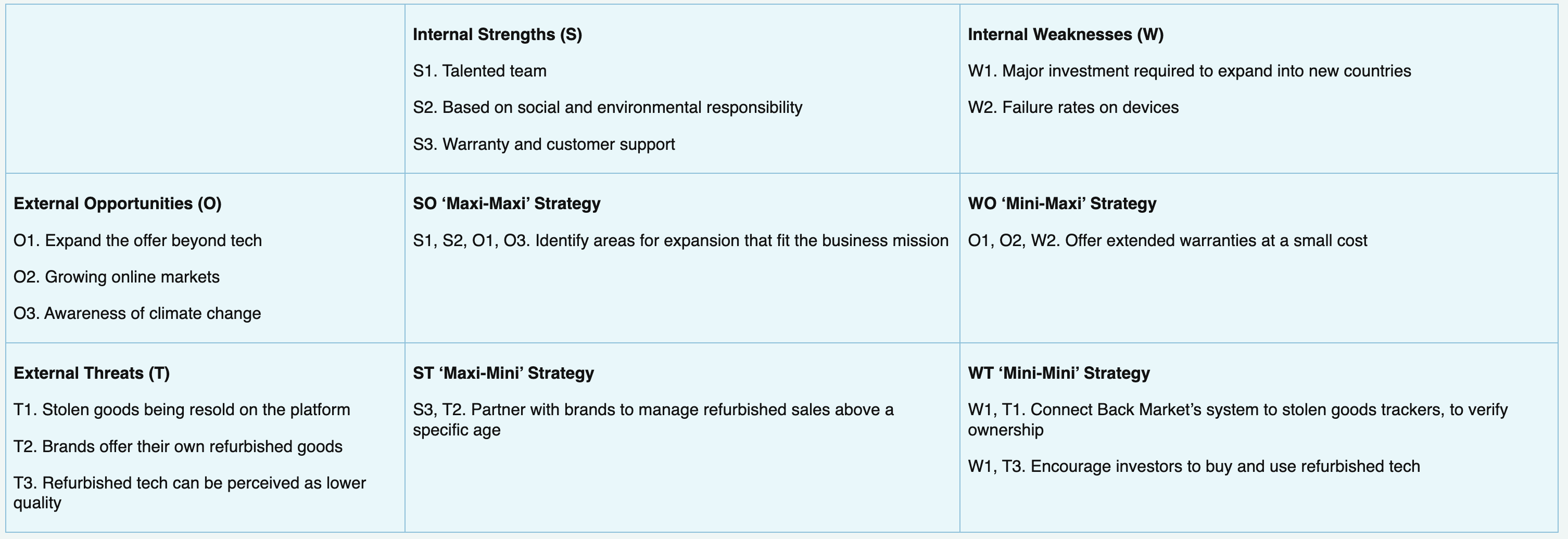
TOWS Matrix- a tool that allows you to take the material captured in your audit, to pot it into the matrix and to extract your strategic marketing options
Provides a synthesis analysis that facilitates matching th external threats an opportunities with the internal weaknesses and strengths of the organization
SO: Maxi-Maxi strategy
Strengths and Opportunities: This is a strong position and it’s about using the organisation’s strengths to maximise opportunities. Described as the aggressive strategy, it often involves expansion and diversification.
WO: Mini-Maxi Strategy
Weaknesses and Opportunities: Where weaknesses have been identified, they should be minimised by taking advantage of opportunities. It can be described as a competitive strategy.
ST: Maxi-Mini Strategy
Strengths and Threats: This strategy utilises the organisation’s strengths to minimise threats. It is often seen as a conservative strategy.
WT: Mini-Mini Strategy
Weaknesses and Threats: The WT strategy aims to minimise weaknesses and avoid threats, and if this is the only strategy available to the organisation, it may be that a complete review is required to see whether the organisation is still viable. It has been called a defensive strategy as it’s about protecting the organisation.
TOWS Framework Example
Digital Strategy Models
Led by practitioners rather than researchers
The three models of a digital marketing strategy follow a similar three-step route from pre-purchase, to purchase, to post-purchase, recognising that they may happen simultaneously
Traditional and digital approaches to strategy
The fundamental changes are the move from a product focus to taking customers on a journey
The digital strategy models recognise that not all companies have products to sell; some companies may be intermediaries for peer providers and peer users.
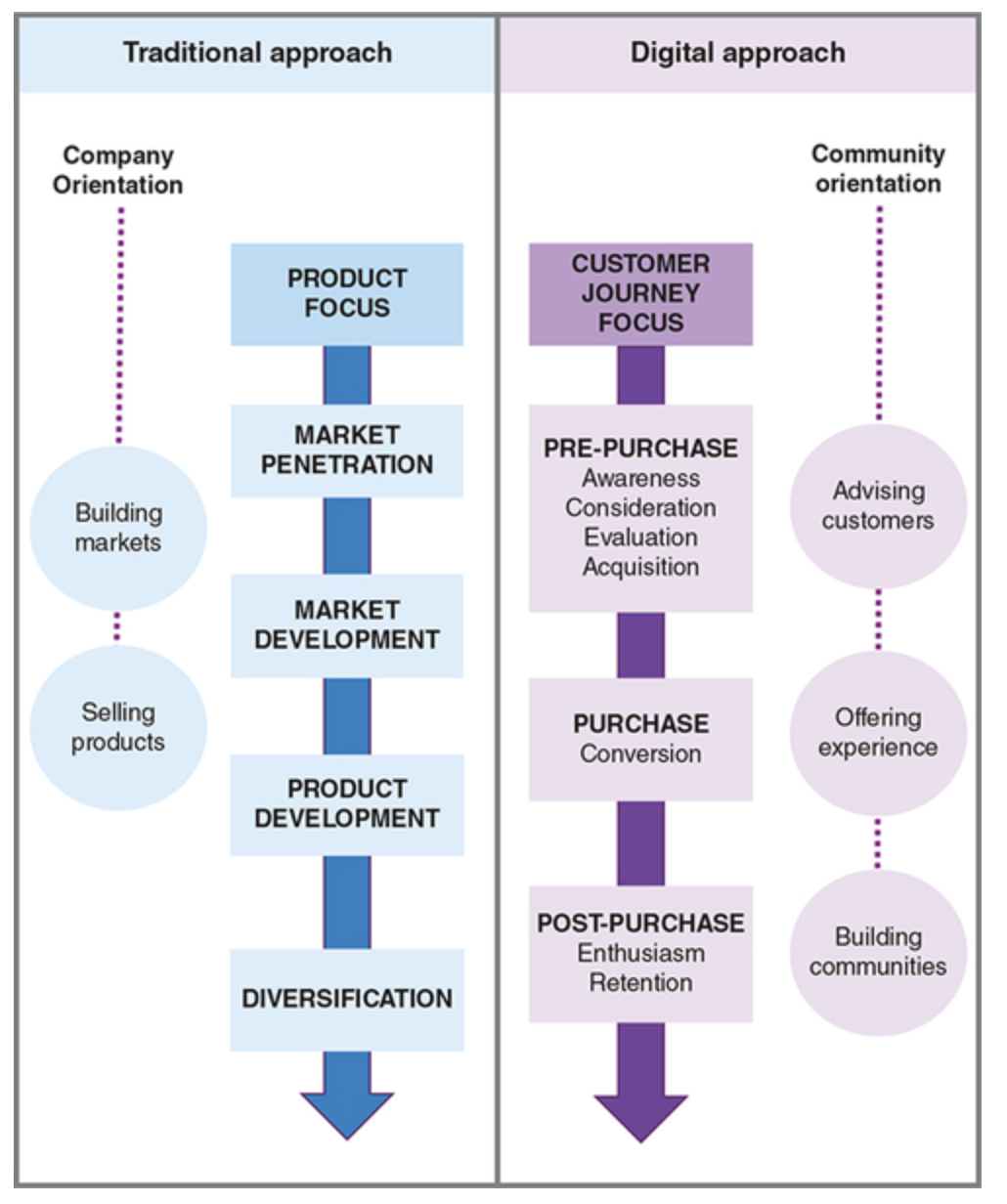
Traditional Strategy Models
Focus on the product, whether it’s encouraging existing customers to purchase existing products (market penetration), making existing customers aware of new products (product development) or encouraging new customers to purchase existing products (market development).
Our world is changing, which means that it’s less about traditional promotion and more about awareness in a social setting, especially as we have access to more data.
Digital Strategy Models
Contain other differences as the main measured action is conversion, which is facilitated using technology
Adding digital tracking mechanisms makes measurement of our digital marketing activities easier to understand, and enables us to see what works well
Continues beyond conversion
The Digital Marketing Strategy Framework
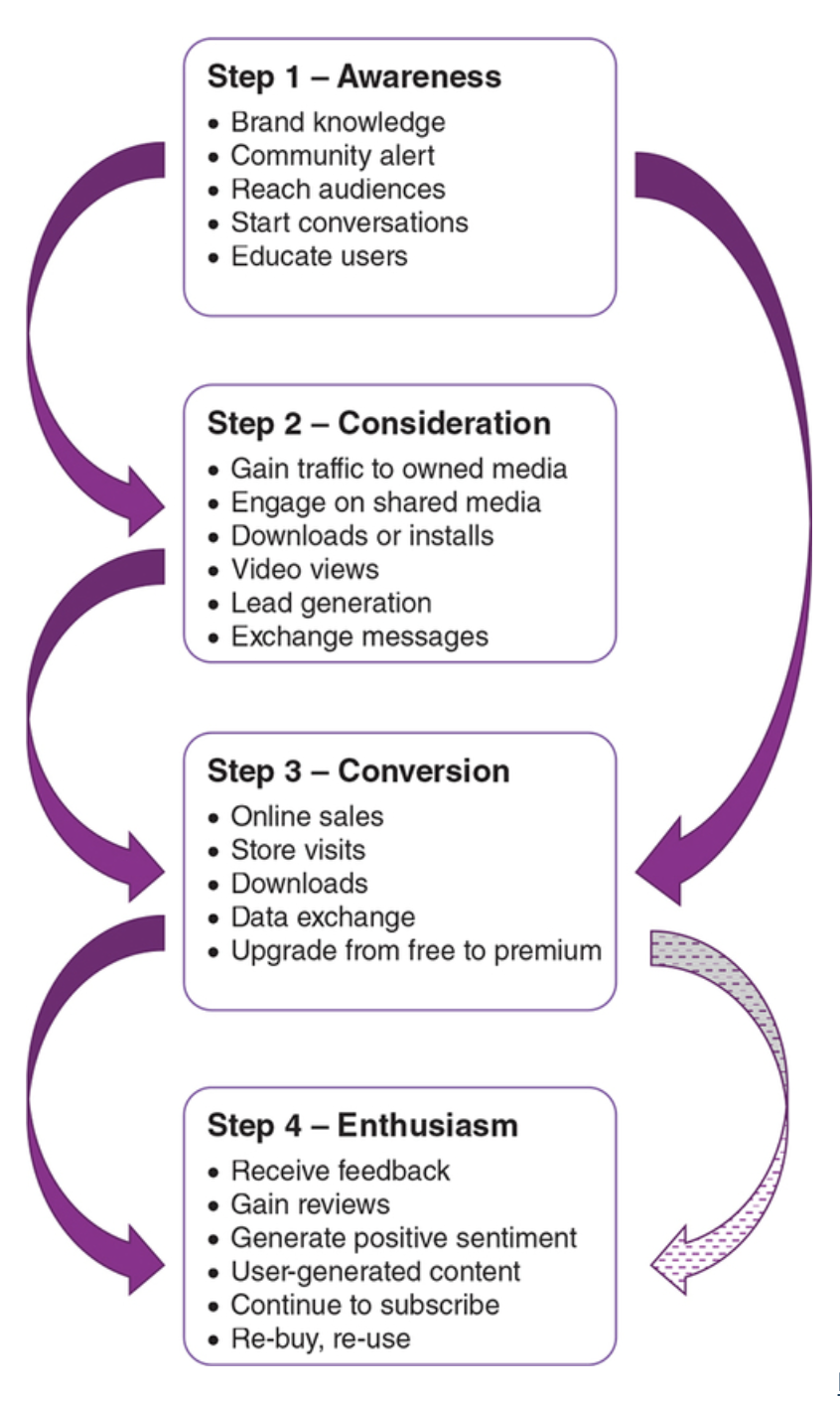
Social media companies ask organisations to identify their strategy when advertising. They offer three choices:
Awareness-
whether that’s about the brand, the community, the activity or a product. In a digital space, awareness can take place faster than in the offline environment
Purpose is sharing knowledge and understanding of the product or brand, perhaps alerting people to a new community, or reaching audiences with specific messages
Depending on the type of product, customers may take the next step, consider, or move to conversion, or stop and never move forward.
Consideration-
This may be bypassed if consumers move from awareness direct to conversion. Or they may reach this step and never progress further, having evaluated the offer, perhaps dismissing it in favour of another offer
Potential consumers evaluate brands through visits to the website or they explore online communities to learn more
Conversion-
Can take place immediately after awareness
Speed between steps in the major difference with digital marketing
It’s important to remember that conversion is not simply a sale, and it is different for different organisations
Enthusiasm
passion for the company, the desire to return and re-buy or to share with others
This includes promoting the organisation via positive online reviews or feedback or adding other forms of user-generated content
Acquisition, Conversion, and Retention Framework (ACR)
Circular rather than a linear model, as the organisation acquires, converts and retains customers
The notion of customers taking an online journey from acquisition to conversion and retention includes three steps. As with the digital marketing strategy framework, acquisition and conversion may take place within minutes.
Framework for how organizations can better harness digital marketing
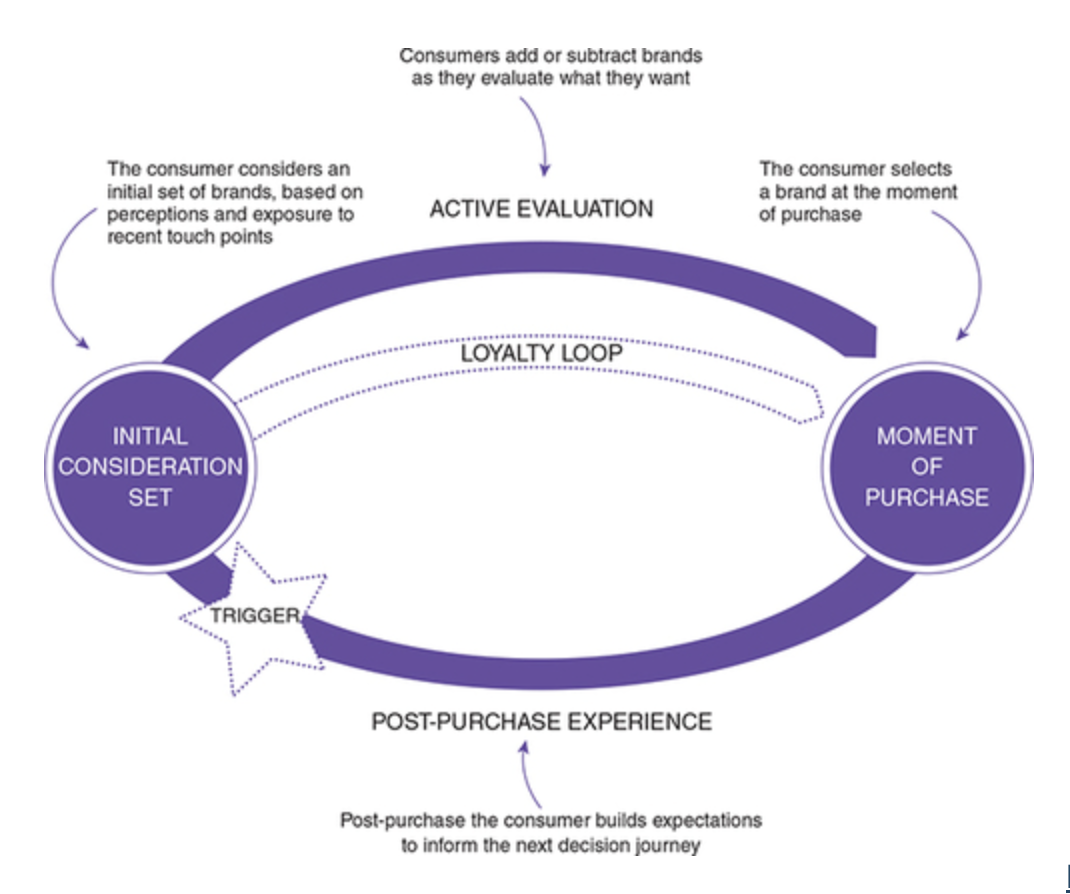
The McKinsey Consumer Decision Journey
Considers the plan an organization should make
Loop model instead of linear model
Comprises four phases: (a) initial consideration set; (b) active evaluation; (c) moment of purchase; and (d) post-purchase experience.
The strategy’s plan can change due to disruptions in the marketplace that were not predicted or were ignored
The key components in a strategy are that it is:
A short statement
Based on a strategy model of your choice
Not timed
An overview rather than precise details
Usually brave!
Digital marketing mix objectives
Focus on what not the how
These objectives are all SMART – specific, measurable, achievable, realistic and timed – and are written as simple sentences, rather than long paragraphs.
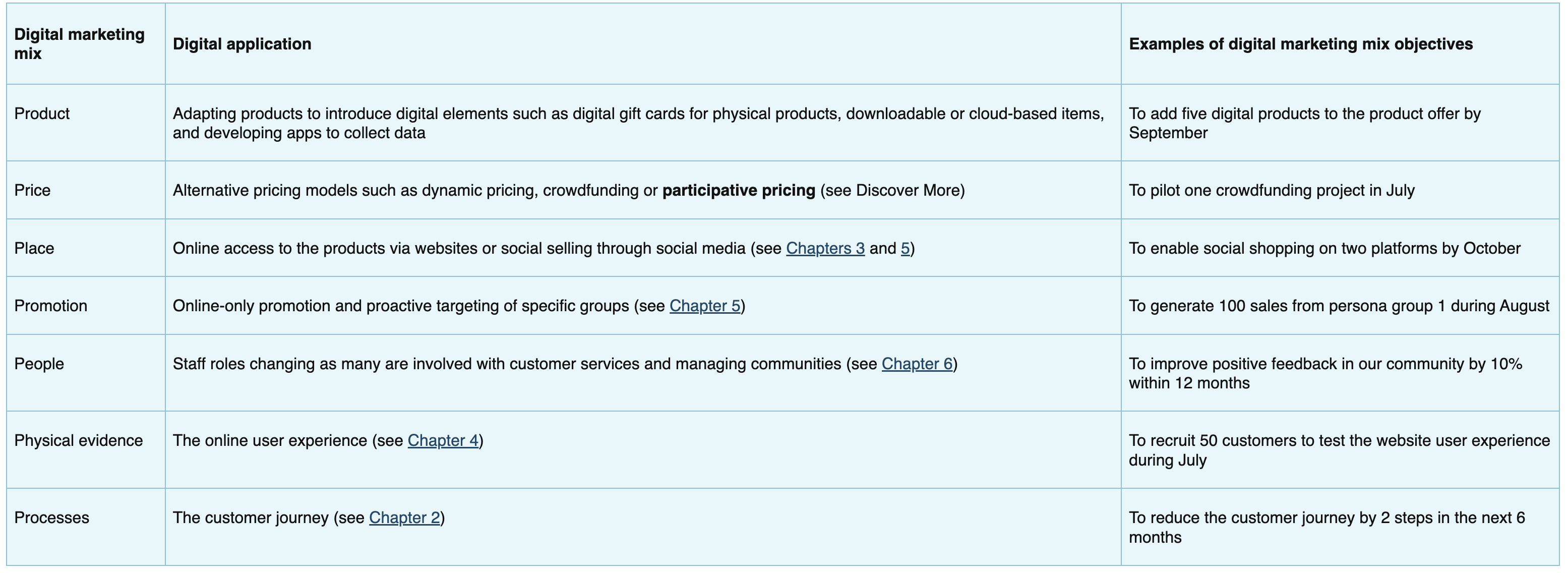
Digital Marketing Mix Objectives Example
Pricing: To offer 25% discount for Uber Eats on Mondays in the next 12 months
Place: To offer 25% discount in Spain in the next 12 months
Promotion: To organise a social media campaign that generates 100,000 orders in 6 months
Physical evidence: To photograph the top 25 food products in Spain within 3 months
People: To recruit the top 50 restaurants in Spain into using the app within 6 months
Digital marketing campaign objectives: To launch a social media campaign in 2 months’ time aimed at key personas
Reach, Engage, Activate, Nurture (REAN)
Reach: Activities to generate awareness that can be measured, such as attracting traffic to owned media
Engage: Customers’ conversations or activities before conversion, such as watching videos, liking the brand on social media
Activate: Similar to conversion and centred on the sale, such as downloading an app or buying online
Nurture: Looking after the customer, encouraging them to return, such as opening emails and re-subscribing to online services
Example of REAN
Reach: To reach 5,000 new customers before December (marketing promotion team)
Engage: To engage with 30% of all web visitors in quarter 2 (communications team)
Activate: To activate sales from 10% of all web visitors over the next 6 months (sales team)
Nurture: To nurture 80% of all customers by July (customer services team)
Sell, Serve, Speak, Save, Sizzle – the 5Ss
Sell
a traditional objective that looks at sales growth. It is about the numbers – the volume of sales or ‘conversion activities’, such as newsletter registrations, downloads and other relevant activities. Sales objectives may also be created within strategic business objectives.
Serve
Customer service objectives ensure that organisations strive to improve and develop the service. It is the one area where smaller businesses can compete with large businesses, which may struggle to consistently deliver fabulous service when they have thousands of staff.
Speak
Staying in contact with customers and planning communications. Some organisations send you daily emails, some weekly and some every now and then. ‘Speak’ also incorporates evolving the live chat function, where people can instantly speak to company representatives online. This element may involve the communications, marketing or web teams.
Save
Important factor in business management
Saving time often improves the customer journey
some objectives can achieve two elements in one
Sizzle
The toughest objective to develop
The magic, the factor that makes a difference to a product or service, and adds something so different to the product, promotion or other part of the digital marketing mix that it stands out
It’s often not obvious within the organisation but can be developed with the help of customers
Example of the 5S
Sell: To increase sales via our Instagram page to 5% in the next quarter
Serve: To add messaging functionality to WhatsApp to automatically respond to FAQs, by June
Speak: To add live video chat to the website within 12 months
Save: To analyse frequently asked questions and add chatbots by December
Sizzle: To create a how-to video channel to explain our FAQs by the year end
Trello
Uses a card-sorting system where you place cards or actions into columns that address: to do, doing and done. It’s useful when creating objectives and developing digital marketing plans as you can tag other team members with activities to share the workload.

