W3L1: The Pharmacology of Reward & Addiction - Dopamine & Desire
 Call Kai
 Learn
Learn Practice Test
 Spaced Repetition
 Match
Match Flashcards
 Knowt Play
1/28

There's no tags or description
Looks like no tags are added yet.
Name | Mastery | Learn | Test | Matching | Spaced | Call with Kai |
|---|
No analytics yet
Send a link to your students to track their progress
29 Terms
How are neuromodulators generally produced & distributed?
Produced/generated in a bundle of nerve cells deep in the brain
Distributed to rest of the cortex via long projections from the bundle of nerves
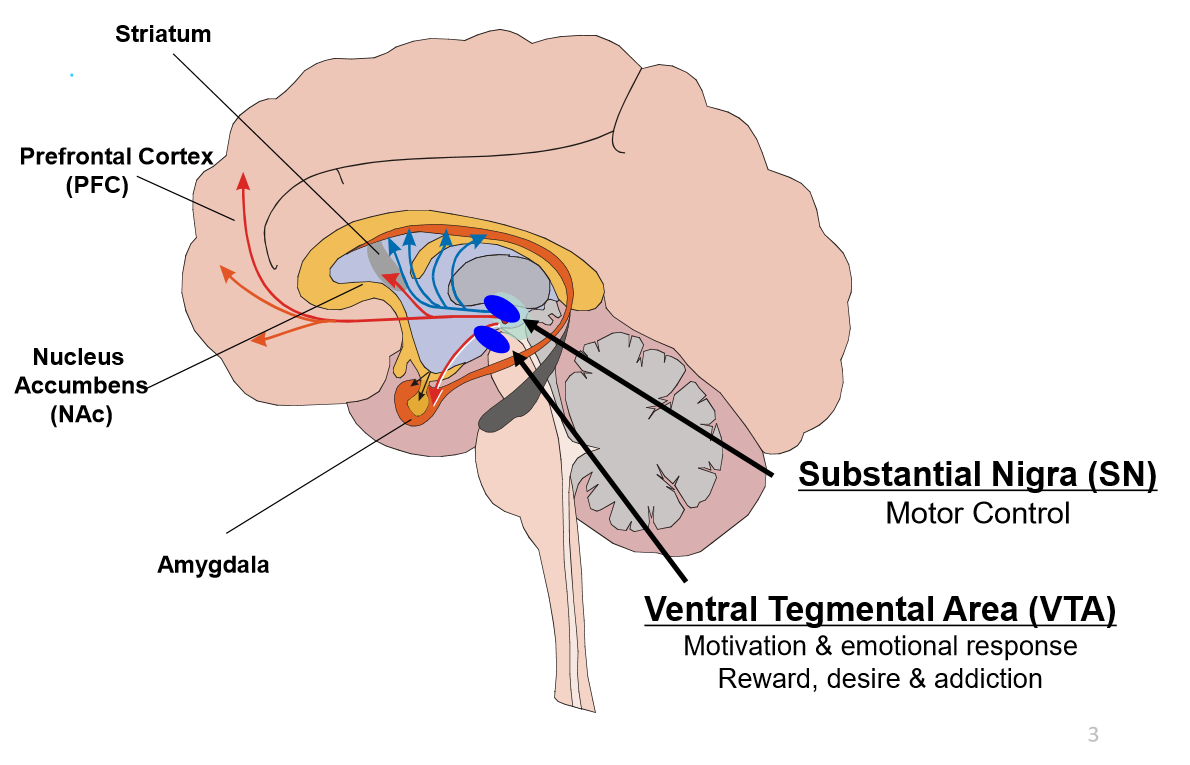
What are the 2 locations in which dopamine is produced, & what do these locations implicated for its functioning?
Substantia nigra: motor coordination
Long projections into the basal ganglia & motor cortex
Ventral tegmental area:
Motivation, emotional response, reward, desire, & addictive behaviours
Describe the process of dopamine synthesis
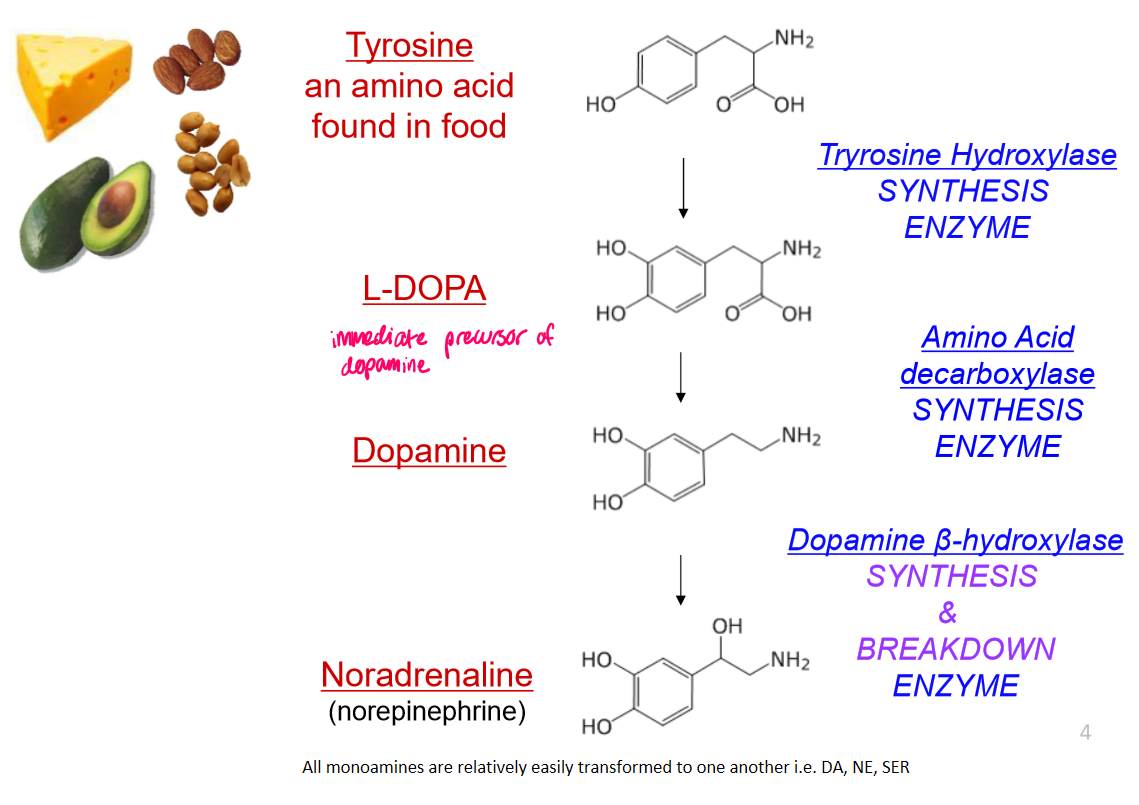
Tyrosine (amino acid) synthesised from food (cheese, nuts, avocado)
Tyrosine converted to L-DOPA (immediate precursor of dopamine) by tyrosine hydroxylase (synthesis enzyme)
L-DOPA converted to dopamine by amino acid decarboxylase (synthesis enzyme)
Why is L-DOPA particularly important for Parkinson’s disease?
L-DOPA is found naturally in the brain but can be produced as a synthetic drug
Give to Parkinson’s disease patients → up-regulate dopamine synthesis → improved motor control
What is Parkinson’s disease?
Loss of motor control resulting from death of dopamine cells in the Substantia Nigra
Symptoms:
Resting motor tremor
Rigidity + being inert → difficulty initiating movements
Cognitive impairments & dementia
Reduced executive function
Describe the management of Parkinson’s disease & the implications of this treatment
No cure BUT symptoms can be v through drugs + deep brain stimulation (^ motor activity of midbrain structures)
Implications: impulsivity, hypersexuality, gambling, & addictive-like behaviours
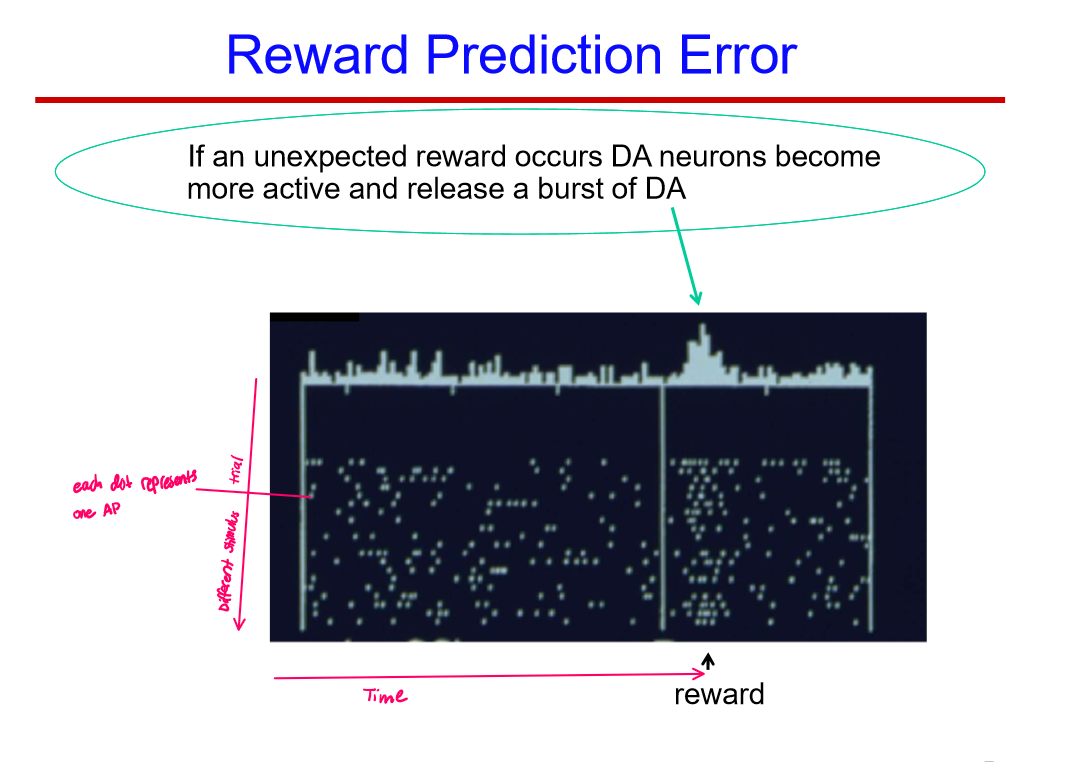
What is reward prediction error?
When a reward was either more or less rewarding than what the brain predicted it to be, altering the amount of dopamine released
How does dopamine release relate to motor control?
Dopamine is released when a muscle is moved to the correct location
Sensory information sent to brain regarding whether the limb moved to where it was meant to go or if it needs to be adjusted
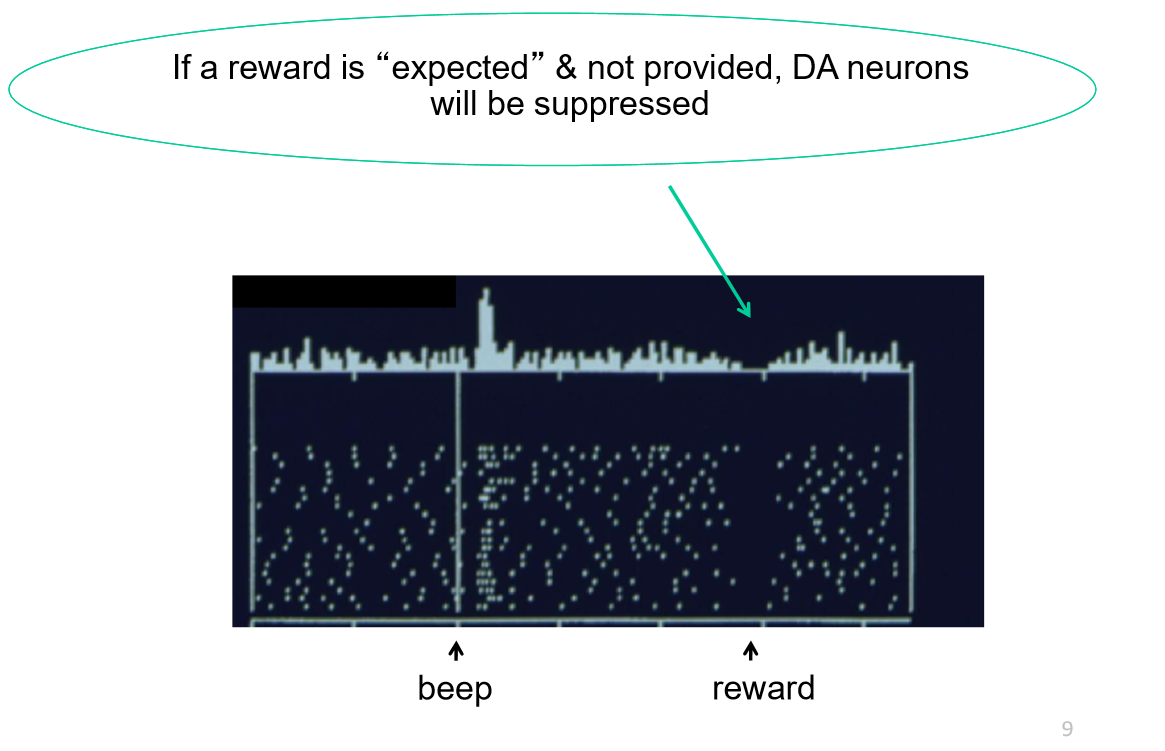
How does the timing of dopamine release change, with respect to reward & expectation?
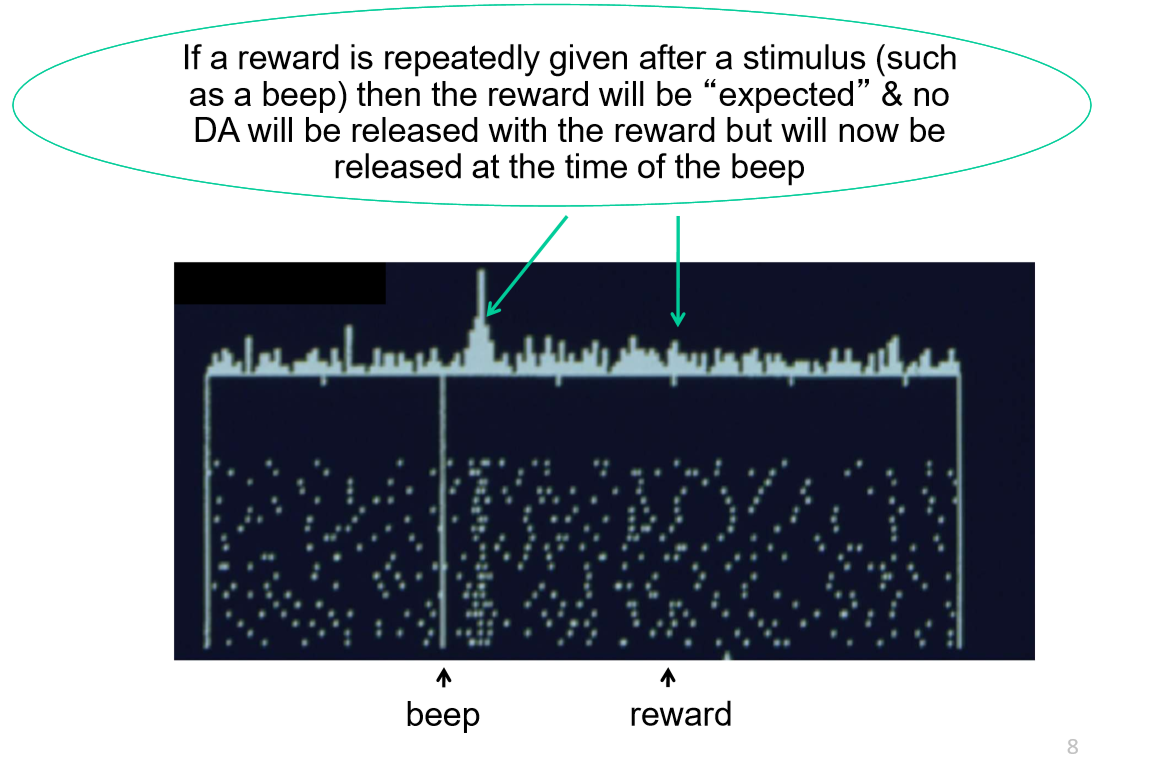
Reward is repeatedly given after a stimulus → reward becomes expected → no DA is released w/ reward
DA is eventually released with the stimulus; anticipation of a reward
What happens to DA neurons if a reward is expected but not provided?
DA neurons become suppressed
Provide an example of reward prediction error
You unexpectedly find $50 on the ground --> you are happy
You receive $150 after a very long day at work when you were expecting $300 --> you are disappointed
Even though you objectively receive more money in scenario 2, because it is not what you predicted, you are disappointed
Shows how dopamine is closely related to reward prediction
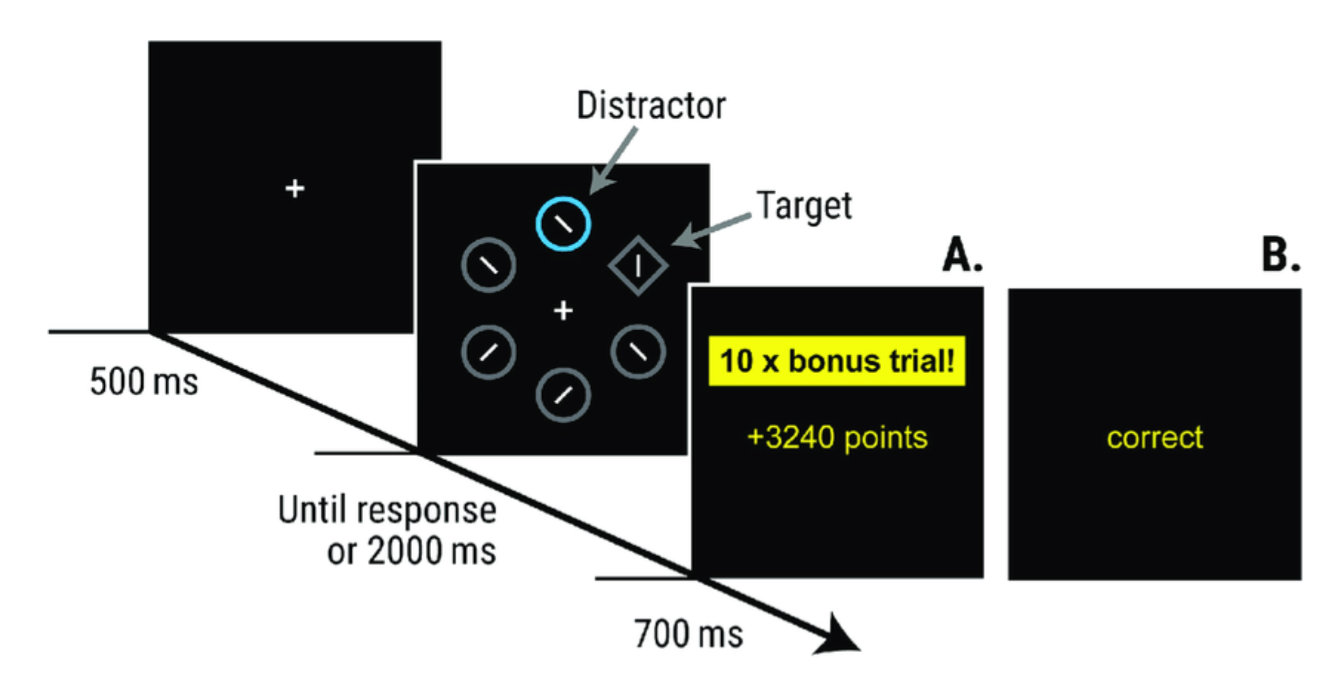
Describe how the value-modulated attentional capture task (VMAC) was used to display how the value of rewards & its cues can be indexed in behavioural paradigms
People are very good @ learning what predicts a reward
VMAC: participants asked to identify a symbol in the target next to the distractor
Symbol was either a horizontal or vertical line
2 types of distractors; high contrast & low contrast
Identify correct symbol in the target when the high contrast distractor is present --> bonus points
Addiction: people are distracted by high-value cue much more, @ the detriment of their performance @ identifying the target
Only need to stare at the target and not the distractor to perform well
Those that learn cues associated w/ reward more easily are very readily distracted by the distraction cue
Not able to ignore the reward cue, even though it is detrimental to performance
What is cognitive effort?
the brain's examination of how worthwhile it is to engage in an activity, & whether it is consistent w/ one's goals or whether one should engage in behaviour which will give more immediate gratification
How does the metabolic activity of the brain during less effortful tasks differ to the metabolic activity of the brain during more effortful tasks
It doesn’t; metabolic activity remains the same
What is a proposed explanation for why attention & cognitive task are effortful?
Cognitive effort linked to working memory & cognitive effort
Theory: DA codes for both goal-reward & effort costs, & the aversive feeling of cognitive effort reflects ‘opportunity cost’
Task persistence is justifiable only while progress outpaces accruing costs
Cognitive tasks w/ low success are particularly unpleasant (feels like a waste of time) → bias someone towards disengaging
What is opportunity cost & how is dopamine involved?
Opportunity cost: the value of the next best alternative that must be given up in order to pursue a certain action
Role of DA: there must be a balance of task persistence (working towards a goal) vs exploring other options
Task persistence relies on executive control, esp. working memory
What is the proposed theory for how working memory in people w/ AUD is a predictor of relapse?
poor working memory --> poor balancing of opportunity cost ideas; they are not able to hold the potential long term outcomes of an action if they persist as opposed to seeing out immediate gratifying behaviours
What is drug abuse?
the use of illicit substances (or illicit use of legal substances) characterised by recurrent & clinically significant adverse consequence
What is drug addiction?
chronic health condition that occurs when someone is unable to stop consuming a drug or activity, even if it is causing physical & psychological harm, or affecting their life
What is drug dependence?
the state where drug taking becomes compulsive, taking precedence over other needs
How do drug additions arise & how are they perpetuated?
Initially, taking the drug feels good. Later, after the reward-related cues of the substance have been learned, it is the anticipation of the reward which makes people take the drug, not the actual feeling of the drug itself
Example: seeing drug paraphernalia → ^ desire to use drugs, as opposed to wanting to experience a specific feeling
Cravings are exacerbated under feelings of stress
Stress ^ cognitive load → v working memory capacity (important for long-term goals)
Describe the properties of cocaine which make it addictive
Cocaine blocks the reuptake of dopamine from the synapse
More dopamine remains in the synapse --> people constantly feel good --> more rewarding that what people initially expected of the drug --> addiction
Describe the properties of amphetamines which make it addictive
Blocks reuptake of dopamine AND reverses the transporter → double-action of pushing out dopamine
Compare the psychological effects of cocaine w/ amphetamine
Cocaine: rewarding things are now more rewarding than expected
Amphetamine: things that usually aren't rewarding are now rewarding and things that are usually rewarding are now more rewarding than expected
What is methylphenidate (Ritalin)?
Used as a treatment for ADHD
DA & NA reuptake inhibitor
Similar to a cocaine analog; same pharmacophore as cocaine
Takes longer to see effects than cocaine
Not as addictive as cocaine b/c the dopamine spike following the cue isn't almost immediate
The quicker dopamine release following a cue, the more addictive the drug is
What is the difference between ice & speed?
Ice: most pure
Smoked or injected
Speed: less pure
Snorted, swallowed, or injected
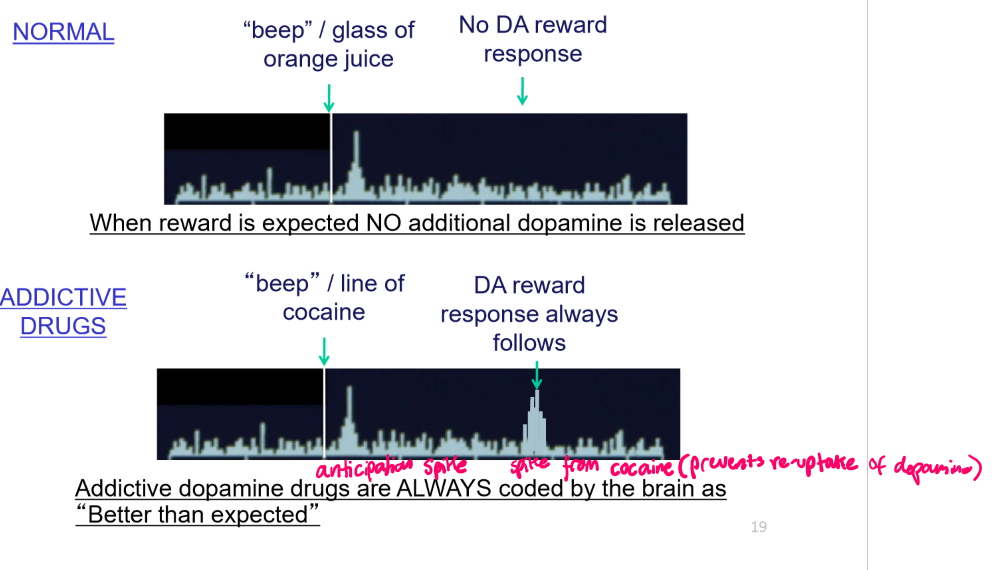
How does DA release differ between regular reward & addictive drugs?
Normal: no additional DA is released when a reward is expected
Addictive drugs: always coded by the brain as better than ex[ected
How have animal models been used to display addiction?
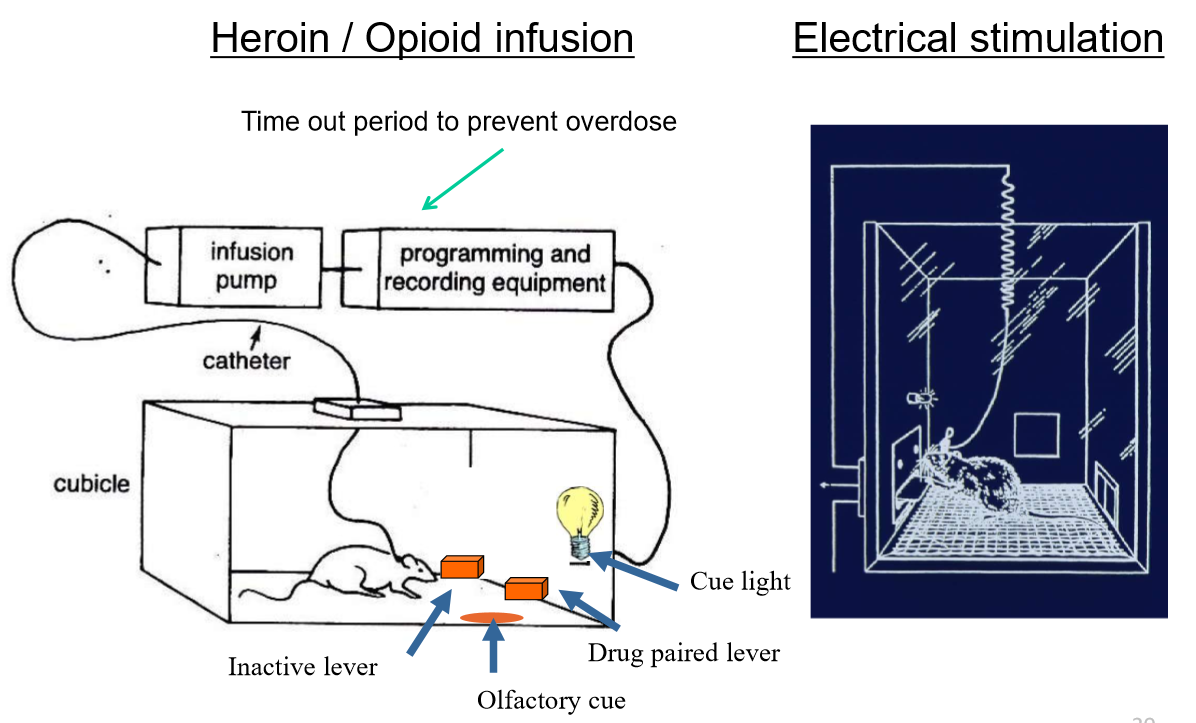
Put an electrode into the reward centres of an animal's brain --> keeps stimulating until the animal dies
Dopamine is so strong that it overpowers everything, even pain
Animal models presented w/ buttons for drugs or food --> continuously pressed level for drugs & ignored food until they died
What are the 2 problems with addiction that over-rule free will, & what is the final result of these problems?
Drugs initiate ‘wanting’ → drug urges/craving in addicted people which takes control over time
Cognitive (‘top-down’) control is v by impaired function of PFC (caused by excessive dopamine)
Seen through PFC abnormalities in imaging studies
Lots of substance abuse in adolescence/young adults b/c of under-developed pre-frontal lobes
Stress --> v top-down control -b/c of ^ cognitive load --> ^ likelihood of acting on compulsions --> drug abuse
Final result: addictive behaviour
Failures of ‘top-down’ control contribute to loss of control over urges to take drugs

