U1 - AOS2
0.0(0)
 Studied by 0 people
 Call Kai
 Learn
Learn Practice Test
 Spaced Repetition
 Match
Match Flashcards
 Knowt Play
Card Sorting
1/171

There's no tags or description
Looks like no tags are added yet.
Last updated 11:54 AM on 6/21/23
Name | Mastery | Learn | Test | Matching | Spaced | Call with Kai |
|---|
No analytics yet
Send a link to your students to track their progress
172 Terms
1
New cards
Specialised cell
a cell with features that allow it to perform a specific function
2
New cards
goblet cells
intestinal mucosal epithelial cells that serve as the primary site for nutrient digestion and mucosal absorption
3
New cards
epithelial cells
a type of cell that covers the inside and outside of the surfaces of your body. They are found on your skin, blood vessels, and organs, including your urinary tract.
4
New cards
Tissue
a group of similar specialised cells working together to carry out a specific function
5
New cards
Organ
two or more tissues that work together to perform one or more specialised tasks
6
New cards
System
a group of organs that work together to perform vital functions
7
New cards
Enzymes
help digestion by breaking down large molecules into smaller ones
8
New cards
Cell differentiation
process by which unspecialised cells, called stem cells, become specialised cells
9
New cards
Gene expression
process in which the information stored in genes is used to build the different structures in a cell. Gene expression determines how a cell will differentiate and function
10
New cards
Carbohydrate
important source of immediate energy for all living organisms
11
New cards
lipids
includes fats and oils and are an important energy source in animals
12
New cards
Amino acids
required for protein synthesis
13
New cards
Vitamins
group of organic compounds that are quired in very small amounts for cellular processes
14
New cards
Minerals
essential for cellular processes
15
New cards
16
New cards
evolution of organisms
\
* The first known organism were unicellular microbes
* The evolution of multicellular organisms meant huge increases in the diversity and level of complexity of organisms in addition to extensions in lifespans, as organisms continue to live, even when individual cells die
* In a unicellular organism, the single cell must perform all the functions needed to stay alive and their size is limited by the ability of diffusion to provide nutrients and remove wastes.
* In multicellular organisms the different functions of life are shared out between different groups of cells which are specialised for the role
* The first known organism were unicellular microbes
* The evolution of multicellular organisms meant huge increases in the diversity and level of complexity of organisms in addition to extensions in lifespans, as organisms continue to live, even when individual cells die
* In a unicellular organism, the single cell must perform all the functions needed to stay alive and their size is limited by the ability of diffusion to provide nutrients and remove wastes.
* In multicellular organisms the different functions of life are shared out between different groups of cells which are specialised for the role
17
New cards
Multicellular organisms
* Classified as
* its cells (except the reproductive cells) must have the same DNA
* its cells must be connected and must communicate and cooperate to function as a single organism
* it must have different cells that are specialised and responsible for specific functions (one of which must be reproduction)
* its cells must be dependent on each other for survival.
* Formed from when stem cells differentiate into specialised cells or through mitotic divisions (e.g. a zygote forming a multicellular embryo)
* its cells (except the reproductive cells) must have the same DNA
* its cells must be connected and must communicate and cooperate to function as a single organism
* it must have different cells that are specialised and responsible for specific functions (one of which must be reproduction)
* its cells must be dependent on each other for survival.
* Formed from when stem cells differentiate into specialised cells or through mitotic divisions (e.g. a zygote forming a multicellular embryo)
18
New cards
Location and function of stem cells in plants
\
* Are found in the meristems of plants
* The shoot apical meristem gives rise to new leaves and flowers
* The root apical meristem gives rise to the roots
* Are found in the meristems of plants
* The shoot apical meristem gives rise to new leaves and flowers
* The root apical meristem gives rise to the roots
19
New cards
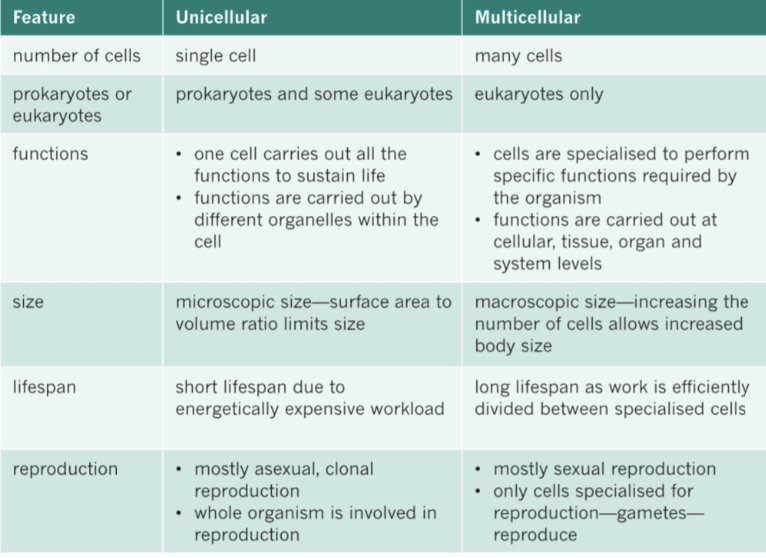
Difference between multicellular and unicellular organisms
20
New cards
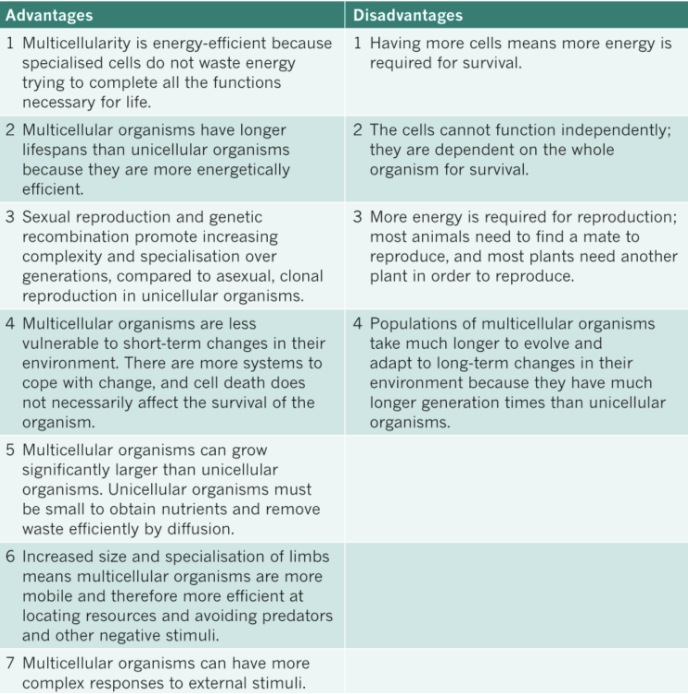
Advantages and disadvantages of multicellularity
21
New cards
levels of organisation
Organised into tissues, organs and systems
22
New cards
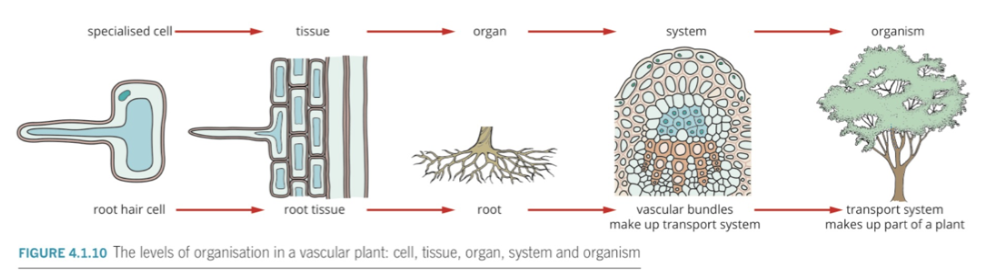
levels of organisation - vascular plants
__Specialised cells__ → involved in the transport of nutrients and water and acquiring energy via photosynthesis
__Tissues__ → vascular tissues, which are involved in the transport of water and nutrients throughout the plant. 'There are two types of vascular tissue are
* Xylem → transports water into the leaf for mesophyll. Cells to use in photosynthesis and for transpiration from stomata
* Phloem → transports sucrose and amino acids around the plant
__Organs__
* Roots → absorb water and store water and nutrients required by the plant from the soil. They support and anchor the plant
* Leaves → where photosynthesis occurs to convert light energy into chemical energy that fuels the organism’s cells. The leaves overall shape makes them well suited for photosynthesis
* Made of epidermis, photosynthetic tissue and vascular tissue
* Stems → support leaves, flowers and fruits. They help store and transport water and nutrients between the roots and shoots, and grow new plant tissue
* Made of dermal tissue, ground tissue and vascular tissue
* Flower → reproductive structures + facilitates the fertilisation of the ovules by the sperm
* Fruit → protect the developing seeds of the plant and help disperse seeds allowing allowing new plants to grow
__Systems__
* Root system → usually underground and functions to support the structure of the plant and absorb water and nutrient from the soil
* Shoot system
* Non-reproductive (vegetative) parts of the plant e.g. leaves and stems
* Reproductive parts of the plant e.g. flowers and fruits
__Tissues__ → vascular tissues, which are involved in the transport of water and nutrients throughout the plant. 'There are two types of vascular tissue are
* Xylem → transports water into the leaf for mesophyll. Cells to use in photosynthesis and for transpiration from stomata
* Phloem → transports sucrose and amino acids around the plant
__Organs__
* Roots → absorb water and store water and nutrients required by the plant from the soil. They support and anchor the plant
* Leaves → where photosynthesis occurs to convert light energy into chemical energy that fuels the organism’s cells. The leaves overall shape makes them well suited for photosynthesis
* Made of epidermis, photosynthetic tissue and vascular tissue
* Stems → support leaves, flowers and fruits. They help store and transport water and nutrients between the roots and shoots, and grow new plant tissue
* Made of dermal tissue, ground tissue and vascular tissue
* Flower → reproductive structures + facilitates the fertilisation of the ovules by the sperm
* Fruit → protect the developing seeds of the plant and help disperse seeds allowing allowing new plants to grow
__Systems__
* Root system → usually underground and functions to support the structure of the plant and absorb water and nutrient from the soil
* Shoot system
* Non-reproductive (vegetative) parts of the plant e.g. leaves and stems
* Reproductive parts of the plant e.g. flowers and fruits
23
New cards
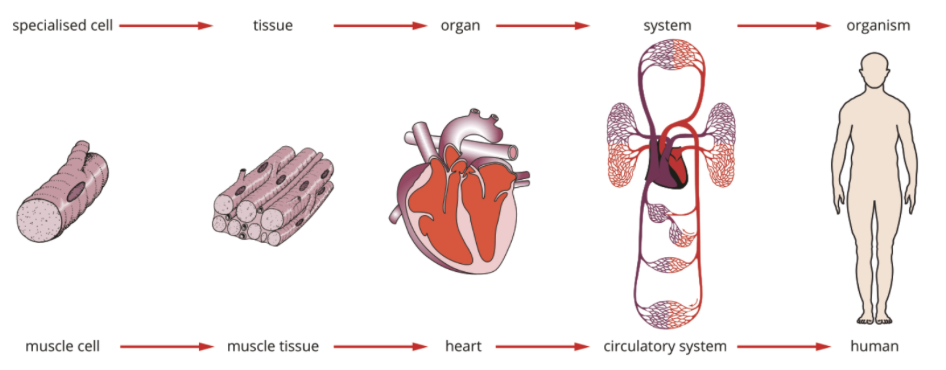
levels of organisation - complex animals
__Specialised cells__ → most complex animals are made of hundreds of different cell types that are specialised to perform different functions e.g. red blood cells and neurons
__Tissues__
* Muscle tissue → formed by cells that can contract + for movement
* Epithelial tissue → formed by one or more layers that cover most internal and external surfaces of the organism
* Connective tissue → forms the supporting and connecting structures of the body
* Nervous tissue → consists of highly specialised cells called neurons that sense stimuli and transmit signal for communication and coordination
__Organs__ → there are many organs in complex animals e.g. eyes, skin, kidney and heart
Systems → respiratory, circulatory, digestive, excretory, immune, nervous, endocrine, reproductive, muscular, skeletal and integumentary system
__Organism__ → the highest level of organisation which is the organism itself
__Tissues__
* Muscle tissue → formed by cells that can contract + for movement
* Epithelial tissue → formed by one or more layers that cover most internal and external surfaces of the organism
* Connective tissue → forms the supporting and connecting structures of the body
* Nervous tissue → consists of highly specialised cells called neurons that sense stimuli and transmit signal for communication and coordination
__Organs__ → there are many organs in complex animals e.g. eyes, skin, kidney and heart
Systems → respiratory, circulatory, digestive, excretory, immune, nervous, endocrine, reproductive, muscular, skeletal and integumentary system
__Organism__ → the highest level of organisation which is the organism itself
24
New cards
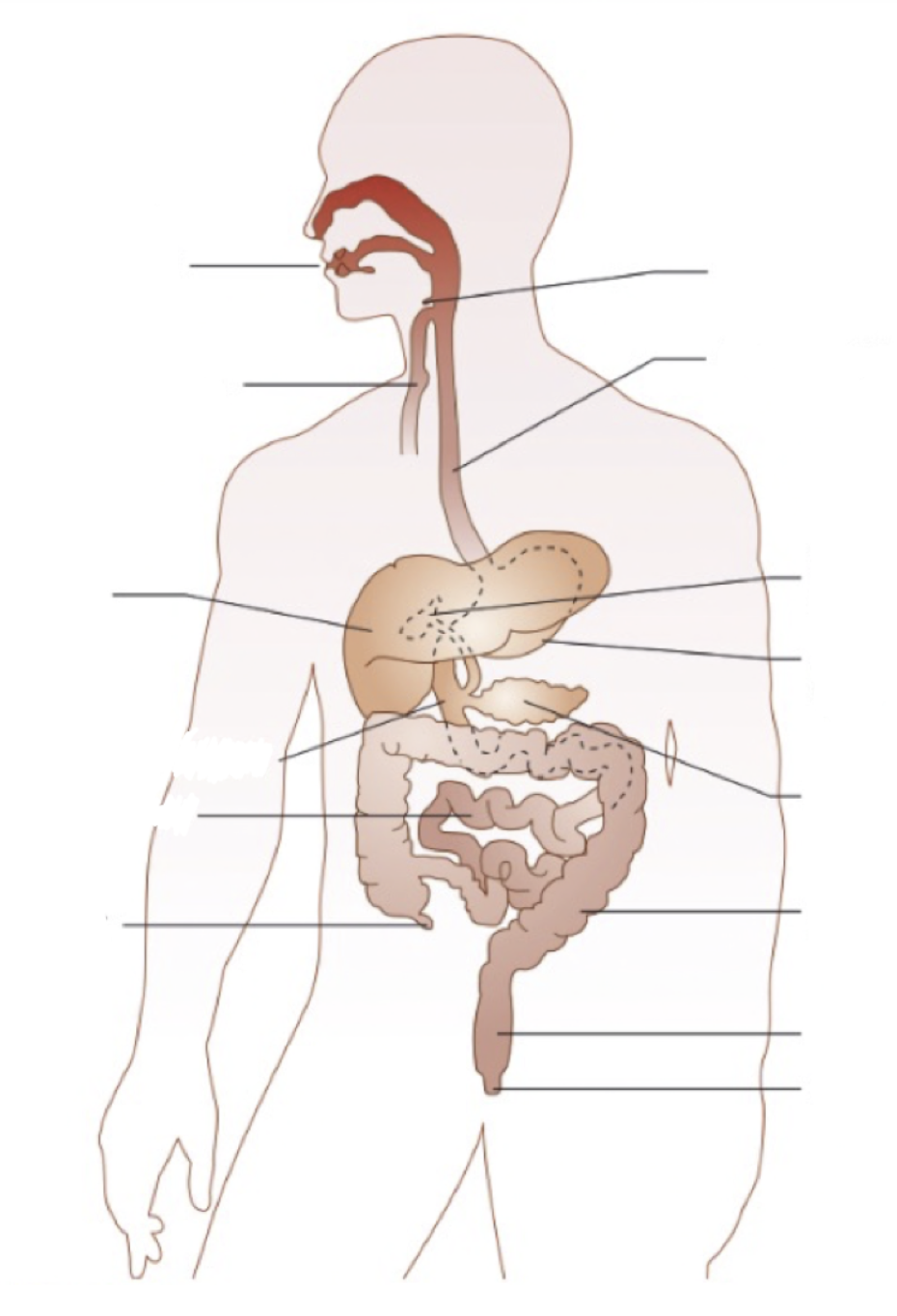
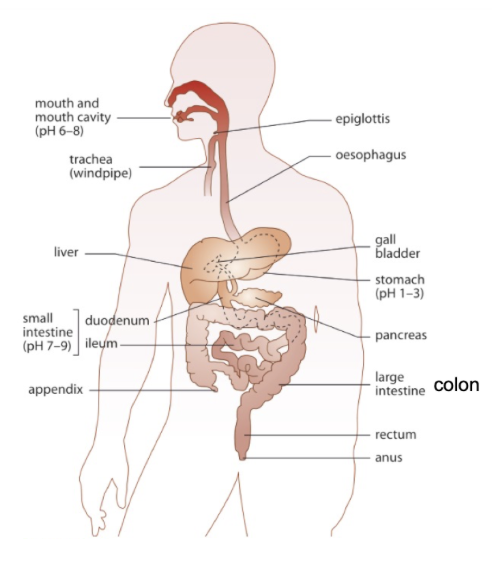
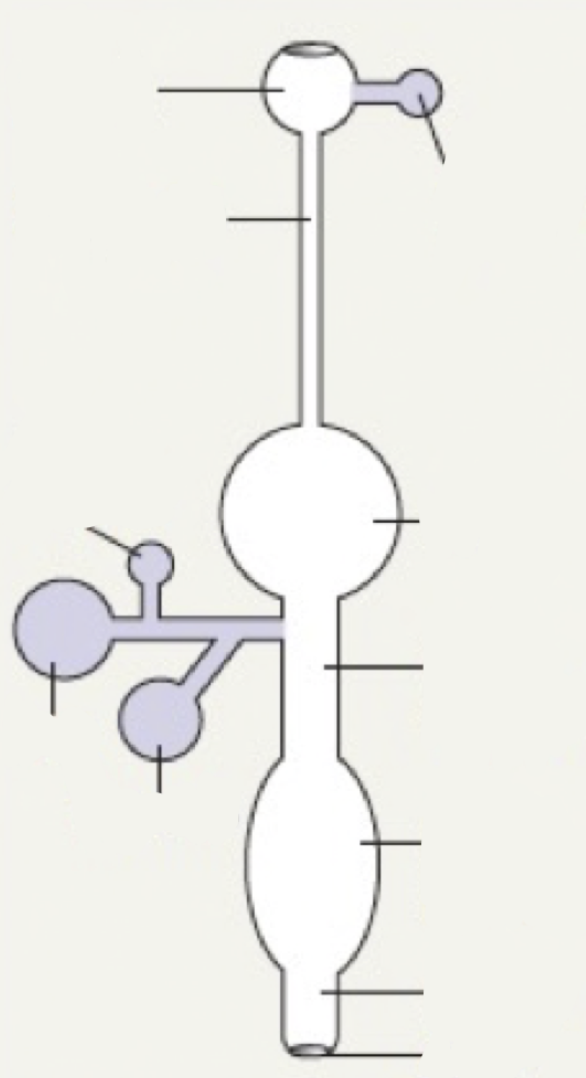
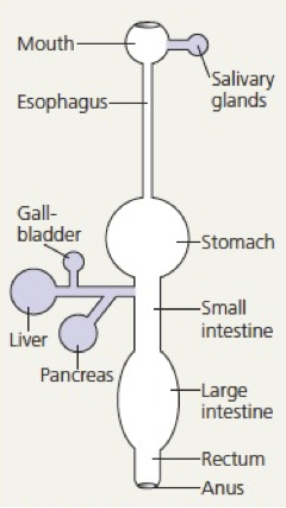
digestive system
Comprised of the alimentary canal (organs through which food actually passes - oesophagus, stomach, small and large intestine) and the accessory organs (aid in digestion but don’t actually transfer food - salivary glands, pancreas, liver, gallbladder)
25
New cards
digestion
\
* is the physical and chemical breakdown of large molecules of carbohydrates, proteins and fats
* is the physical and chemical breakdown of large molecules of carbohydrates, proteins and fats
26
New cards
27
New cards
28
New cards
purpose of digestion
* Purpose is to break large molecules down into smaller subunits as
* To break down large macromolecules into smaller soluble molecules so that they can be absorbed across the wall of the intestine into the bloodstream
* The structure of the ingested macromolecules might not be useful to the body so they need to be broken down and then subunits need to be reassembled into more useful macromolecules
* Large molecules are also typically chemically inert
* To break down large macromolecules into smaller soluble molecules so that they can be absorbed across the wall of the intestine into the bloodstream
* The structure of the ingested macromolecules might not be useful to the body so they need to be broken down and then subunits need to be reassembled into more useful macromolecules
* Large molecules are also typically chemically inert
29
New cards
types of digestion
* Types of digestion
* Physical → a mechanism to break down large food into pieces to increase its surface area as digestive enzymes only act on the outside surface area of food. Without physical digestion, digestion would take a very long time as the enzymes would have a relatively small surface area to work on
* Chemical → process of breaking apart complex molecules into simple molecules which is carried out by digestive enzymes (they increase the rate of breakdown of food molecules). Digestive enzymes split food molecules by the process of hydrolysis
* Physical → a mechanism to break down large food into pieces to increase its surface area as digestive enzymes only act on the outside surface area of food. Without physical digestion, digestion would take a very long time as the enzymes would have a relatively small surface area to work on
* Chemical → process of breaking apart complex molecules into simple molecules which is carried out by digestive enzymes (they increase the rate of breakdown of food molecules). Digestive enzymes split food molecules by the process of hydrolysis
30
New cards
stages of digestion
\
* Ingestion → food is taken into the body via the act of eating
* Digestion → food is broken down both physically (e.g. chewing) and chemically (e.g. enzymatic hydrolysis)
* Absorption → digested food products reabsorbed into the bloodstream and transported to cells
* Assimilation → digested food products reconverted into the fluid and solid parts of a cell / tissue
* Elimination → undigested food residues are egested (not excreted) from the body as semi-solid faeces
* Ingestion → food is taken into the body via the act of eating
* Digestion → food is broken down both physically (e.g. chewing) and chemically (e.g. enzymatic hydrolysis)
* Absorption → digested food products reabsorbed into the bloodstream and transported to cells
* Assimilation → digested food products reconverted into the fluid and solid parts of a cell / tissue
* Elimination → undigested food residues are egested (not excreted) from the body as semi-solid faeces
31
New cards
digestive system - types of enzymes
\
* Carbohydrases (amylase), which act on carbohydrates → made in mouth and pancreas
* Protease (pepsin, trypsin), which act on proteins → made in pancreas
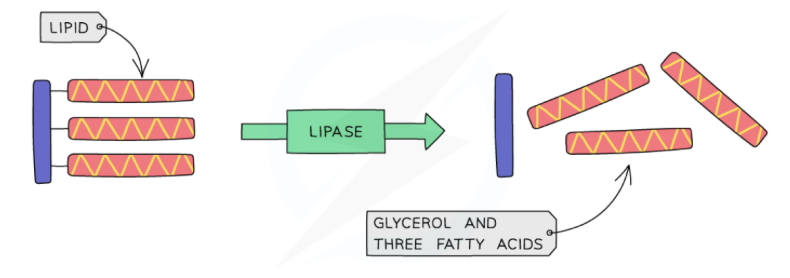
* Lipases, which acts on lipids / triglycerides → made in pancreas
* Carbohydrases (amylase), which act on carbohydrates → made in mouth and pancreas
* Protease (pepsin, trypsin), which act on proteins → made in pancreas
* Lipases, which acts on lipids / triglycerides → made in pancreas
32
New cards
digestive system - mouth
\
* contains saliva which moistens the food, and acts as a lubricant.
* Saliva which is released from the salivary glands contains amylase (→carbohydrases→enzymes) which break down carbohydrates (starch) into maltose
* Its optimum pH is 7.
* The teeth physically/mechanically digest the food (mastication) into smaller pieces with a larger surface area for the enzymes to work on
* The food then passes down the oesophagus to the stomach as a ball called a bolus.
* contains saliva which moistens the food, and acts as a lubricant.
* Saliva which is released from the salivary glands contains amylase (→carbohydrases→enzymes) which break down carbohydrates (starch) into maltose
* Its optimum pH is 7.
* The teeth physically/mechanically digest the food (mastication) into smaller pieces with a larger surface area for the enzymes to work on
* The food then passes down the oesophagus to the stomach as a ball called a bolus.
33
New cards
digestive system - epiglottis
This flap, at the entrance to the larynx, prevents food from entering the trachea and respiratory system, directing it down the oesophagus. The epiglottis is also associated with the gag and cough reflex.
34
New cards
digestive system - oesophagus
Food travels down this tube to the stomach, aided by muscular contractions (peristalsis)
35
New cards
digestive system - stomach
\
* The stomach secretes gastric juices and protein-digesting enzymes (proteases) from the gastric chief cells and other specialised epithelial cells in the stomach
* Contains a mucous membrane which prevents the acids from damaging the lining of the stomach
* Stomach is acidic (contains HCI) to kill microorganisms
* Food is held in the stomach for several hours so protease enzymes (pepsin) can chemically digest protein (polypeptides) into peptides
* The squeezing of the muscles in the wall of the stomach churns the food (peristalsis)
* When the sphincter muscle at the bottom of the stomach relaxes food (now a liquid paste called chyme) is passed into the duodenum
* The stomach secretes gastric juices and protein-digesting enzymes (proteases) from the gastric chief cells and other specialised epithelial cells in the stomach
* Contains a mucous membrane which prevents the acids from damaging the lining of the stomach
* Stomach is acidic (contains HCI) to kill microorganisms
* Food is held in the stomach for several hours so protease enzymes (pepsin) can chemically digest protein (polypeptides) into peptides
* The squeezing of the muscles in the wall of the stomach churns the food (peristalsis)
* When the sphincter muscle at the bottom of the stomach relaxes food (now a liquid paste called chyme) is passed into the duodenum
36
New cards
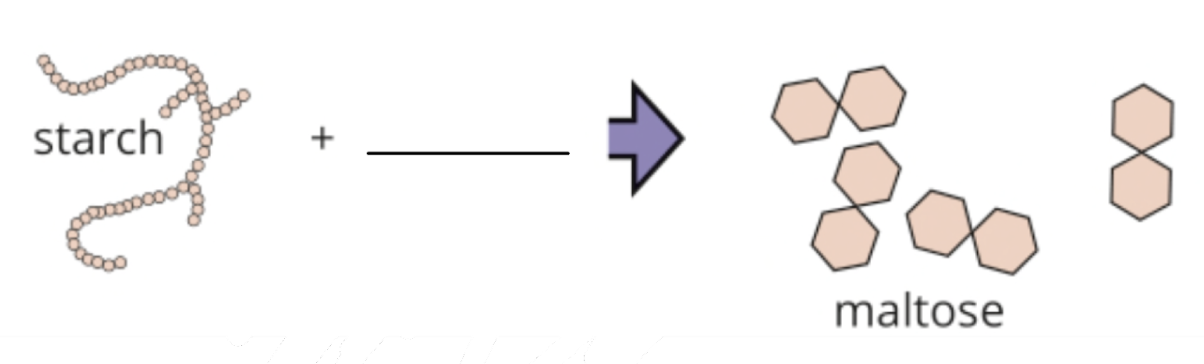
what digestive enzyme is this
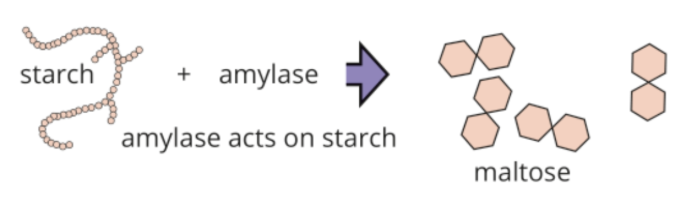
37
New cards
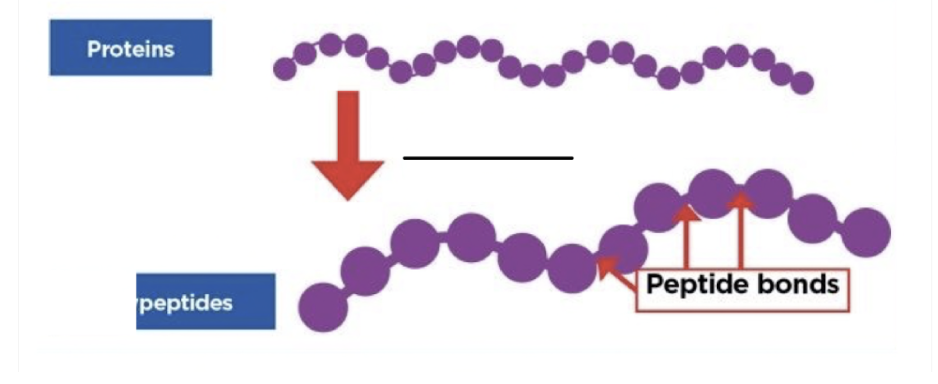
what digestive enzyme is this
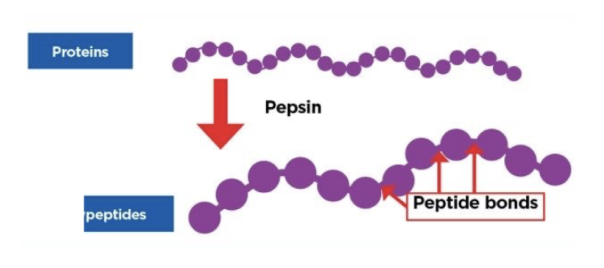
38
New cards
Peristalsis
moves food along by waves of circular muscle contraction. Only occurs in one direction. It is also involved in churning (physical digestion) of semi digested food to mix it with enzymes and speed up digestion
39
New cards
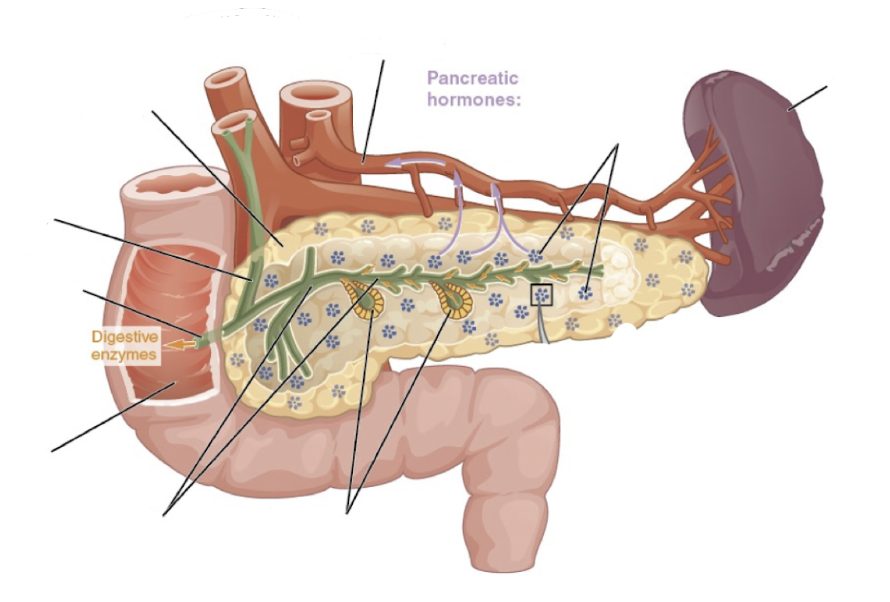
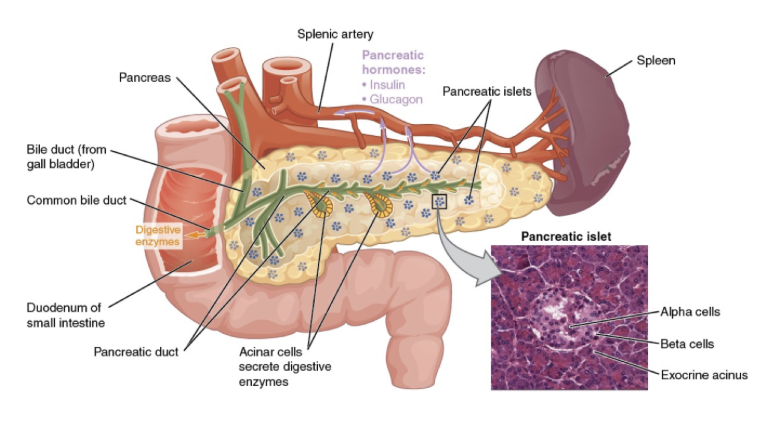
digestive system - Pancreas
\
* Further digests partially digested chyme from the stomach
* It synthesises and secretes digestive enzymes which are added to the chyme in the duodenum
* Carbohydrases (amylase) → starch into maltose (a disaccharide made of two glucoses)
* Proteases (trypsin) → proteins into peptides
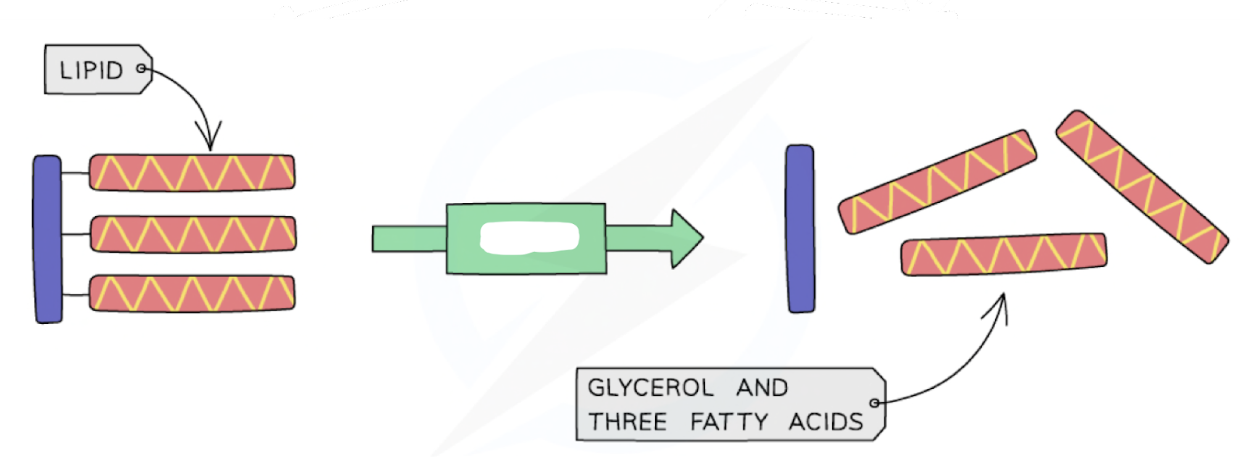
* Lipases → lipids / triglycerides into fatty acids and glycerol
* Pancreatic enzymes have an optimum pH of 7
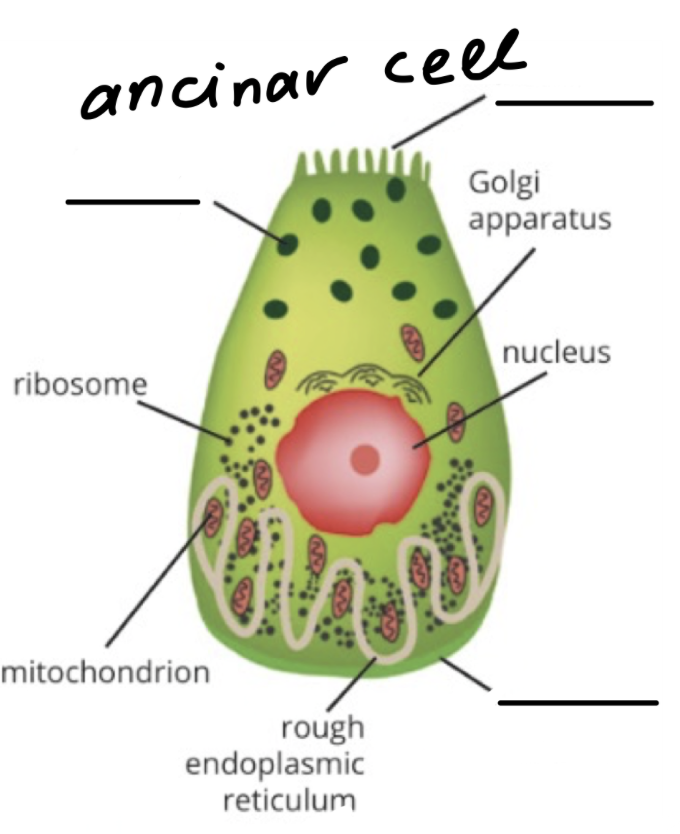
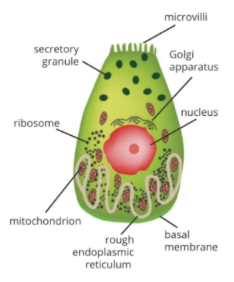
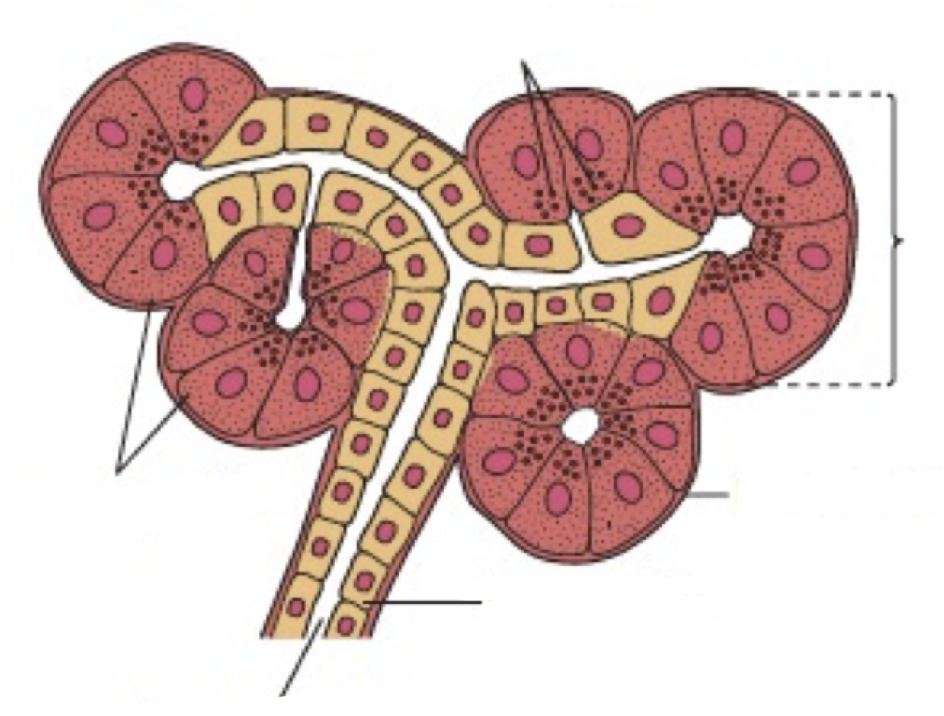
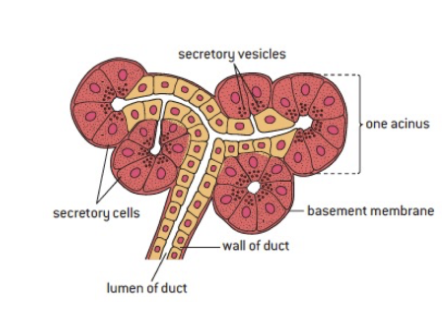
* Small groups of gland cells cluster round the ends of tubes called ducts, into which the enzymes are secreted. The digestive enzymes are proteins and are synthesised in pancreatic acinar cells on ribosomes on the rough ER → processed in the golgi body and are secreted by exocytosis
* releases alkaline compounds (bicarbonate ions), which neutralise the acidic chyme coming from the stomach → creates an optimum pH for the pancreatic enzymes to work
* Ducts within the pancreas merge into larger ducts, forming one pancreatic duct, where pancreatic juice is secreted into the lumen of the duodenum
* Further digests partially digested chyme from the stomach
* It synthesises and secretes digestive enzymes which are added to the chyme in the duodenum
* Carbohydrases (amylase) → starch into maltose (a disaccharide made of two glucoses)
* Proteases (trypsin) → proteins into peptides
* Lipases → lipids / triglycerides into fatty acids and glycerol
* Pancreatic enzymes have an optimum pH of 7
* Small groups of gland cells cluster round the ends of tubes called ducts, into which the enzymes are secreted. The digestive enzymes are proteins and are synthesised in pancreatic acinar cells on ribosomes on the rough ER → processed in the golgi body and are secreted by exocytosis
* releases alkaline compounds (bicarbonate ions), which neutralise the acidic chyme coming from the stomach → creates an optimum pH for the pancreatic enzymes to work
* Ducts within the pancreas merge into larger ducts, forming one pancreatic duct, where pancreatic juice is secreted into the lumen of the duodenum
40
New cards
digestive system - Liver and gallbladder
\
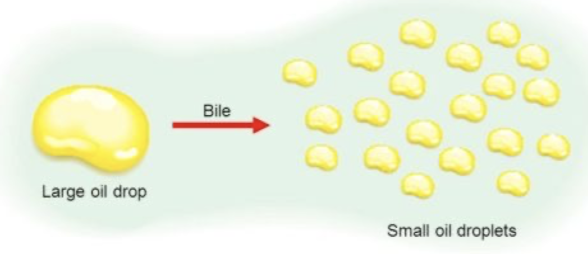
* Liver produces surfactants in bile to break up lipid droplets
* The liver make bile which is stored in the gallbladder and passes out the bile duct
* Gallbladder stores and regulates the release of bile
* Liver produces surfactants in bile to break up lipid droplets
* The liver make bile which is stored in the gallbladder and passes out the bile duct
* Gallbladder stores and regulates the release of bile
41
New cards
digestive system - Bile
\
* It is alkaline and neutralises the acidic semi-digested food as it passes from the stomach into the duodenum
* It emulsifies large lipid globules into tiny droplets which increases the surface area that the lipases can work on, speeding up digestion
* It is alkaline and neutralises the acidic semi-digested food as it passes from the stomach into the duodenum
* It emulsifies large lipid globules into tiny droplets which increases the surface area that the lipases can work on, speeding up digestion
42
New cards
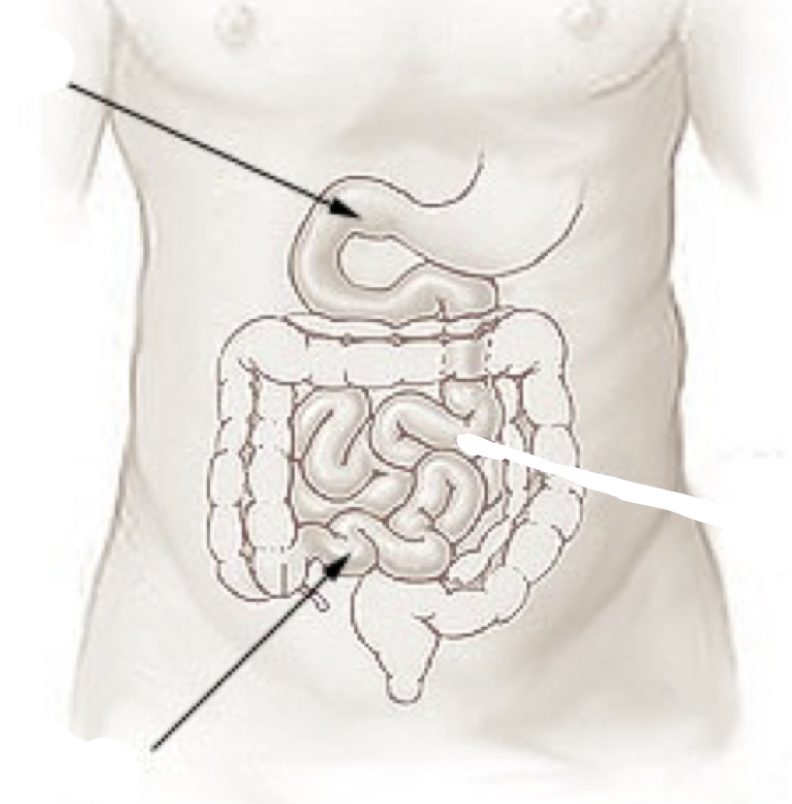
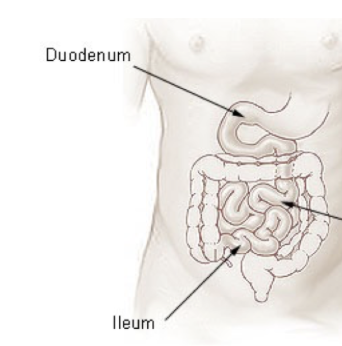
digestive system - small intestine
\
* Primary function is to absorb nutrients and mineral from food
* Enzymes produced in the pancreas and the small intestine and bile from the liver and gallbladder further break down food
* Enzymes produced from the wall of the intestine
* Maltase → digests maltose (disaccharide) into glucose (monosaccharide)
* Peptidases → digests peptides into amino acids
* The average length of the small intestine is 7m → therefore food has a long way to travel which allows digestive reactions enough time to digest and absorb the food
* Broken into the duodenum and ileum
* Absorption happens in the ileum
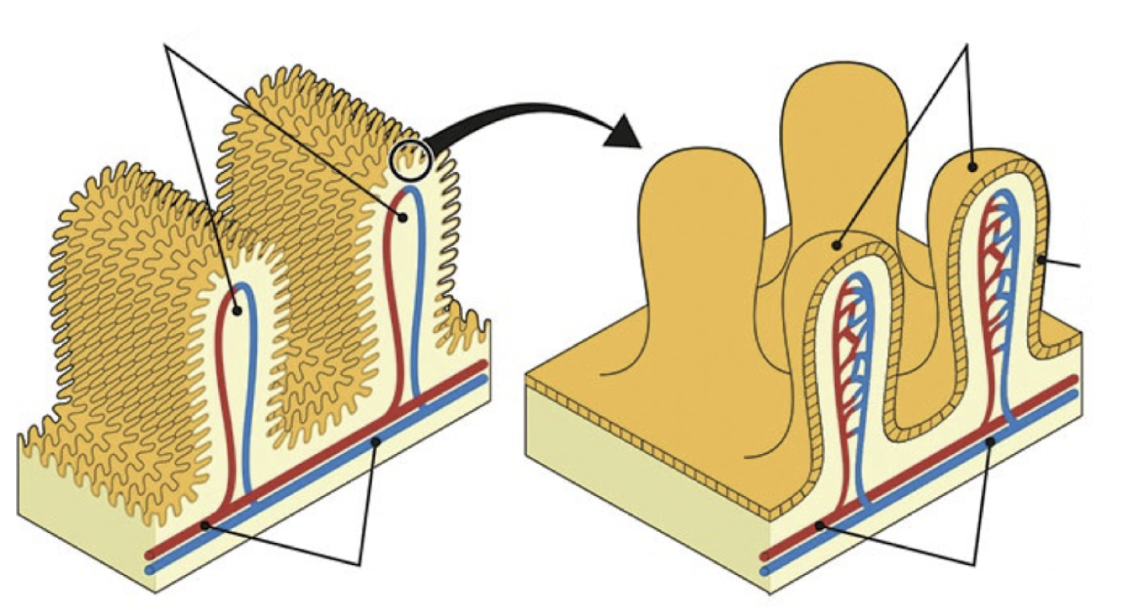
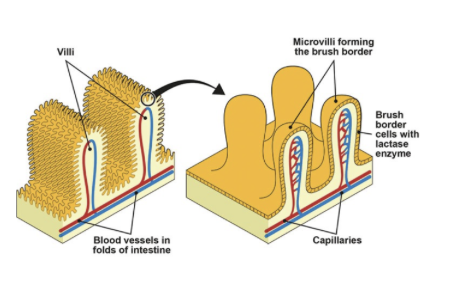
* The microvilli on the plasma membrane of two epithelial cells form a brush border that has digestive enzymes and channel proteins embedded within it
* Primary function is to absorb nutrients and mineral from food
* Enzymes produced in the pancreas and the small intestine and bile from the liver and gallbladder further break down food
* Enzymes produced from the wall of the intestine
* Maltase → digests maltose (disaccharide) into glucose (monosaccharide)
* Peptidases → digests peptides into amino acids
* The average length of the small intestine is 7m → therefore food has a long way to travel which allows digestive reactions enough time to digest and absorb the food
* Broken into the duodenum and ileum
* Absorption happens in the ileum
* The microvilli on the plasma membrane of two epithelial cells form a brush border that has digestive enzymes and channel proteins embedded within it
43
New cards
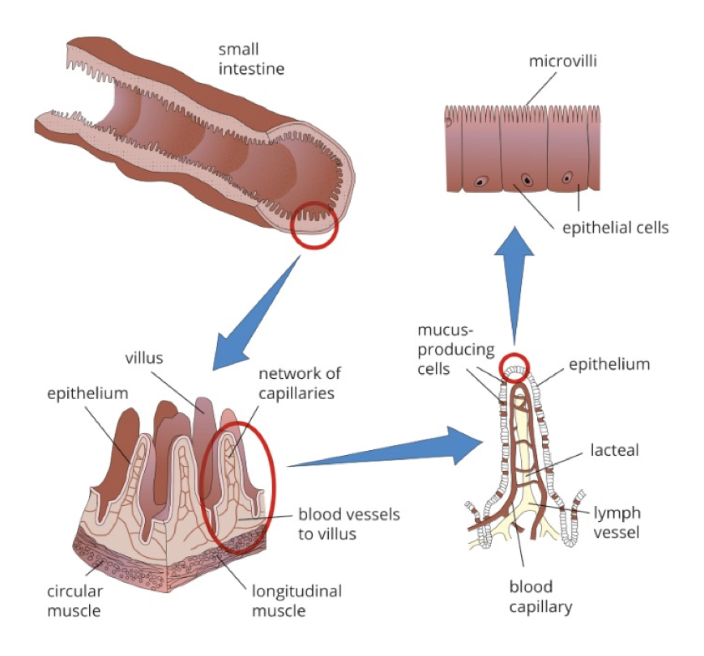
digestive system - ileum - villi
* Surface area is increased through the villi
* small finger-like projection of the mucosa on the inside of the intestine wall
* Each villi contains a network of capillaries inside
* Digested food enters the capillaries, but the products of fat digestion enter the lacteal
* absorbs glucose and other monosaccharides, amino acid, fatty acids and glycerol
* Features:
* Microvilli →Folding of epithelial membrane furtherincreases surface area
* Rich blood supply → Dense capillary network rapidly transports absorbed products
* Epithelial cells (enterocytes) → Minimises diffusion distance between lumen and blood
* possess large numbers of mitochondria to provideATP for active transport mechanisms absorbing molecules against a concentration gradient
* Lacteals → Absorbs lipids from the intestine into the lymphatic system
* Intestinal glands/crypts → release digestive juices
* Membrane proteins → Facilitates transport of digested materials into epithelial cells
* small finger-like projection of the mucosa on the inside of the intestine wall
* Each villi contains a network of capillaries inside
* Digested food enters the capillaries, but the products of fat digestion enter the lacteal
* absorbs glucose and other monosaccharides, amino acid, fatty acids and glycerol
* Features:
* Microvilli →Folding of epithelial membrane furtherincreases surface area
* Rich blood supply → Dense capillary network rapidly transports absorbed products
* Epithelial cells (enterocytes) → Minimises diffusion distance between lumen and blood
* possess large numbers of mitochondria to provideATP for active transport mechanisms absorbing molecules against a concentration gradient
* Lacteals → Absorbs lipids from the intestine into the lymphatic system
* Intestinal glands/crypts → release digestive juices
* Membrane proteins → Facilitates transport of digested materials into epithelial cells
44
New cards
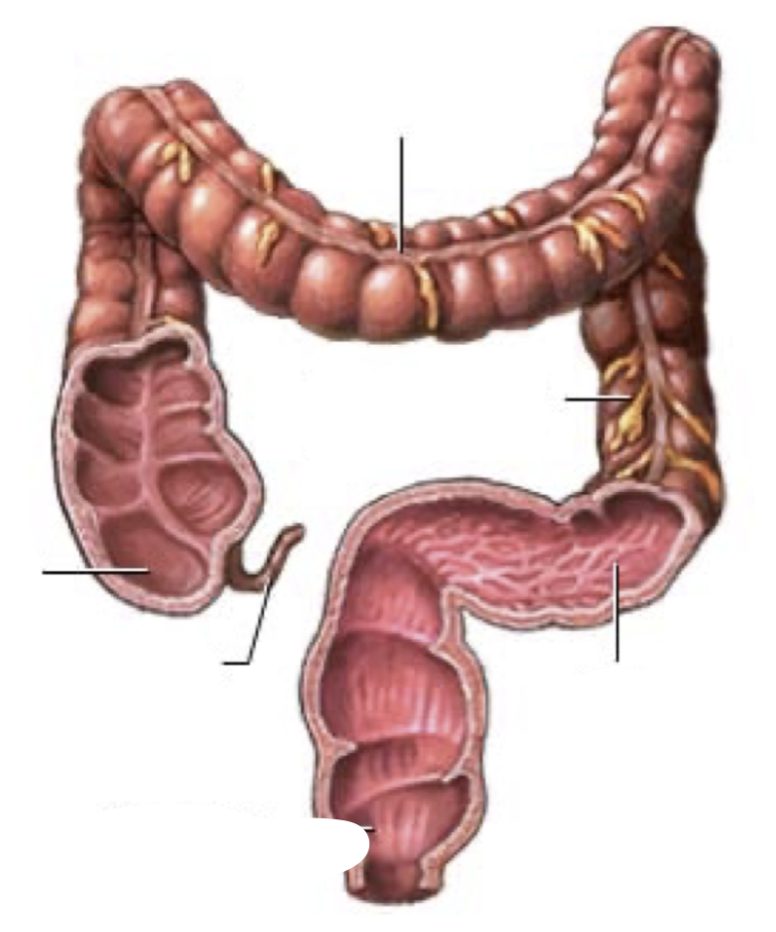
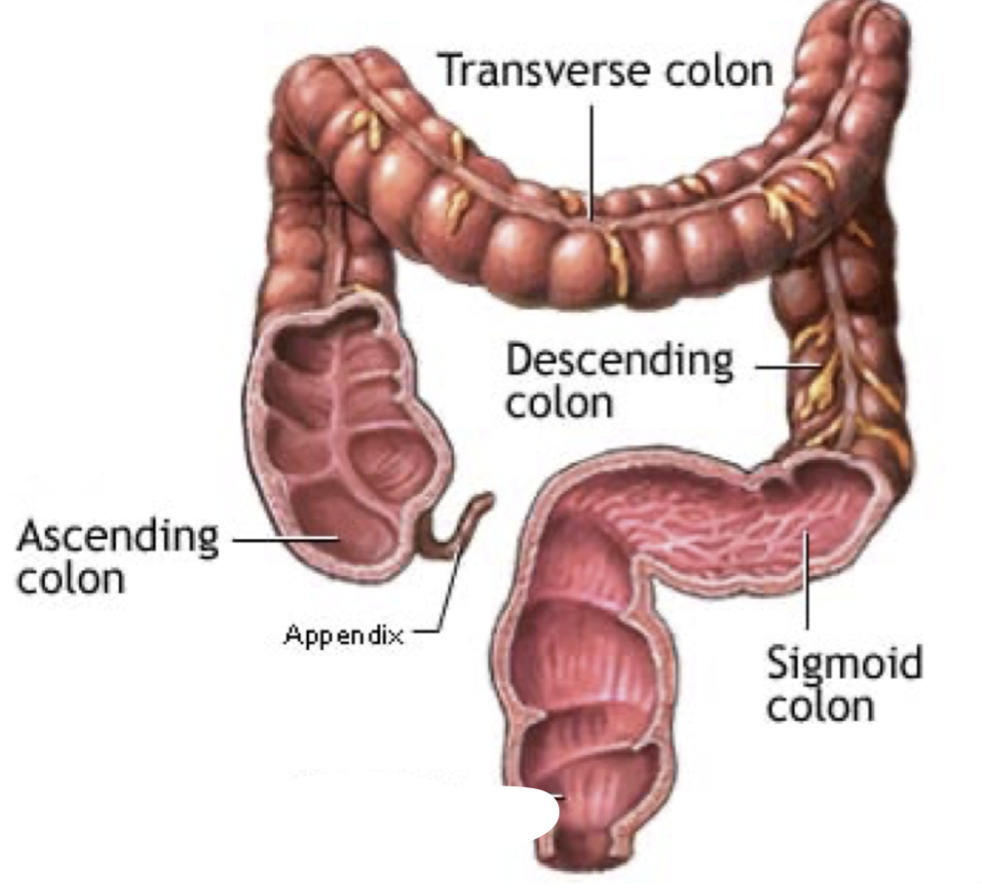
digestive system - large intestine
\
* Made of the colon, rectum and anus
* Undigested food e.g. cellulose (we don’t have an enzyme to digest it) and dead and living bacteria goes through the large intestine
* Water is reabsorbed as the waste from digestion moves along the colon leaving faeces, which is stored in the rectum until expelled through the anus
* Made of the colon, rectum and anus
* Undigested food e.g. cellulose (we don’t have an enzyme to digest it) and dead and living bacteria goes through the large intestine
* Water is reabsorbed as the waste from digestion moves along the colon leaving faeces, which is stored in the rectum until expelled through the anus
45
New cards
46
New cards
47
New cards
48
New cards
49
New cards
50
New cards
51
New cards
52
New cards
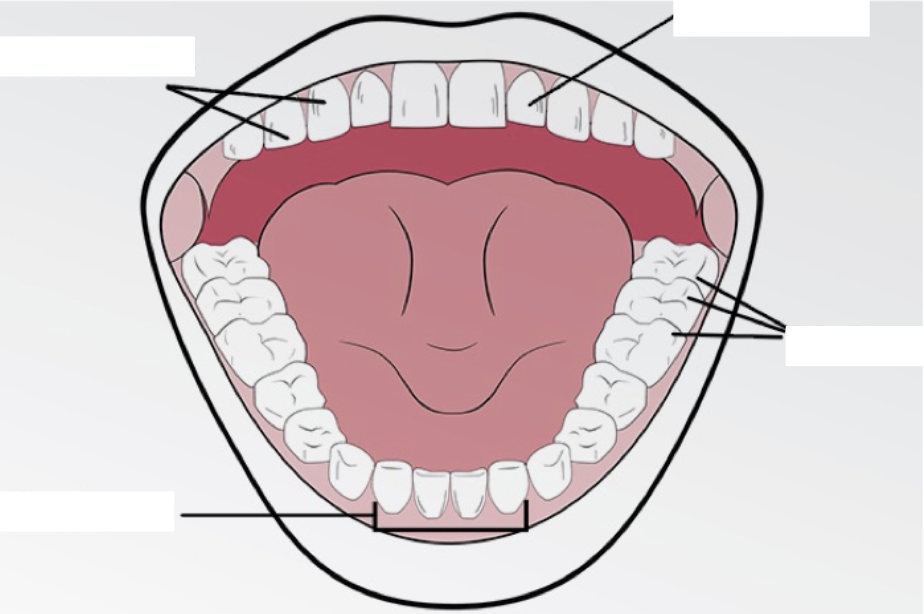
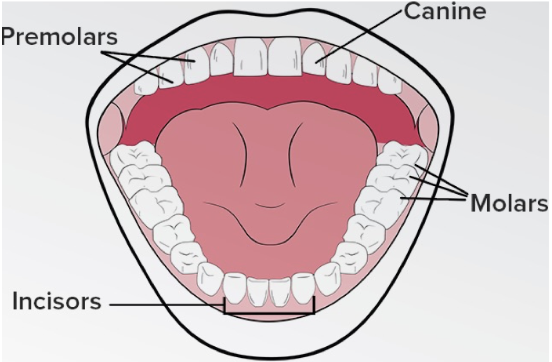
types of teeth + their function
\
* Incisor → cutting or bitting
* Canine → stabbing
* Premolar → grinding and crushing
* Molar → grinding and crushing
* Incisor → cutting or bitting
* Canine → stabbing
* Premolar → grinding and crushing
* Molar → grinding and crushing
53
New cards
54
New cards
connection between teeth and diet
\
* Carnivores
* large pointed incisors and canines to stab and tear meet
* Jagged premolars for shredding
* Herbivores
* Broad premolars and molars to grind down plant materials
* Small or absent canines
* Incisors to cut plant material
* Carnivores
* large pointed incisors and canines to stab and tear meet
* Jagged premolars for shredding
* Herbivores
* Broad premolars and molars to grind down plant materials
* Small or absent canines
* Incisors to cut plant material
55
New cards
dental adaptation
is a structural variation reflecting diet which is also an evolutionary adaptation of teeth for processing different kinds of food
56
New cards
Stomach and Intestinal Adaptations - variation in length of digestive system
Herbivores and omnivores have longer alimentary canals relative to their body size than carnivores, as plant matter is more difficult to digest than meat due to the cellulose in the cell walls. A longer digestive tract provides more time for digestion and more surface area for the absorption of nutrients
57
New cards
Stomach and Intestinal Adaptations - gut structure
\
* Carnivores have short and simple guts
* Herbivores have longer and more complex guts
* Carnivores have short and simple guts
* Herbivores have longer and more complex guts
58
New cards
Fermentation
\
* Herbivores have fermentation chambers to break down the cellulose in the cell walls of plant matter they eat. As the breakdown of cellulose occurs anaerobically it occurs by fermentation
* Cellulose → main component of plant cell walls, but its molecules are too large to be absorbed without digestion, and many herbivores don’t have cellulase to digest it. To get around this problem, herbivores have a symbiotic relationship (mutualism) with bacteria that produce cellulase
* The bacteria receive shelter and free nutrients and in return convert cellulose into simpler molecular
* Herbivores have fermentation chambers to break down the cellulose in the cell walls of plant matter they eat. As the breakdown of cellulose occurs anaerobically it occurs by fermentation
* Cellulose → main component of plant cell walls, but its molecules are too large to be absorbed without digestion, and many herbivores don’t have cellulase to digest it. To get around this problem, herbivores have a symbiotic relationship (mutualism) with bacteria that produce cellulase
* The bacteria receive shelter and free nutrients and in return convert cellulose into simpler molecular
59
New cards
the two types of fermentation
hindgut and foregut
60
New cards
hindgut
Hindgut → fermentation in caecum after the small intestine
* In this system there is a longer caecum
* Food comes from the small intestine to the caecum then passes into the large intestine
* Fermentation (digestion of cellulose) occurs by symbiotic microbes in the enlarged caecum
* Seen in herbivores with a simple, single-chambered stomach
* Disadvantage is that it limits the advantage obtained from the symbiotic relationship, as the products of digestion aren’t completely absorbed
* Some animals counteract this by producing two types of faeces - they reingest the first to further digest it and absorb nutrients
* In this system there is a longer caecum
* Food comes from the small intestine to the caecum then passes into the large intestine
* Fermentation (digestion of cellulose) occurs by symbiotic microbes in the enlarged caecum
* Seen in herbivores with a simple, single-chambered stomach
* Disadvantage is that it limits the advantage obtained from the symbiotic relationship, as the products of digestion aren’t completely absorbed
* Some animals counteract this by producing two types of faeces - they reingest the first to further digest it and absorb nutrients
61
New cards
foregut
Foregut → fermentation in rumen before the small intestine
* Seen in herbivores with large complex stomachs
* In this system there is a rumen which is the fermentation chamber
* Microbes in the rumen digest cellulose
* Food can be regurgitated for further physical breakdown
* 1. The food enters the rumen where it is partially digested
* 2. The cud (regurgitated food) is regurgitated and chewed again and mixed with saliva to break it into smaller particles, thus facilitation digestion
* Advantage is that the products of digestion by microorganisms are available for absorption along the entire length of the small intestine
* Disadvantage is that the complete digestion of plant material in the rumen by microorganisms takes a long time
* Seen in herbivores with large complex stomachs
* In this system there is a rumen which is the fermentation chamber
* Microbes in the rumen digest cellulose
* Food can be regurgitated for further physical breakdown
* 1. The food enters the rumen where it is partially digested
* 2. The cud (regurgitated food) is regurgitated and chewed again and mixed with saliva to break it into smaller particles, thus facilitation digestion
* Advantage is that the products of digestion by microorganisms are available for absorption along the entire length of the small intestine
* Disadvantage is that the complete digestion of plant material in the rumen by microorganisms takes a long time
62
New cards
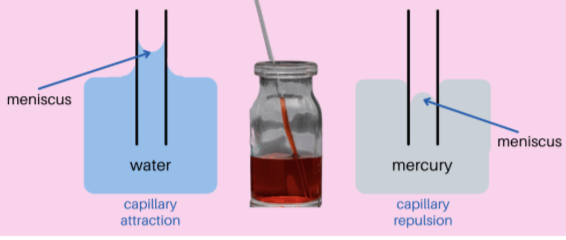
Capillary action
liquid flow through a narrow space from the combined effects of cohesion, adhesion and surface tension
63
New cards
pathways for root absorption
\
* There are two possible pathways for movement of water and mineral ions absorbed from the soil through the roots. These are the extracellular pathway and the cytoplasmic pathway.
* In the extracellular pathway, most water molecules and some mineral ions pass through or between cell walls. In the cytoplasmic pathway, most mineral ions and some water molecules pass through the cytoplasm of living root cells.
* The cytoplasmic pathway involves substances entering a root hair cell by crossing the cell's plasma membrane, and then passing from cell to cell through microscopic channels called plasmodesmata.
* The three types of transport that move substances across plasma membranes along the cytoplasmic pathway include active transport of mineral ions, osmosis of water molecules and diffusion of potassium and phosphate ions
* There are two possible pathways for movement of water and mineral ions absorbed from the soil through the roots. These are the extracellular pathway and the cytoplasmic pathway.
* In the extracellular pathway, most water molecules and some mineral ions pass through or between cell walls. In the cytoplasmic pathway, most mineral ions and some water molecules pass through the cytoplasm of living root cells.
* The cytoplasmic pathway involves substances entering a root hair cell by crossing the cell's plasma membrane, and then passing from cell to cell through microscopic channels called plasmodesmata.
* The three types of transport that move substances across plasma membranes along the cytoplasmic pathway include active transport of mineral ions, osmosis of water molecules and diffusion of potassium and phosphate ions
64
New cards
\
\
65
New cards
66
New cards
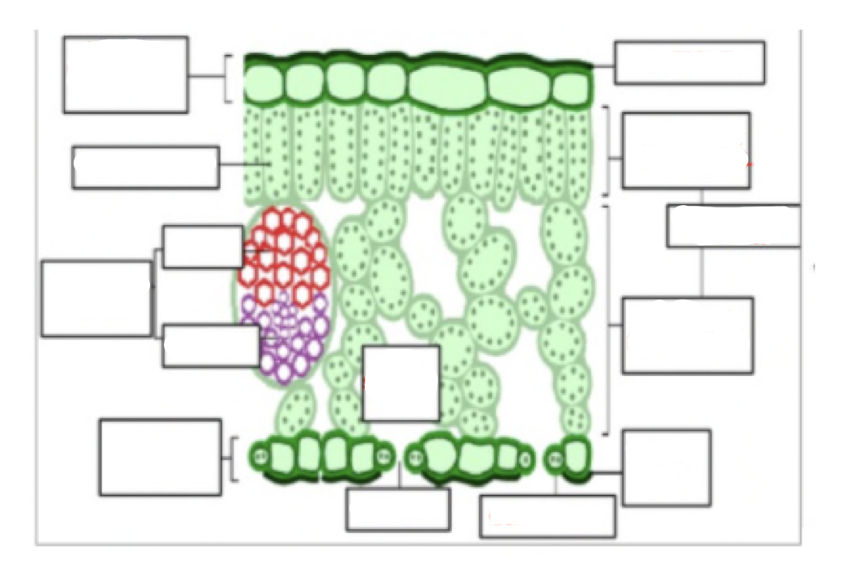
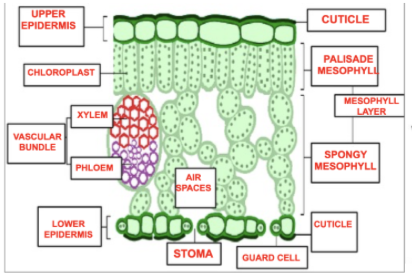
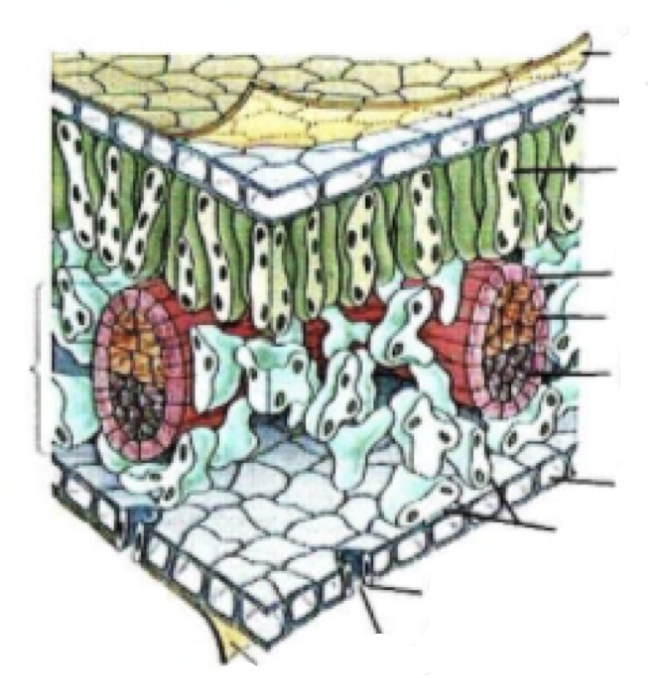
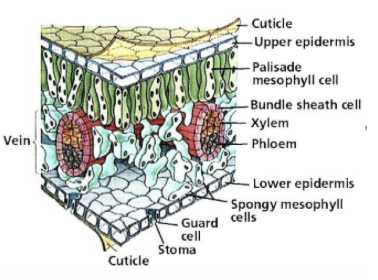
epidermal tissues (upper and lower epidermis)
\
* cover the plant and aids in the regulation of gas exchange
* cover the plant and aids in the regulation of gas exchange
67
New cards
Palisade mesophyll
which carries out most of photosynthesis
68
New cards
Spongy mesophyll
\
* has air spaces which allow for gas exchange, including the diffusion of carbon dioxide throughout the leaf
* has air spaces which allow for gas exchange, including the diffusion of carbon dioxide throughout the leaf
69
New cards
Xylem
\
* transports water and dissolved minerals around the plant
* transports water and dissolved minerals around the plant
70
New cards
Phloem
which transports sugar and amino acids around the plant
71
New cards
Cuticle
a waterproof waxy layer that acts as a barrier and prevents excessive water loss
72
New cards
Upper epidermis
protects the inner cells, prevents water loss and allows sunlight to penetrate
73
New cards
Lower epidermis
protects the inner cells and allows the stomata to open and close depending on the needs of the plant
74
New cards
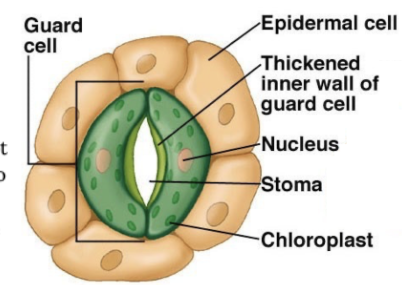
Guard cells
regulate gas exchange and water loss by causing the stoma pore to open or close. When water passes into the guard cells, their turgor increases causing them to expand and open the stoma. In a hot and dry environment plants close stomata to reduce water loss, but this reduces the rate of photosynthesis. Open stomata during the day (due to photosynthesis) and close it during the night
75
New cards
Stoma (or stomata)
\
* small pores, typically on the undersides of leaves that are open or closed under the control of guard cells which facilitate the exchange of oxygen (waste product of photosynthesis) and carbon dioxide (for photosynthesis). Their open and closure can be moderated by plant to reduce water loss
* small pores, typically on the undersides of leaves that are open or closed under the control of guard cells which facilitate the exchange of oxygen (waste product of photosynthesis) and carbon dioxide (for photosynthesis). Their open and closure can be moderated by plant to reduce water loss
76
New cards
Air space
allows for rapid diffusion of gases through intercellular spaces
77
New cards
Vein (vascular bundle)
transport fluids and is made up of the xylem and phloem
78
New cards
Vascular Plant
\
* consists of the xylem and phloem (which make up the vein)
* Not all plants have vascular systems for transport
* consists of the xylem and phloem (which make up the vein)
* Not all plants have vascular systems for transport
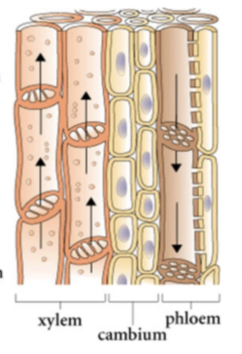
79
New cards
position of xylem is a plant
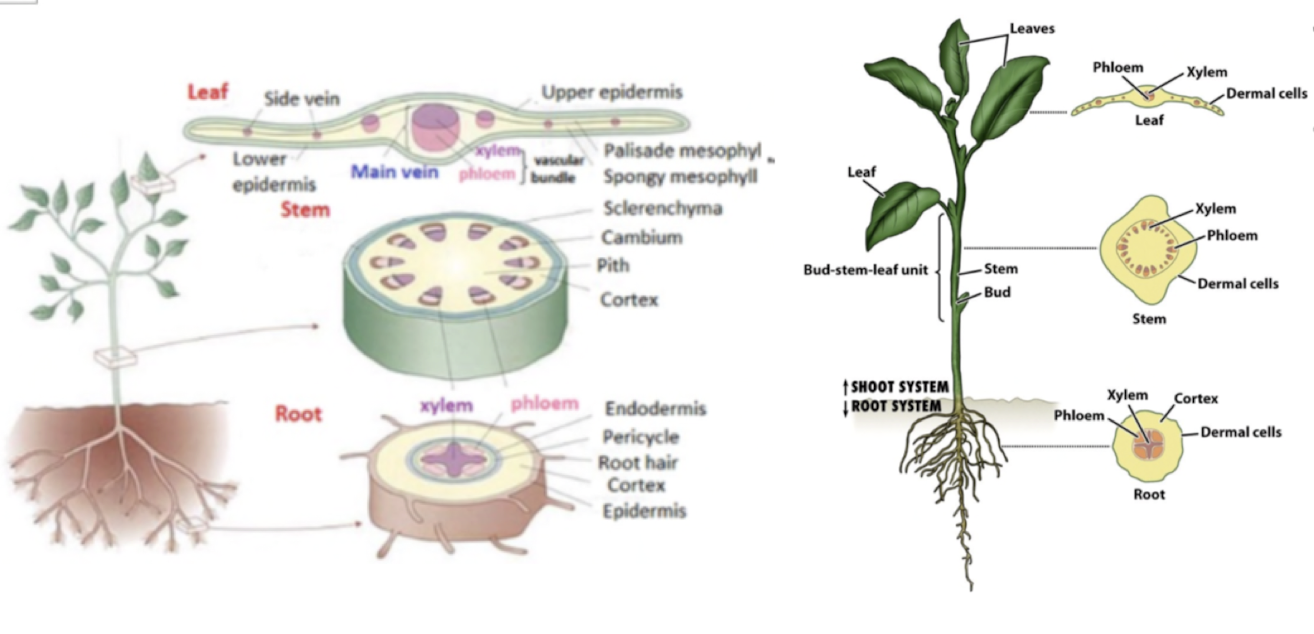
80
New cards
\
*Xylem*
*Xylem*
\
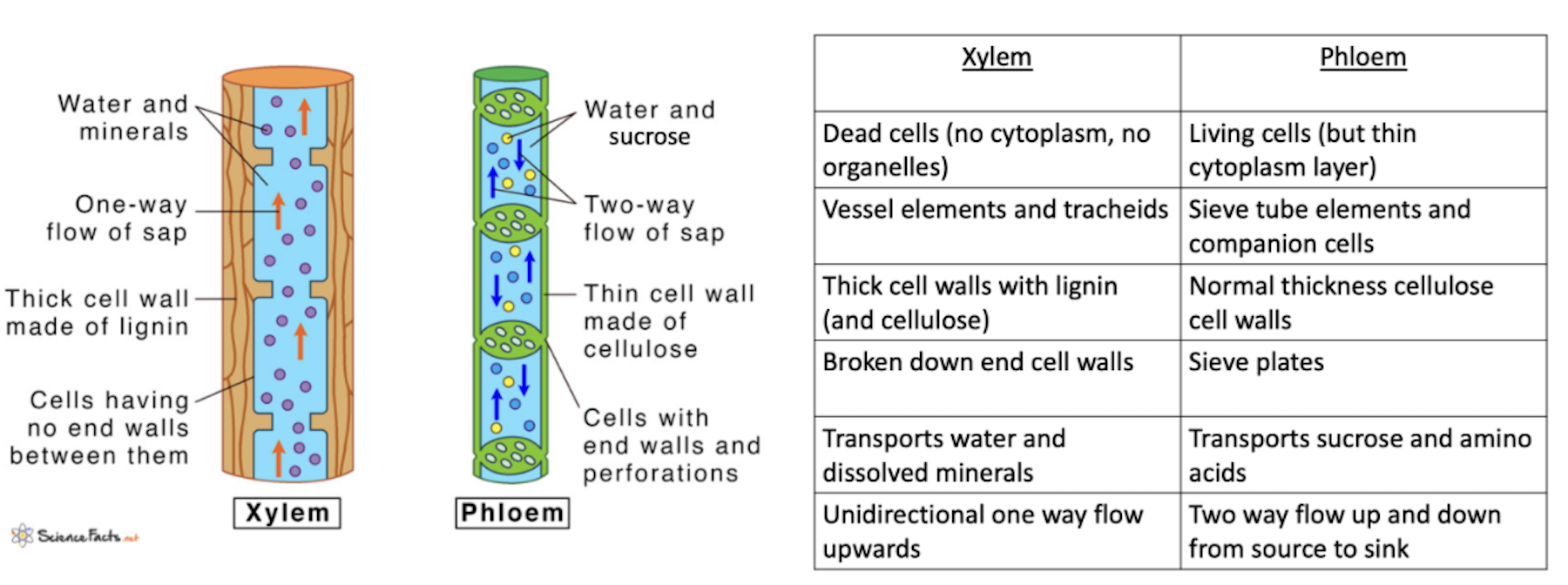
* empty with no cytoplasm
* Transport water and dissolved minerals in one direction up the plant
* Found in vascular bundles with phloem + in the root, stem and leaves
* xylem tissue consists of xylem vessels and tracheids
* empty with no cytoplasm
* Transport water and dissolved minerals in one direction up the plant
* Found in vascular bundles with phloem + in the root, stem and leaves
* xylem tissue consists of xylem vessels and tracheids
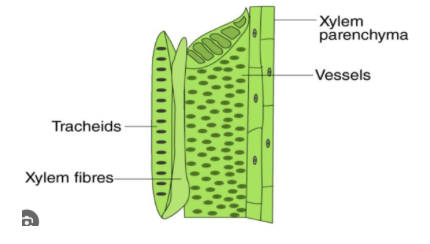
81
New cards
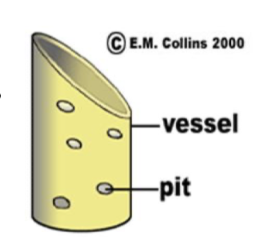
Xylem vessels
\
are long water filled tube consisting of specialised elongated cells joined end to end
* Mature xylem are dead and end walls are broken down which forms a continuous hollow tube for movement of water up the plant from the root, through the stem and to the leaves
* No nucleus or cytoplasm
* Are strong to withstand negative pressure (as water is transported under tension) and not collapse due to thickened cellulose and lignin in the cell wall
* Has pits and perforations in the sidewalls to allow lateral movement of water and dissolved minerals between xylem vessels if one column gets blocked
* Water is pulled up the xylem under tension, shown when a xylem vessel is broken, water doesn’t leak out but air is drawn in
are long water filled tube consisting of specialised elongated cells joined end to end
* Mature xylem are dead and end walls are broken down which forms a continuous hollow tube for movement of water up the plant from the root, through the stem and to the leaves
* No nucleus or cytoplasm
* Are strong to withstand negative pressure (as water is transported under tension) and not collapse due to thickened cellulose and lignin in the cell wall
* Has pits and perforations in the sidewalls to allow lateral movement of water and dissolved minerals between xylem vessels if one column gets blocked
* Water is pulled up the xylem under tension, shown when a xylem vessel is broken, water doesn’t leak out but air is drawn in
82
New cards
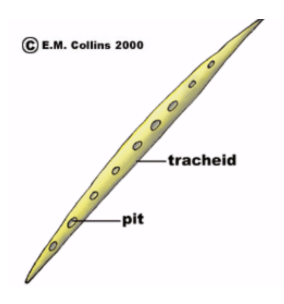
Tracheids
\
are single large tapering water-filled specialised cells
* When mature they lose their nucleus and cytoplasm leading to cylindrical skeletons of dead cells joined to form continuous tubes (same as xylem vessels)
* Pits and perforations in the lignified cell wall
* Aren’t connected end to end as their ends overlap with water transferred horizontally through pits
are single large tapering water-filled specialised cells
* When mature they lose their nucleus and cytoplasm leading to cylindrical skeletons of dead cells joined to form continuous tubes (same as xylem vessels)
* Pits and perforations in the lignified cell wall
* Aren’t connected end to end as their ends overlap with water transferred horizontally through pits
83
New cards
Phloem
\
* Transports organic compounds such as sucrose and amino acids from the leaves (where it is produced by photosynthesis) to the stems and roots for respiration or storage and back again when necessary (moves in 2 directions)
* transports sugars from source to sink
* Sugars are stored as starch in storage organs that can be broken down and moved around the plant if sugar levels are low
* Sucrose is transported rather than glucose as it sucrose is not as readily available for plant tissues to metabolise directly in respiration and therefore can be transported without being metabolised
* Sugars travel from the source to sink
* Unlike xylem it is living tissue
* An elongated cell with few organelles
* Composed of:
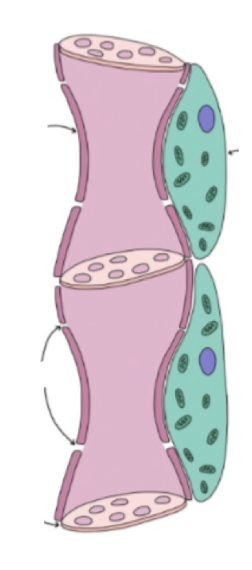
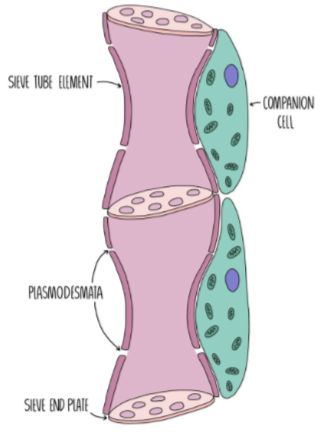
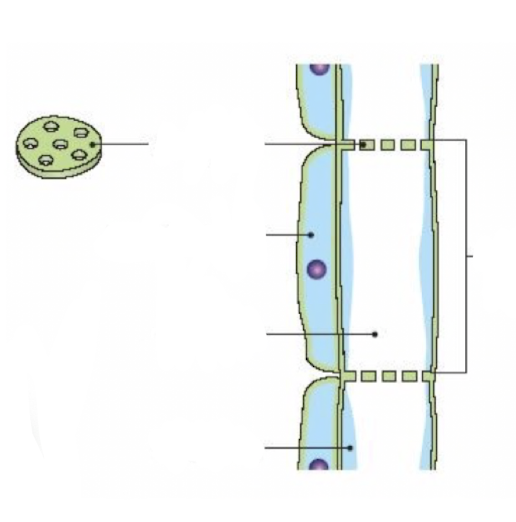
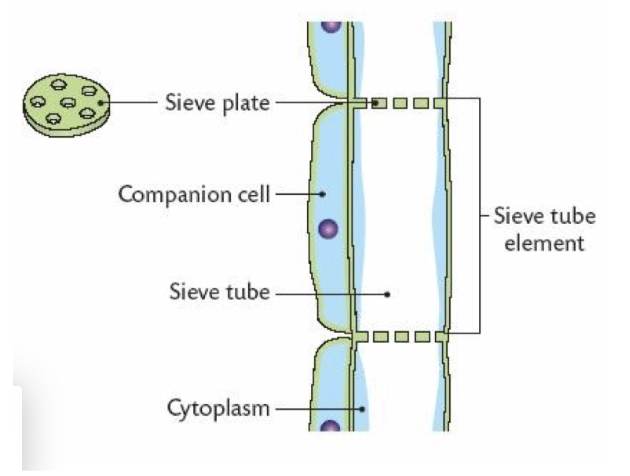
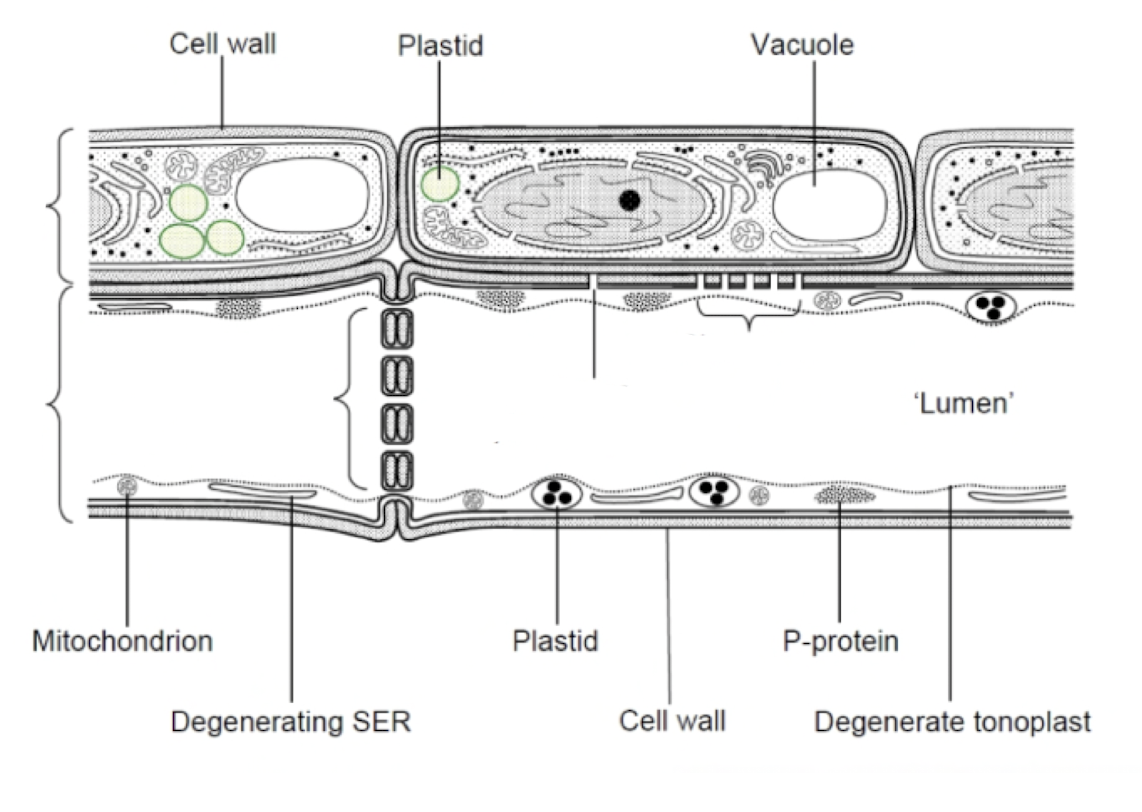
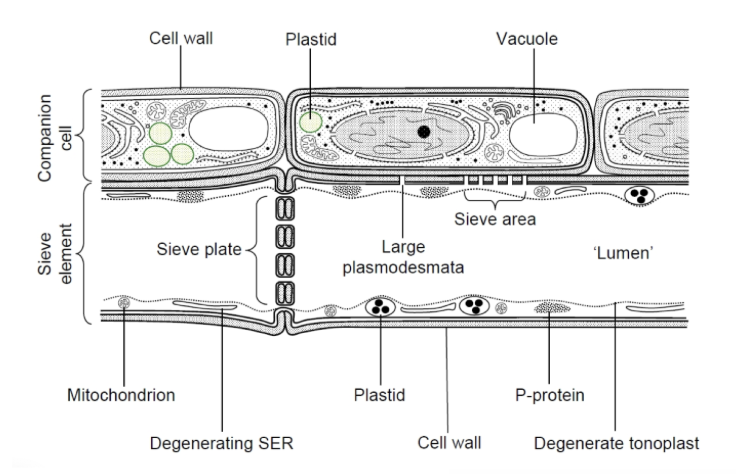
* Sieve tube elements → form linear rows of elongated cells lacking a nucleus and lignin from their cell walls that transport substances directly from one cell to another through small pores
* Companion cells → are a type of parenchyma cell with a nucleus that directs the activities of the sieve tube cell because the sieve tube cell lacks a nucleus since it is used for the passage of sugars
* Sieve plates → are end cell walls with pores
* Plasmodesmata → pits in the wall of the phloem
* Transports organic compounds such as sucrose and amino acids from the leaves (where it is produced by photosynthesis) to the stems and roots for respiration or storage and back again when necessary (moves in 2 directions)
* transports sugars from source to sink
* Sugars are stored as starch in storage organs that can be broken down and moved around the plant if sugar levels are low
* Sucrose is transported rather than glucose as it sucrose is not as readily available for plant tissues to metabolise directly in respiration and therefore can be transported without being metabolised
* Sugars travel from the source to sink
* Unlike xylem it is living tissue
* An elongated cell with few organelles
* Composed of:
* Sieve tube elements → form linear rows of elongated cells lacking a nucleus and lignin from their cell walls that transport substances directly from one cell to another through small pores
* Companion cells → are a type of parenchyma cell with a nucleus that directs the activities of the sieve tube cell because the sieve tube cell lacks a nucleus since it is used for the passage of sugars
* Sieve plates → are end cell walls with pores
* Plasmodesmata → pits in the wall of the phloem
84
New cards
85
New cards
86
New cards
87
New cards
Xylem vs Phloem
88
New cards
Photosynthesis
\
* Carbon dioxide enters the leaf by diffusion from the air through stomata
* CO2 is a raw material needed for photosynthesis
* Oxygen is a waste product from photosynthesis that is diffused out of the leaf
* Carbon dioxide enters the leaf by diffusion from the air through stomata
* CO2 is a raw material needed for photosynthesis
* Oxygen is a waste product from photosynthesis that is diffused out of the leaf
89
New cards
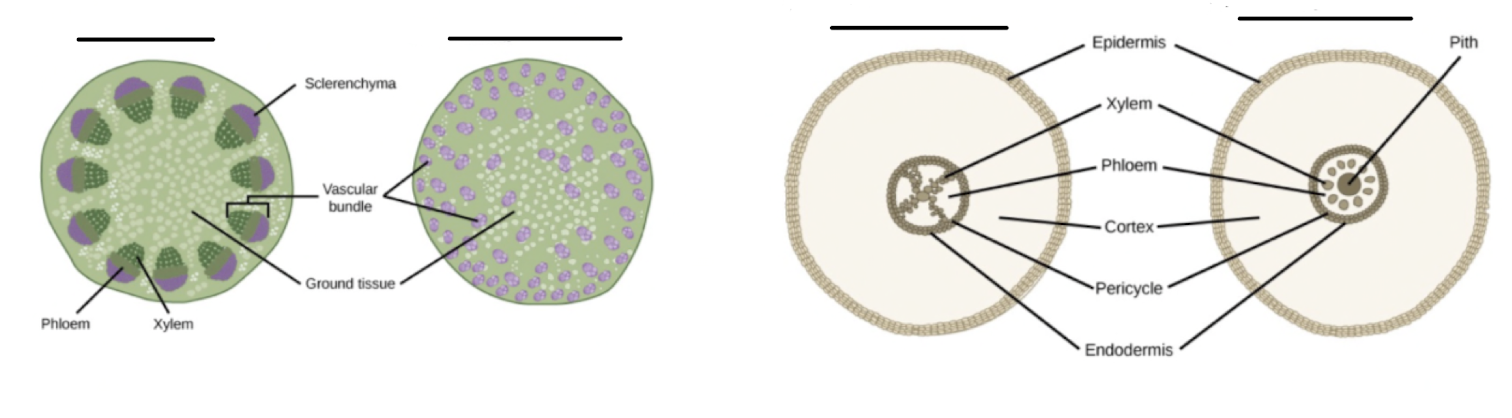
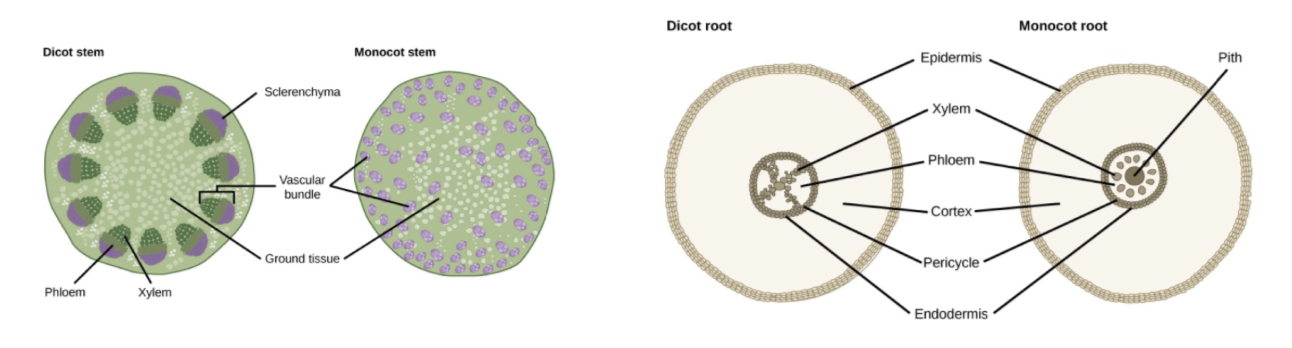
Dicots and monocots
\
* Are the two types of plants with vascular systems
* The distribution of tissues in each is different
* Are the two types of plants with vascular systems
* The distribution of tissues in each is different
90
New cards
91
New cards
Gas exchange
\
* Plant cells are loosely packed which allow rapid diffusion of gases through air spaces
* During gas exchange oxygen and carbon dioxide diffuse from these air spaces through the water film covering the cells and into the cell along concentration gradients
* Occurs through air spaces in the spongy mesophyll and out the stomata in leaves
* Occurs in the epidermis of stems through lenticels and out through stomata
* Roots exchange gases with the air spaces in the soil
* Plant cells are loosely packed which allow rapid diffusion of gases through air spaces
* During gas exchange oxygen and carbon dioxide diffuse from these air spaces through the water film covering the cells and into the cell along concentration gradients
* Occurs through air spaces in the spongy mesophyll and out the stomata in leaves
* Occurs in the epidermis of stems through lenticels and out through stomata
* Roots exchange gases with the air spaces in the soil
92
New cards
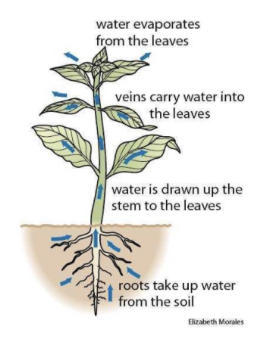
Transpiration
\
* Is the unidirectional movement of water from the stomata in the xylem vessels
* Loss of water vapour from the surface of the plant by evaporation
* It is passive as it is controlled by the heat energy of the sun and doesn’t require ATP from the plant
* Is not a primary need of a plant but is mainly a consequence of having open stomata for gas exchange
* Is the unidirectional movement of water from the stomata in the xylem vessels
* Loss of water vapour from the surface of the plant by evaporation
* It is passive as it is controlled by the heat energy of the sun and doesn’t require ATP from the plant
* Is not a primary need of a plant but is mainly a consequence of having open stomata for gas exchange
93
New cards
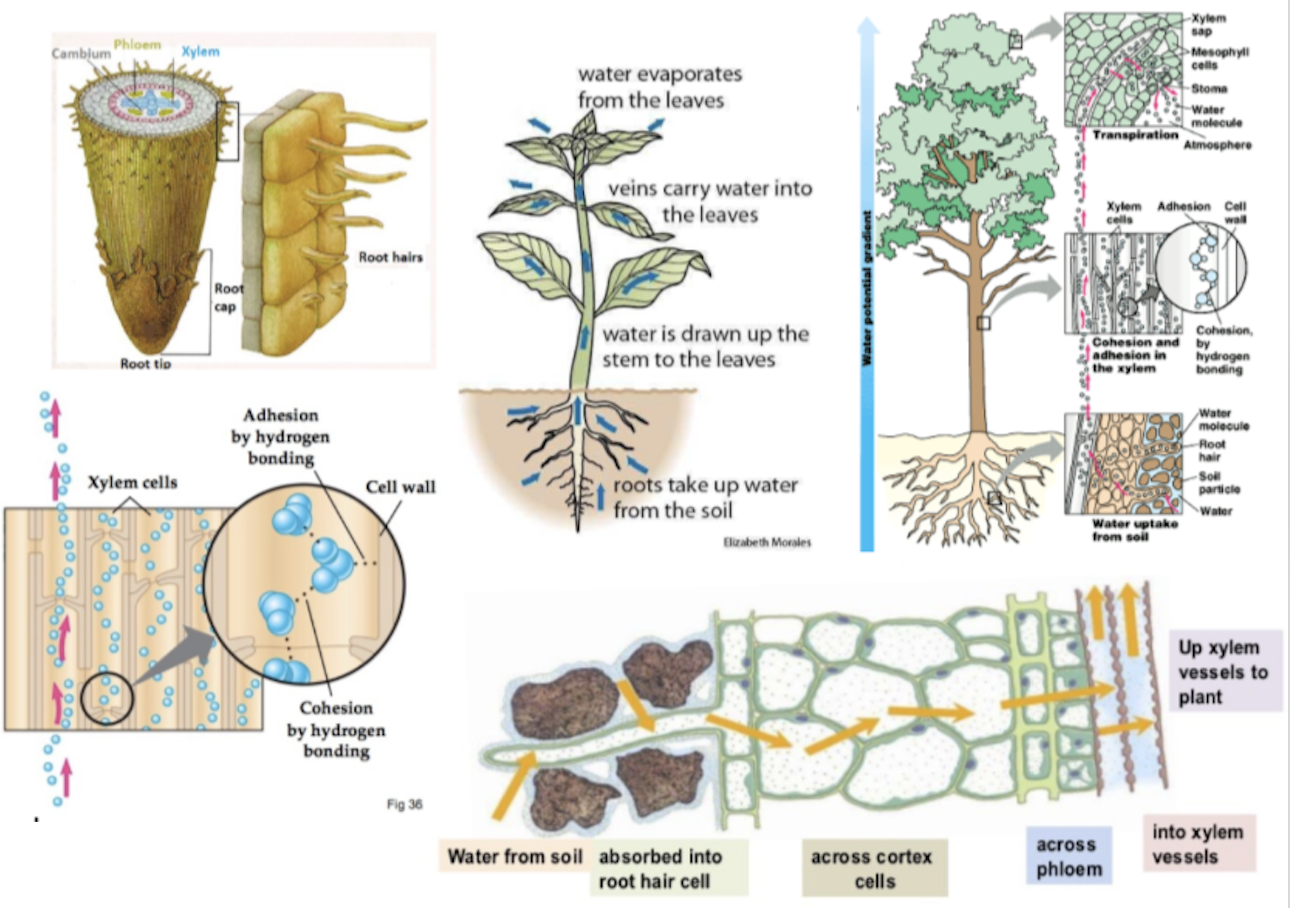
The transpiration stream
* Results from the tension from the evaporation of water from the top of the xylem and cohesion tension
* The molecules of water in the leaf evaporate as they gain energy from the sun
* As they do this, they pull (transpirational pull) up the molecules behind them in the column resulting in the movement of water up the xylem
* The water moves down a water potential gradient (top of plant has low water potential as water is more likely to leave as it is continually evaporating + the air spaces in the leaves have a higher relative humidity than the atmosphere) → top of the plant has less water → water movies from the bottom of the plant up to the top
* The molecules of water in the leaf evaporate as they gain energy from the sun
* As they do this, they pull (transpirational pull) up the molecules behind them in the column resulting in the movement of water up the xylem
* The water moves down a water potential gradient (top of plant has low water potential as water is more likely to leave as it is continually evaporating + the air spaces in the leaves have a higher relative humidity than the atmosphere) → top of the plant has less water → water movies from the bottom of the plant up to the top
94
New cards
Process of transpiration
1. Osmosis of water into root hairs (specialised cells with a large surface area for efficient uptake of water and mineral ions) → cortex of root (transports water and nutrients absorbed by the root epidermis)→ xylem of root (this movement causes root pressure). Mineral ions are absorbed by active transport as the roots have a higher solute concentration
2. Cohesion (between water molecules so when some water molecules move they pull others with them) and adhesion ( between water molecules and the cell wall of the xylem which helps to ensure that the column doesn’t break under forces of suction) by hydrogen bonding draw water up the xylem in the stem
3. Water moves into the xylem of the leaf → moves by osmosis out of the xylem into the spongy mesophyll cells → evaporates into the air spaces → evaporates and diffuse out of the stomata in the leaves into the atmosphere
95
New cards
\
#### *Factors affecting transpiration*
#### *Factors affecting transpiration*
\
* Heat gives the water molecules more kinetic energy, as they move around more and have enough energy to break the weak forces attracting them to the other water molecules and turn from liquid water into water vapour.
* Humidity also affects the rate of transpiration because it affects the concentration gradient
* If the air outside the plant is less saturated with water, and the stomata are open, then water will diffuse out into the drier air
* However is the atmosphere is humid then transpiration won’t occur
* Light as stomata open during light (sunlight will also warm the leaf)
* Wind as it sweeps away the water vapour (humid air) near the stomata
* Heat gives the water molecules more kinetic energy, as they move around more and have enough energy to break the weak forces attracting them to the other water molecules and turn from liquid water into water vapour.
* Humidity also affects the rate of transpiration because it affects the concentration gradient
* If the air outside the plant is less saturated with water, and the stomata are open, then water will diffuse out into the drier air
* However is the atmosphere is humid then transpiration won’t occur
* Light as stomata open during light (sunlight will also warm the leaf)
* Wind as it sweeps away the water vapour (humid air) near the stomata
96
New cards
Cohesion tension
\
* Transmitted all the way down the xylem and pulls water passively into the roots
* Causes the stem to become narrower
* Transmitted all the way down the xylem and pulls water passively into the roots
* Causes the stem to become narrower
97
New cards
Nail polish stomata peel
\
* A layer of nail polish is painted on the lower and upper side of a leaf and peeled of to make an impression
* The lower epidermis peel would have impressions of stomata and guard cells as the majority of stomata are on the underside of a leaf
* The upper epidermis wouldn’t have many impressions as it doesn’t have many if any stomata
* A layer of nail polish is painted on the lower and upper side of a leaf and peeled of to make an impression
* The lower epidermis peel would have impressions of stomata and guard cells as the majority of stomata are on the underside of a leaf
* The upper epidermis wouldn’t have many impressions as it doesn’t have many if any stomata
98
New cards
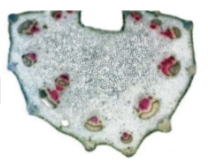
Celery
\
* A celery stalk is placed in a beaker of coloured water, which will travel up the xylem in the stem and leaves
* This causes the xylem and leaves (as a result of the coloured water travelling through it) to turn coloured
* A celery stalk is placed in a beaker of coloured water, which will travel up the xylem in the stem and leaves
* This causes the xylem and leaves (as a result of the coloured water travelling through it) to turn coloured
99
New cards
Potometers
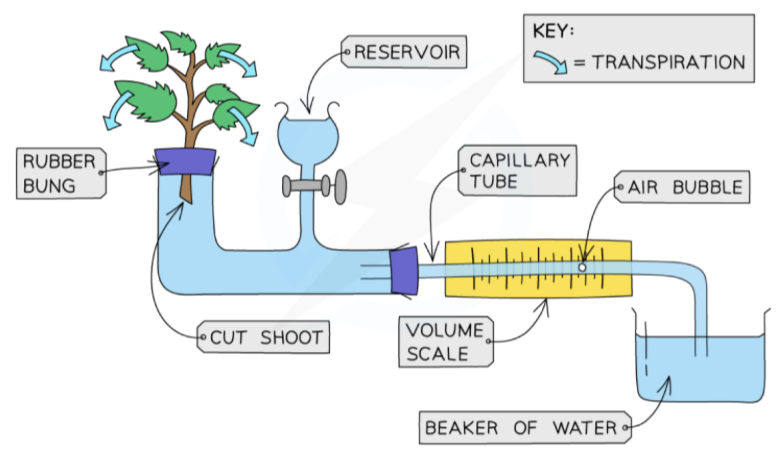
As measuring the amount of water leaving the leaves via transpiration is very difficult, a potometer is used to measure the amount of water taken up the plant which can help estimate transpiration, as 99% of that water is lost via transpiration
100
New cards
Air bubble potometer
\
* You either time how long it takes the air bubble to move a set distance, or record the distance the bubble moves in a set time
* The reservoir easily allows the capillary tube to the re-filled for repeat measurements, so that the same set up can be used
* The capillary tube is very narrow so small volumes of water being absorbed by the plant can easily be measured
* You either time how long it takes the air bubble to move a set distance, or record the distance the bubble moves in a set time
* The reservoir easily allows the capillary tube to the re-filled for repeat measurements, so that the same set up can be used
* The capillary tube is very narrow so small volumes of water being absorbed by the plant can easily be measured
 Note
Note  Flashcards (77)