Lecture 8 - Drug Information: Systematic Approach & Resources
 Studied by 0 people
 Call Kai
 Learn
Learn Practice Test
 Spaced Repetition
 Match
Match Flashcards
 Knowt Play
1/38

There's no tags or description
Looks like no tags are added yet.
Name | Mastery | Learn | Test | Matching | Spaced | Call with Kai |
|---|
No analytics yet
Send a link to your students to track their progress
39 Terms
systematic approach to drug information meaning
structured and organized method for finding, evaluating, and providing accurate answers to drug-related questions; developed and modified for contemporary practice that improves efficiency
steps in systematic approach to drug information
1. Identify the requestor
2. Obtain background information
3. Define the true question
4. Categorize the question
5. Perform a systematic search
6. Analyze the information
7. Disseminate the information
8. Document
9. Follow-up
Identify the requestor
is it a health care professional? if so, what type? is it a patient or the media?
clarify when response is needed (immediate or later) and method of response (verbal, email, note, etc.)
Obtain background information
patient specific or general information; gather context surrounding the question
Questions to consider in systematic approach
Place the question into a drug information category
• Patient-specific
– Age
– Weight/height
– Kidney/liver function
– Allergies
– Medical conditions
– Medications
• Patient Medical Record/DOB
Probing Based on Type of Question
availability, drug interaction, compatibility with other drugs or medical devices, adverse drug reactions, pregnancy, lactation, drug ID
Categorize the Question
• Adverse Drug Reactions
• Availability
• Dosage/Administration
• Drug Interactions
• Drugs in Pregnancy/Lactation
• General Information
• Identification
• Pharmaceutics
• Pharmacoeconomics
• Pharmacokinetics
• Physical Stability/Compatibility
• Therapeutic Use
• Toxicology
Perform a Systematic Search
based on background information gathered and category of question, consult multiple tertiary sources and primary/secondary as appropriate
Analyze the Information
using clinical judgement and considering background information gained via quality sources
disseminate information through…
text, verbal, email
document systemic information
Record your work (the question, sources consulted, response provided) for medical records and notes in profile
resource types
tertiary, secondary, primary
tertiary resources
textbooks (like DiPiro’s pharmacotherapy), review articles, clinical guidelines, databases (like lexidrug and micromedex)
pros and cons of tertiary resources
• Pro: Comprehensive, concise, great for general background, easy to use, familiar, convenient
• Con: Published less frequently (dated), bias?
secondary resources
searchable databases (like pubmed, EMBASE, MEDLINE) that are used to find primary literature or tertiary review articles
pros and cons of secondary resources
• Pro: Efficient search
• Con: Skill dependent
primary resources
original findings (e.g., research studies)
pros and cons of primary resources
• Pros: In-depth, Current (✓ date)
• Cons: Time, Need strong literature evaluation skills
Top 10 Reasons to Use Tertiary Resources
1. Learn about a disease state
2. Learn about a treatment guidelines
3. Specifics about a drug (indication, dose, dose kidney dysfunction, peds)
4. Find a drug interaction
5. Check commercial availability of drug/dosage form
6. Find the cost of a drug
7. Check drug compatibility
8. Determine safety in pregnancy/lactation
9. Drug identification
10. Brand/generic name
Evaluating Tertiary Literature
analyze author/editor experience
relevance to topic
referenced
updates (current vs old)
error free
user friendly
Common Textbooks
• DiPiro’s Pharmacotherapy
• Applied Therapeutics: Clinical Use of Drugs
• Harrison’s Principles of Internal Medicine
• Handbook of Non-Prescription Drugs
where can you find prescribing information (PI)?
• Product/packaging
• Manufacturer’s Website
• FDA Website: Drugs@FDA
• Daily Med
Common General Medication Information Resources
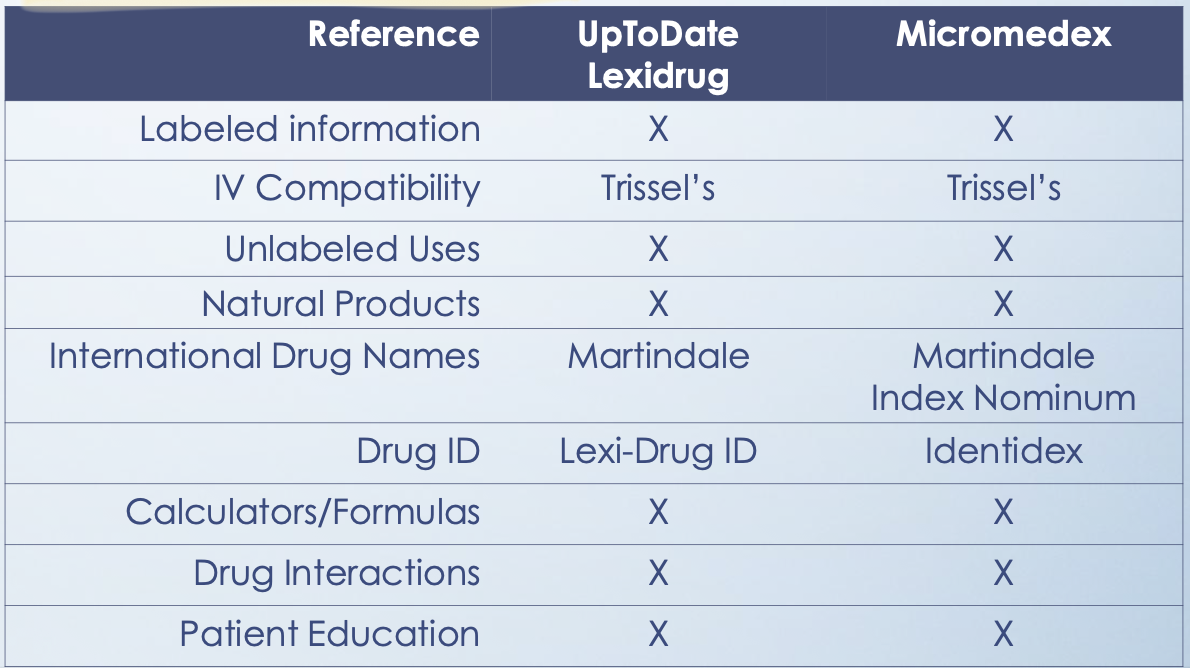
UpToDate Lexidrug, Micromedex
UpToDate Lexidrug vs Micromedex
toxicology: uptodate = lexi-tox, micromedex=poisindex
pregnancy/lactation: uptodate=Briggs' Drugs in Pregnancy & Lactation, micromedex=reprorisk
Pregnancy/Lactation resouces
• Briggs’ Drug use in Pregnancy and Lactation
– Available in UpToDate Lexidrug
• Hale’s Medication and Mother’s Milk
Pediatrics/Neonatology resources
• UpToDate Lexidrug
– Compounding recipes
– Preparation for administration
• Neofax (Micromedex)
• Textbook:
– Nelson Textbook of Pediatrics
• AAP Red Book
– Charts/Tables
– Infections Diseases
– Vaccines/Antibiotics
IV compatibility resources
• Trissel’s
– Lexidrug and Micromedex
• ASHP Injectable Drug Information
compounding resources
• UpToDate Lexidrug
• ASHP Extemporaneous Formulations
vet pharm resources
Plumb’s Veterinary Drug Handbook
Drug Safety Recalls & Shortages inffo
• Recalls, Market Withdrawals & Safety Alerts
– FDA Website
• Drug Shortages
– ASHP Resources (shows current and resolved)
Dietary and Herbal Supplements resources
NIH Office of Dietary Supplements and National Center for Complementary and Integrative Health, natural products database (in lexidrug), NatMedPro
foreign drugs resources
• UpToDate Lexidrug
– Martindale
• Micromedex
– Martindale
– Index Nominum
FDA orange book
lists drug products approved based on safety and effectiveness, comparing brand and generic
FDA purple book
lists all FDA-licensed biological products, including information about both reference products and their corresponding biosimilar and interchangeable products
FDA green book
list of all FDA-approved and conditionally approved animal drug products
CDC pink book
vaccines
CDC yellow book
international travel health and vaccines
red book
drug pricing, manufacturer availability (in micromedex)
AAP red book
comprehensive guide for healthcare professionals on pediatric infectious diseases
 Note
Note  Flashcards (66)