C37 CIA IFRS 2
 Call Kai
 Learn
Learn Practice Test
 Spaced Repetition
 Match
Match Flashcards
 Knowt Play
1/21

There's no tags or description
Looks like no tags are added yet.
Name | Mastery | Learn | Test | Matching | Spaced | Call with Kai |
|---|
No analytics yet
Send a link to your students to track their progress
22 Terms
Purpose of RA
Adjusts PV of future CFs to reflect compensation entity requires for bearing uncertainty ab amount & timing of CFs from non-financial risk
RA is higher for risks with:
Low freq / high sev
Longer duration contracts
Wide prob distr
Less known ab current estimate & its trend
RA is lower for risks with:
Emerging experience → more aware ab timing & amt of CFs
RA → Level of Aggregation
IFRS 17 Principles
Measurement → requires unit of account level
Presentation & Disclosure → requires aggregated level
Possible RA granularities
Aggregate → allocate back to unit of account level to satisfy Measurement
Unit of Account level → sum to get aggregate RA to satisfy Presentation & Disclosure
RA → Diversification Benefit
If units of account are diversified → lower aggregate RA
If RA calculated @ aggregate lvl
Benefit factored in
If RA calculated @ unit of acount lvl then sum
Diversification benefit might not be accurately reflected
Is reinsurance credit risk reflected in the RA?
NO
Reflected thru reduction in expected CFs
4 Methods for Calculating RA
Quantile methods
Cost-of-Capital method
Margin method
A combination of methods
Calculating RA → Quantile Method
Use distr of FCFs to determine RA for a given prob
Ex: VaR, CTE
Generate distr using Monte Carlo, bootstrap, etc
Pro: satisfies IFRS17 Disclosure req → gives CI for RA
Con: inaccurate if distr misrepresented
Calculating RA → Cost of Capital (CoC) Method
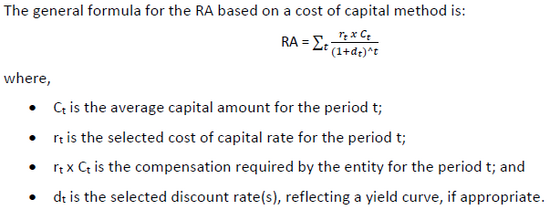
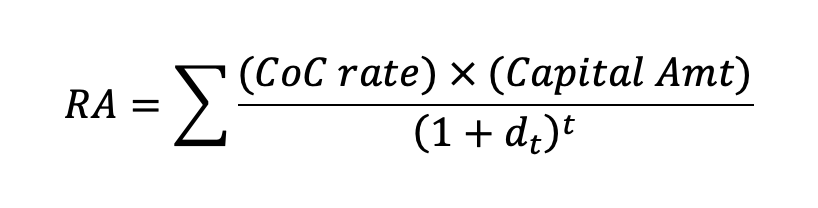
RA based on compensation required to meet target return on capital
3 Components
Projected capital amts
CoC rates
Discount Rates
Pro: conceptually close to def’n of RA
Con: operationally complex bc need projection of capital requirements
Calculating CoC Rate
CoC Rate = Target ROE - Investment Rate
Note: If Target ROE is after tax → remove tax first!
CoC Rate = Target ROE/(1-Tax%) - Investment Rate
Calculating RA → Margin Method
Select margins that reflect compensation entity requires for uncertainty of non-financial risk
RA for Reinsurance Held → Granularity
Pick 2 of gross, net, or ceded
Then add/subtract to get the third
4 Methods for Calculating RA for Reinsurance Held
Quantile methods
Cost of Capital methods
Catastrophe models
Proportional scaling
specific to reinsurance held
Calculating RA for Reinsurance → Catastrophe Models
Use output from cat model tailored to entity’s book of business
Select percentile directly from given distr
Calculating RA for Reinsurance → Proportional Scaling
Best for quota share
Use RA for direct business → scale to ceded portion
i.e. use same RA as % of PV(future CFs)
Can be modified to consider ceding commissions, expense allowances, etc.
RA for Catastrophe Reinsurance
May need to calculate net RA & ceded RA separately
Reason:
Low freq, high sev events
Standard Quantile method may product RA that’s too small
Method for Calculating: CoC method
w/ assumption for required capital set at higher percentile
Calculating RA → Ex of combining methods
Unit of account level combination
For groups w/ less skewed distr → VaR quantile method
For groups w/ highly skewed distr → CoC
Calculating RA → Aggregate/entity-level approach
Primarily use Quantile or CoC method
Simplified CoC Method
IDEA: Target profit margin allocated between
Reserve risk
UW risk
Other risks not relevant to RA
Given:
Profit Margin %
Capital Allocation % → Reserve / UW / Other risks
RA for LIC = EP x (Profit margin %) x (Capital % for Reserve risk)
RA for LRC = UEP x (Profit margin %) x (Capital % for UW + Reserve risks)
Quantile Method → Methods to generate Distribution
Monte Carlo
Bootstrap
Pro: recognizes heavy tails & other observations that departs from theoretical distr
Con: Bad for small samples → assumes each sampled variable is indep from another
May not adequately represent low freq/high sev events
Scenario Modelling
Ex: FCT
But may not meet materiality threshold for RA
Calculating RA using CoC Method
CoC Rate
r = Target ROE/(1-Tax Rate) - Investment Rate
Undiscounted Capital
Unpaid Loss x Liability/Surplus Ratio
Undiscounted Capital for non-financial risk
Remove other risks → market, operational
RA → IFRS17 Disclosure Requirements
Need CI for RA
Use quantile method

