Chapter 18 - Prep for Citric Acid Cycle
 Call Kai
 Learn
Learn Practice Test
 Spaced Repetition
 Match
Match Flashcards
 Knowt Play
1/19

There's no tags or description
Looks like no tags are added yet.
Name | Mastery | Learn | Test | Matching | Spaced | Call with Kai |
|---|
No analytics yet
Send a link to your students to track their progress
20 Terms
Is the conversion of pyruvate to acetyl CoA reversible?
No, it is irreversible; once pyruvate has been converted to acetyl CoA by the pyruvate dehydrogenase complex, acetyl CoA must either by oxidized or stored as fat
animals don’t have the enzymes to convert acetyl CoA → pyruvate
What complex accomplishes the conversion oxidative decarboxlation of pyruvate to acetyl CoA?
The pyruvate dehydrogenase complex, which is in the mitochondrial matrix
PDC produces CO2 and captures high-transfer potential electrons as NADH
PDC has 3 enzymes and 5 coenzymes
E2 enzyme makes up the core of PDC
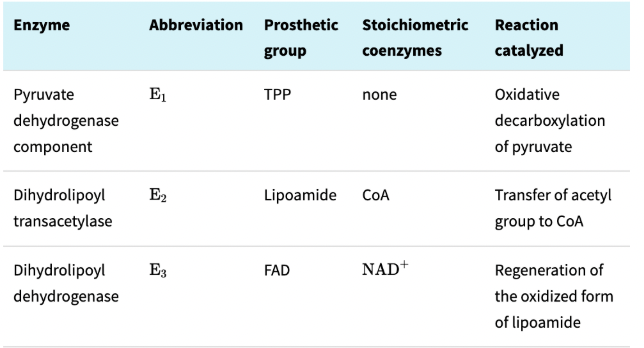
What are the three enzymes of the PDC?
Pyruvate dehydrogenase (E1) → uses TPP; oxidative decarboxylation of pyruvate
Dihydrolipoyl transacetylase (E2) → uses lipoamide and CoA; transfer of acetyl group to CoA
Dihydrolipoyl dehydrogenase (E3) → uses FAD and NAD+; regeneration of oxidized lipoamide
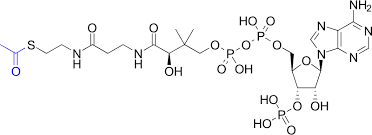
What is the structure of acetyl CoA and where does the energy reside?
Acetyl group connected to CoA via a thioester bond; the energy comes from the thioester bond, which is favorably hydrolyzed
Thioester bond is high-energy because it offers less resonance stabilization with the C=O group
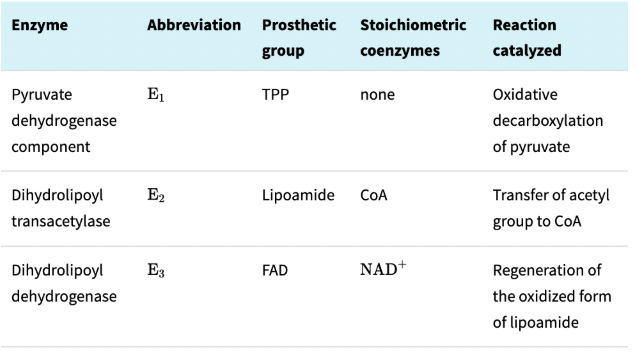
What are the five coenzymes of the PDC?
Catalytic coenzymes → TPP, lipoamide, FAD
Stoichiometric conenzymes (function as substrates) → CoA, NAD+
All are derivatives of vitamin B, except lipoamide
What’s the overall reaction for the conversion of pyruvate to acetyl CoA?
Pyruvate + CoA + NAD+ → acteyl CoA + CO2 + NADH
What links glycolysis to TCA cycle?
The pyruvate dehydrogenase complex, which converts pyruvate to acetyl CoA
this is where the first CO2 is lost in cellular respiration
What are the three steps in the synthesis of acetyl CoA from pyruvate?
decarboxylation, oxidation, and transfer to CoA

Why would a patient with vitamin B deficiency experience lactic acidosis?
Because vitamin B is precursor for 4 of 5 coenzymes of PDC, without them PDC cannot function so pyruvate builds up and is converted to lactate by LDH
What is the first step in the conversion of pyruvate to acetyl CoA?
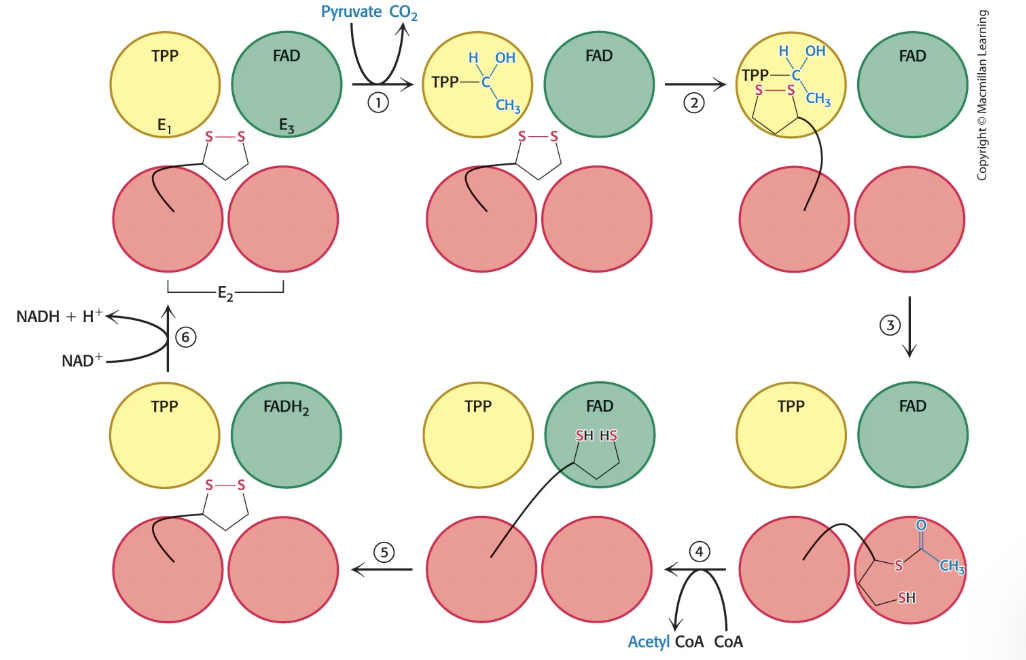
Decarboxylation → pyruvate combines with ionized carbanion of TPP and is decarboxylated
CO2 lost
catalyzed by E1 pyruvate dehydrogenase
this is the rate-limiting step and main regulatory point
What is the second step in the conversion of pyruvate to acetyl CoA?
Oxidation → the hydroxyethyl group attached to TPP is oxidized to form an acetyl group that is transferred to a lipoamide, creating an energy rich thioester bond
also catalyzed by E1 pyruvate dehydrogenase
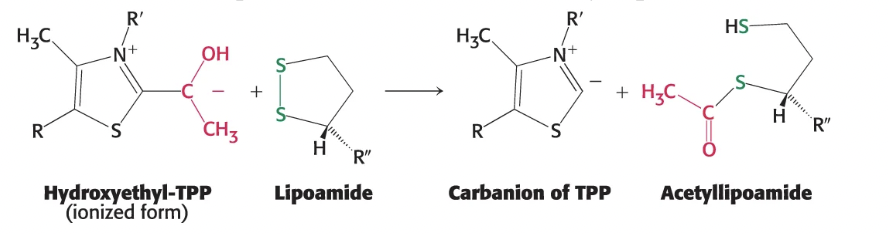
What is the structure of the lipoamide in PDC?
It is covalently attached to lysine residue in E2, and it acts as an arm that swings from E1 → E2 → E3, allowing for substrate channeling
the disulfide bond in the ring is the reactive site
What is the third step in the conversion of pyruvate to acetyl CoA?
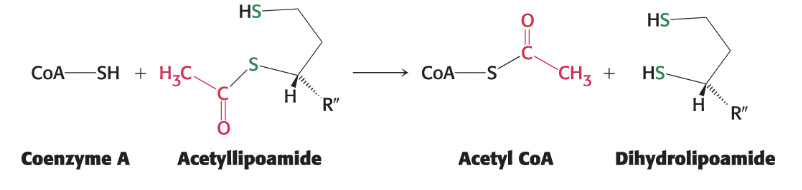
Formation of acetyl CoA → the acetyl group from acetyl-lipoamide is transferred to CoA to form acetyl CoA
catalyzed by E2 dihydrolipoyl transacetylase
What is the fourth step in the conversion of pyruvate to acetyl CoA?
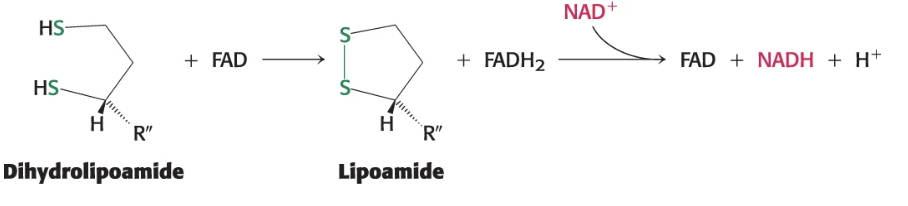
Dihydrolipoamide produced in the formation of acetyl CoA must be reoxidized to lipoamide in order for the PDC to complete another reaction
catalyzed by E3 dihydrolipoyl dehydrogenase
two electrons from dihydrolipoamide are transferred to FAD prosthetic group and then to NAD+ to produce NADH
What is the NADH producing step in PDC?
The fourth step, the regeneration of lipoamide from dihydrolipoamide by E3 dihydrolipoamide dehydrogenase
How are the E2 and E3 components of PDC regulated?
Dihydrolipoyl transacetylase E2 → inhibited by acetyl CoA, its product
Dihydrolipoyl dehydroganse E3 → inhibited by NADH, its product
How is PDC mainly regulated via pyruvate dehydrogenase E1?
Allosteric
ATP, acetyl CoA, and NADH inhibit PDH
ADP and pyruvate stimulate PDH
Covalent modification
Pyruvate dehydrogenase kinase (PDK) phosphorylates PDH, inactivating it; ATP, NADH, and acetyl CoA stimulate PDK
Pyruvate dehydrogenase phosphatase (PDP) dephosphorylates PDH, activating it; Ca2+ stimulates PDP (muscle contraction)
What factors stimulate PDH and thus formation of acetyl CoA?
PDP dephosphorylates PDH, activating it; Ca2+ stimulates PDP
ADP and pyruvate stimulate PDH allosterically
What factors inhibit PDH and thus formation of acetyl CoA?
PDK phosphorylates PDH, inactivating it; ATP, NADH, and acetyl CoA stimulate PDK
ATP, NADH, and acteyl CoA also allosterically inhbit PDH
Where do PDP and PDK reside in the PDC?
They are attached to the pyruvate dehydroganse E1 part of the complex and the phosphorylate/dephosphorylate a serine residue on E1

