List of Op Amp Symbols, Definitions, and Equations
 Call Kai
 Learn
Learn Practice Test
 Spaced Repetition
 Match
Match Flashcards
 Knowt Play
1/12

There's no tags or description
Looks like no tags are added yet.
Name | Mastery | Learn | Test | Matching | Spaced | Call with Kai |
|---|
No analytics yet
Send a link to your students to track their progress
13 Terms
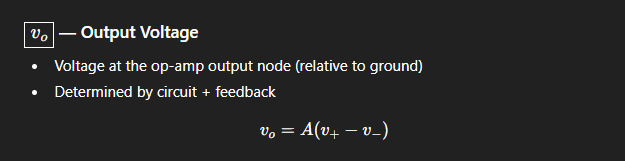
V0 - The Output Voltage
The output voltage for an op-amp circuit is the voltage at the output node, which is determined by the input voltages and the gain of the op amp.
Vs - The Source/Input Voltage
External source of voltage that is fed into the op amp. Defined in the problem, minimal level of mathematics involved.
V+ - The Non-Inverting Input Voltage
The voltage at the positive terminal of the op amp.
V- The Inverting Input Voltage
The voltage at the negative terminal of the op amp circuit.
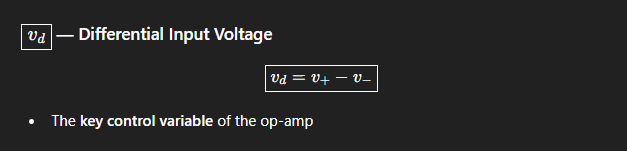
Vd - The Differential Input Voltage
The differential input voltage is defined as the difference between the non-inverting input voltage and the inverting input voltage; in particular, Vd = v+ - v-
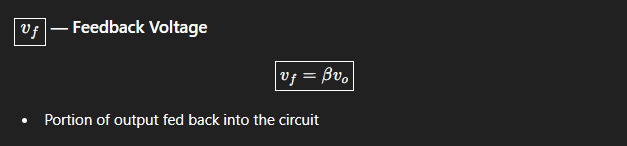
Vf - Feedback Voltage
The feedback voltage is defined as the portion of the output voltage fed back into the circuit.
A - Open-Loop Gain
The internal gain of the op-amp circuit, typically the value is extremely large.
For ideal op-amp circuits, the amp is infinite.

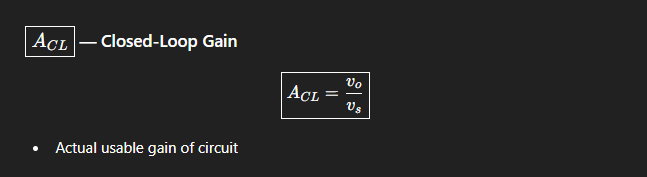
Closed-Loop Gain
The closed-loop gain is defined as the output voltage divided by the source voltage.
Feedback Factor

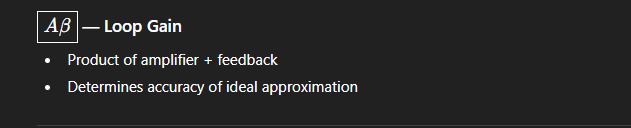
Loop Gain
Input Currents
i+
i-
Defined as the currents entering into the op-amp terminals
Rin - Input Resistance
The input resistance is defined between V+ and V-; for an ideal op-amp circuit, the input resistance is defined as infinite.
Output Resistance - R0
The output resistance is defined as the internal resistance of the output stage; for an ideal op amp, the output resistance is 0.

