Bio 2 Test 2
 Call Kai
 Learn
Learn Practice Test
 Spaced Repetition
 Match
Match Flashcards
 Knowt Play
1/97

There's no tags or description
Looks like no tags are added yet.
Name | Mastery | Learn | Test | Matching | Spaced | Call with Kai |
|---|
No analytics yet
Send a link to your students to track their progress
98 Terms
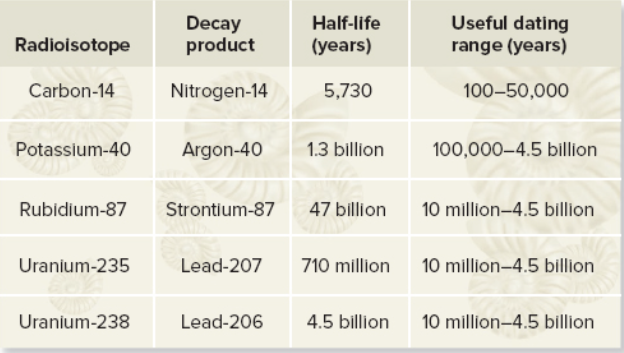
You uncovered a fossil that you suspect is around 100 million years old. Which of the radioisotope pairs in the table below could you eliminate as an appropriate choice for radioisotope dating the accompanying rock?
Carbon-14/Nitrogen-14 (half-life = 5,730 years; useful dating range = 100–50,000 years)
In Earth's history, what might the cooling of the Earth and the resulting change from a forested to a grassy landscape have made adaptive in humans?
Bipedalism
The origin of the mitochondrion and chloroplast is hypothesized to have involved
prokaryotic cells that became internal symbionts within an early eukaryotic cell.
Hominins are
all forms of humans, extinct and extant.
Which of the following are the closest ancestors of humans (genus Homo)?
Australopithecines
In 2004, Jun-Yuan Chen and David Bottjer found a fossil approximately 580–600 million years old. Why was this particular fossil significant?
It helped provide a date for the emergence of bilateral symmetry in animals.
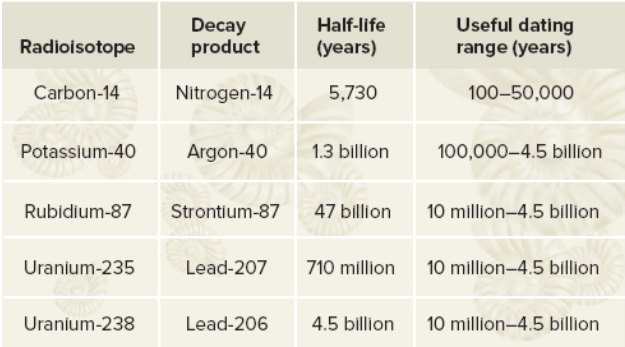
A scientist found an unweathered igneous rock that contained 0.025 g of potassium-40 and 0.075 g of argon-40. The half-life of potassium-40 is 1.3 billion years. Using the table from Figure 22.3b the age of the rock would be estimated to be
2.6 billion years old.
Imagine you are an archaeologist and are working to identify the species of a partial skeleton found in Uganda. You are able to date bones as being approximately 2 million years old and belonging to an adult male. After reconstruction of the skull, you estimate a brain capacity of
. Further examination of the bones leads you to predict a height of about 180 cm. What species does the skeleton most likely belong to?
Homo ergaster
An unfortunate deer becomes stuck in quicksand at the edge of a lake and dies. A few months later, it is buried by sediment in a massive landslide, but by this time, bacteria have fully decomposed its soft tissues. Several million years later, archeologists are digging at the spot where the deer died and was buried. Would the archeologists be able to find a fossil of the deer? Why or why not?
Yes, because its skeleton could have been replaced by minerals to form a fossil.
Which situation would be most likely to form a fossil under normal environmental conditions?
An elephant that died at the edge of a waterhole.
You have discovered a new species of bacteria. Its characteristics include a thick peptidoglycan layer and the ability to produce antibiotics. What do you think is true about this species?
They are likely to be Gram-positive Actinobacteria.
Which of the following statements does NOT describe a function of the cell walls of bacteria?
They prevent horizontal gene transfer.
Amphistegina gibbosa is a species of protist with filose pseudopodia found near coral reefs. What cannot be true of A. gibbosa?
They have sacs under the cell membrane.
Which of the following is NOT true of horizontal gene transfer?
It occurs when genes are transferred from parent to progeny.
Which protist would most likely be phytoplankton?
Euglena (a unicellular alga)
If proteobacteria were eliminated from the environment, which of the following could occur?
An increase in methane in the atmosphere
You are studying the bacteria in the water of a nearby pond. From a 100 mL sample, you use a 0.5 mL subsample to inoculate a plastic dish filled with a semisolid nutrient medium that fosters growth of coliform bacteria. After an appropriate incubation period, you count 100 bacterial colonies growing on the surface of the medium. What conclusion can you make about the coliform bacteria in the pond water?
There are approximately 200 coliform bacterial cells per milliliter.
Plants share a most recent common ancestor with what group of protists?
Green algae
The sexual phase of Plasmodium is called a
gametocyte.
You and a friend are discussing genetics. You comment on the fact that some eukaryotic cells possess genes from the genomes of four or more different species. “No way!” says your friend. “That sounds impossible!” What process supports your statement?
Tertiary endosymbiosis
Among the mammals, only some primates (including most humans) have color vision. What was the likely advantage that probably drove the evolution of primate color vision?
The ability to find ripe fruit.
Which of the following statements best compares the ovary, ovule, and egg?
The ovary is the lower part of the pistil that houses the ovules that in turn contain the eggs.
A prolonged period without rain is causing a major drought in the American Midwestern states. How would you expect crops to respond initially to the stress caused by the drought?
They will take in less carbon dioxide.
Secondary metabolites are organic compounds produced outside of primary metabolic processes essential for cell structure and growth. Based on this information, which of the following is an example of a secondary metabolite?
Steroids
Double fertilization is
fertilization of an egg by one sperm and an endosperm-forming cell by another sperm.
While conducting a plant diversity survey in a temperate rainforest in Washington state, you come across a number of individuals of a low-lying plant species. Back at the lab, tests indicate that the majority of the plant material is haploid. The plant you discovered is likely most closely related to
sphagnum moss.
Pseudoephedrine, based on the chemical structure of ephedrine from the Gnetophyte genus Ephedra , is used as a treatment for
congestion.
Global deforestation remains a major concern as huge tracts of rainforest are cut down each day. How does the removal of such large numbers of trees from the world's forests affect the concentration of carbon dioxide in the atmosphere?
The concentration of carbon dioxide increases, which has a warming effect on the climate.
Ulva is a genus of algae in the phylum Chlorophyta. What characteristic does Ulva share with ferns?
The ability to synthesize organic nutrients using light
After a decline to an historic low about 300 million years ago, carbon dioxide levels in the Earth's atmosphere rose again for a while. Hypothesize a reason why this occurred.
Lower temperatures resulted in reduced plant growth; with less vegetation to absorb carbon dioxide, the carbon dioxide levels rose.
Differentiate between Porifera and Eumetazoa.
The various cell types of Porifera do not form permanent associations into tissues during their life cycle, whereas Eumetazoa possess true, stable tissues.
What would be necessary for a sponge to survive if it had a reduced number of choanocytes?
Phagocytic food gathering would have to increase.
Some vertebrates, like frogs and humans, do not have a conspicuous tail. However, even humans have the remnants of a tail known as the
coccyx.
The nematode Caenorhabditis elegans is important to human medicine because it
has programmed cell death and therefore is useful in cancer and AIDS research.
The recent reassessment of animal classification is the result of
comparisons of DNA and rRNA among different taxa.
The tracheae of adult terrestrial insects have been a factor in the great abundance of insects because they serve the same function, in terms of the delivery of respiratory gases to the cells, as do
the closed circulatory system of cephalopods.
What is a unifying feature of all animals, but is not seen outside of the animal kingdom?
The nature of their small subunit rRNA gene sequences is different.
When division of the zygote reaches the eight-cell stage and the planes of cleavage of the upper four cells line up with those of the bottom four cells so that two tiers of cells result, one directly above the other, the type of cleavage is called
radial cleavage.
If a mutation occurred in a human such that the pharyngeal slits never formed, what do you predict would be the consequence?
The Eustachian tubes would not form.
Which structure of the amniotic egg contains nutrients?
Yolk sac
A bird in your care has an infection in its air sacs. What do you predict would be the effect of this infection?
Metabolism and overall activity levels would decline as a result of lower oxygen flow.
Reptiles are better adapted to life on land than are amphibians. Which external characteristic would a reptile have to lose to make it roughly externally equivalent to an amphibian in terms of ability to tolerate dry land?
Keratin-rich scales
Which structure of the amniotic egg is responsible for gas exchange?
Chorion
As a new curator for a large public aquarium in your city, you are in charge of correctly identifying some of the animals presently in your care. You have two adult animals in tanks in front of you, and you know that one is a lamprey, and the other is a hagfish. Which feature would allow you to correctly identify each animal?
Lampreys are parasitic, while hagfish are not parasitic.
Eutherian mammals are uniquely defined by
longer gestation periods because of more highly developed placentas.
Which structure of the amniotic egg protects the embryo?
Amnion
You need to explain to your study group why the breathing ability of amniotes is different than that of amphibians. Your classmates argue that something like a terrestrial salamander is identical in its breathing mechanism to an amniote. To convince them of the critical breathing innovations of amniotes, you report that in order to breathe as an amniote does, the terrestrial salamander would have to
develop new muscular associations in the ribcage.
Which of the following provides the best evidence that modern humans are evolving?
Adult humans of northern European descent can readily digest lactose.
Which would be most likely to be fossilized?
A common thick-shelled crustacean.
Which situation would be most likely to form a fossil under normal environmental conditions?
An elephant that died at the edge of a waterhole.
Hominins are
all forms of humans, extinct and extant
Which of the following are the closest ancestors of humans (genus Homo)?
Australopithecines
In Earth's history, what might the cooling of the Earth and the resulting change from a forested to a grassy landscape have made adaptive in humans?
Bipedalism
The difference between an akinete and endospore is that
akinetes are whole cells filled with food, whereas endospores are bodies produced inside of cells
An obligate anaerobe is an organism that
is poisoned by oxygen.
How would you describe the body of a fungus?
Tiny threadlike hyphae collectively make up the mycelium.
Plants share a most recent common ancestor with what group of protists?
Green algae
If proteobacteria were eliminated from the environment, which of the following could occur?
An increase in methane in the atmosphere
Should patients with AIDS be concerned about exposure to the fungus, Pneumocystis jiroveci? If so, why?
Those with AIDS should be concerned as the fungus infects individuals whose immune system has been weakened by AIDS and causes pneumonia.
African sleeping sickness is caused by Trypanosoma brucei, a flagellated protist that belongs to a supergroup with a feeding groove. What human disease is caused by the protist most closely related to T. brucei?
Giardiasis
Which of the following statements DOES NOT characterize decomposers?
They are autotrophs.
A pharmaceutical company develops a drug inhibiting mitosis of sporozoites in an effort to prevent malaria. How would this affect the next step of the infection cycle of Plasmodium falciparum?
Merozoites would not be produced.
Alternation of generations means
one phase of the life cycle is diploid and the other is haploid.
Kingdom Plantae is a clade comprised of bryophytes and what other group?
Tracheophytes
Among the mammals, only some primates (including most humans) have color vision. What was the likely advantage that probably drove the evolution of primate color vision?
The ability to find ripe fruit.
If you were given a large showy flower with three petals, six stamens, and three carpels, would you consider it likely to be
a monocot.
The conducting tissue found in vascular plants that functions in transportation of materials throughout the plant, but does not lend structural support to the stem is
phloem.
Which of the following statements best compares the ovary, ovule, and egg?
The ovary is the lower part of the pistil that houses the ovules that in turn contain the eggs.
Plants and streptophyte algae for a clad based on the fact that they share a number of derived traits. Which of the following is NOT one of those derived traits?
chlorophyll a and b.
Which statement best describes the relationship between a carpel and a pistil?
A pistil can be composed of either a single carpel (in which case the two terms are synonymous) or of two or more carpels fused together.
Double fertilization is
fertilization of an egg by one sperm and an endosperm-forming cell by another sperm.
Pseudoephedrine, based on the chemical structure of ephedrine from the Gnetophyte genus Ephedra , is used as a treatment for
congestion.
If a mutation occurred in a human such that the pharyngeal slits never formed, what do you predict would be the consequence?
The Eustachian tubes would not form.
Some vertebrates, like frogs and humans, do not have a conspicuous tail. However, even humans have the remnants of a tail known as the
coccyx.
The nematode Caenorhabditis elegans is important to human medicine because it
has programmed cell death and therefore is useful in cancer and AIDS research.
When division of the zygote reaches the eight-cell stage and the planes of cleavage of the upper four cells line up with those of the bottom four cells so that two tiers of cells result, one directly above the other, the type of cleavage is called
radial cleavage.
Bilateria are characterized by
a plane of symmetry that forms mirror images around a vertical plane in the midline.
Suppose you discover a new species of animal that does not have body segments, but is triploblastic, cephalized, and has a coelom. Under the molecular phylogenetic scheme, you would allocate it to which phylum?
Mollusca
What is the route of water in the water vascular system of a starfish?
Water enters through the madreporite into the ring canal and from thence into the radial canals to the ampullae and finally into the tube feet.
Explore top notes

