Matisse, Picasso & Cubism
 Call Kai
 Learn
Learn Practice Test
 Spaced Repetition
 Match
Match Flashcards
 Knowt Play
1/9

There's no tags or description
Looks like no tags are added yet.
Name | Mastery | Learn | Test | Matching | Spaced | Call with Kai |
|---|
No analytics yet
Send a link to your students to track their progress
10 Terms
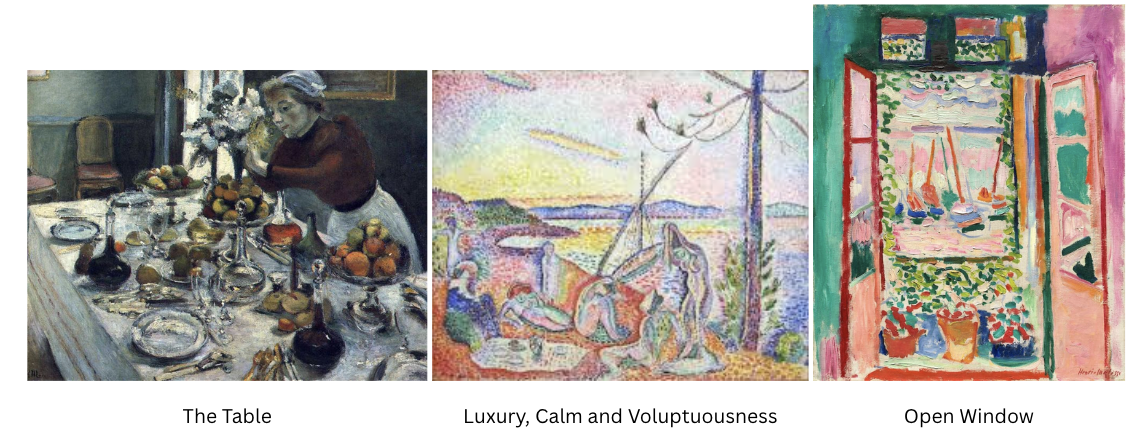
Matisse
a French artist known for his use of bold color and fluid line, he was the foremost representative of Fauvism (20th c.) and a lifelong rival and peer of Picasso.
Henri Matisse – The Table (1896–97)
Early, academic-influenced still life
Visible brushwork, emerging color focus
Transitional work before Fauvism
Interest in surface and composition
Luxury, Calm and Voluptuousness (1904)
Pointillist influence (Signac)
Bright, non-natural color
Leisure and pleasure as themes
Bridge to Fauvism
Open Window, Collioure (1905)
Fauvist breakthrough
Color replaces realistic light
Flattened space
Painting as sensation, not description
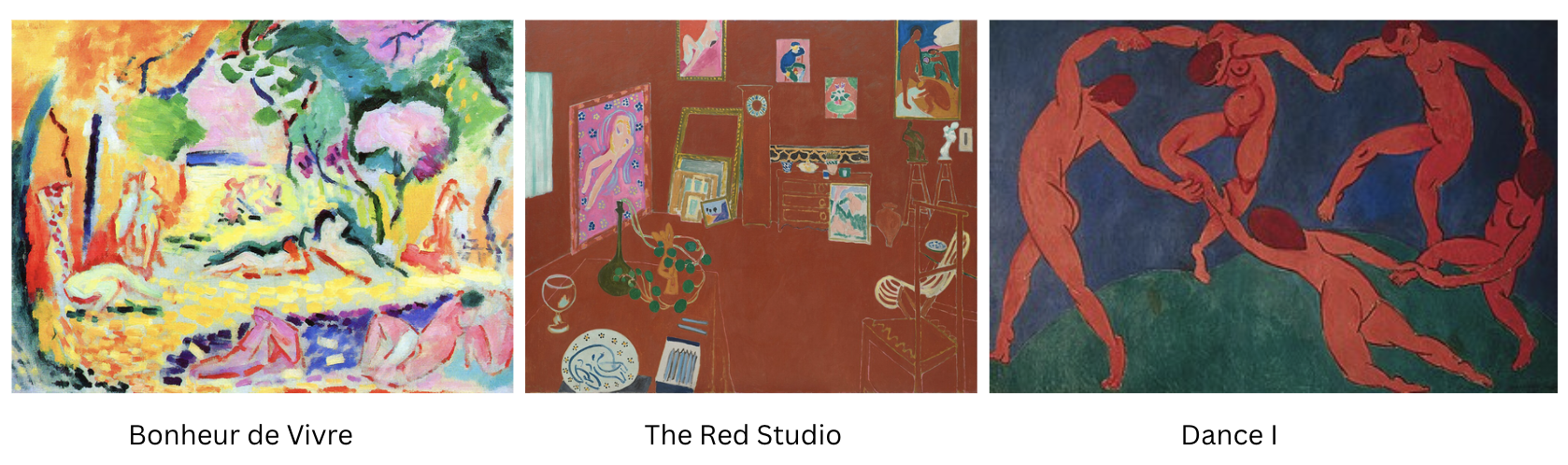
New Directions (Toward Abstraction) - Matisse
Bonheur de Vivre (1905–06)
Directly influenced Picasso → leads to Cubism
Often used to explain color as emotion, not description
The Red Studio (1911)
Shows radical flattening of space
Color completely replaces traditional perspective
Clear step toward abstraction
Dance I (1909)
Iconic simplified human figures
Strong sense of rhythm, movement, and emotion
Near-abstraction while still figurative
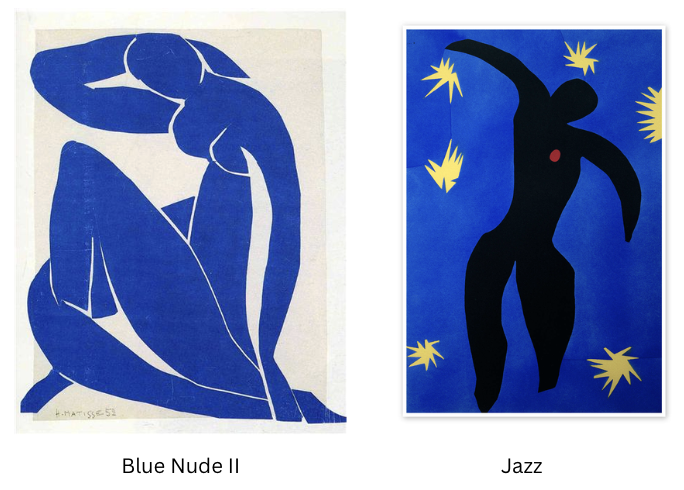
Late Work - Matisse
Blue Nude II (1952)
Cut-out technique
Shape and color only
Radical simplification
Body as abstract form
Jazz (1947)
Illustrated book of cut-outs
Rhythm, movement, color
Art crosses into graphic design
Abstraction for mass media
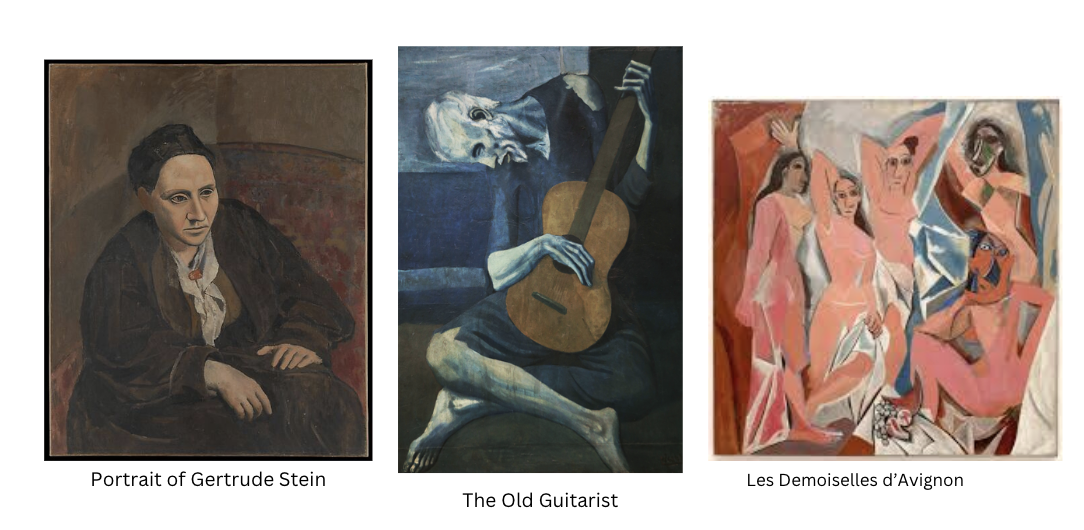
Picasso Before Cubism and his Breakthrough
Portrait of Gertrude Stein (1905–06)
Clear turning point toward Cubism
Mask-like face → break from realism
Often used to explain Picasso’s transition to modernism
The Old Guitarist (1903–04)
Blue Period
Poverty and isolation
Elongated, expressive figure
Emotional realism
BREAKTHROUGH
Les Demoiselles d’Avignon (1907)
Radical break with tradition
Distorted bodies and space
African mask influence
Birth of Cubism
Roots of Cubism (Proto-Cubism)
Cézanne’s Influence
Nature reduced to geometric forms
Multiple viewpoints
Structure over illusion
Early Cubism (Proto-Cubism) 20th c.
artists began breaking forms into simplified geometric shapes and flattening space, inspired by Cézanne and non-Western art.
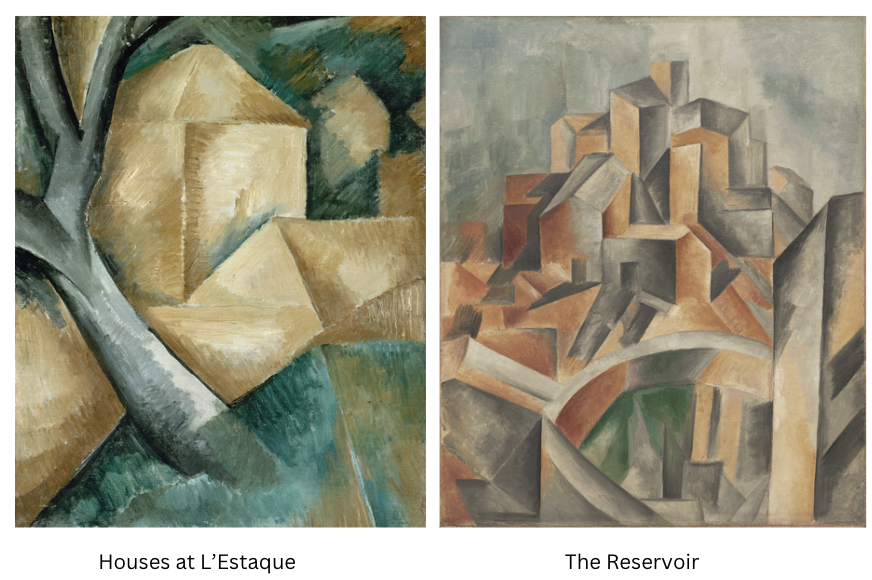
Georges Braque – Houses at L’Estaque (1908)
Simplified geometric architecture
Reduced color palette
Space becomes solid
Cézanne’s influence
Picasso – The Reservoir, Horta de Ebro (1909)
Fragmented landscape
Interlocking planes
Early Cubist space
Move away from perspective
Analytic Cubism
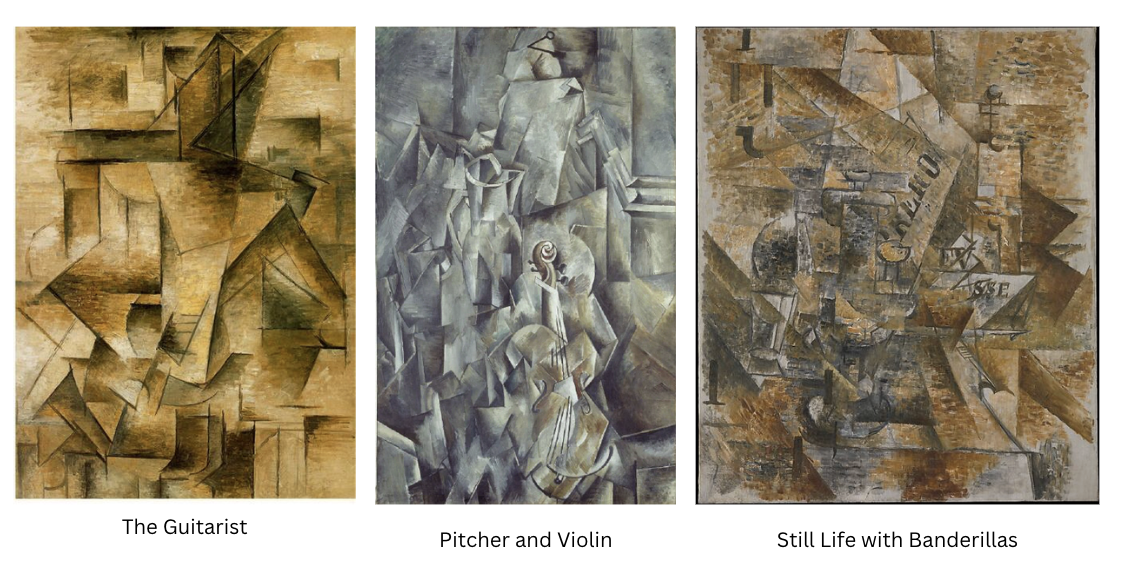
analyzes objects by breaking them into fragmented planes, showing multiple viewpoints at once, often using a restricted, monochrome color palette.
Picasso – The Guitarist (1910)
Monochrome palette
Multiple viewpoints
Difficult to “read” image
Braque – Pitcher and Violin (1909–10)
Still life fragmented
Overlapping planes
Shallow space
Braque – Still Life with Banderillas (1911)
Mixed materials (sand)
Texture emphasized
Reality vs illusion
Synthetic Cubism
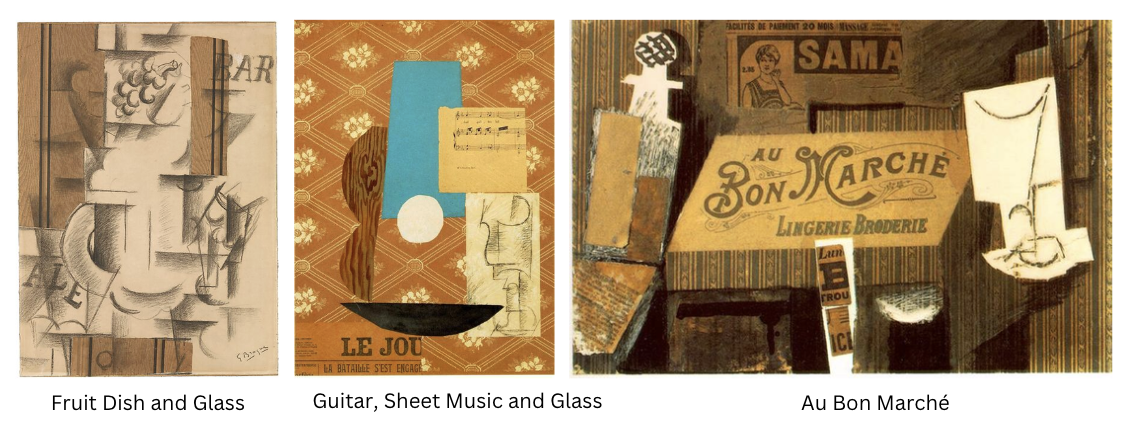
reconstructs objects using simpler shapes, brighter color, collage, and real materials, making images more legible.
Braque – Fruit Dish and Glass (1912)
Collage introduced
Real materials pasted
Simpler, bolder forms
Picasso – Guitar, Sheet Music and Glass (1912)
Collage + drawing
Everyday materials
More legible imagery
Picasso – Au Bon Marché (1913)
Commercial imagery
Typography enters art
Art + advertising
Salon Cubism
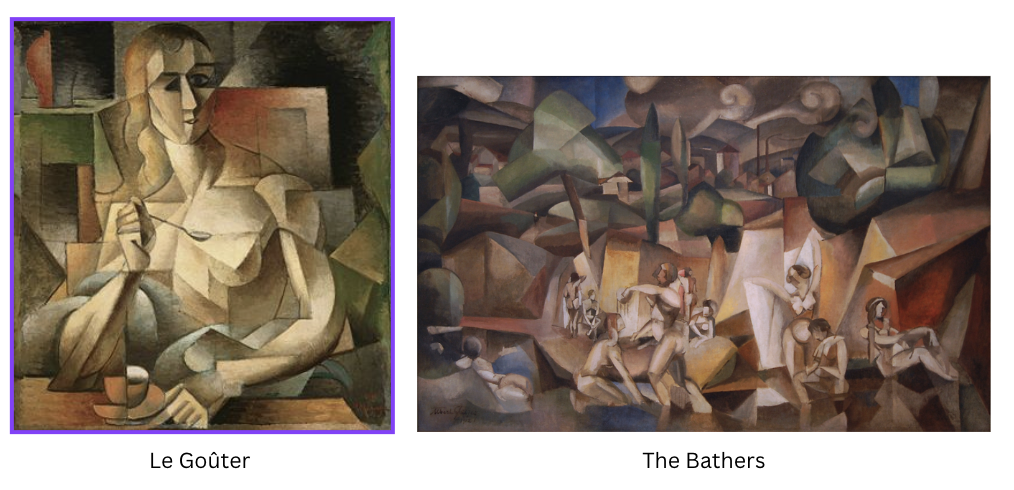
Albert Gleizes – The Bathers (1912)
Monumental Cubism
More readable figures
Public exhibition style
Cubism enters mainstream
Jean Metzinger – Le Goûter (1911)
Balanced Cubist composition
Theory + practice combined
Softer Cubism
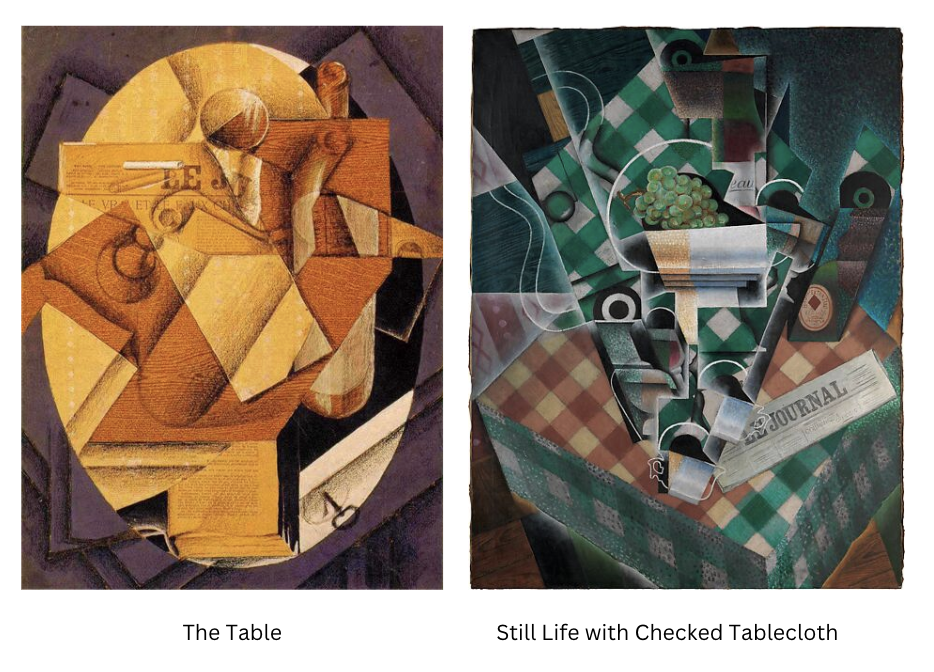
JUAN GRIS (Ordered Cubism)
more accessible, monumental version of Cubism shown in public exhibitions, combining Cubist structure with clear figures and decorative order.
Juan Gris – The Table (1914)
Clear structure
Bright color
Precision
Still Life with Checked Tablecloth (1915)
Decorative pattern
Strong geometry
Readable space
Controlled composition
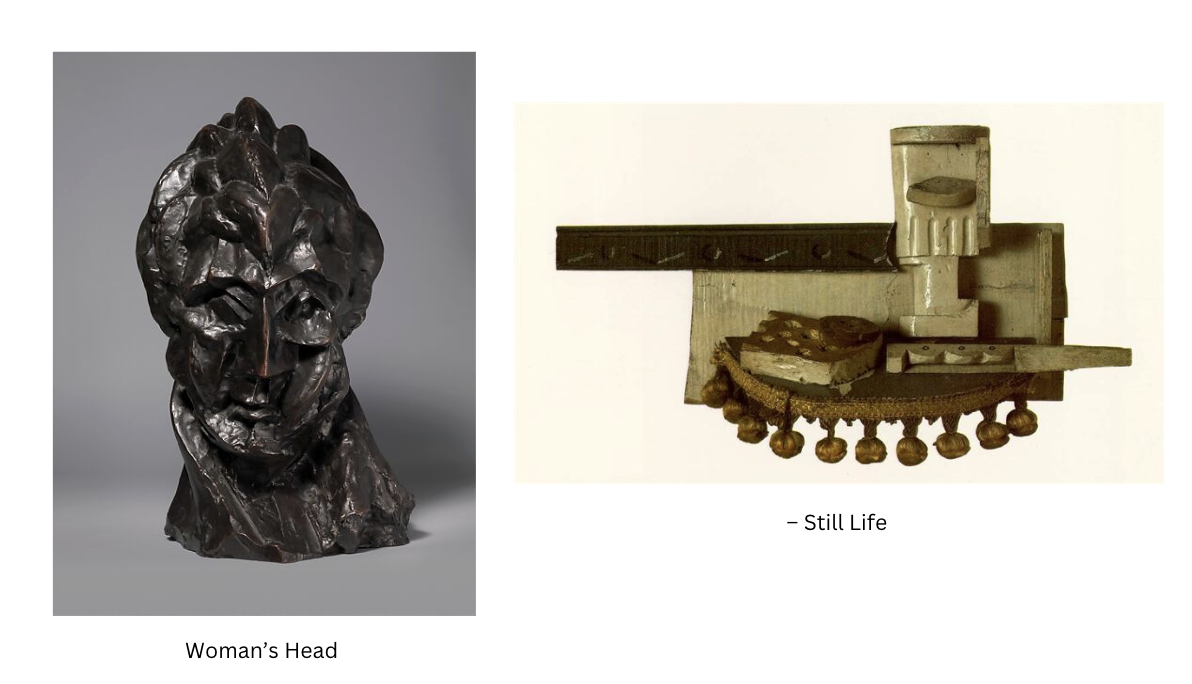
Cubist Sclupture
Picasso – Woman’s Head (1909)
Fragmented planes
Sculpture as constructed form
Picasso – Still Life (1914)
Assemblage sculpture
Everyday materials
Break from carving
Expansion of Cubist ideas
Explore top notes

Explore top flashcards
