hnsc 1210 unit 10 - nutrients, recreational physical activity, and the body's responses
 Call Kai
 Learn
Learn Practice Test
 Spaced Repetition
 Match
Match Flashcards
 Knowt Play
1/143

There's no tags or description
Looks like no tags are added yet.
Name | Mastery | Learn | Test | Matching | Spaced | Call with Kai |
|---|
No analytics yet
Send a link to your students to track their progress
144 Terms
benefits of physical activity
Improves sleep quality; supports healing, tissue building, and waste removal
Supports better nutritional health
Expends energy, allowing more food intake; if nutritious foods chosen → improves nutrient intake
Improves body composition (more lean muscle mass)
Increases bone density
Strengthens the immune system
Lowers cancer risk
Lifelong activity lowers breast & colon cancer risk; improves lung/chest function
Lowers cardiovascular disease risk; reduces blood pressure; slows resting pulse; improves blood cholesterol profile
Lowers risk for type 2 diabetes; normalizes glucose tolerance
Reduces gallbladder disease risk (especially in women)
Helps with weight control and cholesterol regulation
Lowers anxiety and depression
Improves self-image
Lowers mortality rates
Improves quality of life
what does the canadian society exercise of physiology (CSEP) recommend for adults ages 18-64 years of age
150 minuets of vigorous intensity activity each week to achieve health benefit
according to 2018-2019 survey how many Canadians ages 18-64 meet 150 minuet per week recommendation
just over 50%
moderate-intensity activities
cause you to sweat a little and to breathe harder
ex. include brisk walking, water aerobics, bike riding, and gardening
vigorous-intestine activities
cause you to sweat more and be ‘out of breath’
ex. include jogging, swimming laps, aerobic, hiking, and cross country
What is the minimum recommended duration for each activity session?
At least 10 minutes.
How often should muscle and bone strengthening activities be included?
Two days per week.
muscle strengthening actives
activities designed to increase muscle strength, power, endurance and mass. These include lifting weights, using resistance bands, push-ups, sit-ups, etc.
bone strengthening activities
weight bearing activities design to promote bone growth and strength. These include skipping, running, jumping, weight training and sports like tennis and volleyball.
What health risks are reduced by following physical activity guidelines?
Premature death, coronary heart disease, stroke, hypertension, colon cancer, breast cancer, type 2 diabetes, and osteoporosis.
Besides lowering disease risk, what else does physical activity improve?
Physical fitness, body composition, and mental health indicators.
How does the amount of physical activity relate to benefits?
More activity = greater health benefits.
What is recommended for people who are currently inactive?
Start with small amounts of activity and gradually increase duration, frequency, and intensity.
What fuels does the body use during physical activity?
Carbohydrates (CHO), fatty acids, and small amounts of amino acids from protein.
What determines the mixture of fuels used during activity?
The intensity, duration, and prior training level of the individual.
when the body is at rest where does it derive half it’s energy from?
from fatty acids
rest coming mainly from glucose and a bit from amino acids
body adjusts it’s fuel use to use glucose stored in the muscles when
during activity
What fuel do muscles use in the early minutes of activity?
Muscle glycogen, which provides most of the initial energy.
as activity continues
messenger molecules (e.g the hormone epinephrine) signal the liver and fat cells to free their stored energy, which the muscles can then pick up and use
How does the body supply fuel during prolonged activity?
Hormones like epinephrine signal the liver and fat cells to release stored energy (glucose + fatty acids) for the muscles to use.
Do muscles share their glycogen with other tissues?
No — muscles hoard their glycogen and do not release it into the bloodstream for other tissues.
How do glycogen stores compare to fat stores?
Glycogen stores are limited (support ~2,000 calories), while fat stores can provide 70,000+ calories for long periods of activity.

How long can glycogen support activity?
it supports daily activities and moderate exercise but will run out faster during high-intensity exercise.
How does exercise intensity affect glycogen use?
Higher-intensity exercise uses more glycogen and depletes it faster; lower-intensity exercise relies more on fat stores.
What fuel does the body rely on during very intense, short activity (e.g., quarter-mile race) (anaerobic activity)?
Glucose from muscle glycogen, because oxygen supply is too limited to use fat.
heart and lungs can only supply so much oxygen in short periods of time
Why can’t fat be used for energy during intense activity?
Fat requires oxygen to break down, but during intense bursts the demand for energy is higher than oxygen supply.
What is anaerobic metabolism?
Rapid glucose breakdown without oxygen; provides quick energy but depletes muscle glycogen quickly.
muscle relies heavily on their glycogen supply during this type of activity
What are key features of anaerobic activity?
Requires strength, does not need oxygen, and does not work the heart/lungs for a long sustainable time.
generates quickly but at a big expense to the muscle stores of glycogen
What fuels does the body use during moderate aerobic activity?
Both glucose and fatty acids, which helps conserve glycogen stores.
Why can the body use fat during aerobic activity?
The heart and lungs supply enough oxygen, allowing fat to be broken down for energy.
How does aerobic activity affect glycogen use?
It uses glycogen slowly, allowing longer activity before glycogen runs out.
What is a key principle of aerobic metabolism?
A little glucose helps metabolize a lot of fat.
How does muscle fitness affect fuel use?
Fitter muscles draw more oxygen from the blood and burn fatty acids more efficiently.
How do trained muscles affect fat and glycogen use?
They burn more fat at higher intensities, which spares glycogen (less glycogen is used to perform the activity).
How does training affect muscle glycogen stores?
Trained muscles adapt to store more glycogen (up to a limit).
How long do glycogen stores last during activity?
About 2 hours, depending on intensity, diet, and fitness level.
What fuels activity in the first 10 minutes?
Muscles rely almost entirely on their own glycogen stores.
How much glycogen is used in the first 20 minutes of moderate activity?
About 1/5th (20%) of available glycogen.
Why is it important to maintain glucose levels during physical activity?
Because glucose fuels working muscles and prevents early fatigue during prolonged activity
What happens when glycogen stores are depleted?
Activity can only continue briefly while the liver converts lactic acid and amino acids into glucose in an attempt to keep blood sugar levels elevated.
What happens when glycogen depletion is combined with hypoglycemia?
The nervous system can’t function properly, causing extreme fatigue and loss of coordination.
What do long-distance athletes call the point where glycogen runs out?
“Hitting the wall.” It occurs when glycogen is fully depleted and blood sugar drops.
3 dietary strategies and 1 training strategy that can help maintain glucose concentrations, postponing exhaustion in endurance athletes
eating a high CHO diet daily
taking in some CHO during activity
eat a CHO rich meal within 2 hours post activity
eating a high CHO diet daily
the more CHO a person eats, the more glycogen muscles store (up to a limit) and the longer the stores will last during physical activity
What did the endurance study comparing mixed, high-carb (83% energy from CHO), and high-fat diets show?
The high-carbohydrate diet gave athletes the longest endurance, because it maximized glycogen stores.
How did mixed (55% energy from CHO) and high-fat (94% from fat) diets affect endurance?
Mixed diets supported moderate endurance; high-fat diets resulted in the poorest endurance due to low glycogen stores.
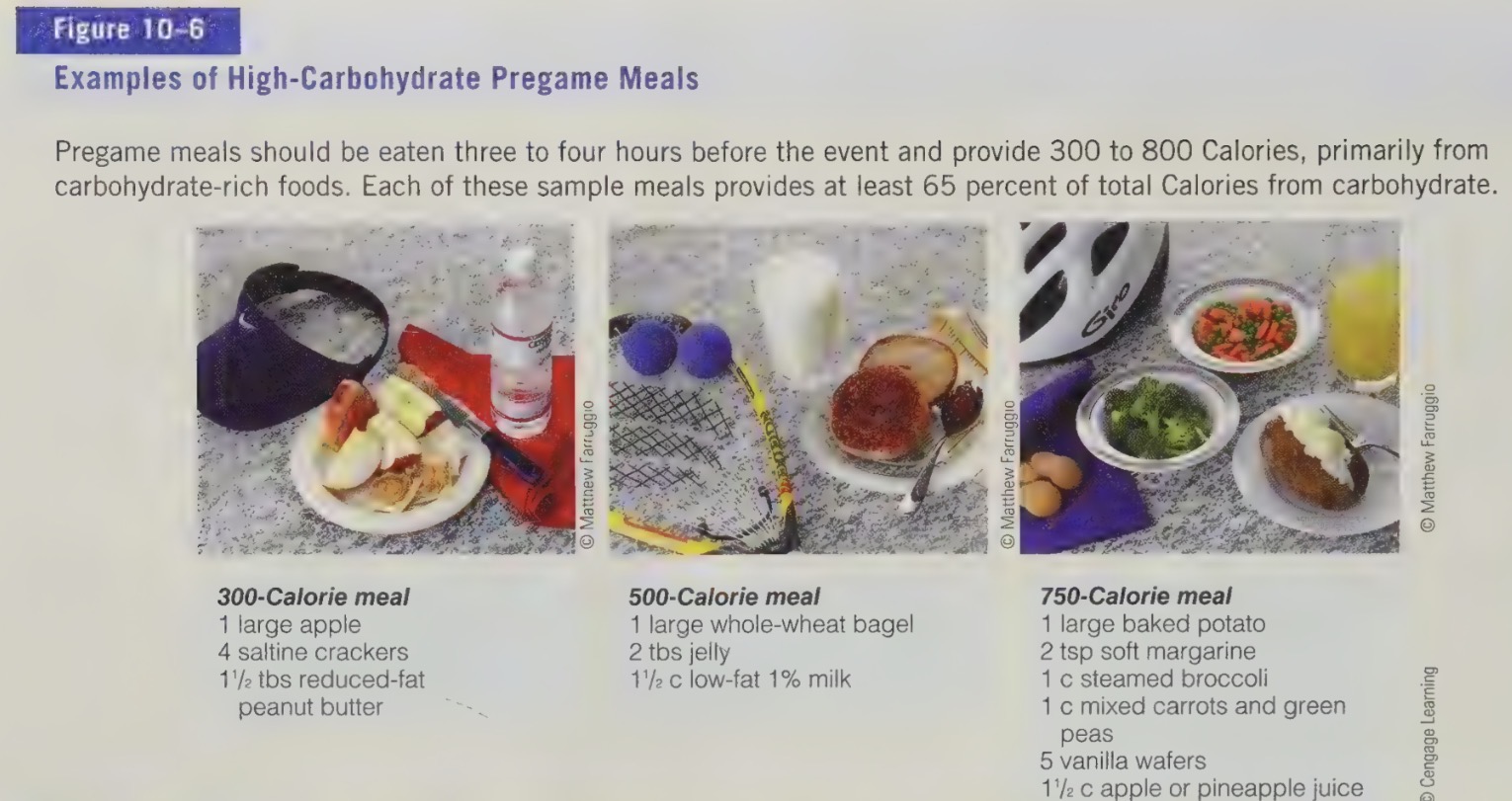
Why do athletes eat high-carbohydrate meals before events?
To fill glycogen stores, improving endurance and delaying fatigue.
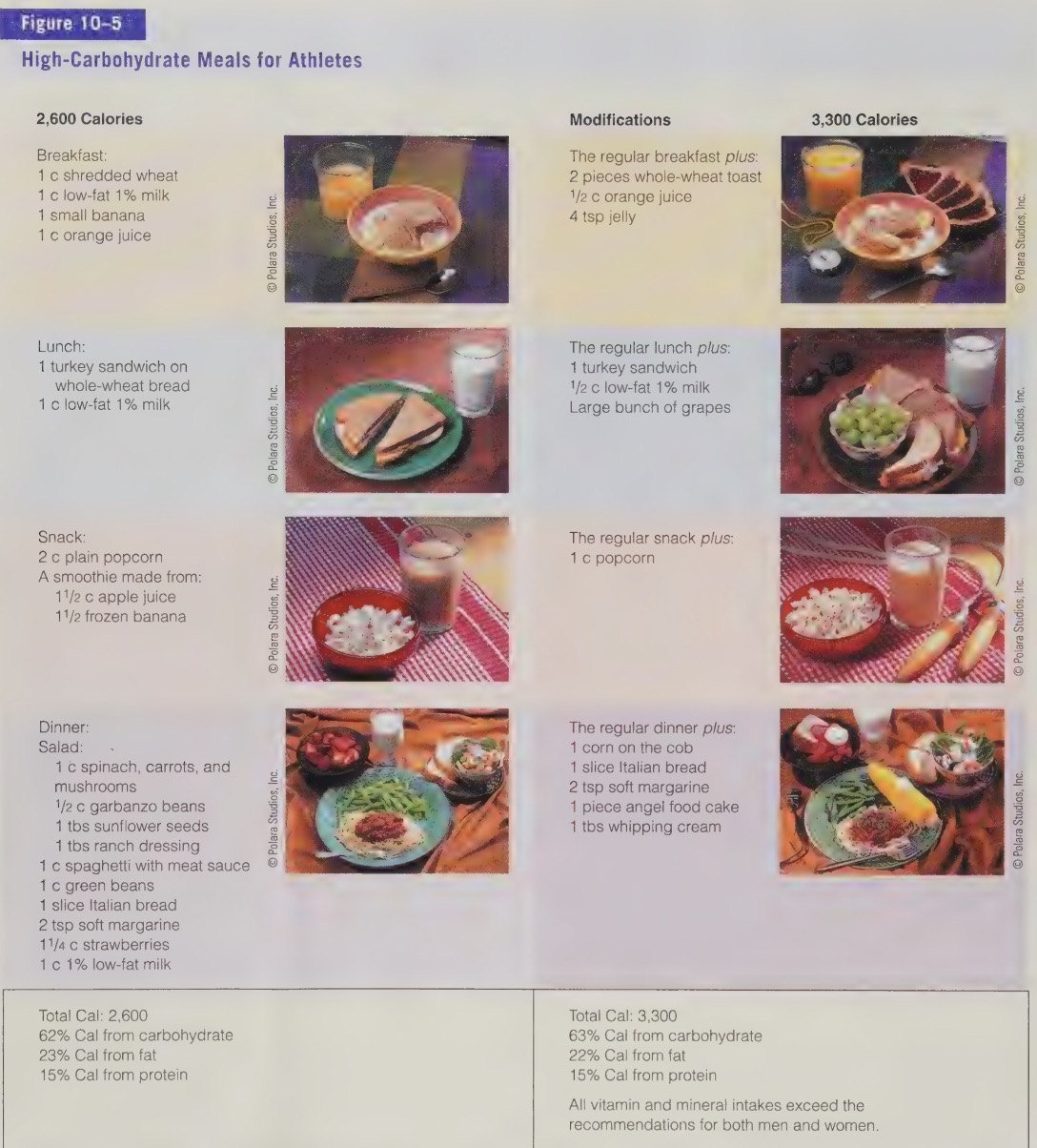
What do the figures on high-carbohydrate meals show?
Examples of high-carb diets at 2,600 kcal and 3,300 kcal, and examples of high-carb pregame meals athletes can eat.
taking in some CHO during activity
for endurance activities greater than 45 minuets in during action, we need to take in about 30-60g of CHO every hour
usually though sports drinks (8oz of sports drink provides approx. 14g CHO) or
sports gels (1-2oz packet contains approx. 24-28g HCO
recommended to consume 8-10oz water with each packet if your activity is shorter duration, or is not exhaustive in nature, you will not benefit from carbs during activity (e.g daily jog, 40 minuet aerobic class, etc.)
eating a CHO rich meal within 2 hours post activity
boosts muscle glycogen stores
recommended to choose high glycemic index (GI) foods, because they fill glycogen stores more quickly
What is carbohydrate (CHO) loading?
A training strategy involving moderate exercise followed by a high-carbohydrate diet to increase muscle glycogen stores beyond normal levels.
explains that the athlete decreases training during the week before the event, and eats a high CHO diet during 3 days prior to the event
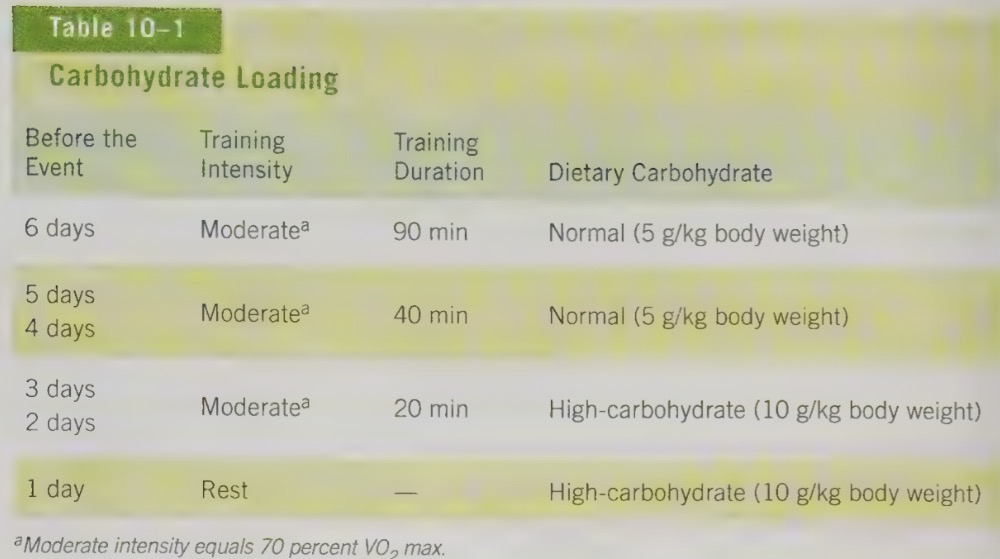
What does CHO loading achieve?
It allows muscles to store up to nearly double their usual glycogen levels.
Which athletes benefit from carbohydrate loading?
Those doing endurance activity lasting 90 minutes or longer.
Does CHO loading help athletes in short-duration activities?
No — activities shorter than 90 minutes do not see meaningful benefit.
How do high-fat diets affect athletic performance?
They usually impair performance because they reduce glycogen availability.
Why is too little fat (<20% of energy) a problem?
It can make it hard to meet calorie and nutrient needs, harming performance.
What fat intake is recommended for endurance athletes?
20–30% of total energy intake.
Why do athletes still need some body fat?
Body fat provides long-lasting fuel — even lean runners have enough fat to run multiple marathons.
When does the body start using more fat than glycogen?
After 20+ minutes of moderate, aerobic exercise.
When do fat cells start shrinking during exercise?
Only after the first 20 minutes of sustained moderate activity.
Why doesn’t spot reducing work?
You cannot choose where fat comes from. The body uses fat from areas with the most stored fat, not necessarily where you want to lose it.
When does muscle protein synthesis increase?
In the hours of rest following physical activity.
Why is eating protein with carbohydrate after exercise helpful?
It enhances muscle protein synthesis, helping repair and build muscle.
Why do different exercises lead to different proteins being built?
Muscle contraction patterns send signals to genes to build specific proteins (e.g., weight lifting vs. jogging).
Why do athletes need more protein?
After deciding which proteins to build, muscles require extra amino acids from food to support growth and repair.
Why do endurance athletes use more protein for fuel?
If their diet is low in carbohydrates, the body breaks down protein so amino acids can be converted to glucose for energy.
Why do strength athletes need more protein?
Not for fuel, but to build and repair muscle after high-intensity resistance training.
What is the main difference in protein use between endurance and strength athletes?
Endurance athletes may burn more protein for energy, while strength athletes use more protein to build muscle.
protein intake
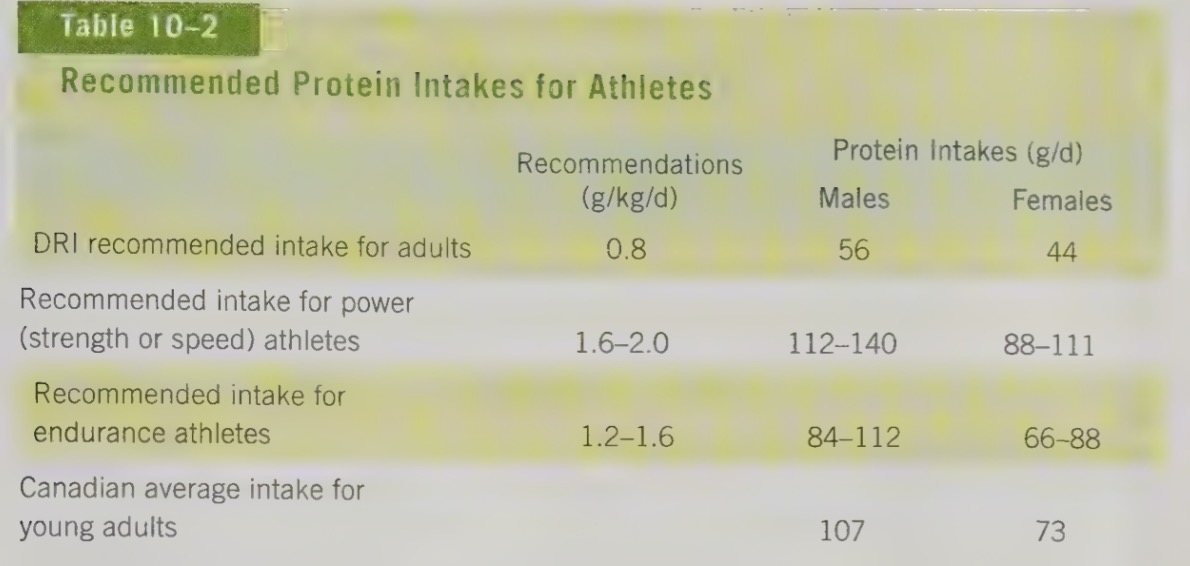
athletes need more protein than average adults
average protein intake in Canada come fairly close to meet needs
if person wants to build or retain muscle, they must take ample carbohydrates so their protein doesn’t get used as energy
how much protein is needed to build one pound of muscle?
70-105g of protein
in order to build one pound of muscle a week, we need to add how much additional protein above the DRI recommendations?
10-14g of protein
how many grams of protein is 3oz of chicken?
~30g protein
how many grams of protein is 2 slices pork tenderloin
~25g protein
how many grams of protein in 1 lean ground beefy patty
20g protein
what is the maximum amount of muscle that can be added per week?
2 pounds
Do extra protein or protein powders stimulate extra muscle growth?
No. The body can only build about 2 pounds of muscle per week, regardless of extra protein.
What does the body do with excess protein?
Extra amino acids cannot be stored — they are converted to glucose or fat for storage.
Do most athletes need protein supplements?
No. Athletes who eat adequate food usually already get enough protein.
What truly stimulates muscle growth?
Physical activity and training, not extra protein intake.
What common belief about protein and muscle growth is false?
athletes will increase their protein intake through increased food intake or by protein powders due to the belief that because the body builds muscle protein from amino acids, eating extra protein will stimulate muscle growth
How do vitamins and minerals support athletic performance?
They indirectly help performance by assisting with energy release from nutrients and oxygen transport.
do athletes have increased needs for vitamins and minerals?
Sometimes, depending on training intensity and diet, but needs are usually met through adequate food intake.
Can vitamin or mineral supplements enhance athletic performance?
Not usually—supplements don’t boost performance unless there is an existing deficiency.
supplements
meta-analysis discussed in textbook looked at more than 10,000 athletes from 15 sports at varying levels
found that about half of the athletes used vitamin supplements
do supplements enhance performance in athletes who are already well-nourished?
no they do not enhance performance
Does strenuous physical activity increase energy needs?
Yes — but athletes who eat nutrient-dense foods usually meet their vitamin/mineral needs because they’re eating more overall.
When might an athlete benefit from a vitamin/mineral supplement?
If they have a known deficiency or their food intake is low or restricted.
How do vitamin/mineral deficiencies affect performance?
Deficiencies can impair physical performance, making correction essential for athletes.
one vitamin and one mineral are often discussed in relation to physical activity
vitamin E and iron
vitamin E in relation to physical activity
some athletes take mega doses because of its potential role as an antioxidant, believing it will prevent oxidative damage to the muscle
some evidence supports this vitamin may protect against exercise-induced oxidative stress
little evidence that this vitamin supplement can enhance athletic performance
iron in relation to physical activity
physically active women are prone to iron deficiency, especially those that participate in endurance activities (e.g long distance running)
physical activity effects iron status in several ways
we lose iron in our sweat
physical activity may cause small blood losses through the digestive tract in some athletes
the muscles have a high demand for iron to make the iron-containing molecules of aerobic metabolism
Why are female athletes more prone to iron deficiency?
Low intake of iron-rich foods + menstrual iron losses + increased athletic demands = high risk for deficiency.
Why does iron deficiency hurt athletic performance?
Iron is needed to deliver oxygen to muscles; low oxygen reduces aerobic capacity and causes easy fatigue.
What is hemolysis and when can it occur in athletes?
Hemolysis is the bursting of red blood cells, often caused by high-impact contact with hard surfaces (e.g., running on concrete).
Does hemolysis usually contribute to iron deficiency or anemia in athletes?
No. The iron released from burst red blood cells is recycled, not lost, so it rarely causes anemia.
What is sports anemia?
A temporary condition seen early in training where blood hemoglobin levels appear low, but it’s not true iron deficiency.
What causes sports anemia and is it harmful?
It’s a harmless adaptation to increased physical activity and goes away on its own, even with continued training.
Why is water the body’s most important nutrient during activity?
Because the body loses water through sweat, breathing, and respiration, making hydration essential.
How much water can endurance athletes lose?
2+ liters per hour of activity.

