Limits of Functions
 Studied by 0 people
 Call Kai
 Learn
Learn Practice Test
 Spaced Repetition
 Match
Match Flashcards
 Knowt Play
1/34

There's no tags or description
Looks like no tags are added yet.
Name | Mastery | Learn | Test | Matching | Spaced | Call with Kai |
|---|
No analytics yet
Send a link to your students to track their progress
35 Terms
What is the definition of a limit at a point?
Let f be a real function, a a point in its domain (or a limit point of it). We say limx → a f(x) = A if for every ε > 0, there exists a δ > 0 such that whenever 0 < |x − a| <δ, we have |f(x) − A| < ε.
This means we can make f(x) as close as we want to A by making x sufficiently close to a, but not equal to it.
Prove limx→0x = 0
Let ε > 0. Choose δ = ε.
If 0 < |x − 0| < δ, then |x − 0| = |x| < ε
Hence the limit holds.
Prove limx→0|x| = 0
Let ε > 0. Choose δ = ε. If 0 < ||x| - 0| < δ then ||x| − 0| = |x| < ε. Hence the limit holds.
Prove limx→82x = 16
We need |2x − 16| < ε
⇔ |x − 8| < ε/2
Prove limx→8(10x − 2) = 78
We need |(10x − 2) − 78| = 10|x − 8| < ε
So choose δ = ε/10. ✅
What is the squeeze theorem?
Let f, h, g be real functions.
If for some α > 0, f(x) ≤ h(x) ≤ g(x) ∀ x ∈ (x0 − α, x0 + α)∖{x0},
and limx→x0f(x) = limx→x0g(x) = A,
then
limx→x0h(x) = A.
Basically if h(x) is trapped between two functions that both tend to the same limit, it must tend to that same limit.
What is a right hand limit?
limx→a+f(x) = A means f(x) → A as x > a and x → a
What is a left hand limit?
limx→a-f(x) = A means f(x) → A as a > x and x → a
When does the two-sided limit exist?
iff both one-sided limits exist and are equal.
When do we write limx→∞f(x) = L?
If for every ε > 0 there exists M > 0 such that x > M ⇒ |f(x) − L| < ε. (As x grows very large, f(x) gets arbitrarily close to L)
When do we write limx→−∞f(x) = L?
If for every ε > 0 there exists N > 0 such that x < −N ⇒ |f(x) − L| < ε. (As x grows very large, f(x) gets arbitrarily close to L)
How do we write an infinite limit?
We write limx→x0f(x) = ∞ if ∀ M > 0, ∃ δ > 0 such that 0 < |x − x0| < δ ⇒ f(x) > M which means f(x) increases without bound as x approaches x₀.
When do we write limx→∞f(x) = ∞?
If for all M > 0, there exists N > 0 such that x > N ⇒ f(x) > M
What is the definition for limx→x0+f(x)?
For every ε > 0 there exists δ > 0 such that |f(x) - A| < ε whenever x0 < x < x0 + δ
What is the definition for limx→a-f(x)?
For every M > 0 there exists δ > 0 such that f(x) < -M whenever a - δ < x < a
What is the definition for limx→∞f(x) = A?
For every ε > 0 there exists k > 0 such that |f(x) - A| < ε whenever x > k
What is the definition for limx→af(x) = -∞?
For every M > 0 there exists δ > 0 such that f(x) < -M whenever 0 < |x - a| < δ
What is the definition for limx→-∞f(x) = ∞?
For every M > 0 there exists k > 0 such that f(x) > M whenever x < k
What is the definition for limx→x0f(x) = A?
For every ε > 0 there exists δ > 0 such that |f(x) - A| < ε whenever 0 < |x - x0| < δ
What is the definition for divergence to infinity limx→x0f(x) = ∞?
For every M > 0 there exists δ > 0 such that f(x) > M whenever 0 < |x - x0| < δ
What is the definition for the non-existence of a limit?
There exists ε0 > 0, such that for every δ > 0, there exists xδ with 0 < |x - xδ| < δ for which |f(xδ) - A| > ε0
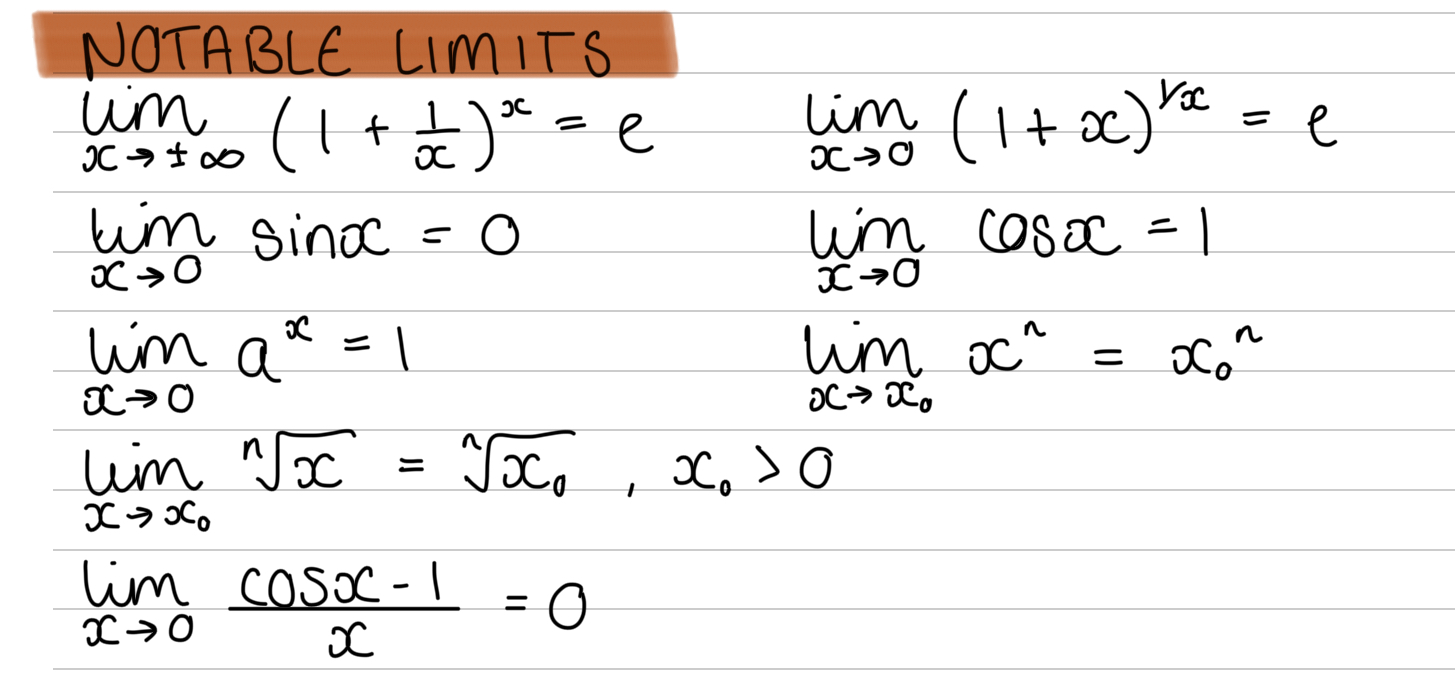
What are the key limits?

What is the algebra of limits?
limcf(x) = c(limf(x))
lim(f(x) + g(x)) = limf(x) + limg(x)
lim(f(x)g(x)) = (limf(x))(limg(x))
If g(x) =/ 0, limg(x) =/ 0
lim(f(x)/g(x)) = (limf(x))/(limg(x))
What are some more properties of limits?
limx→x0c = c
limx→x0x = x0
limx→x0x² = (limx→x0x)² = x0²
limx→x0xn = x0n
limx→x0(f(x))1/2 = (limx→x0f(x))1/2
What is composition?
z = f(y), y = g(x) → z = f(g(x))
What is the change of variable theorem?
If limy→y0f(y) = A and limx→x0g(x) = y0 where g(x) =/ y0 and x =/ x0 then limx→x0f(g(x)) = limy→y0f(y) = A
What does it mean if a function f(x) is continuous at x0?
f(x0) is defined
limx→x0f(x) exists
limx→x0f(x) = f(x0)
If f is defined on a closed interval [a, b] = {x ∈ R ; a \< x0 \< b} limx→a+f(x) = f(a) and limx→b-f(x) = f(b)
What are the properties of continuous functions?
If f(x) and g(x) are continuous,
f + g, f - g, f . g and f/g when g =/0 are all continuous
f(g(x)) is continuous
If f has an inverse on [a, b] then f-1 is also continuous
What are elementary functions?
A composition of a finite number of arithmetic operations (+, -, . , /), exponentials, trig, logarithms, constants, power functions and inverse trig
What is the continuity of elementary functions?
All elementary functions are continuous on their domain
What is a bounded function?
We say f : A → R is bounded if the set f(A) ⊆ R is a bounded set i.e. there exists M > 0 such that -M < f(x) < M for all x in A.
What is the Intermediate Value Theorem?
Let f : [a, b] → R be continuous. Suppose f(a) < 0 < f(b). Then there exists a c in (a, b) such that f(c)= 0
What are some more notable limits?
Define what it means for f to be a function from X to Y
A function f from X to Y assigns to each element x∈X exactly one element f(x)∈Y
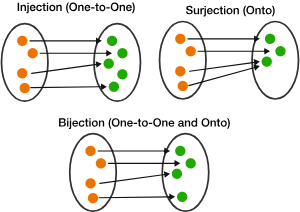
Injective vs surjective vs bijective functions
Injective (one-to-one): maps distinct inputs to distinct outputs (no repeats)
Surjective (onto): ensures every element in the codomain is mapped to by at least one input (no leftovers)
Bijective: is both, creating a perfect pairing where each input has a unique output, and every output has a unique input, meaning the domain and codomain have the same size.
 Note
Note  Flashcards (46)