2.1.4 - precipitation and excess runoff in the hydrological cycle
 Call Kai
 Learn
Learn Practice Test
 Spaced Repetition
 Match
Match Flashcards
 Knowt Play
1/23

There's no tags or description
Looks like no tags are added yet.
Name | Mastery | Learn | Test | Matching | Spaced | Call with Kai |
|---|
No analytics yet
Send a link to your students to track their progress
24 Terms
What is excess runoff
When there is more water on the surface than usual
What does water require in order to make the transfer from vapour to liquid
A non-gaseous surface
What does condensation take place around
A small piece of dust or sea salt particles this is called a condensation nuclei
Why is warm air less dense than cold air
Because as the particles heat up they vibrate more and expand - moving away from eachother - and then because there is less space between the particles it is less dense
Why does hot air float upwards
Because it is less dense than the surrounding matter the hot air moves up and around the cold air - this is called air uplift
Frontal rainfall diagram
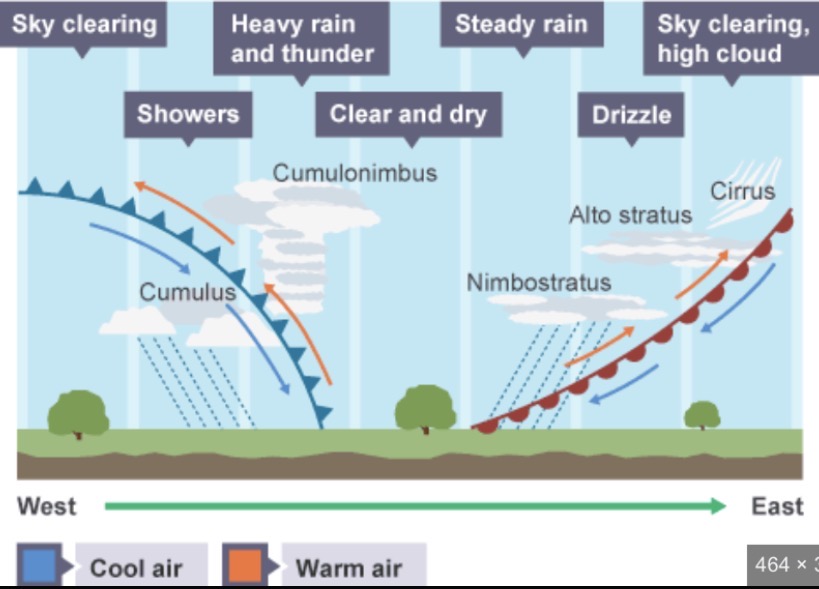
During frontal rainfall where is rain heavier
At the cold front
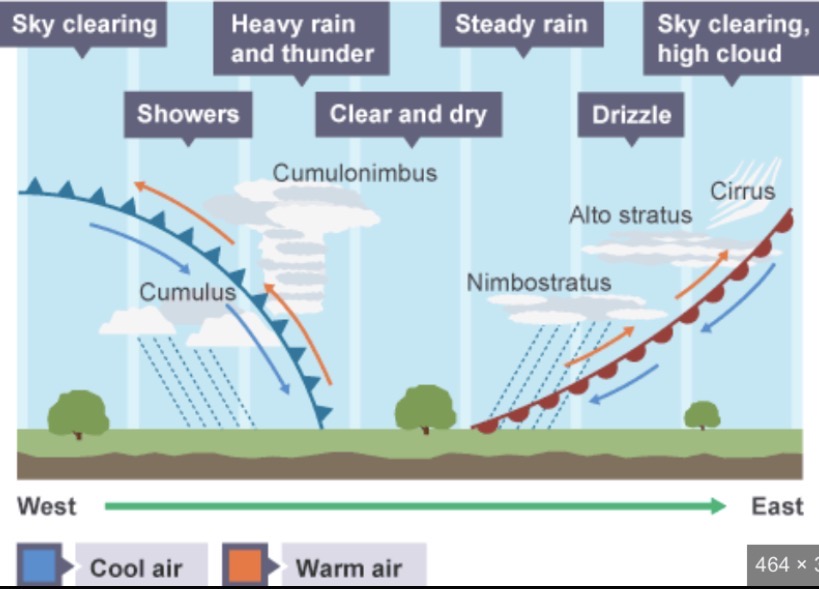
What is this also known as
A depression - when it’s raining
What are the 3 types of rainfall
convectional
Frontal
Orographic
Which is the most common type of rainfall
Frontal
Frontal rainfall
warm air is forced to rise above the cold air
It cools when it reaches high altitude and condensation occurs
When the water droplets become too heavy in the cloud they fall due to gravity
Orographic rainfall
warm air from the coast blows inland from the west in the uk
When the warm air comes into contact with the hills e.g. Pennines it is forced over them into the cooler air above
The warm air meeting the cold air creates condensation around a condensation nuclei
This then forms a cloud and will eventually read to precipitation when the clouds are too heavy so the water will fall due to gravity
Convectional rainfall
water on the surface is heated due to the solar radiation from the sun
Warm air rises above the cool air
This causes condensation around a condensation nuclei
Rain may then occur if the clouds become too heavy
What are the 2 main theories of precipitation formation
the collision coalescence
The Bergeron-findeisen process
The collision coalescence
supersized condensation nuclei e.g. large sea salt particles provide seeds around which very larger water droplets form
The larger super droplets fall under the force of gravity and collide with smaller droplets, absorbing them
The Bergeron findeisen process
clouds at high altitudes contain a mixture of water droplets and ice crystals
The ice crystals absorb water droplets, causing them to grow
The ice crystals are fractured as they are jostled by Hugh altitude air currents
This movement causes hexagonal ice shapes to develop with a larger surface area
Now more water vapour can condense around the ice, making them grow faster
When the ice crystals become too heavy they fall and if the air they fall into is warm enough then they melt
What are similarities between the CCP and the BFP
both influenced by gravity
Both increase in size
Both absorb water vapour
Both need condensation nuclei to form
What are some differences between the CCP and the BFP
BFP is ice crystals and water vapour where as CCP is just water vapour
In CCP the particles have to be moving to absorb water vapour
CCP isn’t influence by high altitude currents
CCP has pear/circle shape where as BFP has a hexagonal shape
What are the physical factors that affect excess runoff
snowmelt/ablation
Storm activity
Monsoon season
What human factors affect excess runoff
urbanisation
Drain and sewer network
Deforested areas
Physical factors more likely to cause excess runoff
possibly as they occur naturally and so are more difficult to manage however things like urbanisation can’t be managed and we can’t pull down a full city as we have already built it
How many people died in Sierra Leone due to the mudslide
1141 people
Why was Sierra Leone more succeptible to a mudslide
Deforestation had weekend the soil as there wasn’t any roots holding it together
How does deforestation change the water cycle
increase in surface storage and overland flow
Soil is compacted by rain drop impact
Water can’t soak into the ground

