Diagram of M5: B16.1: Plant Hormones & Growth (unf. gibberellins) | Quizlet
 Call Kai
 Learn
Learn Practice Test
 Spaced Repetition
 Match
Match Flashcards
 Knowt Play
1/45

There's no tags or description
Looks like no tags are added yet.
Name | Mastery | Learn | Test | Matching | Spaced | Call with Kai | Chat |
|---|
No analytics yet
Send a link to your students to track their progress
46 Terms
state 4 reasons why plants must respond to abiotic conditions
. cope with changing conditions / avoid abiotic stress
. maximise photosynthesis or to obtain more light / water / minerals
. avoid, herbivory / grazing
. to ensure germination is in suitable conditions / pollination / seed set / seed dispersal ;
Chemical coordination: what are the 2 main limitations of plants?
. rooted (therefore immobile)
. no rapidly responding nervous system
Chemical coordination: main difference between plant respones and animal responses
plant responses are slower
Chemical coordination: name 4 important plant hormones
auxins
gibberellins
ABA (abscisic acid)
ethene
TERM
6 functions of auxins
DEFINITION
. control cell elongation
. prevent abscission (leaf fall)
. maintain apical dominance
. involved in tropisms
. stimulate release of ethene
. involved in fruit ripening
TERM
4 functions of gibberellins
DEFINITION
. control cell elongation
. trigger mobilisation of food stores in a seed at germination
. stimulate pollen tube growth in fertilisation
TERM
2 functions of ethene
DEFINITION
. causes fruit ripening
. promotes abscission in deciduous trees
TERM
2 functions of ABA
DEFINITION
. maintains dormancy of seeds and buds
. stimulates cold protective responses (e.g. antifreeze production, stomatal closing)
Chemical coordination: why are chemicals essential in plant responses?
. signal to other species (e.g. protecting themselves from pest attacks)
. chemical defenses against herbivores
. communicate with other plants?
. seed germination
. LT growth of a tree
etc.
why are scientists still unsure about many plant responses?
. very low concentrations, so hard to isolate plant hormones and measure changes because they work at
. multiple interactions between the different chemical control systems, so hard to isolate single chemicals in a specific response
Auxins: what are they?
growth stimulants produced in plants
Auxins: example of an auxin
IAA (indoleacetic acid)
Auxins: where are they produced?
. tips of roots
. tips of shoots
. meristems
Auxins: where can they move? how?
. down the stem
. up the root
via transport tissue and between cells
Auxins: what does the effect of auxins depend on?
. concentration
. interactions with other hormones
Auxins: what are the 3 main effects on plant growth?
. stimulate growth of apical shoot
. apical dominance
. low conc = root growth promoted
what is the apical shoot?
the shoot growing upwards
what are lateral shoots?
shoots that extend horizontally from the plant stem
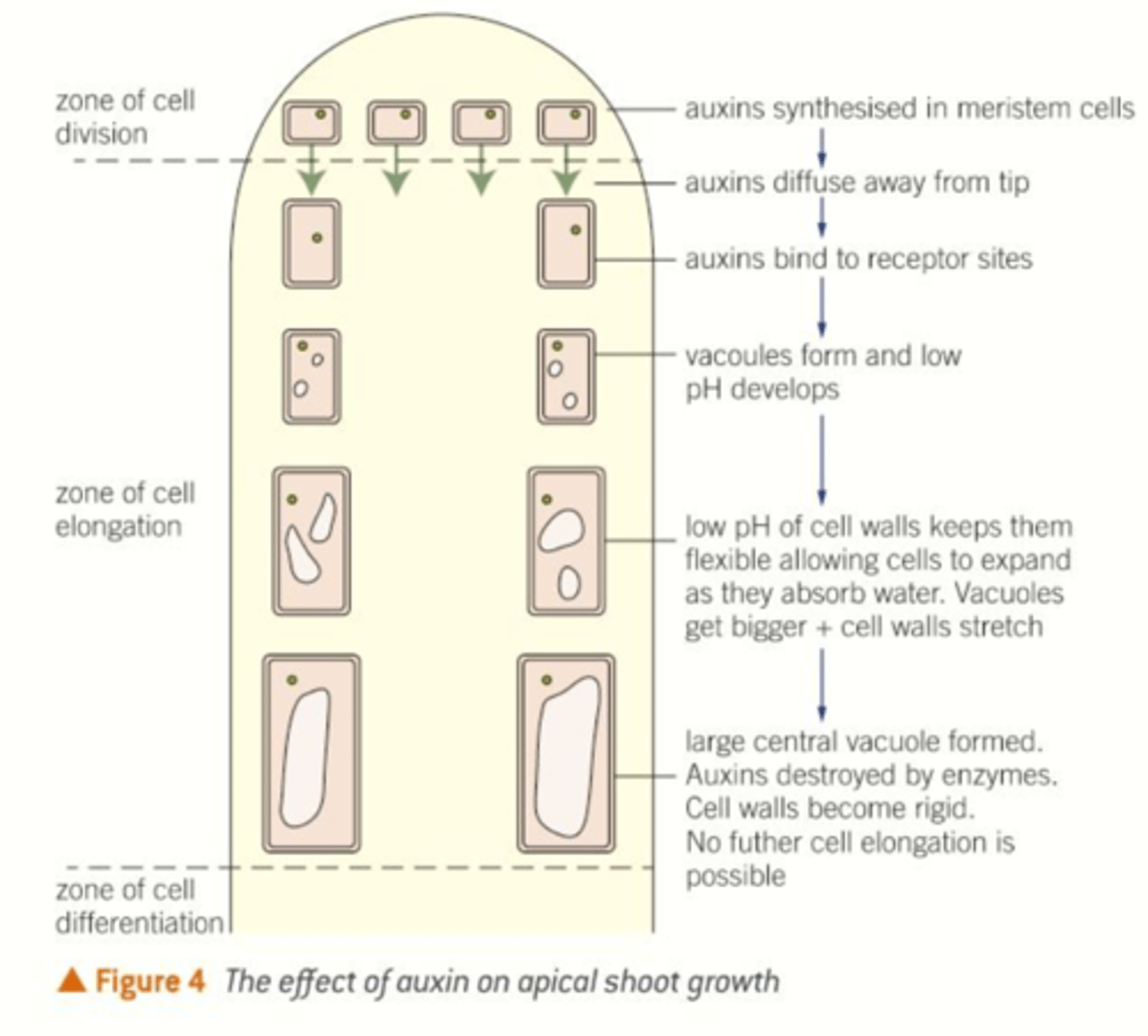
Auxins: functions - apical shoot growth: how does it stimulate apical shoot growth?
affect the plasticity of the cell walls, making it stretchier
1. auxin molecules bind to specific receptor sites in the plant cell membrane
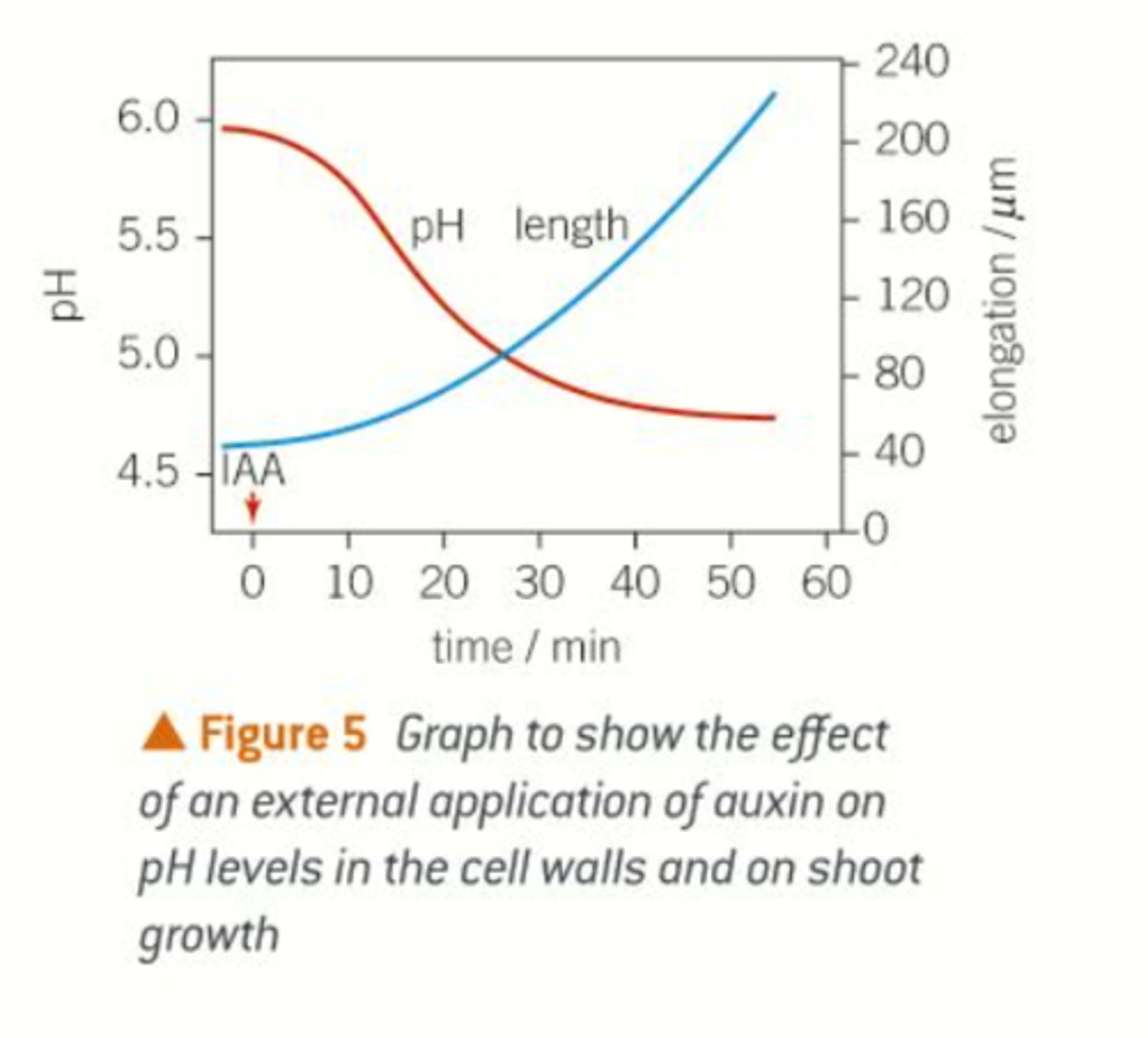
2. causes pH to fall to app 5 pH (optimum for the enzymes needed to keep the walls flexible and plastic)
3. as cells mature, auxin is destroyed
4. pH rises, making the enzymes inactive
5. cell wall becomes rigid and more fixed in shape/size
6. cell can no longer expands and grow
Auxins: functions - apical shoot growth: graph to show the effect of the application of auxin on pH in the cell wall and on shoot growth
Auxins: functions - apical dominance: how does it result in apical dominance?
high concentrations suppresses growth of lateral shoots
1. auxin produced in the tip
2. this stimulates quick growth of the main shoot
3. auxin moves down the stem
4. lateral shoots are inhibited by the auxin
auxin concentration is lower farther down the stem, so the lateral shoots at the bottom grow more strongly
Auxins: functions - apical dominance: describe experimental evidence showing that auxins are involved in apical dominance
1. apical shoot is removed
2. auxin-producing cells are removed = no auxin
3. lateral shoots grow faster
4. auxin applied artificially to the cut apical shoot = apical dominance reasserted and lateral shoot growth is suppressed
Auxins: functions - apical dominance: there were some issues with the evidence for the role of auxins in apical dominance
. what were they?
. how were they overcome?
correlation doesn't equal causation as there may have been unexpected effects of cutting off the apical bud
. exposure to oxygen? - cells at the cut end of the stem could have produced a hormone to promote lateral bud growth?
1. a ring of auxin transporter inhibitor could be added below the apical bud
2. auxin couldn't travel to lateral buds
3. lateral buds grew
therefore... low levels of auxin promote growth of lateral shoots
Auxins: functions - apical dominance: there is still another issue with the evidence for apical dominance. what was it?
3rd variable could have been involved
Auxins: functions - apical dominance: name 2 other chemicals that could have caused the results in the experiments
. abscisic acid
. cytokinins
Auxins: functions - apical dominance: how could abscisstic acid be involved in apical dominance?
abscisic acid inhibits bud growth
high auxin levels may keep the abscisic acid levels high in the bud... if the apical tip is removed, the levels of abscisic acid drop, and the lateral buds start to grow
so it may be the abscisic acid causing it, not the auxin levels?
Gibberellins: what are they involved in?
. the germination of seeds
. elongation of plant stems
what are the food stores found in dicot seeds?
cotyledons
what are the food stores found in monocot seeds?
endosperm
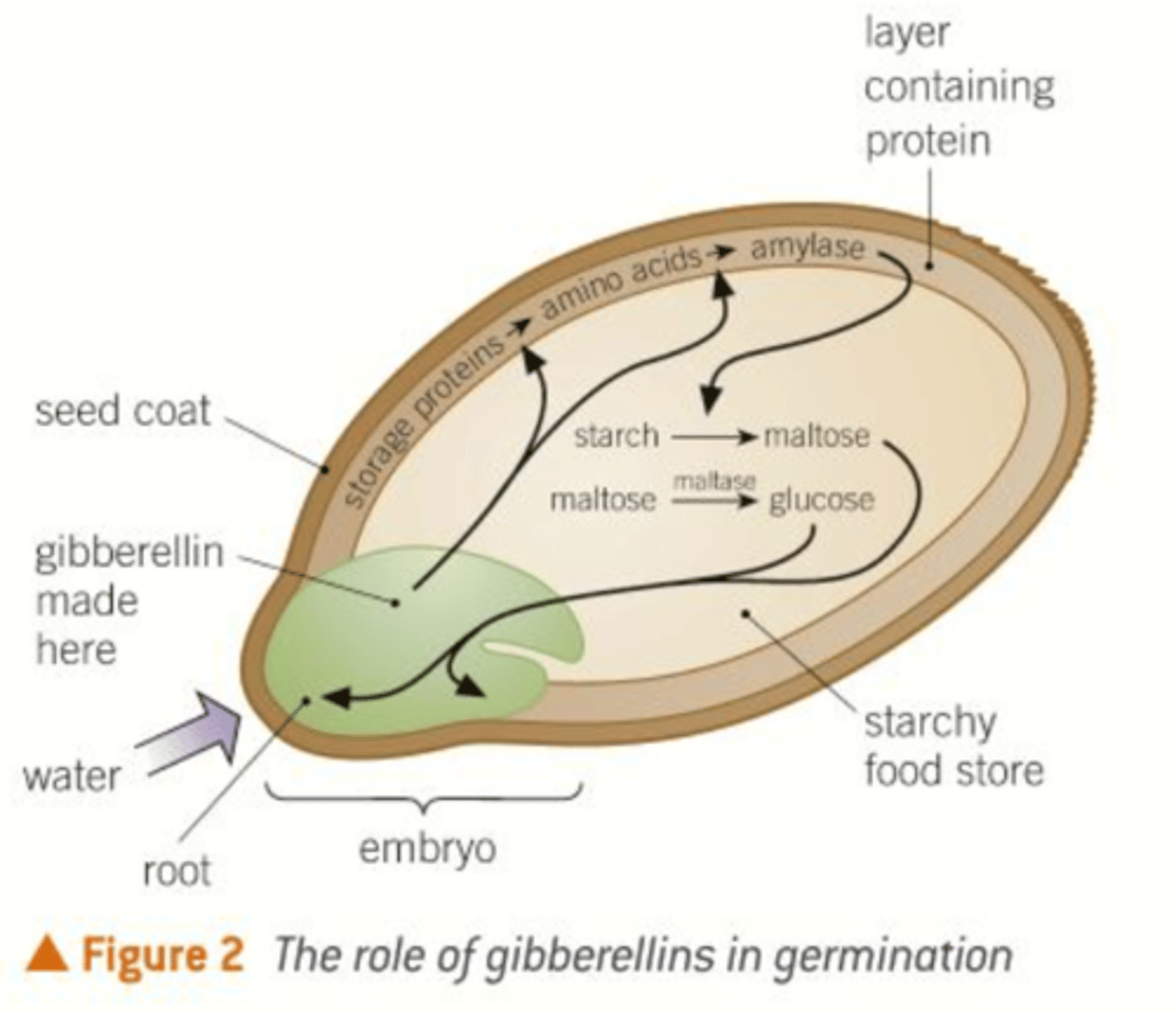
Gibberellins: germination - evidence suggests that gibberellins switch on genes which code for ___________ and ___________
amylases, proteases
Gibberellins: germination - what other hormone is thought to be involved? describe
ABA - may act as an antagonist to gibberellins
Gibberellins: germination - what determines whether a seed will germinate?
the relative levels of gibberellin and ABA
Gibberellins: germination - give 2 sources of experimental evidence that supports the role of gibberellin in germination
. mutant varieties have been bred
. gibberellin biosynthesis inhibitors
Gibberellins: germination - evidence: mutant varieties
these lack the gene which enables them to make gibberellins
. they don't germinate
. if they're applied to the seed externally, they germinate normally
Gibberellins: germination - evidence: gibberellin biosynthesis inhibitors
if they're applied to the seeds, they don't germinate as they can't produce gibberellins
. if the inhibition is removed, they germinate
. if gibberellins are applied, the seeds germinate
Gibberellins: germination - diagram to show the role of gibberellins in germination
Gibberellins: elongation of plant stems - how do they do this?
they affect the length of the internodes
Gibberellins: elongation of plant stems - what are internodes?
the regions between the leaves on a stem
Gibberellins: elongation of plant stems - how were gibberellins discovered?
rice seedlings infected with the fungus from the genus Gibberella grew extremely tall and thin
define tropism
a directional growth response in which the direction of the response is determined by the direction of the external stimulus
Auxins: how much is needed?
very small quantities have a large effect
Auxins: functions -
promotes root growth, up to a point
although auxins are produced in the roots, they are also transported from the apical shoots
if you remove the apical shoots, less auxin reaches the roots, stopping root growth - replacing the auxin artificially at the cut apical shoot restores growth of the roots
if auxins are too high, root growth is inhibited
Gibberellins: germination - how does this happen?
1. seed absorbs water
2. embryo activates
3. embryo produces gibberellins
4. gibberellins stimulate the production of enzymes, which break down the food stores found in the seed
5. food stores used to produce ATP for building materials, so it can grow and break through the seed coat
why is it good for plant hormones to work with other substances?
very fine control over the responses of the plant can be achieved
what is synergism?
when different hormones work together to give each other a greater response than they would have independently
what is antagonism?
when different hormones oppose the actions of each other. the balance determines the response of the plant