Articular Systems & Joints
 Call Kai
 Learn
Learn Practice Test
 Spaced Repetition
 Match
Match Flashcards
 Knowt Play
1/58

There's no tags or description
Looks like no tags are added yet.
Name | Mastery | Learn | Test | Matching | Spaced | Call with Kai |
|---|
No analytics yet
Send a link to your students to track their progress
59 Terms
What is the articular system made of?
Joints, associated ligaments, & accessory structures
What is a joint/articulation?
A point of contact between two bones, bones & cartilage, or bone & teeth
How are articular systems classified structurally?
The presence or absence of space b/w the articulating bones (i.e. synovial cavity)
Type of connective tissue that binds bone together (i.e. cartilage)
What is the articular system?
The system by which bones are jointed to one another by flexible connective tissue, permitting a degree of movement
What is cartilage?
A dense network of resilient, semi-rigid connective tissue of collagen & elastin fibres located in parts of the skeleton where more flexibility is required
e.g. costal cartilage of ribs
How is cartilage nourished, & what is the implication of this in relation to injury?
Via diffusion; they are avascular & aneural
Difficult to heal after injury b/c there is no blood flow & ready supply of nutrients
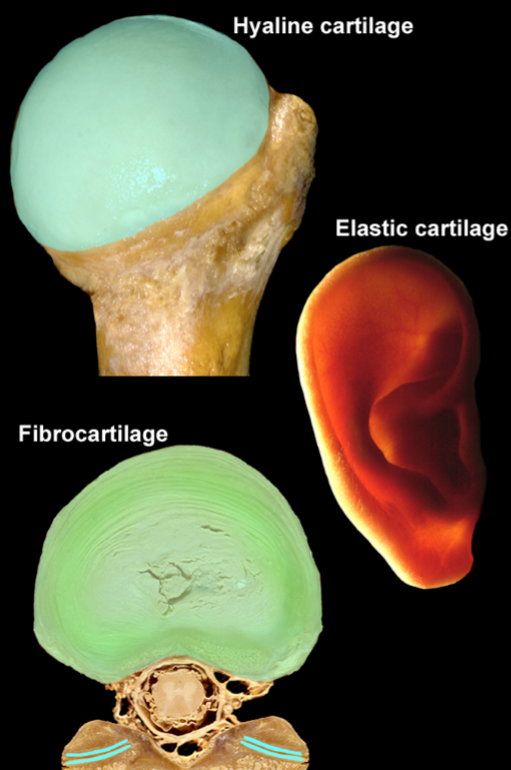
State the three types of cartilage
Hyaline
Elastic
Fibrocartilage
What is hyaline cartilage? Provide some examples
The most common type of cartilage, covering bony articular (epiphyseal) surfaces
Model for early foetal skeleton
Moderate amounts of collagen
Examples:
anterior ends of ribs
nose
parts of larynx
trachea
windpipe
branchial tubes
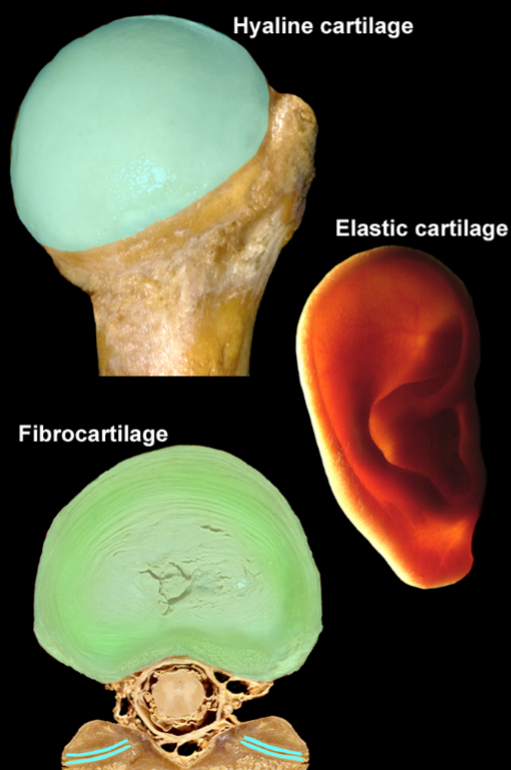
What is elastic cartilage? Provide some examples
Flexible cartilage which forms discrete structures in the external ear, auditory tube, & parts of larynx
Contains bundles of elastic fibres → permits strength & elasticity while maintaining shape
Examples:
Ear
Epiglottis (separates the windpipe & oesophagus)
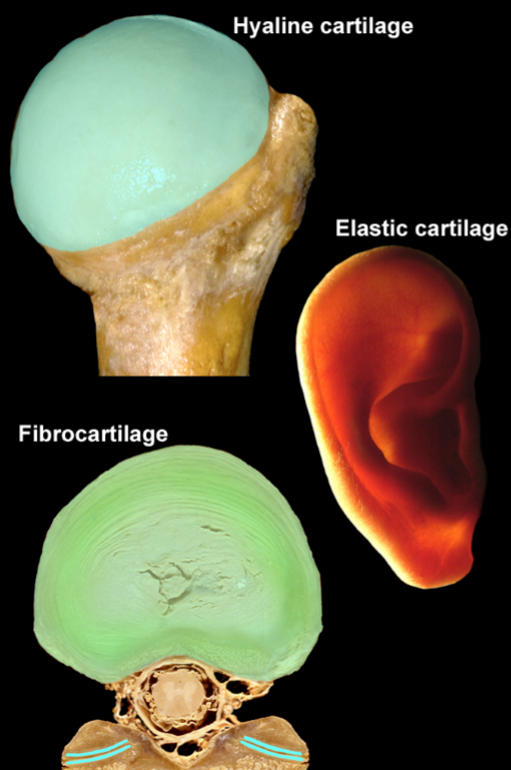
What is fibrocartilage? Provide some examples
Cartilage which forms specialised joints, contributing to articular surfaces
Mix of fibrous tissue + hyaline cartilage
Can withstand prolonged pressure
Substantial amounts of collagen
Supportive structure
Greatest strength & rigidity
Examples:
intervertebral disc
pubic symphysis
State the 3 types of joints/articulations & they key properties
Synovial: moveable
Fibrous: solid, minimal movement
Cartilaginous: solid, minimal movement
What is a synovial joint?
Bones united by a joint/articular cavity, involving many associated structures
articulating bones are joined by an articular capsule, which spans & encloses an articular cavity)
What is a fibrous joint?
Bones united by fibrous tissue, with the degree of movement dependent on the length of the fibres
What is a cartilaginous joint?
Bones united by hyaline or fibrocartilage, which provides strength & shock absorption
What are the 2 broad categories of solid joints?
Fibrous joints
Cartilaginous joints
What are the 3 types of fibrous joints?
Sutures
Syndesmosis
Gomphosis
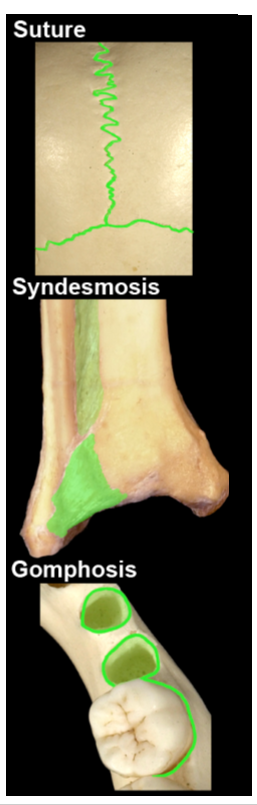
What is a suture joint?
A thin layer of dense, irregular connective tissue called a structural ligament, only present in the skull
What is a syndesmosis joint?
Where two adjacent bones are linked by a ligament, with the length of the ligament determining the degree of movement
What is a ligament?
A sheet of fibrous tissue
What is a gomphosis joint?
Short collagen fibres which run between the root of a tooth & its bony socket
Joined by a periodontal ligament
Specialised type of syndesmosis joint (b/c they are united by a ligament)
Which joints do and don’t have a joint cavity?
Synovial joint: do have a joint cavity
Fibrous & cartilaginous joints: do not have a joint cavity
What are the 2 main types of cartilaginous joint?
Synchondroses (primary)
Symphyses (secondary)
What is a synchondroses (primary) joint? Provie an example
A bar or plate of hyaline cartilage between two ossification centres of a developing bone
Example: epiphyseal plate
What is a symphysis (secondary) joint? Provide an example
Fibrocartilage connecting two separate bones, permitting limited movement
Example: pubic symphysis
Describe the 3 major features of synovial joints
Articular cartilage: hyaline cartilage covers the articulating surfaces of bones
Joint capsule:
Inner synovial membrane: highly vascular, → synovial fluid
Outer fibrous membrane: dense connective tissue which may thicken to form ligaments
Collagen fibres
Extension of periosteum of articulating bones
Accessory structures
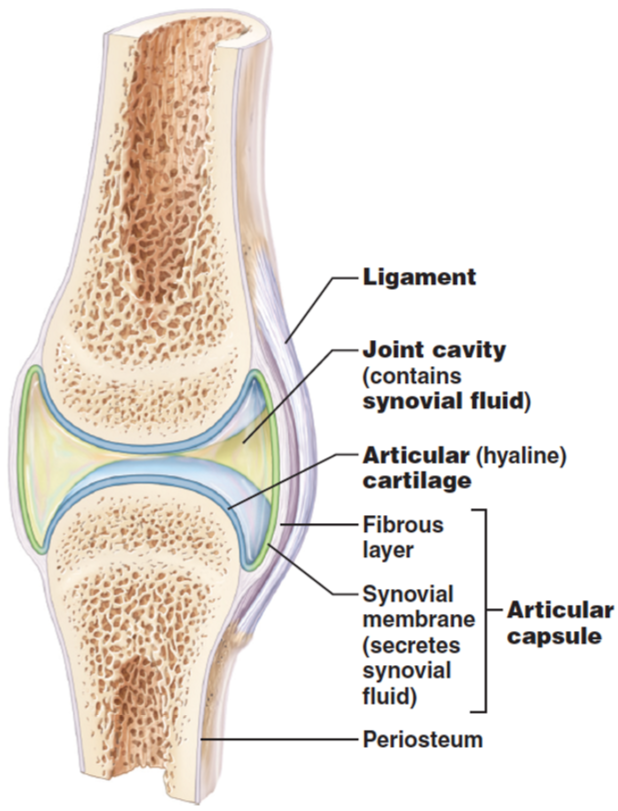
How are synovial joints different to synchondroses joints?
In synchondroses joints, the articulating surfaces are joined together by cartilage. In synovial joints, the articulating surfaces are just covered by cartilage, but are not joined by it
What is the synovial cavity lined with?
The synovial membrane which does NOT extend over the articular cartilage
Secretes viscous synovial fluid from the synovial cells which fills the cavity & from interstitial fluid filtered from blood plasma
Rich blood supply
What is the purpose of synovial fluid?
Reduces friction at the joint --> provides lubrication against cartilage-covered surfaces
Absorbs shock
Produces O2 & removes CO2 from the cells in the articular cartilage (b/c cartilage is avascular)
What is the fibrous capsule of a synovial joint?
Dense irregular tissue made up of collagen fibres which encloses the synovial joint
May be reinforced by ligaments or receive muscle attachments
What are intracapsular structures?
Structures located inside the fibrous capsule of a synovial joint
What does the fibrous capsule of a synovial joint attach to?
The periosteum of the articulating bones
State the 6 types of synovial joints
Plane
Hinge
Pivot
Condyloid
Saddle
Ball & socket
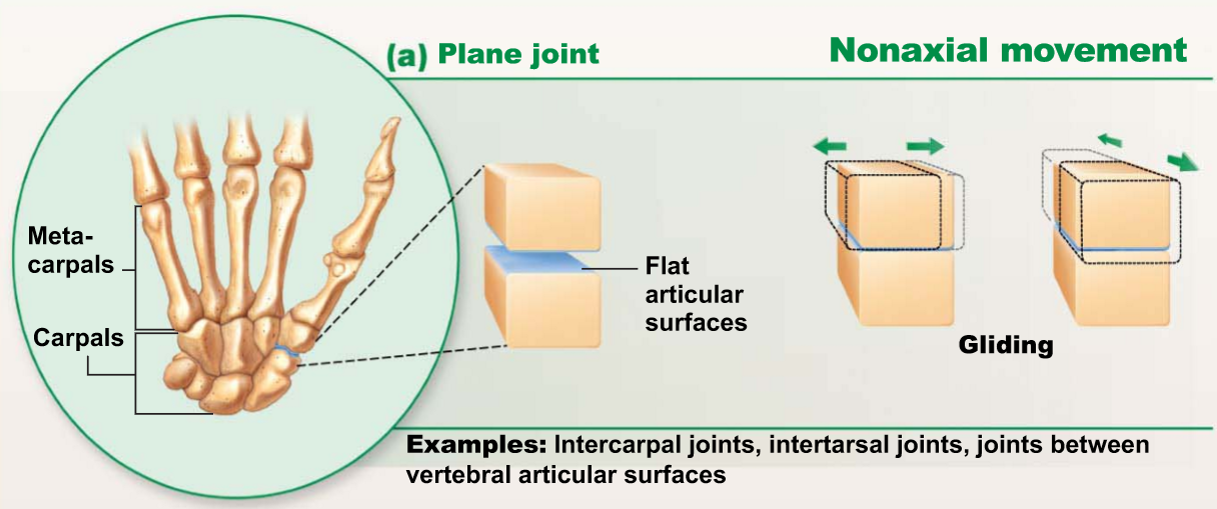
What is a plane joint? Provide an example
Articulating surfaces are flat/slightly curved, allowing for sliding or gliding movements when one bone moves across the surface of another
Example:
Intercarpal joints b/w bones of the wrist
Sternoclavicular joint b/w the sternum & clavicle
Vertebrocostal joints b/w the ribs & the vertebrae
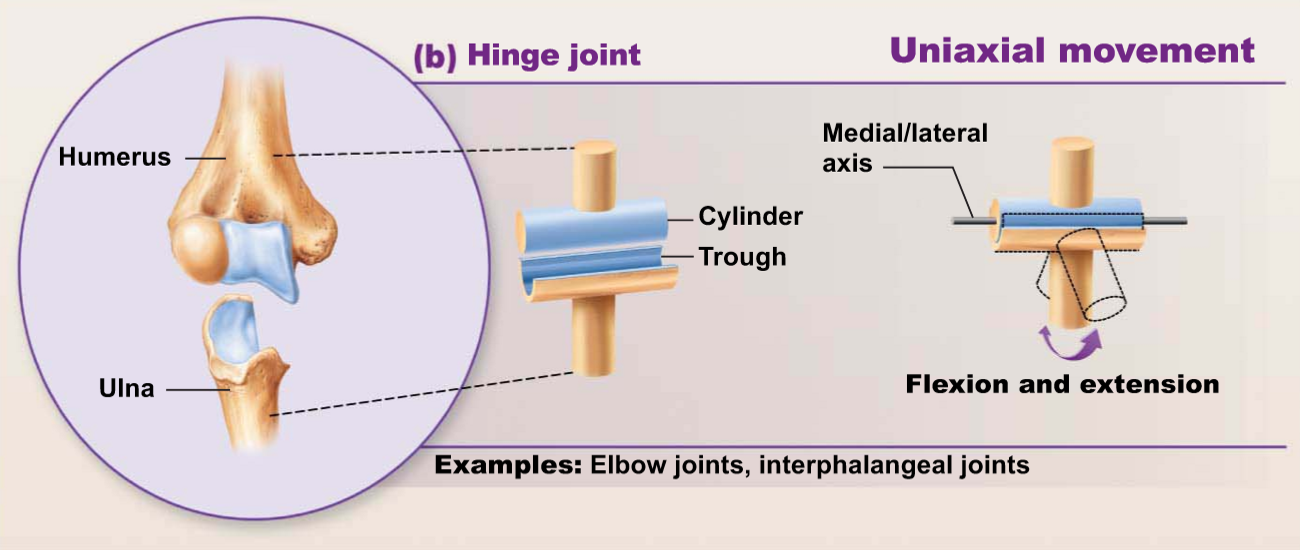
What is a hinge joint? Provide an example
Surfaces of the articulating bones are rounded, allowing movement at right angles to the joint (producing flexion/extension)
Examples:
Ankle joints
Elbow joints
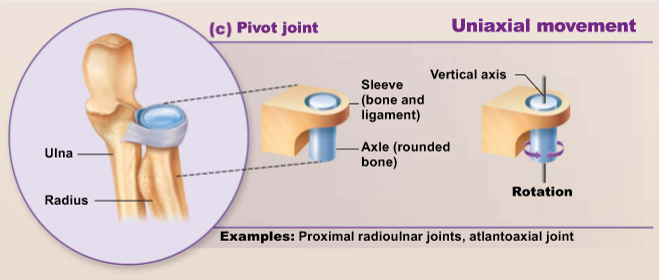
What is a pivot joint? Provide an example
Articulating surfaces are usually a rounded/pointed surface articulating with a ring (formed partly by another bone & partly by a ligament), allowing for movement in line with the longitudinal axis of the bones (rotation)
Examples:
Atlantoaxial joint (neck) b/w first 2 vertebra → head rotation
Radioulnar joint - rotates palm of hand from facing upwards → downwards
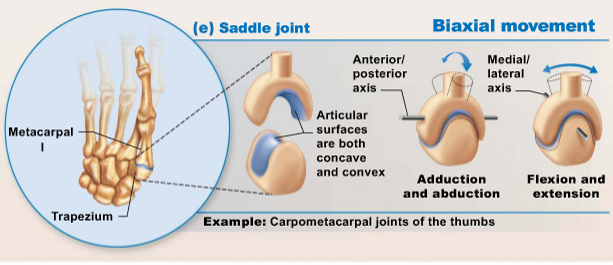
What is a saddle joint? Provide an example
One bone is saddle shaped & the other bone fits into that saddle, allowing for movement around two axes at right angles (flexion/extension & adduction/abduction)
Examples:
Carpometacarpal joint
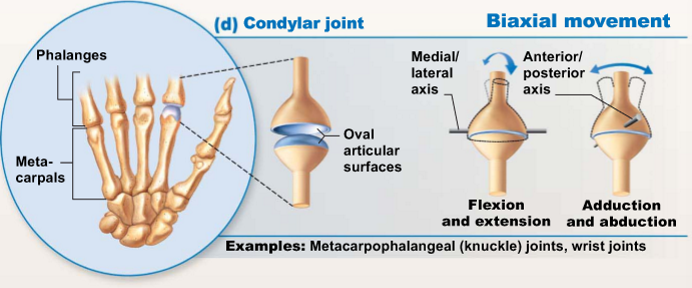
What is a condyloid/ellipsoid joint? Provide an example
Convex oval projection of one bone fits into an oval shaped depression of another bone, allowing for movement around two axes at right angles (flexion/extension & abduction/adduction)
Examples:
Metacarpophalangeal
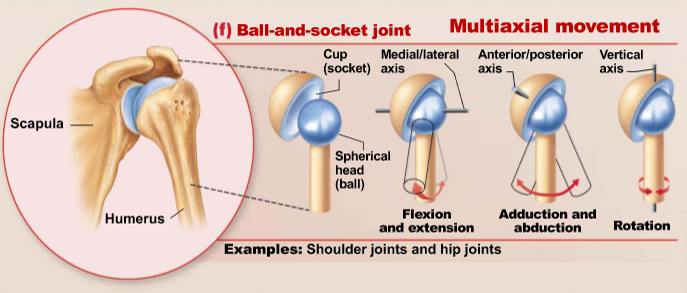
What is a ball-and-socket joint? Provide an example
Ball-like surface of one bone fits into the cap-like depression of another bone, allowing for movement around multiple axes
Flexion/extension, adduction/abduction, circumdation & rotation
Examples:
Glenohumeral joint
Shoulder
Hip
What determines the stability of a synovial joint?
How well the bones fit together
E.g. elbow vs knee
How strong & tight the joint capsule is
E.g. shoulder vs hip
Presence or absence of additional ligaments
E.g. cruciates in knee
The presence or absence of muscles that wrap around/over the joint
E.g. rotator cuff muscles in the shoulder
What are accessory structures?
Structures that help stabilise the joint or provide other mechanisms of support
What are intra-articular structures?
Accessory structures which are located within the articular cavity & float within the synovial fluid
What are the 3 main types of intra-articular structures?
Menisci
Articular discs
Labra
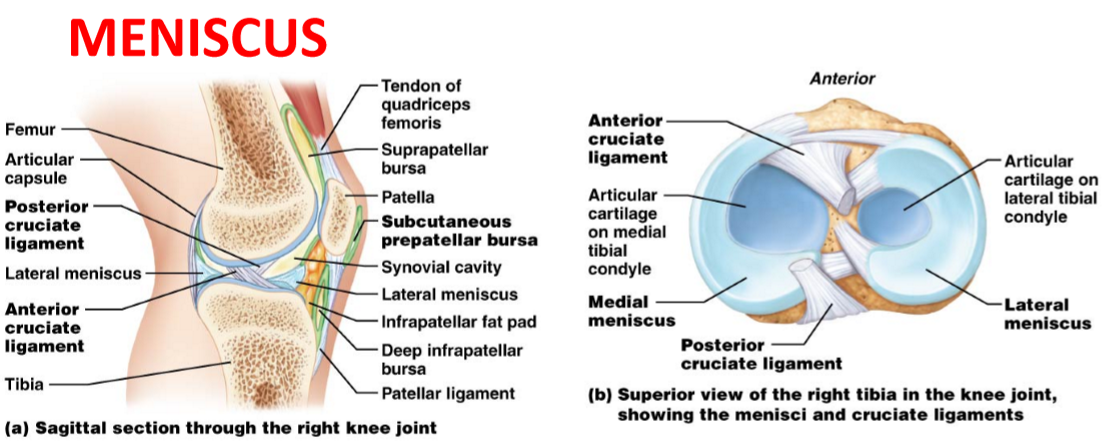
What are menisci?
Cresent-shaped pads of fibrocartilage which are found inside some synovial joints, extend inward from the articular capsule & partially or completely divide it
Allow separate movements to occur simultaneously on each side of partition
Help absorb compression force
Help the fit between the articulating bones
What are articular discs?
Disc-like structures which are made of connective tissue & fibrocartilage
Divide the synovial cavity into 2 separate chambers → allow for 2 separate movements in the same joint space
Binds strongly to the inside of the fibrous membrane (outside of the synovial membrane) of the joint capsule
Separation of discs → different movements occur in each of the spaces
Found in the jaw (temporomandibular joint)
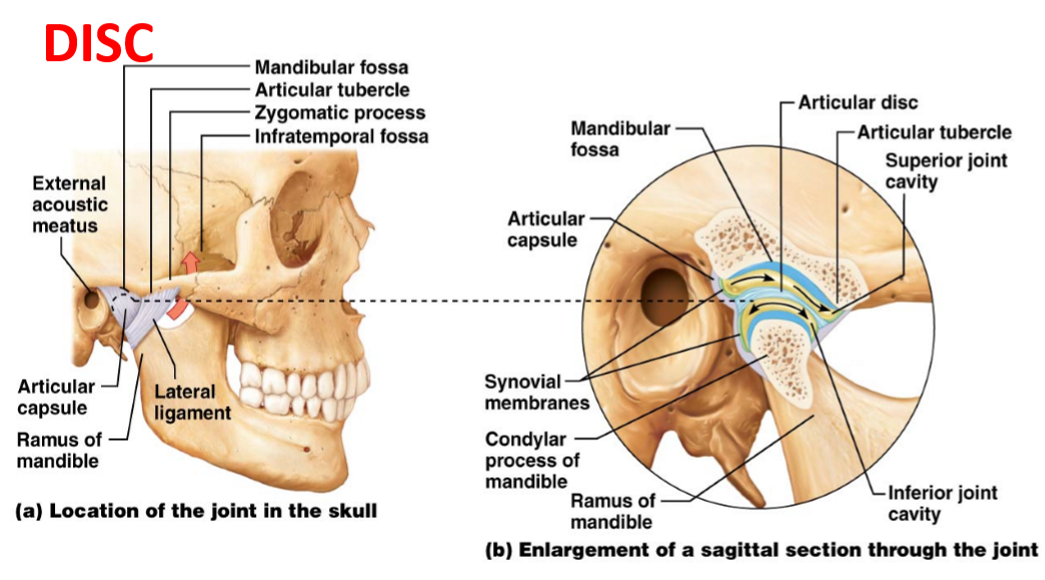
What are labra?
Wedge-shaped structures typically located at the outer margins of ball-&-socket joints (hip & shoulder joints)
Made of fibrocartilage
Enlarges the articulating surfaces of the joints → deepens the joint socket & ^ the contact SA b/w the articulating bones
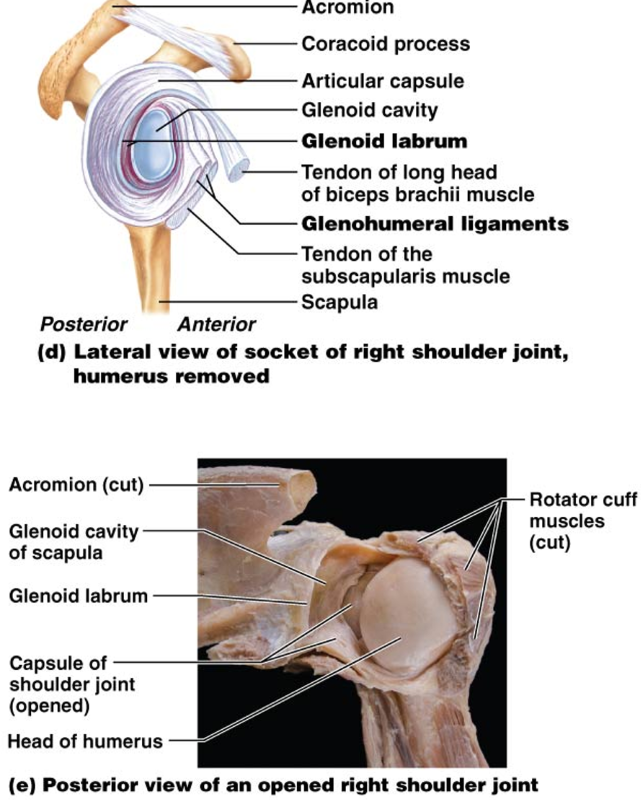
What are extracapsular structures?
Located outside the fibrous capsule of a synovial joint
What are the 2 main types of extracapsular structures?
Fat pads
Bursae & tendon sheaths
What are fat pads?
Sit b/w the synovial & fibrous joint capsules
Provide cushioning for moving joints
Accumulation of adipose tissue
Act as space fillers
Actually intracapsular, but are extrasynovial
Help spread synovial fluid
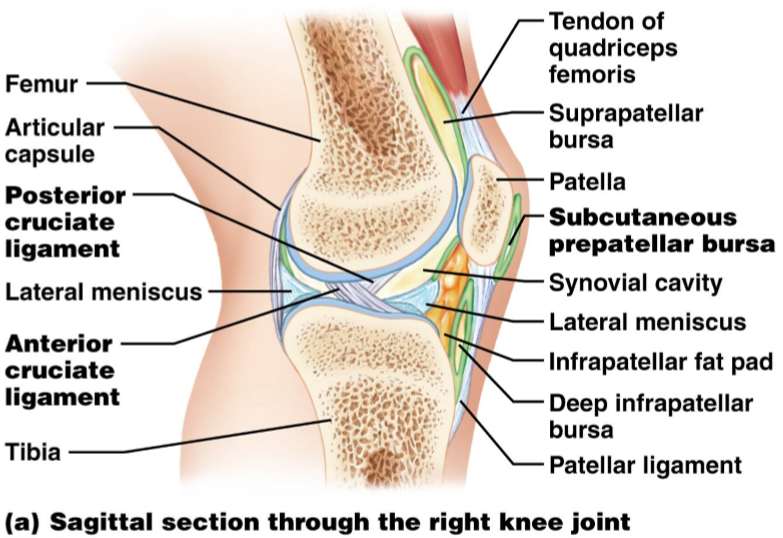
What are bursae & tendon sheaths?
Flattened sac-like structures/bags of lubricant → situated to alleviate friction in the joints
Tendon sheaths wrap around certain tendons as they pass through bony tunnels or near joints → ensures they are protected when rubbing against the rough exterior
Typically located in greater numbers in joints with greater mobility
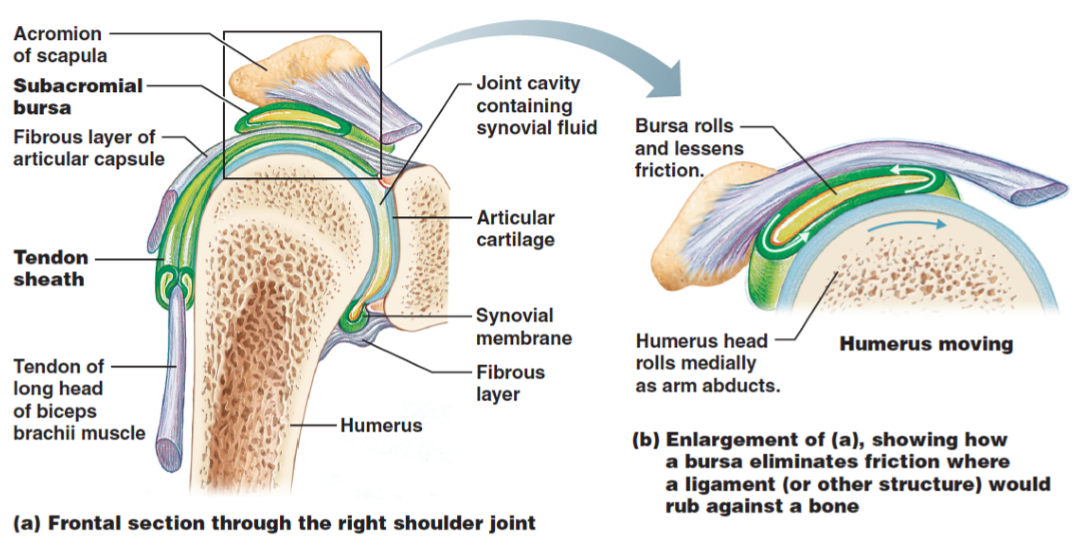
What is bursitis?
Acute or chronic inflammation of a bursa, caused by repeated exertion at a joint
Are bursae strictly part of the synovial joint?
No, but they are quite similar in structure to joint capsules
Walls = outer fibrous membrane filled w/ synovial fluid
Outer membrane produces the synovial fluid
What is the range of motion (ROM) of a joint?
The range, measured in degrees of a circle (360 degrees) through which the bones of a joint can be moved
What are the 6 factors affecting the ROM of a joint?
Structure/shape of the articulating bones
Complementary → interlocking → rotation
Strength & tension of joint ligaments
Tension restricts ROM & direct movement
Arrangement & tension of muscles
Muscle tension reinforces the restraint places on a joint by its ligament
Contact of soft spots
Hormones
E.g. relaxin produced by placenta & ovaries during pregnancy → loosens & ^ flexibility of fibrocartilage of pubic symphis
Disuse
decreases the amount of synovial fluid & flexibility of ligaments & tendons around the joint
What are the 2 key properties of cartilage that particularly suit it to various skeletal roles?
Semi-rigidity; somewhat flexible → allows for movement
Different components for different joints (i.e. different proportions of collagen, elastine & fibrous tissue)
What is the key benefit of hyaline cartilage being avascular & aneural?
Avascular:
Low friction surface
^ compression resistance
Optimal nutrition through diffusion
Support of high-water content
Aneural:
No pain during motion
Protective against damage from internal structures
Control of posture & movement
What is synovitis?
Thickening of the synovium → excess synovial fluid → stifness, warmth & swelling
What is the position called in which a joint has maixmum stability?
Close-packed position
What is the function of collateral ligaments at hinge joints?
Thickenings of capsule @ either side of hinge joint → prevent excessive side-to-side motion
What type of ligament configuration allows the greatest range of movement whilst also being more likely to get sprained?
A ligament that is arranged in discrete parts

