Lecture 7: Critical Discourse Analysis (CDA)

0.0(0)
studied byStudied by 9 people
0.0(0)
full-widthCall Kai
learnLearn
examPractice Test
spaced repetitionSpaced Repetition
heart puzzleMatch
flashcardsFlashcards
GameKnowt Play
Card Sorting

1/15

encourage image

There's no tags or description

Looks like no tags are added yet.

Study Analytics
Name
Mastery
Learn
Test
Matching
Spaced

No study sessions yet.

16 Terms

1
New cards
<p><span style="background-color: transparent; font-family: &quot;Times New Roman&quot;, serif;"><strong><span>1. What is CDA?</span></strong></span></p><ul><li><p style="text-align: justify;"><span style="background-color: transparent; font-family: &quot;Times New Roman&quot;, serif;"><span>emerged in the 1970s, reflecting a turn from the purely structural dimension to the f</span><strong><u><span>____________ aspect</span></u></strong><span> of language.&nbsp;</span></span></p></li><li><p style="text-align: justify;"><span style="background-color: transparent; font-family: &quot;Times New Roman&quot;, serif;"><span>studies language use in its s</span><strong><u><span>_____-p________ context</span></u></strong><span>&nbsp;</span></span></p></li><li><p style="text-align: justify;"><span style="background-color: transparent; font-family: &quot;Times New Roman&quot;, serif;"><span>regards '</span><strong><u><span>discourse as s_________ pr________</span></u></strong><span>' (Fairclough and Wodak, 1997).&nbsp;</span></span></p></li><li><p style="text-align: justify;"><span style="background-color: transparent; font-family: &quot;Times New Roman&quot;, serif;"><strong><span>The Power Link:</span></strong><span> CDA's central interest is the relationship between </span><strong><span>language and p_________ </span></strong><span>. Its primary aim is to </span><strong><span>unearth the id____________ </span></strong><span>underlying discourse, especially those that maintain </span><strong><span>unequal power relations</span></strong><span>.</span></span></p></li></ul><p></p>

1. What is CDA?

  • emerged in the 1970s, reflecting a turn from the purely structural dimension to the f____________ aspect of language. 

  • studies language use in its s_____-p________ context 

  • regards 'discourse as s_________ pr________' (Fairclough and Wodak, 1997). 

  • The Power Link: CDA's central interest is the relationship between language and p_________ . Its primary aim is to unearth the id____________ underlying discourse, especially those that maintain unequal power relations.

functional, socio-political, social practice, power, ideologies

2
New cards
<ul><li><p style="text-align: justify;"><span style="background-color: transparent; font-family: &quot;Times New Roman&quot;, serif;"><strong><span>The Critical Stance (van Dijk):</span></strong><span>&nbsp;</span></span></p><ul><li><p style="text-align: justify;"><span style="background-color: transparent; font-family: &quot;Times New Roman&quot;, serif;"><span>CDA is explicitly n</span><strong><span>______ p___________ n________</span></strong><span>.&nbsp;</span></span></p></li><li><p style="text-align: justify;"><span style="background-color: transparent; font-family: &quot;Times New Roman&quot;, serif;"><span>It is a form of critical science that starts from prevailing social problems, takes the perspective of the op___________, and critically analyzes t_______ i____ p_______ who are </span></span><span style="background-color: transparent; font-family: &quot;Times New Roman&quot;, serif; color: blue;"><strong><u><span>responsible for the problems</span></u></strong></span><span style="background-color: transparent; font-family: &quot;Times New Roman&quot;, serif;"><span>.&nbsp;</span></span></p></li><li><p style="text-align: justify;"><span style="background-color: transparent; font-family: &quot;Times New Roman&quot;, serif;"><span>It is research with a st__________ , committed to </span></span><span style="background-color: transparent; font-family: &quot;Times New Roman&quot;, serif; color: blue;"><strong><u><span>radical social change for fairness and equality</span></u></strong></span><span style="background-color: transparent; font-family: &quot;Times New Roman&quot;, serif;"><span>.</span></span></p></li></ul></li></ul><p style="text-align: justify;"><span style="background-color: transparent; font-family: &quot;Times New Roman&quot;, serif;"><span>Example:</span></span></p><p style="text-align: justify;"><span style="background-color: transparent; font-family: &quot;Times New Roman&quot;, serif;"><span>If you are asking yourself:&nbsp;</span></span></p><p style="text-align: justify;"><span style="background-color: transparent; font-family: &quot;Times New Roman&quot;, serif;"><span>&nbsp;&nbsp;&nbsp;- what is there in the picture?&nbsp;</span></span></p><p style="text-align: justify;"><span style="background-color: transparent; font-family: &quot;Times New Roman&quot;, serif;"><span>&nbsp;&nbsp;-What makes the components of the picture cohere?&nbsp;</span></span></p><p style="text-align: justify;"><span style="background-color: transparent; font-family: &quot;Times New Roman&quot;, serif;"><span>You are probably doing Discourse Analysis, looking at the linguistic/ visual structure of the discourse.</span></span></p><table style="min-width: 25px;"><colgroup><col style="min-width: 25px;"></colgroup><tbody><tr><td colspan="1" rowspan="1" style="vertical-align: top; padding: 5pt; overflow: hidden; overflow-wrap: break-word;"><p style="text-align: justify;"><span style="background-color: transparent; font-family: &quot;Times New Roman&quot;, serif;"><em><span>FYI: This picture is taken from an article on working mothers, published on the 8 March 2010</span></em></span></p></td></tr></tbody></table><p style="text-align: justify;"><span style="background-color: transparent; font-family: &quot;Times New Roman&quot;, serif;"><span>Of course, discourse is not limited to linguistic features but includes visual elements as well.</span></span></p><p style="text-align: justify;"><span style="background-color: transparent; font-family: &quot;Times New Roman&quot;, serif;"><span>If you are looking closer at the picture and ask:</span></span></p><p style="text-align: justify;"><span style="background-color: transparent; font-family: &quot;Times New Roman&quot;, serif;"><span>- Where is the picture taken from? During what period?</span></span></p><p style="text-align: justify;"><span style="background-color: transparent; font-family: &quot;Times New Roman&quot;, serif;"><span>- Why is the woman represented that way?</span></span></p><p style="text-align: justify;"><span style="background-color: transparent; font-family: &quot;Times New Roman&quot;, serif;"><span>- What is another possible way of representing the woman?</span></span></p><p style="text-align: justify;"><span style="background-color: transparent; font-family: &quot;Times New Roman&quot;, serif;"><span>- What assumption is hidden in the picture?</span></span></p><p style="text-align: justify;"><span style="background-color: transparent; font-family: &quot;Times New Roman&quot;, serif;"><span>And numerous more critical questions</span></span></p><p style="text-align: justify;"><span style="background-color: transparent; font-family: &quot;Times New Roman&quot;, serif;"><span>Then you are doing Critical Discourse Analysis</span></span></p>
  • The Critical Stance (van Dijk): 

    • CDA is explicitly n______ p___________ n________

    • It is a form of critical science that starts from prevailing social problems, takes the perspective of the op___________, and critically analyzes t_______ i____ p_______ who are responsible for the problems

    • It is research with a st__________ , committed to radical social change for fairness and equality.

Example:

If you are asking yourself: 

   - what is there in the picture? 

  -What makes the components of the picture cohere? 

You are probably doing Discourse Analysis, looking at the linguistic/ visual structure of the discourse.

FYI: This picture is taken from an article on working mothers, published on the 8 March 2010

Of course, discourse is not limited to linguistic features but includes visual elements as well.

If you are looking closer at the picture and ask:

- Where is the picture taken from? During what period?

- Why is the woman represented that way?

- What is another possible way of representing the woman?

- What assumption is hidden in the picture?

And numerous more critical questions

Then you are doing Critical Discourse Analysis

not politically neutral, oppressed, those in power, stance

3
New cards

2. Main tenets of CDA

1. CDA perceives discourse, or discursive practice, as ______ ________.

  • Language is social: language is a social phenomenon, part of society, not somehow external to it. 

    • 'social practice' = human activity, emphasizing the con____________ aspect of activity and its relation to s______ str_________. 

    • discourse: the com______________ pr________ in which language is produced and interpreted in a social setting.

  • M_____-m______ Scope: Discourse encompasses spoken and written linguistic texts and visual or audio-visual modes.

  • Goal: To analyze the d_____________ dimension of social and cultural phenomena.

  • Discourses exist in relation to other discourses, which can be supporting, competing or conflicting. 

    • Example. Classroom discourse: 

      • Classroom discourse is a social practice - a communicative process which is conventionally organized. During a classroom discourse, both spoken and written texts are present in visual or audio-visual modes. 

      • One classroom discourse exists in relation to other classroom discourses; e. g., following a certain syllabus in terms of content.

social practice, conventional, social structure, communicative process, Multi-Modal, discursive

4
New cards

2. Main tenets of CDA

2. Discourse is both Socially Constituted and constitutive

  • The relation between discourse and the social is a ___________ one (Fairclough, 2001). 

  • _________ __________: Discourse is conditioned by the social

    • Discourse is socially constituted = Discourse complies with social ___________ in reflecting social reality and conforming to pre-existing institutional/societal norms regarding what is said and how it's said (e.g., classroom interaction).

      • In other words, discourse is socially constituted in both the what and the how dimensions. 

  • __________ ___________ (forming part of sth): Discourse is not one-way.

    • Discourse also actively contributes to the ________ and reshaping of s_______ str__________ and can lead to social continuity or social change (Fairclough, 2001). 

    • Discourse is ______ ___________ (toàn năng, có khả năng vô hạn trong mọi việc) and is conditioned by social reality or other discourses.

      • CDA vs. Post-Structuralism: CDA differs by not reducing all social life to discourse; it recognizes that material reality exists independently of discourse, avoiding the post-structuralist notion of discourse being "omnipotent."

        • Examples: Think about a classroom discourse again 

          • How a classroom discourse is organized reflects the social structure, i.e. the power relation between teachers and students, for example: 

            • Ask yourself' in a classroom discourse, 

              • Who has more power? 

              • Who decides what to learn? 

              • How are the students' and teachers' tables arranged? 

          • All these things (and others) reflect the pre-existing social relation between discourse participants (teachers and students). 

          • The content of the lessons (what to teach) is also conditioned by social structure. 

          • By complying with the social norms, we are at the same time reshaping those norms and re-enforcing them. 

=> Discourse is both socially conditioned and conditioning.
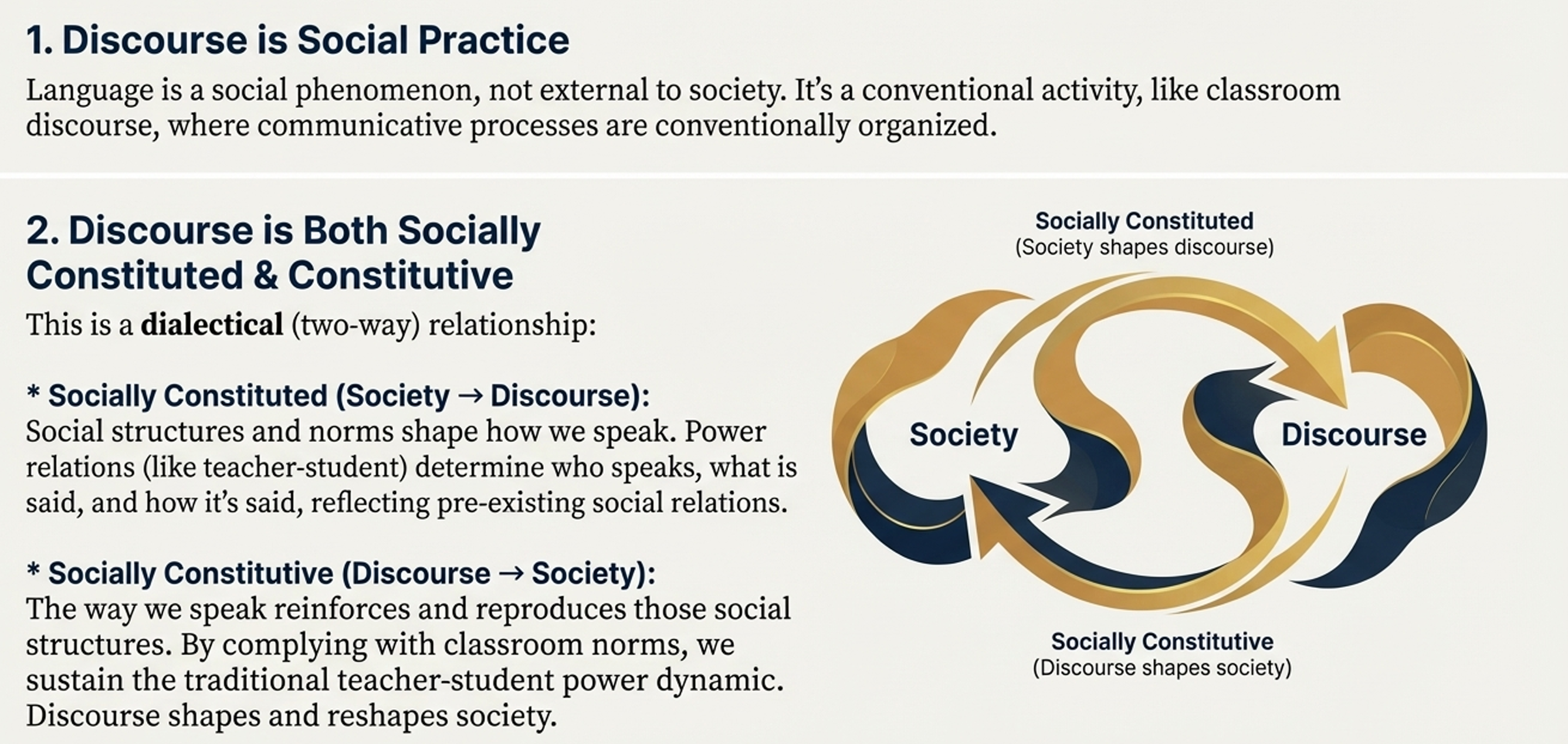
dialectical, Socially Constituted, conventions, Socially Constitutive, shaping, social structures, not omnipotent

5
New cards

2. Main tenets of CDA

3. Discourse should be analyzed within its _______ ___________ (contextualized)

  • Discourse is h__________ and can only be understood with reference to its social context or existing discourses

  • Analyzing discourse means not just analyzing texts, nor analyzing processes of production and interpretation, but analyzing the relationship between t_____ , pr__________, and their s_______ c___________

  • s_________ c____________: both the immediate conditions of the situational context and the conditions of institutional and social structures on a higher level (Fairclough, 2001):

    • Immediate situational context.

    • Institutional and social structures (higher level).

  • CDA also introduces the notion of in_____________ and in_______________ (a text blends elements, styles, or genres from different discourses), which highlight the importance of seeing texts in relation to other existing texts.

  • Examples: 

    • If you want to analyze a political speech, say, Bush's Ultimatum to Hussein (19/3/2003). Can you just work on the text itself? 

    • Yes, if you are a structural grammarian. 

    • No, if you are a Critical Discourse Analyst: You need to study the political situation where the speech appeared, for example, 

      • what was going on in Iraq? 

      • What has the US done? 

      • What had been expected by the US? And so on. 

    • You need to study the social context: 

      • where and when the speech was given? 

      • Who the addressor and addressee were? 

    • You also need to study other already-existing speeches given by Bush on the same issue.

social context, historical, texts, processes, social conditions, Social conditions, intertextuality, interdiscursivity

6
New cards

2. Main tenets of CDA

4. Discourse f___________ i________________

  • Ideology m___________: Ideology is mediated (carried/transmitted) through language use (Fairclough, 1995, 2001). 

    • Discourse reflects the interests of certain social groups (race, gender, etc.).

    • We don't usually say ideology directly ("I believe men are more valuable than women"). Instead, ideology sneaks in through word choice, naming, and framing.

  • Language embodies our cultural and social values; hence, when we speak, we do not just say words, we s______ o_____ c_______ (Goddard & Patterson, 2000:67).

  • CDA practitioners are interested in finding out what these un_____________ id__________ are. 

  • If certain ideologies disadvantage a particular social group, then the uncovering of these ideologies can raise people's awareness , which is believed to be the first step towards e____________ (the process of giving people social or political freedom and rights).

    • ⇒ Emancipatory Goal: CDA doesn't focus on intent (deliberate or subconscious), but on uncovering the ideology

  • Examples:

    • Do you see the difference in the use of the following pairs of phrases?

      • Sinh con trai - Sinh quý tử

      • Đánh bom cảm tử - Đánh bom liều chết/Đánh bom khủng bố

      • The Vietnam war - The American war/The Resistance War against America

  • When people use language, they are faced with language choices. Their choice of language reflects their culture, their point of view or their political stance, whether they mean it or not.

    • ⇒ Non- ________________: There is no neutral discourse (Coates, 1998). Language embodies cultural and social values; speakers make selections that embed beliefs, often unaware of the underlying ideology.

functions ideologically, Mediation, speak our culture, underlying ideologies, emancipation, Non-Neutrality

7
New cards

2. Main tenets of CDA

5. CDA is research with a stance

  • CDA is always explicit about its own po__________ and com____________. 

  • CDA is committed to radical social change for f_______ and equality.

    • The goal of CDA is to help change society so it becomes fairer and more equal 

  • CDA takes sides with the opp__________ and less powerful in discourse. 

    • CDA researchers support m___________ or powerless groups (e.g., minorities, workers, women, etc.) and analyze how language keeps them oppressed.

  • CDA attempts to be a sy___________ kind of analysis which based on particular linguistic theories and social contextual information to draw out conclusions. 

    • CDA still follows a scientific and structured method, combining linguistic analysis (grammar, word choice, etc.) and social context to explain hidden meanings and power relations.

  • The term 'cr_________' is to be understood as having distance the data, embedding the data in the social, taking a political stance explicitly, and a focus on self-reflection as scholars do research (Wodak and Meyer, 2001:9).

    • Taking distance from the data: Not just describing what’s said, but asking why it’s said that way.

    • Embedding the data in the social: Seeing how the text connects to social structures (e.g., patriarchy, capitalism).

    • Taking a political stance: Openly saying your perspective.

    • Self-reflection: Being aware of your own bias as a researcher.

  • Example: 

    • Some people are against racism (their point of view is explicit) and they found that some discourses are reflecting/ disseminating racist point of view. They do critical analysis of those discourses to raise people's awareness about racism in those discourses. See Kim (2014) in the reading handout.

position, commitment, fairness, oppressed, marginalized, systematic, critical

8
New cards

3. What is ideology, critical, and power?

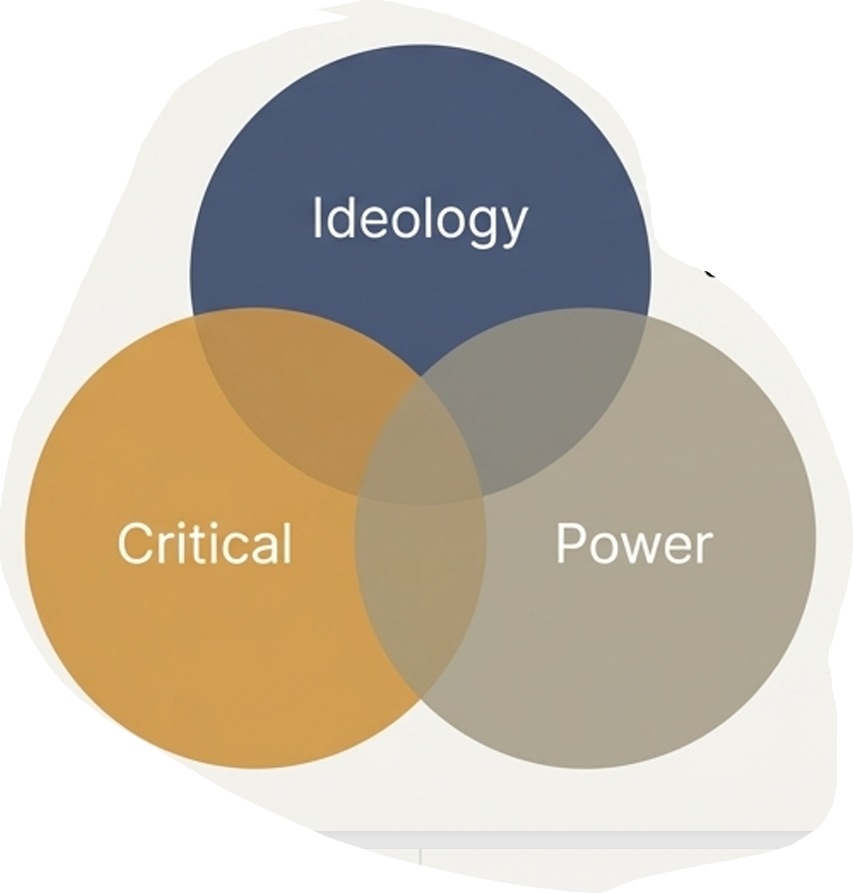
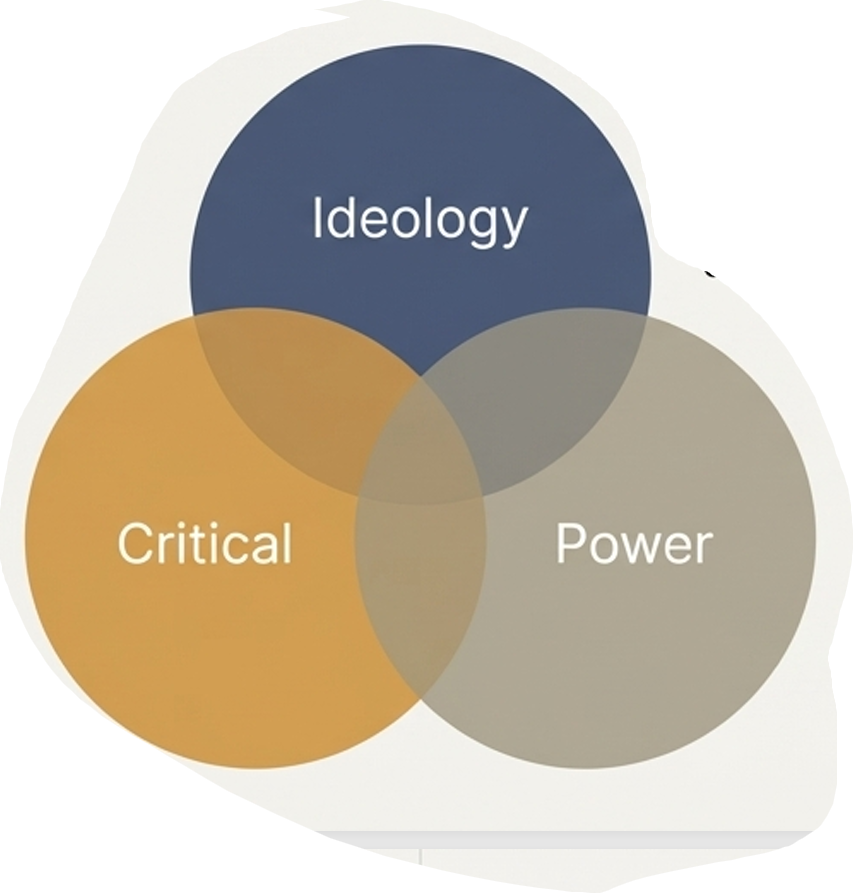
CDA revolves around 3 key concepts: “critical, ideology, and power”

  • _________

    • having distance to the data, embedding the data in the social, taking a political stance explicitly, and a focus on self-reflection as scholars doing research.

  • _________ (controversial & elusive academic issues):  

    • 'A mosaic of cultural assumptions, political beliefs and institutional practices' - Simpson (1993: 176)

      • Language is the physical form of ideology = Language is an indispensable part of studying ideology (Fairclough, 2001, 1995)

        • For CDA, ideology plays a crucial role in establishing and maintaining unequal power relations. 

Critical, Ideology

9
New cards

3. What is ideology, critical, and power?

CDA revolves around 3 key concepts: “critical, ideology, and power”

  • Power

    • People often have different powers in society, and CDA studies such relations of difference (particularly the effects of differences on social structure).

    • Language and social power are interconnected in many ways:

      • Language in_______ power (language indirectly indicates who has power, authority, or higher status_: 

      • Language ex________ power: 

      • Language is in________ where there is contention over and a challenge to power: 

indexes, expresses, involved

10
New cards

Power does n____ d_______ from language, but language can be used to ch_________ power, to s______ (to try to destroy or damage something, especially an established political system) it, to a____ dis____________ of power in the short and long term (Fairclough, 2001).

For CDA, language is n___ p_________ on its own:

  • Language gains power by the u_____ that powerful people make of it. 

  • CDA often: 

    • chooses the perspective of those who s________ and 

    • critically analyzes the language use of those i____ p________r who are:

      • responsible for the existence of inequalities

      • also have the means and opportunity to improve conditions.

not derive, challenge, subvert, alter distributions, not powerful, use, suffer, in power
11
New cards
<p><span style="background-color: transparent; font-family: &quot;Times New Roman&quot;, serif;"><span>Ideologies are cl_______ l_______ to power (Fairclough, 2001):</span></span></p><ul><li><p style="text-align: justify;"><span style="background-color: transparent; font-family: &quot;Times New Roman&quot;, serif;"><span>The nature of ideological assumptions is embedded in particular con</span><strong><em><u><span>____________ </span></u></em></strong><span>(</span><strong><em><u><span>rules and habits we follow when we speak or act in society</span></u></em></strong><span>)</span></span></p><ul><li><p style="text-align: justify;"><span style="background-color: transparent; font-family: &quot;Times New Roman&quot;, serif;"><span>The nature of those conventions depends on the p________ r__________ that underlie the conventions:</span></span></p><ul><li><p style="text-align: justify;"><span style="background-color: transparent; font-family: &quot;Times New Roman&quot;, serif;"><span>“Conventions” = the social rules, habits, or norms we follow in language and behavior.</span></span></p></li><li><p style="text-align: justify;"><span style="background-color: transparent; font-family: &quot;Times New Roman&quot;, serif;"><span>“Depend on the power relations” means these conventions are shaped by who has power in society.</span></span></p><ul><li><p style="text-align: justify;"><span style="background-color: transparent; font-family: &quot;Times New Roman&quot;, serif;"><span>The way we are taught to act or speak (the conventions) is not neutral, but reflects the influence of powerful groups (like governments, media, men over women, rich over poor, etc.).</span></span></p></li></ul></li></ul></li></ul></li></ul><p></p>

Ideologies are cl_______ l_______ to power (Fairclough, 2001):

  • The nature of ideological assumptions is embedded in particular con____________ (rules and habits we follow when we speak or act in society)

    • The nature of those conventions depends on the p________ r__________ that underlie the conventions:

      • “Conventions” = the social rules, habits, or norms we follow in language and behavior.

      • “Depend on the power relations” means these conventions are shaped by who has power in society.

        • The way we are taught to act or speak (the conventions) is not neutral, but reflects the influence of powerful groups (like governments, media, men over women, rich over poor, etc.).

closely linked, conventions, power relations
12
New cards
<p><span style="background-color: transparent; font-family: &quot;Times New Roman&quot;, serif;"><span>Ideologies are closely linked to l______:&nbsp;</span></span></p><ul><li><p style="text-align: justify;"><span style="background-color: transparent; font-family: &quot;Times New Roman&quot;, serif;"><span>Using language is the c___________ form of social b_________ where we rely most on 'c__________ s______' assumptions:</span></span></p><ul><li><p style="text-align: justify;"><span style="background-color: transparent; font-family: &quot;Times New Roman&quot;, serif;"><span>Our beliefs, values, and worldviews (ideologies) are ex__________ through language, in what we say and how we say it.</span></span></p></li><li><p style="text-align: justify;"><span style="background-color: transparent; font-family: &quot;Times New Roman&quot;, serif;"><span>Talking, writing, texting, etc. are the most common ways we interact with other people in society.</span></span></p></li><li><p style="text-align: justify;"><span style="background-color: transparent; font-family: &quot;Times New Roman&quot;, serif;"><span>When we speak, we don’t usually stop to question everything we say. We depend on </span></span><span style="background-color: transparent; font-family: &quot;Times New Roman&quot;, serif; color: blue;"><strong><u><span>what feels “normal” or “obvious”</span></u></strong></span><span style="background-color: transparent; font-family: &quot;Times New Roman&quot;, serif;"><span> (things society has already taught us to accept as “common sense”).</span></span></p></li></ul></li></ul><p></p>

Ideologies are closely linked to l______: 

  • Using language is the c___________ form of social b_________ where we rely most on 'c__________ s______' assumptions:

    • Our beliefs, values, and worldviews (ideologies) are ex__________ through language, in what we say and how we say it.

    • Talking, writing, texting, etc. are the most common ways we interact with other people in society.

    • When we speak, we don’t usually stop to question everything we say. We depend on what feels “normal” or “obvious” (things society has already taught us to accept as “common sense”).

language, commonest, behavior, common sense, expressed
13
New cards
<p><span style="background-color: transparent; font-family: &quot;Times New Roman&quot;, serif;"><strong><span>4. Methods of doing CDA</span></strong></span></p><p style="text-align: justify;"><span style="background-color: transparent; font-family: &quot;Times New Roman&quot;, serif;"><span>Fairclough's 3D framework (2001): Description, Interpretation, Explanation </span></span></p><ul><li><p style="text-align: justify;"><span style="background-color: transparent; font-family: &quot;Times New Roman&quot;, serif;"><strong><span>Description </span></strong><span>of texts (Text level - what is literally written or said)</span></span></p><ul><li><p style="text-align: justify;"><span style="background-color: transparent; font-family: &quot;Times New Roman&quot;, serif;"><span>Linguistic features and other modalities are closely examined.&nbsp;</span></span></p></li><li><p style="text-align: justify;"><span style="background-color: transparent; font-family: &quot;Times New Roman&quot;, serif;"><span>analytical moves from the micro levels of vocabulary and grammar to a higher level of ________ structures.&nbsp;</span></span></p></li><li><p style="text-align: justify;"><span style="background-color: transparent; font-family: &quot;Times New Roman&quot;, serif;"><span>The set of textual features should be treated as a resource from which CDA practitioners may choose to focus on a limited number of analytical tools, relevant to particular texts and for particular purposes. (See reading provided)</span></span></p><ul><li><p style="text-align: justify;"><span style="background-color: transparent; font-family: &quot;Times New Roman&quot;, serif;"><span>Example: In analysing a number of texts, Helen found these metaphorical expressions</span></span></p><ul><li><p style="text-align: justify;"><span style="background-color: transparent; font-family: &quot;Times New Roman&quot;, serif;"><strong><em><span>bờ vai, phái mạnh, lái, ngựa hoang, trụ cột</span></em></strong><span> ⇒ referring to men/husbands</span></span></p></li><li><p style="text-align: justify;"><span style="background-color: transparent; font-family: &quot;Times New Roman&quot;, serif;"><strong><em><span>Phái đẹp, thuyền, đồng cỏ xanh bất tận, bến đỗ</span></em></strong><span> ⇒ referring to women/wives</span></span></p></li></ul></li></ul></li><li><p style="text-align: justify;"><span style="background-color: transparent; font-family: &quot;Times New Roman&quot;, serif;"><span>What gender assumptions/ ideologies do you think underlie the use of these expressions?</span></span></p><ul><li><p style="text-align: justify;"><span style="background-color: transparent; font-family: &quot;Times New Roman&quot;, serif;"><span>These expressions imply men = strong, women = weak/valued for looks → gender ideology.</span></span></p></li></ul></li></ul></li></ul><p></p>

4. Methods of doing CDA

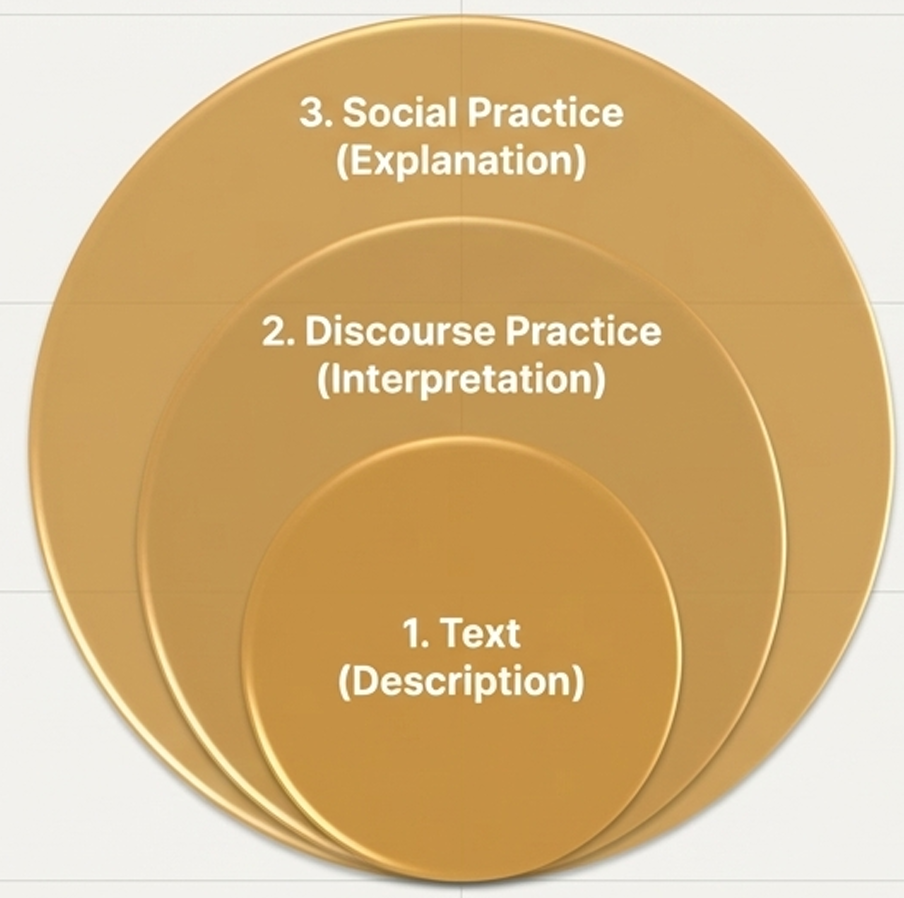
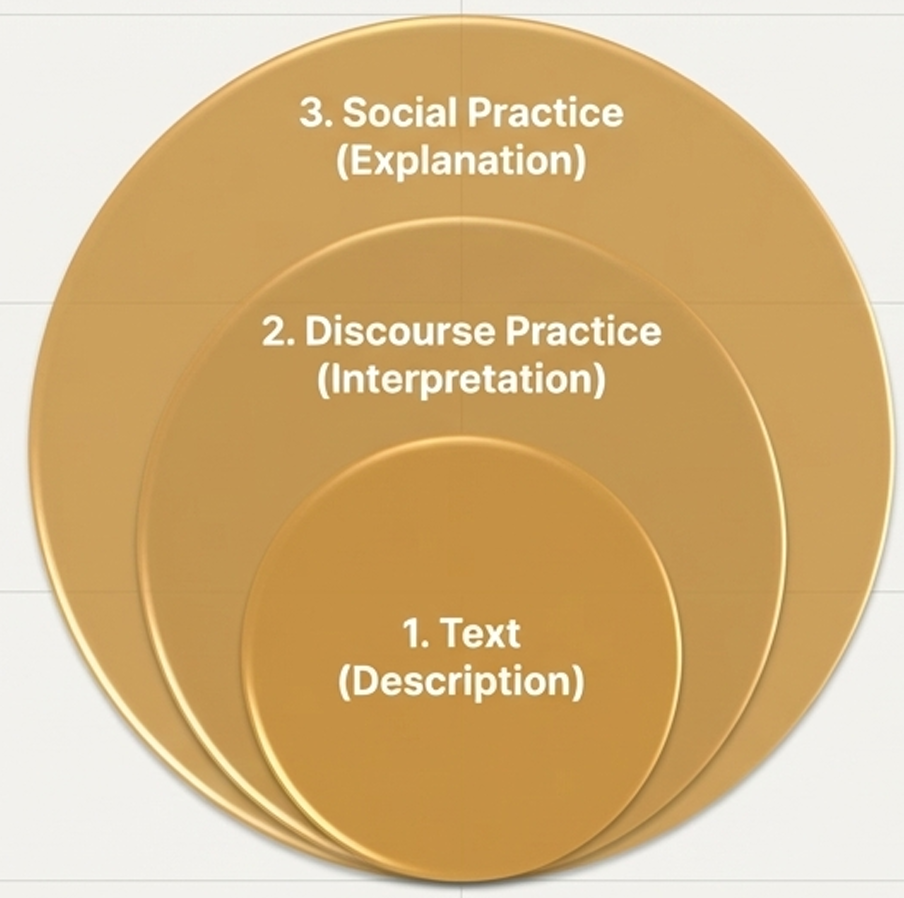
Fairclough's 3D framework (2001): Description, Interpretation, Explanation

  • Description of texts (Text level - what is literally written or said)

    • Linguistic features and other modalities are closely examined. 

    • analytical moves from the micro levels of vocabulary and grammar to a higher level of ________ structures. 

    • The set of textual features should be treated as a resource from which CDA practitioners may choose to focus on a limited number of analytical tools, relevant to particular texts and for particular purposes. (See reading provided)

      • Example: In analysing a number of texts, Helen found these metaphorical expressions

        • bờ vai, phái mạnh, lái, ngựa hoang, trụ cột ⇒ referring to men/husbands

        • Phái đẹp, thuyền, đồng cỏ xanh bất tận, bến đỗ ⇒ referring to women/wives

    • What gender assumptions/ ideologies do you think underlie the use of these expressions?

      • These expressions imply men = strong, women = weak/valued for looks → gender ideology.

textual

14
New cards
<ul><li><p style="text-align: justify;"><span style="background-color: transparent; font-family: &quot;Times New Roman&quot;, serif;"><strong><span>Interpretation </span></strong><span>of the relationship between the pr__________ and int_____________ processes (Discourse practice - how people produce and interpret that text, based on their background knowledge and assumptions)</span></span></p><ul><li><p style="text-align: justify;"><span style="background-color: transparent; font-family: &quot;Times New Roman&quot;, serif;"><span>deals with discourse processes and their dependence on b</span><strong><span>_____________ </span></strong><span>assumptions.&nbsp;</span></span></p></li><li><p style="text-align: justify;"><span style="background-color: transparent; font-family: &quot;Times New Roman&quot;, serif;"><span>Formal textual features (vocabulary, grammar, ...) are 'cues' which activate elements of interpreters' </span><strong><span>background knowledge</span></strong><span>.&nbsp;</span></span></p></li><li><p style="text-align: justify;"><span style="background-color: transparent; font-family: &quot;Times New Roman&quot;, serif;"><span>Interpreters will have to draw on their </span><strong><span>background knowledge</span></strong><span> to interpret these cues (to understand any presupposition or implication of the text)</span></span></p></li><li><p style="text-align: justify;"><span style="background-color: transparent; font-family: &quot;Times New Roman&quot;, serif;"><span>Example:&nbsp;</span></span></p><ul><li><p style="text-align: justify;"><span style="background-color: transparent; font-family: &quot;Times New Roman&quot;, serif;"><span>What background knowledge does Helen need to interpret the metaphor "lái" referring to men and "thuyền" referring to women?</span></span></p><ul><li><p style="text-align: justify;"><span style="background-color: transparent; font-family: &quot;Times New Roman&quot;, serif;"><span>To understand “lái” (driver) for men and “thuyền” (boat) for women, you need to know the metaphor in Vietnamese culture where men “steer” and women “are steered” → implies male dominance.</span></span></p></li></ul></li><li><p style="text-align: justify;"><span style="background-color: transparent; font-family: &quot;Times New Roman&quot;, serif;"><span>...to remember our history, but not to perpetuate it; to give young people like you in both our countries the chance to live in your tomorrows, not in </span><strong><em><span>our yesterdays</span></em></strong><span>. As Ambassador Pete Peterson has said so eloquently, "We cannot change </span><strong><em><span>the past</span></em></strong><span>. What we can change is the future. "&nbsp;</span></span></p><ul><li><p style="text-align: justify;"><span style="background-color: transparent; font-family: &quot;Times New Roman&quot;, serif;"><span>You need background knowledge of Vietnam – US relations (referring to moving on from the war).</span></span></p></li></ul></li><li><p style="text-align: justify;"><span style="background-color: transparent; font-family: &quot;Times New Roman&quot;, serif;"><span>How do you interpret the two highlighted phrases? What background knowledge do you need to interpret them?</span></span></p></li></ul></li></ul></li></ul><p style="text-align: justify;"><span style="background-color: transparent; font-family: &quot;Times New Roman&quot;, serif;"><span>⇒ Interpretation = understanding what the text means and w_______ k___________ is n_________ to get that meaning.</span></span></p><p><br></p>
  • Interpretation of the relationship between the pr__________ and int_____________ processes (Discourse practice - how people produce and interpret that text, based on their background knowledge and assumptions)

    • deals with discourse processes and their dependence on b_____________ assumptions. 

    • Formal textual features (vocabulary, grammar, ...) are 'cues' which activate elements of interpreters' background knowledge

    • Interpreters will have to draw on their background knowledge to interpret these cues (to understand any presupposition or implication of the text)

    • Example: 

      • What background knowledge does Helen need to interpret the metaphor "lái" referring to men and "thuyền" referring to women?

        • To understand “lái” (driver) for men and “thuyền” (boat) for women, you need to know the metaphor in Vietnamese culture where men “steer” and women “are steered” → implies male dominance.

      • ...to remember our history, but not to perpetuate it; to give young people like you in both our countries the chance to live in your tomorrows, not in our yesterdays. As Ambassador Pete Peterson has said so eloquently, "We cannot change the past. What we can change is the future. " 

        • You need background knowledge of Vietnam – US relations (referring to moving on from the war).

      • How do you interpret the two highlighted phrases? What background knowledge do you need to interpret them?

⇒ Interpretation = understanding what the text means and w_______ k___________ is n_________ to get that meaning.


productive, interpretative, background, what knowledge, needed
15
New cards
<ul><li><p style="text-align: justify;"><span style="background-color: transparent; font-family: &quot;Times New Roman&quot;, serif;"><strong><span>Explanation </span></strong><span>of the relationship between discourse processes and ________ processes (Social practice – how that text connects to social power, institutions, and ideologies.)</span></span></p><ul><li><p style="text-align: justify;"><span style="background-color: transparent; font-family: &quot;Times New Roman&quot;, serif;"><span>How is this discourse positioned in relation to the situational, institutional, and societal levels? Are these struggles overt or covert? Does the discourse challenge or sustain existing power relations/ ideologies?</span></span></p><ul><li><p style="text-align: justify;"><span style="background-color: transparent; font-family: &quot;Times New Roman&quot;, serif;"><span>Finally, you connect the text to </span><strong><em><span>society and power structures</span></em></strong><span>:</span></span></p><ul><li><p style="text-align: justify;"><span style="background-color: transparent; font-family: &quot;Times New Roman&quot;, serif;"><span>Does the text </span><strong><em><span>challenge </span></em></strong><span>or </span><strong><em><span>support </span></em></strong><span>existing ideologies?</span></span></p></li><li><p style="text-align: justify;"><span style="background-color: transparent; font-family: &quot;Times New Roman&quot;, serif;"><span>Who benefits from the meanings created?</span></span></p></li><li><p style="text-align: justify;"><span style="background-color: transparent; font-family: &quot;Times New Roman&quot;, serif;"><span>Are the power struggles </span><strong><em><span>visible </span></em></strong><span>(________) or </span><strong><em><span>hidden </span></em></strong><span>(________)?</span></span></p></li></ul></li></ul></li><li><p style="text-align: justify;"><span style="background-color: transparent; font-family: &quot;Times New Roman&quot;, serif;"><span>Example:&nbsp;</span></span></p><ul><li><p style="text-align: justify;"><span style="background-color: transparent; font-family: &quot;Times New Roman&quot;, serif;"><span>From the metaphorical expressions that Helen found about men and women, she sees that </span><strong><em><u><span>women are represented as weak and passive while men are represented as strong, active, and dependable.</span></u></em></strong><span>&nbsp;</span></span></p></li><li><p style="text-align: justify;"><span style="background-color: transparent; font-family: &quot;Times New Roman&quot;, serif;"><span>In the explanation process, Helen asks herself if the assumptions she has come up with challenge or support the existing gender ideologies.&nbsp;</span></span></p><ul><li><p style="text-align: justify;"><span style="background-color: transparent; font-family: &quot;Times New Roman&quot;, serif;"><span>→ These metaphors </span><strong><em><span>support traditional gender ideology</span></em></strong><span>, not challenge it.</span></span></p></li><li><p style="text-align: justify;"><span style="background-color: transparent; font-family: &quot;Times New Roman&quot;, serif;"><span>→ They reproduce a view that men should lead and women should depend on men.</span></span></p></li></ul></li></ul></li></ul></li></ul><ul><li><p style="text-align: justify;"><span style="background-color: transparent; font-family: &quot;Times New Roman&quot;, serif;"><span>If you were Helen, how can you answer?</span></span></p></li></ul><p style="text-align: justify;"></p><p style="text-align: justify;"><span style="background-color: transparent; font-family: &quot;Times New Roman&quot;, serif;"><span>Explanation = analyzing how discourse m_________ or ch_______ social power and ideology.</span></span></p><p><br></p>
  • Explanation of the relationship between discourse processes and ________ processes (Social practice – how that text connects to social power, institutions, and ideologies.)

    • How is this discourse positioned in relation to the situational, institutional, and societal levels? Are these struggles overt or covert? Does the discourse challenge or sustain existing power relations/ ideologies?

      • Finally, you connect the text to society and power structures:

        • Does the text challenge or support existing ideologies?

        • Who benefits from the meanings created?

        • Are the power struggles visible (________) or hidden (________)?

    • Example: 

      • From the metaphorical expressions that Helen found about men and women, she sees that women are represented as weak and passive while men are represented as strong, active, and dependable. 

      • In the explanation process, Helen asks herself if the assumptions she has come up with challenge or support the existing gender ideologies. 

        • → These metaphors support traditional gender ideology, not challenge it.

        • → They reproduce a view that men should lead and women should depend on men.

  • If you were Helen, how can you answer?

Explanation = analyzing how discourse m_________ or ch_______ social power and ideology.


social, overt, covert, maintains, changes

16
New cards

5. Research in CDA

5.1 Overview of CDA Research

CDA (Critical Discourse Analysis) studies how power and ideology are en________ through language in different social contexts.

Data

  • Media discourse

  • Political discourse

  • Textbooks

  • Everyday discourse

  • others

Issues

  • Gender inequality

  • Racism

  • Unequal power enacted in discourse

Students are asked to read the abstracts from the handout. They may be asked to present what they have read.

enacted