Central and peripheral nervous system
 Call Kai
 Learn
Learn Practice Test
 Spaced Repetition
 Match
Match Flashcards
 Knowt Play
1/11

There's no tags or description
Looks like no tags are added yet.
Name | Mastery | Learn | Test | Matching | Spaced | Call with Kai |
|---|
No analytics yet
Send a link to your students to track their progress
12 Terms
what is the central nervous system and peripheral nervous system consist of>
Central nervous system (CNS) – the brain and spinal cord
Peripheral nervous system (PNS) – the parts of the nervous system that are not within the central nervous system and that extend to the rest of the body
what are sense organs
The nervous system allows detection of stimuli in the surroundings and the coordination of the body's responses to the stimuli.
Stimuli detected by receptor cells together in sense organs.
what are effectors
parts of the body that respond to stimuli. Effectors can be muscles or glands.
pathway followed by nerve impulses
stimulus receptor sensory neurone CNS motor neurone effector
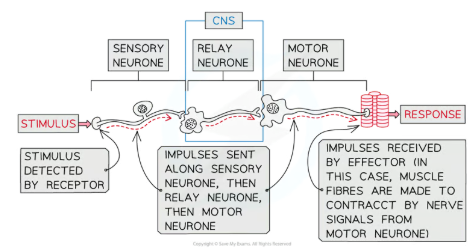
how nervosu system detects changes in environemnt and responds
Receptor cells detect changes in the environment, or stimuli
Nerve impulses travel from the receptor cells along sensory neurones to the central nervous system, or CNS
The CNS acts as a coordinating centre for the impulses that arrive from the receptors, determining which part of the body needs to respond and sending out a new set of impulses along motor neurones
Motor neurones send impulses to the effectors to bring about a response
what does PNS do?
The PNS connects the receptor cells in the sense organs with the CNS, and connects the CNS with effectors
The CNS acts as a central coordinating centre for the impulses that come in from, and are sent out to, any part of the body
what are the two types of motor nerves in peripheral nervous system
The voluntary nervous system: involves motor neurones that are under voluntary or conscious control involving the cerebrum. Voluntary motor neurones function as result of conscious thought.
The autonomic nervous system: involves motor neurones that the conscious areas of brain don’t control- controls involuntary body functions.
what two sections is autonomic nervous system divided into?
Sympathetic nervous system
Parasympathetic nervous system
Structural similarities between the parasympathetic and sympathetic system
Both have myelinated preganglionic fibres that leave the CNS and synapse in a ganglion (a collection of cell bodies outside the central nervous system) with unmyelinated postganglionic fibres
Structural differences between the parasympathetic and sympathetic systems
In the sympathetic system, the ganglia are very close to the CNS, so the preganglionic fibres are short and postganglionic fibres are long
In the parasympathetic system the ganglia are near to or in the effector organ, so the preganglionic fibres are very long and the postganglionic fibres are very short
Functional differences between the parasympathetic and sympathetic autonomic nervous systems
the sympathetic nervous system produces noradrenaline at the snapses and usually produces a rapid response in target organ system. Sometimes referred to as ‘fight or flight’ system. When you are active. or under physical or pychological stress, the sympathetic nervous system will dominate, stimulating the organs of the body to cope with stress
the parasympathetic nervous system often has a slower, calming or inhibitory effect on organ systems and produces the neurotransmitter acetylcholine at the synapses. The parasympathetic system maintains normal functioning of the body and restores calm after stressful situation. Referred to as ‘rest and digest’ or ‘feed and breed’ system
They work antagonistically
what is chemical control?
often slow by long lasting. Hormones travel around body in plasma of blood
They move into target cells by diffusion and attack to receptors on cell membranes
Chemical control often linked to changes which involve growth of an organism and allows for long term responses to environmental changes
Can also be used for rapid day-to-day responses such as control of blood sugar levels

