Physics
 Call Kai
 Learn
Learn Practice Test
 Spaced Repetition
 Match
Match Flashcards
 Knowt Play
1/57

There's no tags or description
Looks like no tags are added yet.
Name | Mastery | Learn | Test | Matching | Spaced | Call with Kai |
|---|
No analytics yet
Send a link to your students to track their progress
58 Terms
Change in wave behavior depends on
Type of wave, wavelength, composition of new medium
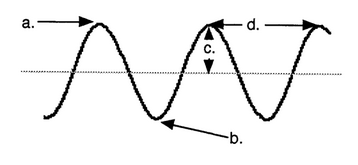
A. Crest
B. Trough
C. Amplitude
D. Wavelength
Wave Characteristics
Energy moving through a particle or field, but the particles just vibrate instead of going anywhere
Crest
Highest point of a wave
Trough
Lowest point of a wave
Equilibrium
Midpoint between the crest and trough
Amplitude
Distance between the equilibrium and crest or trough
Wavelength
Distance from one crest/trough to another
Frequency (measured in?)
Number of waves that pass through a point in a pacific amount of time, measured in Hertz (Hz)
Medium
Material/substance that the wave transfers through
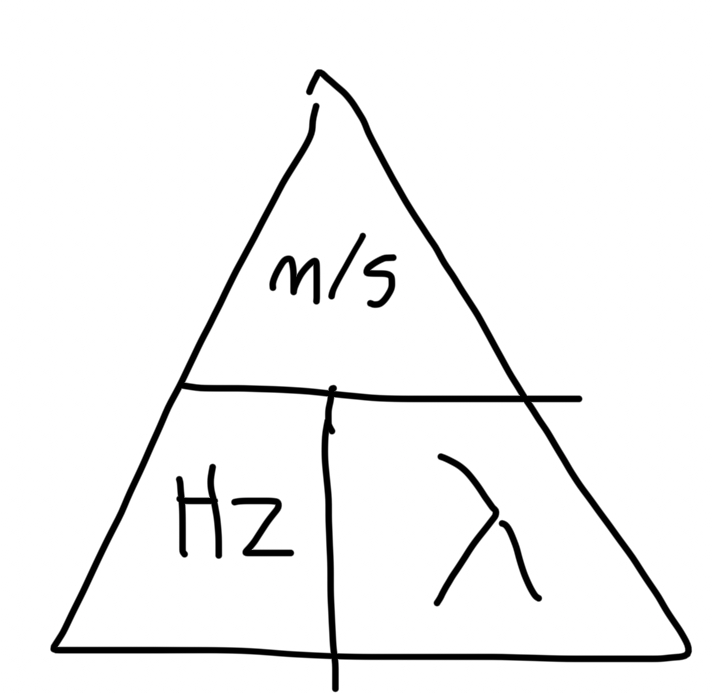
How to calculate a waves speed, frequency, and wavelength?
What wave behavior is a dolphin emitting a click and using the returning sound to locate an object?
Reflection
Which wave is not transverse?
Sound waves
If three pendulums have the same string length and different masses (0.5kg, 1kg, 2kg), how is their period comparable?
All three have the same period
Wave bounces back at boundary
Reflection
Echoes are produced
Reflection
Wave bends around obstacle
Diffraction
Wave spreads through an opening
Diffraction
Wave changes speed in new medium
Refraction
Wave changes direction entering medium
Refraction
Rebound?
Redirect?
Disperse?
Reflection
Refraction
Diffraction
If a speaker emits a tone of constant frequency and an observer hears a higher pitch as a siren approaches
Doppler Effect
Doppler effect
motion changing pitch
Along?
Across?
No medium needed?
Longitudinal
Transverse
Electromagnetic
Particle displacement is parallel to propagation
Longitudinal
Has compressions and rarefactions
Longitudinal
Particle displacement is perpendicular to propagation
Transverse
Has crests and troughs
Transverse
includes radio to gamma spectrum
Electromagnetic
Can travel through vacuum
Electromagnetic
How are transverse and longitudinal waves similar?
They transfer energy from one location to another
A sound wave enters a metal rod from air and its speed increases
Refraction
Which medium generally allows sound to travel fastest?
Solid
For an object in simple harmonic motion, the speed,
The speed is greatest at the equilibrium position and zero at turning points
Particle motion is parallel to wave travel
Longitudinal
Wave motion is perpendicular to wave travel
Transverse
What situation is an example of simple harmonic motion?
A pendulum swinging through small angles
A moving ambulance approached a stationary observer, compared to the emitted sound the observed frequency is?
Higher
Constructive inference
Two waves combing and creating a bigger wave
Destructive inference
Two waves combining and becoming a straight line
If a wave’s amplitude is doubled while its frequency stays the same
The energy carried by the wave increases
If two identical waves meet in opposite directions and at a point, a crest meets a trough of equal size, what is the resulting displacement?
Zero (cancel each other out)
Longitudinal waves
It’s energy travels in the same direction as the particles that are disturbed
Compression
Region where particles are closer together
Rarefaction
Region where particles are further apart
Reflection
Wave hits surface of medium it traveled from
Incident ray in reflection
Ray that strikes the surface
Reflected ray in reflection
Ray that bounces off the surface
Refraction
When a wave enters a new medium and changes its direction and travel angle
Diffraction
Waves traveling around objects or through gaps/holes
Interference occurs when?
Occurs when waves interact with other waves
Standing waves
Vibrating system, some points remain fixed and others in between vibrate
In standing waves, what are nodes and antinodes?
Nodes: fixed points
Antinodes: in between points
Polarization
Restricting transverse waves to vibrate in only one plane/direction
Polarization process?
As light travels in multiple planes, process uses a filter to restrict light into one plane
Doppler Effect
When a wave emitting source moves, a shift in the wave’s wavelength and frequency occurs
In the Doppler effect, the waves what to observer as the object moves?
The waves are pushed together as object moves towards the observer
The waves are stretched apart as the objects move away from the observer
Calculating frequency
Frequency divided by time

