GPCL Fit
 Call Kai
 Learn
Learn Practice Test
 Spaced Repetition
 Match
Match Flashcards
 Knowt Play
1/55

There's no tags or description
Looks like no tags are added yet.
Name | Mastery | Learn | Test | Matching | Spaced | Call with Kai |
|---|
No analytics yet
Send a link to your students to track their progress
56 Terms
sag of the lens, cornea
Fit characteristics of a GPCL primarily rely on the relationship between the _____ and ____
tighter
A greater lens sag will result in a (tighter or looser) fit
looser
lesser lens sag will result in a (tighter or looser) fit
Hydrostatic
_____ forces of the tear film adhere the GPCL to the corneal surface, this is why a uniform tear film is important
loose
A GPCL that is very decentered indicates that a lens is too...
opposite
With eye movement the GPCL will move to the limbus in the ____ direction to the direction of movement

down, up
A GPCL will rotate where the temporal edge moves ____, and the nasal edge moves ___ with blinking
Dynamic stability
lens stability used to describe the lens' behavior between blinks. If a lens is too loose, it will drop inferiorly or to the sides. If the lens fit nicely, it should remain in a static position between blinks.
Lid attachment
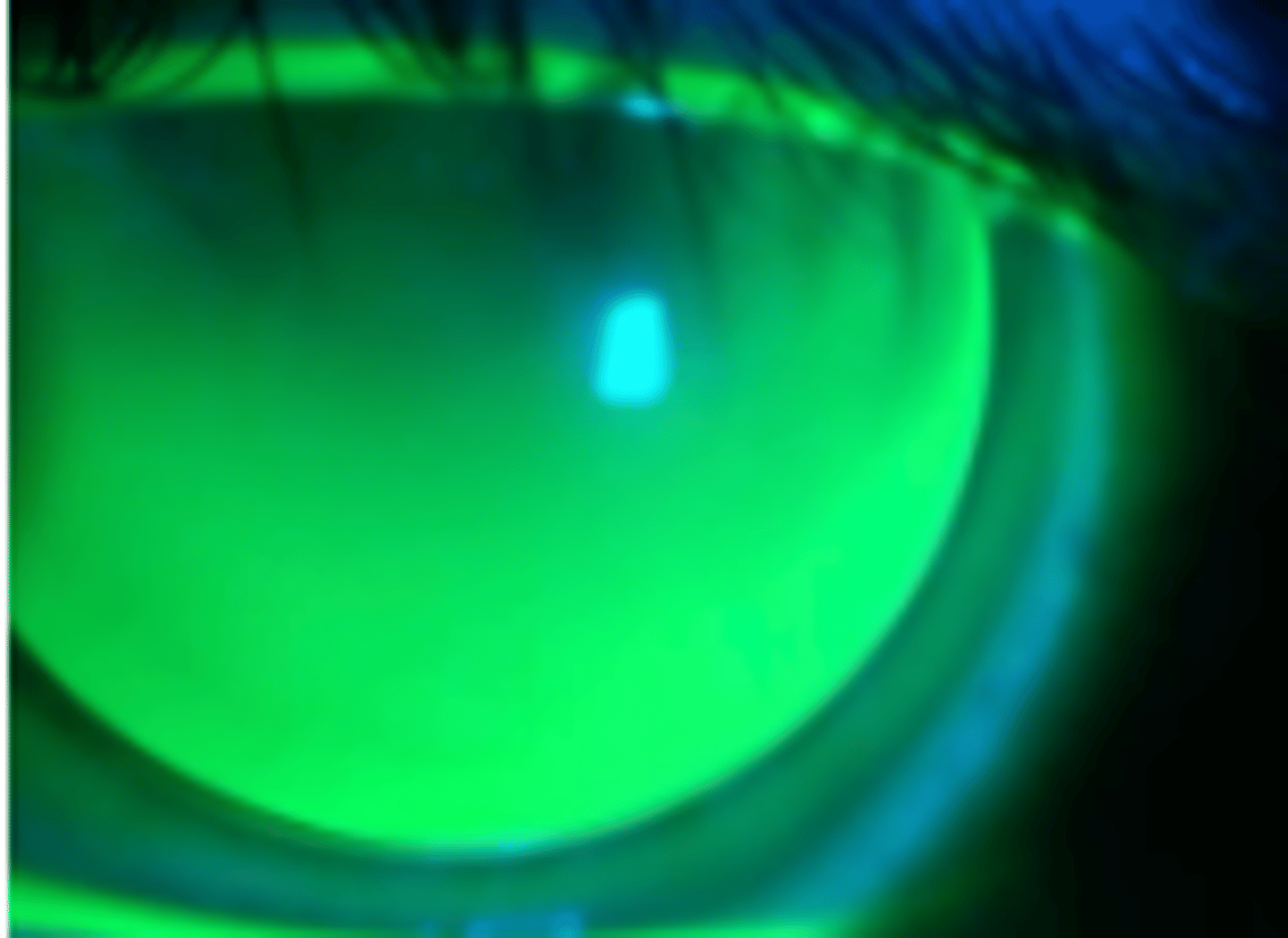
GPCL lid interaction where the lens remains tucked beneath the upper lid and is held in place between blinks. If the upper lid is pulled away, the lens will drop inferiorly.
Pseudo-lid attachment
GPCL lid interaction where the lens remains superior even when the lid is pulled away. This occurs when the lens is flat or there is WTR astigmatism
Interpalpebral
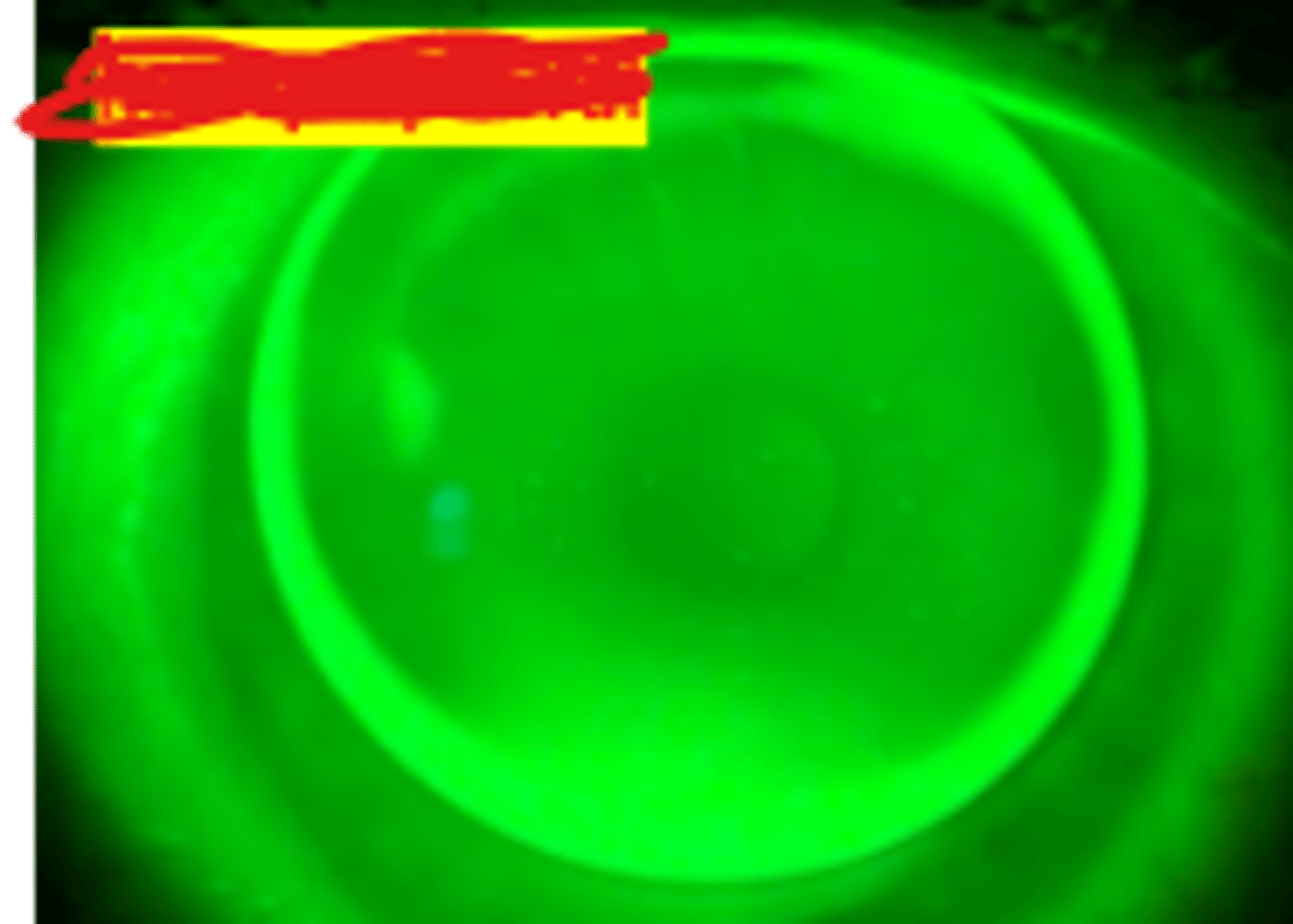
GPCL lid interaction where the lens sits between the upper and lower lids most often in a central position, possibly slightly decentered. Is indicated in higher upper lids or tight eye lids.
Lower lid
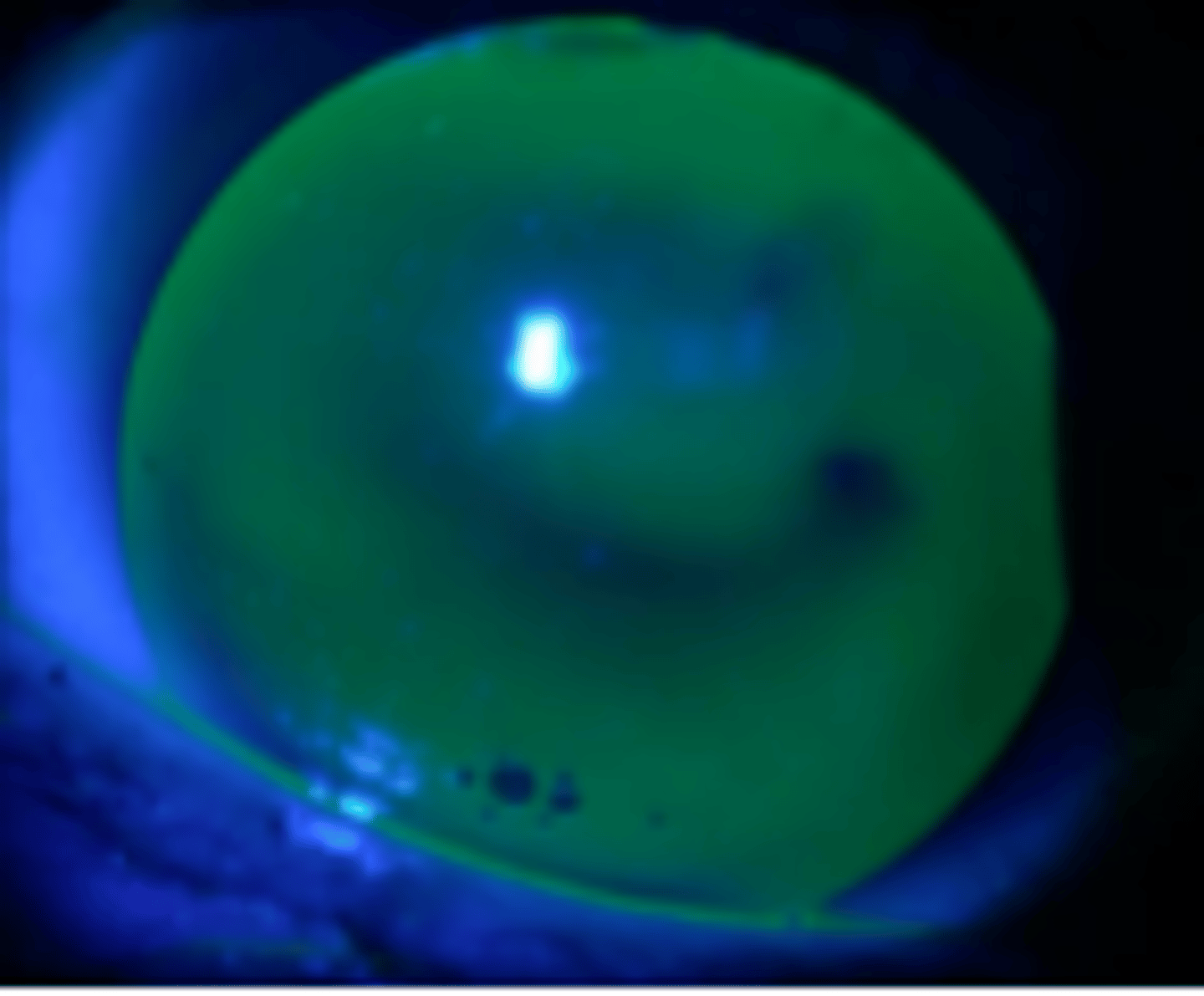
GPCL lid interaction where the lens drops inferiorly between blinks, a variant of an interpalpebral fit. Is the least comfortable and desirable lid interaction to occur. May be indicated in prism ballasted lenses or irregular corneas.
Fluorescein
____ staining is required for evaluating the lens-cornea relationship, but lens position, movement patterns, lid interaction, and stability can all be examined without staining first.
superior bulbar conjunctiva
Fluorescein should be applied to the...
20
At least ____ microns of tear thickness is required to view fluorescein staining of a GPCL. Therefore, if the tear film is any thinner the pattern will appear black.
apical
GPCL pattern location which is the central portion
Mid peripheral
GPCL pattern location which is the area under the intermediate curves. The fit in this area determines lens positioning and movement patterns.
Peripheral
GPCL pattern location which is the area under the peripheral curves. The fit in this area determines the tear exchange.
Aligned
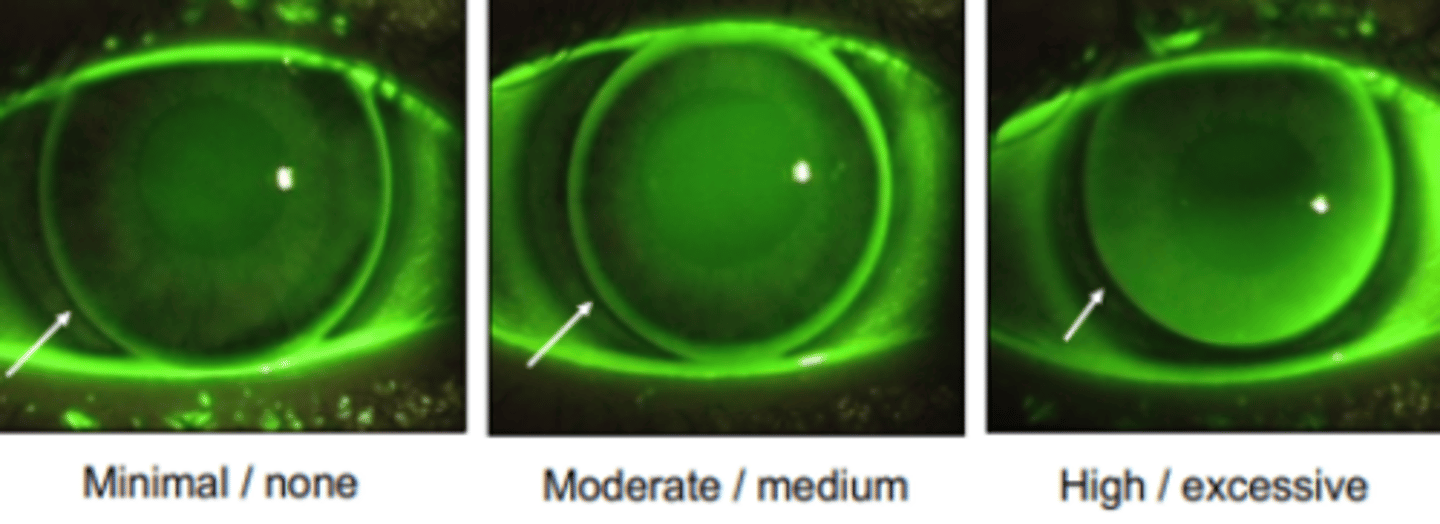
fluorescein pattern observed when the back surface of the lens matches the corneal curvature. Results in a plano lacrimal lens
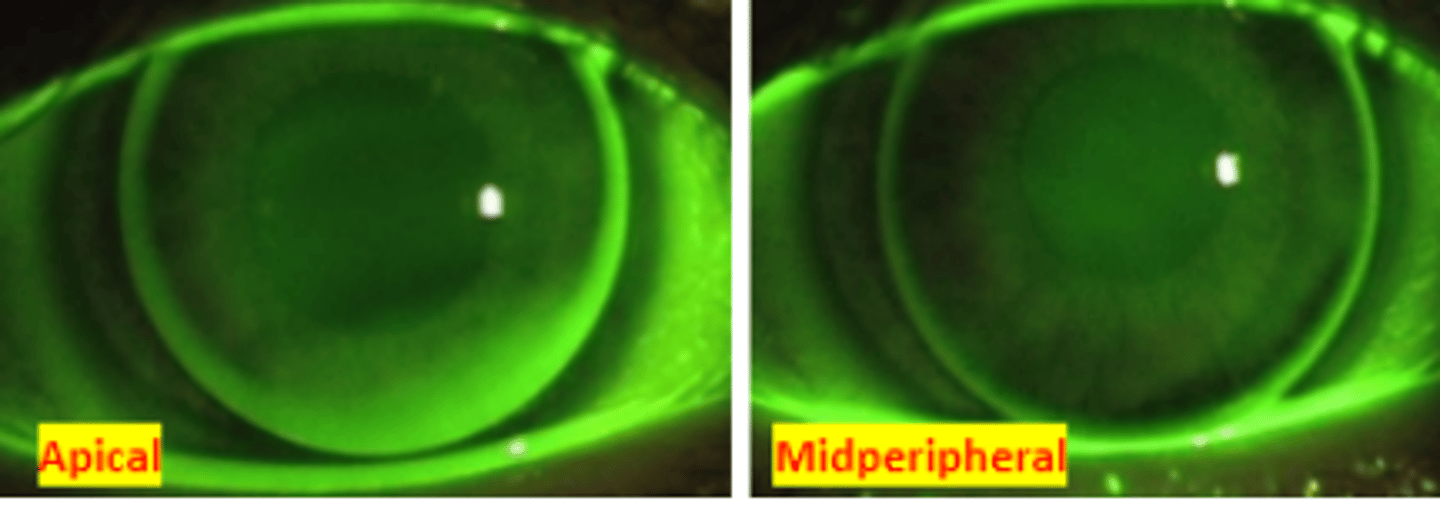
Clearance
fluorescein pattern observed when there is space between the lens and cornea because the lens is steeper than the corneal curvature. Results in a plus powered lacrimal lens
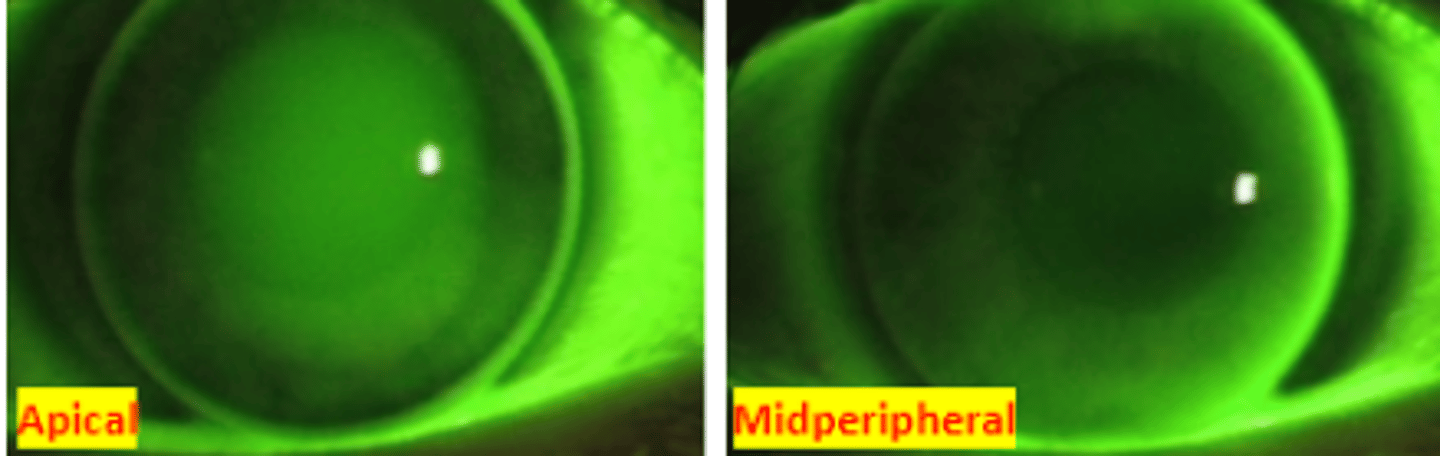
Touch
fluorescein pattern observed when the lens is closer to the central cornea than the peripheral. Results in a minus powered lacrimal lens
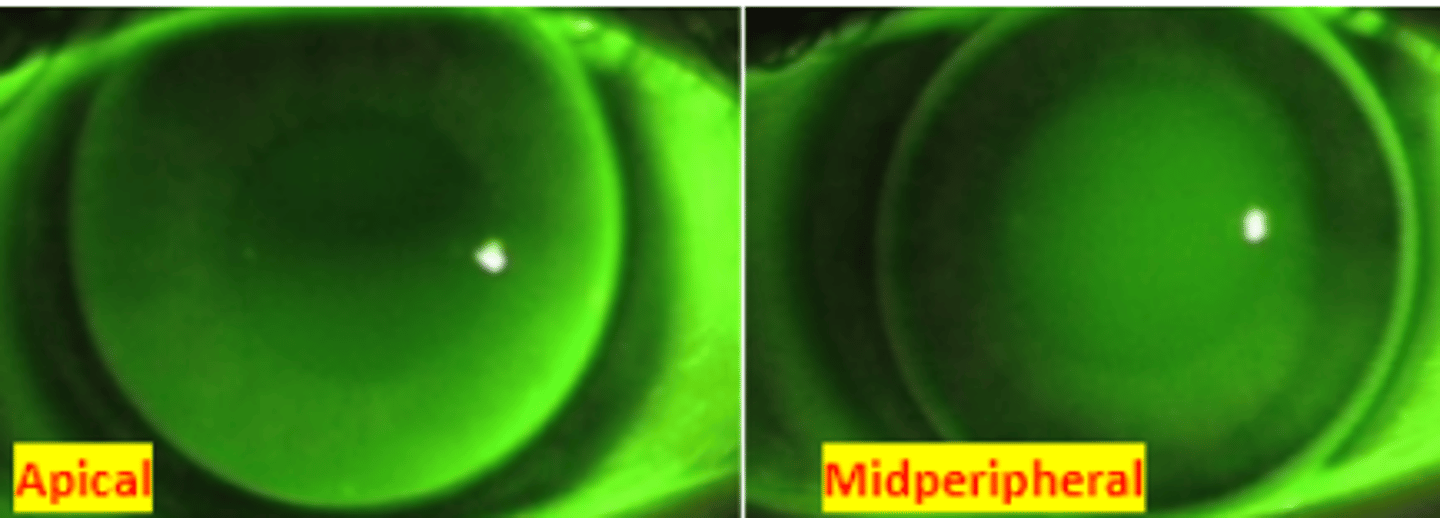
WTR
what type of astigmatism does this fluorescein pattern represent?
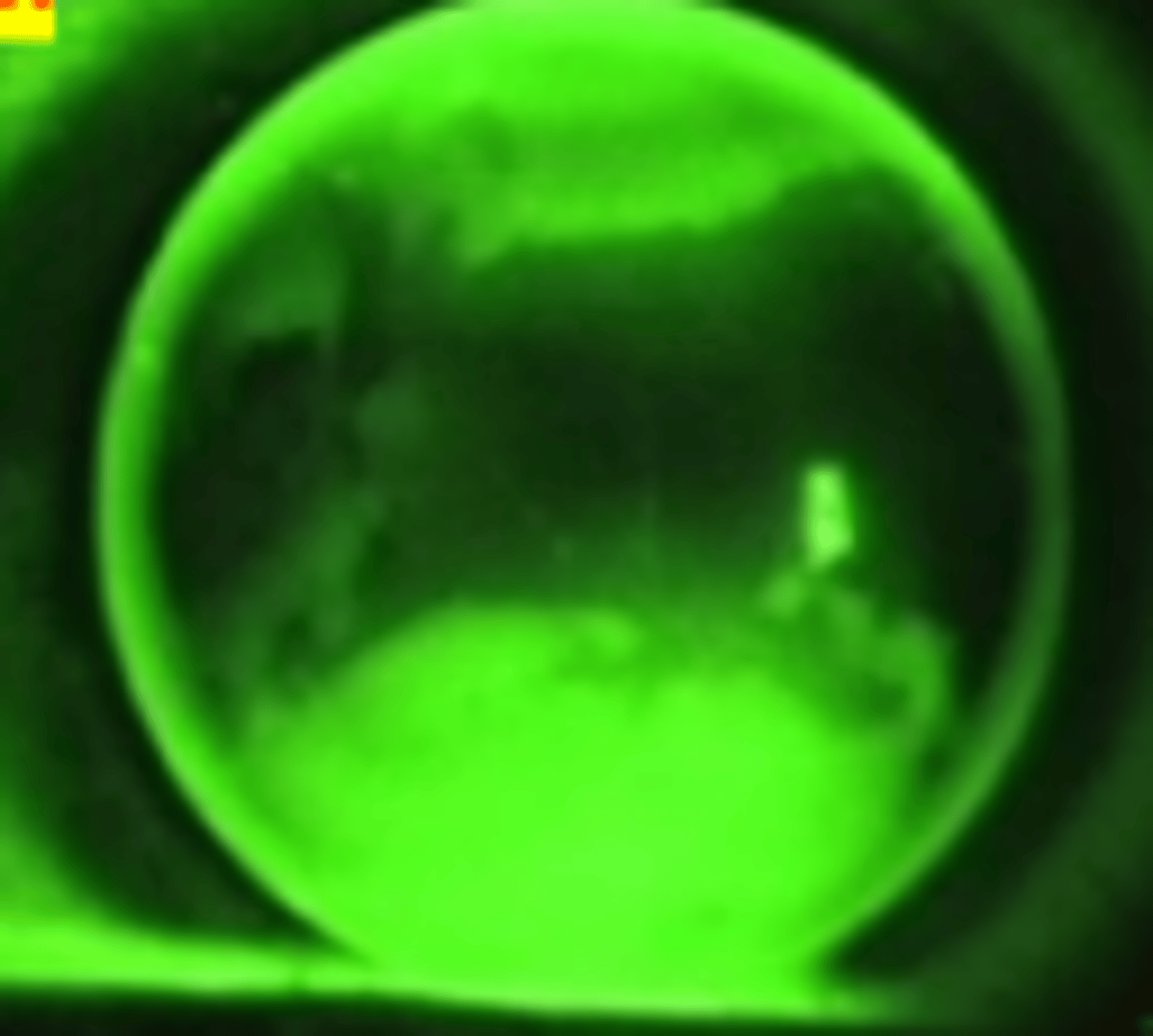
ATR
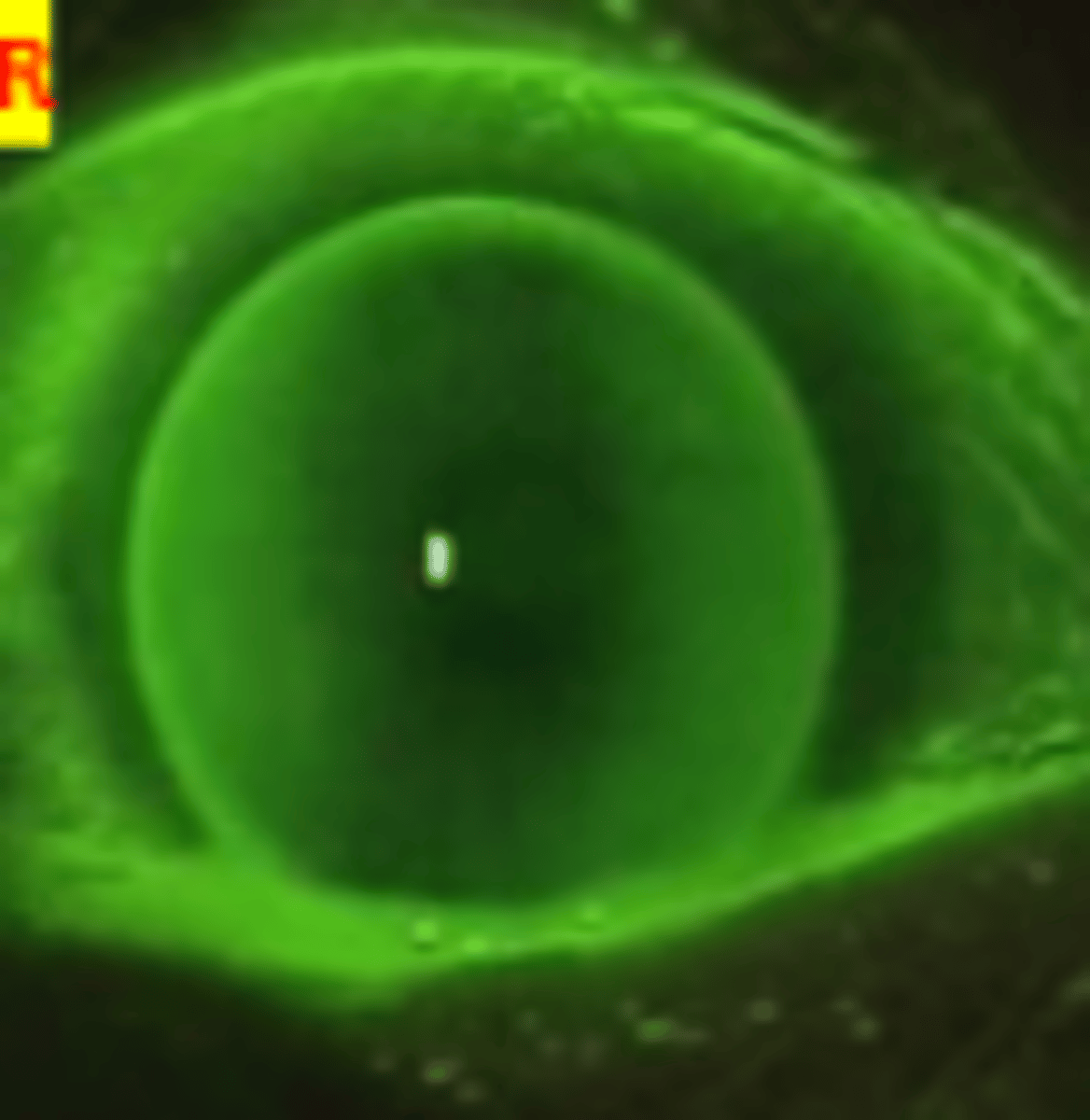
Static
GPCL fluorescein pattern occurring when the lens is centered on the cornea. Lens may need to be manually centered using the patient's lids in order to assess this. Gives the true apical relationship of the lens cornea interaction.
Dynamic
GPCL fluorescein pattern occurring when the lens is sitting in its natural resting position. May not be the same position as the static pattern. Pattern will not be as flat as when it is in static position because the peripheral cornea is flatter.
WTR
A cornea having a large amount of ____ astigmatism will result in a GPCL that is displaced vertically
ATR
A cornea having a large amount of ____ astigmatism will result in a GPCL that is displaced horizontally
steeper
Generally, a (steeper or flatter) fit will center better on astigmatic cornea
steeper
A (flatter or steeper) base curve will result in a more stable fit (better centration, less movement), but will result in less lid attachment and more apical clearance
flatter
A (flatter or steeper) base curve will result in a less stable fit (more decentration, more movement), but will result in more lid attachment and more apical touch
0.10, 0.50
If a change in base curve is desired to get a steeper or flatter fit, the power of the lens must be changed in order to compensate for a change in power of the lacrimal lens.
For every ____ mm change in RGP base curve, the power of the lens must be adjusted by ___ D in order to compensate for the change in power of the lacrimal lens
plus, minus
If the base curve of a gas permeable lens is made steeper, the lacrimal lens becomes more ____, and ____ power must be added to compensate for this change
minus, plus
If the base curve of a gas permeable lens is made flatter, the lacrimal lens becomes more ____, and _____ power must be added to compensate for this change
larger
A (smaller or larger) lens diameter will result in a more stable fit (better centration, less movement, more lid attachment, more apical clearance)
smaller
A (smaller or larger) lens diameter will result in a less stable fit (more decentration, more movement, less lid attachment, more apical touch)
0.4
Lens diameter of an RGP can be altered in ____ mm steps
0.2
A change in the optic zone diameter of a lens will change the peripheral curve width by ____ mm
increase
Overall lens diameter and base curve are directly related to contact lens sagittal depth where an increase in either of these values will (increase or decrease) the sagittal depth as well
thinner
A (thicker or thinner) center thickness will result in a more stable fit (better centration, less movement, more lid attachment)
thicker
A (thicker or thinner) center thickness will result in a less stable fit (more decentration, more movement, less lid attachment)
minus
____ lenticulars are used for low minus and all plus powers in order to increase edge thickness to allow for better lid attachment preventing the lens from dropping inferiorly
plus
____ lenticulars are used for high minus lenses in order to decrease edge thickness preventing the lid from pushing the lens too inferiorly
0.03
Center thickness of an RGP can be altered in ___ mm steps
inferior, less
A thinner edge thickness will result in (superior or inferior) displacement of the lens and (more or less) lid attachment
superior, more
A thicker edge thickness will result in (superior or inferior) displacement of the lens and (more or less) lid attachment
lower/steeper
A _____ edge lift will result in central to inferior positioning, less lid attachment, and less peripheral clearance
higher/flatter
A ____ edge lift will result in superior positioning, more lid attachment, and more peripheral clearance
0.50
Peripheral curve radii of an RGP lens can be altered in ____ mm steps
0.03
Edge lift of an RGP lens can be altered in ____ mm steps
plus carrier, inferior
A lens having a thin taper as seen in a ____ lenses, will show ____ displacement
minus carrier, superior
A lens having a thick edge as seen in _____ lenses, will show _____ displacement which increases lid attachment
away from
plus powers
flatter base curves
thicker center
smaller diameter
Lenses that have a center of gravity ____ the eye will fall inferiorly and be less stable. This can be caused by ____ (4)
towards
minus powers
steeper base curves
thinner center
larger diameter
Lenses that have a center of gravity ____ the eye will stay central and be more stable. This can be caused by ____(4)
steepest
The lens tends to move towards the (flattest or steepest) part of the cornea
nasally, temporal
Corneas tend to flatten more quickly ____ result in ____ displacement of the lens
Base Curve
Peripheral Curve Radii/Edge Lift
Lens Diameter
Optic Zone Diameter/Peripheral Curve Widths
Lenticulars/Center Thickness
order of lens parameter changes made during the fitting process. (5)
Explore top notes

