M06: Cardiac
 Studied by 0 people
 Call Kai
 Learn
Learn Practice Test
 Spaced Repetition
 Match
Match Flashcards
 Knowt Play
1/18

There's no tags or description
Looks like no tags are added yet.
Name | Mastery | Learn | Test | Matching | Spaced | Call with Kai |
|---|
No analytics yet
Send a link to your students to track their progress
19 Terms
MI lab test: troponin I
highly sensitive to cardiac tissue
MI lab test: LDH
Creatine Kinase, CK-MB, LDH
BMP, CBC, BNP, Lipid Profile
MI diagnostic test
12 lead ECG → to determine stable/unstable/nSTEMI/STEMI
Cardiac Angiography** (Left Heart Catheterization)
if STEMI, what test do we do for diagnosis/treatment
Cardiac Angiography** (Left Heart Catheterization)
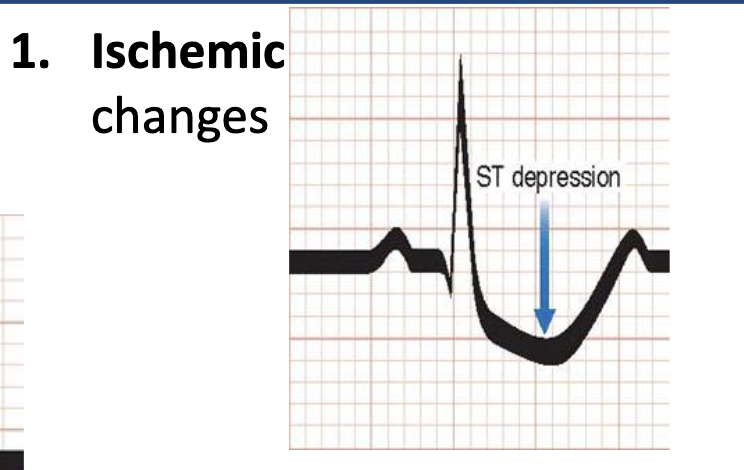
ECG Evolution of MI: stage 1
Ischemic changes
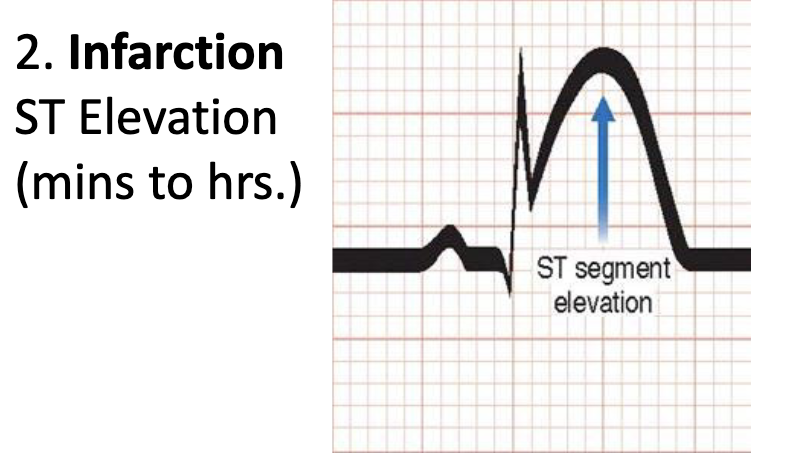
ECG Evolution of MI: stage 2
Infarction ST Elevation (mins to hrs.)
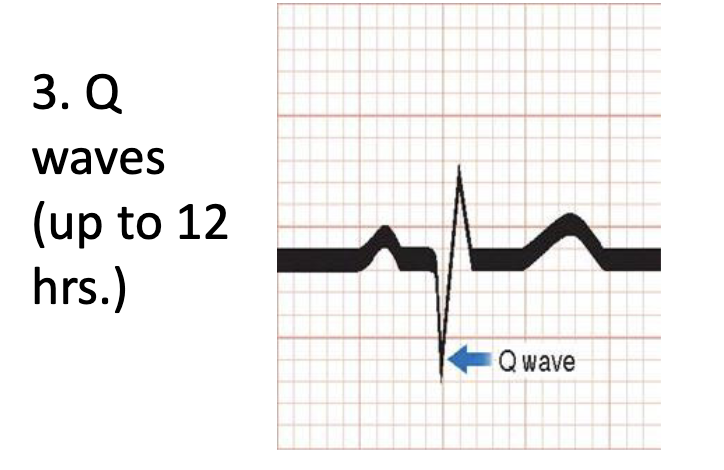
ECG Evolution of MI: stage 3
Q waves (up to 12 hrs.)
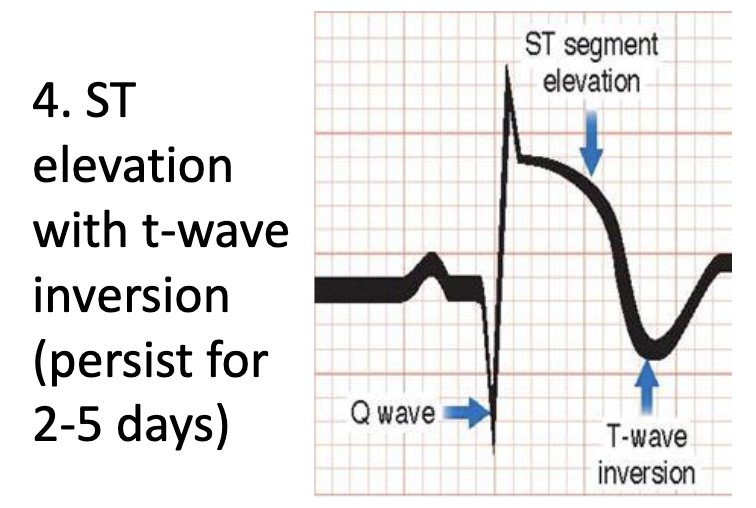
ECG Evolution of MI: stage 4
ST elevation with t-wave inversion (persist for 2-5 days)
Treatment goals of medical management MI
Maximize oxygenation
Control pain (get them to PCI lab)
Dilate coronary arteries
Prevent clots
Decrease myocardial workload
Reperfusion Therapy for MI
Percutaneous coronary intervention
Fibrinolytics (within 30 min of arriving, determine if eligible)
Medication Treatment DURING MI
Morphine (Pain medication)
Oxygen
Nitroglycerin (vasodilate coronary artery, reduce workload on heart)
Aspirin
“MONA”
Medication Treatment AFTER MI
Daily ASA
Betablockers (decrease HR)
Lipid lowering medications (i.e., Statins)
Antiplatelet (i.e., Clopidogrel)
ACE inhibitors or ARB
Surgical management for MI, pre & post op management
Coronary artery bypass graft (CABG)
Pre-op
Education, grooming, labs (Type & Screen), diagnostic tests
Post-op
Monitoring, pain management, medications, sternal precautions (PT/OT)
Complications: Arrhythmias, bleeding, infection, organ failure, cardiac tamponade
CABG Complication: Cardiac Tamponade symptoms
Beck’s Triad
hypotension
diminished heart sounds
distended neck veins
Nursing management: Priority problems for MI
Decreased cardiac output
Decreased tissue perfusion
Pain
Nursing management: Assessment + reassessment! MI
Vital signs and pulse oximetry
Characteristics of pain
ECG
Restlessness
Skin color and temperature, peripheral pulses, diaphoresis
Urine output
Labs
Nursing management: Interventions MI
Administer oxygen
Insert two large-bore IVs
Administer medications as ordered
Continuous ECG monitoring
Bed rest
Nursing management: Teaching MI
Report s/s of MI
Medication education
Quadruple Therapy
Betablocker, Statin, ASA, ACE or ARB
American Heart Association “Life’s simple 7”
Nursing management: Evaluation MI
Nursing Management – Evaluating care outcomes
Resume normal activity
Pain free
Anxiety free
 Note
Note  Flashcards (32)